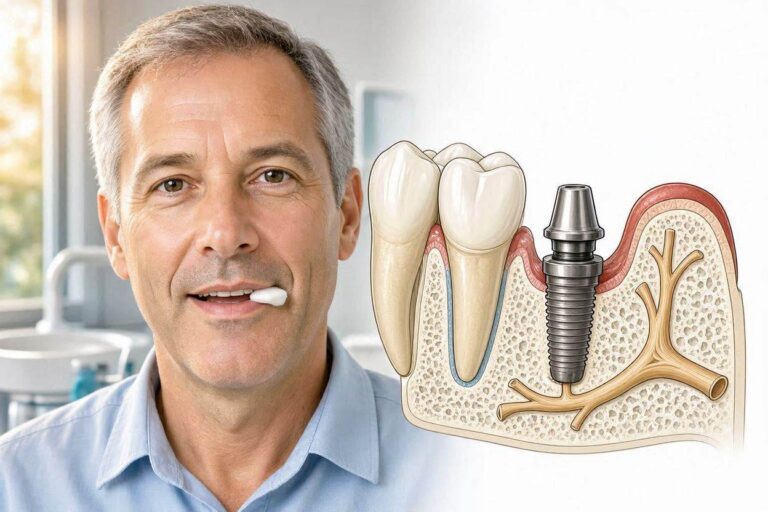
Are Jowls Raised With Dental Implants?
You study your profile in the mirror. The line of your jaw has softened over the years. The lower third of your face seems to have lost definition. You have heard that dental implants can change facial appearance, that they can provide support and structure that dentures cannot. But can they actually raise jowls? Can titanium posts in your jawbone lift the skin and soft tissue along your jawline?
The relationship between dental implants and facial appearance is widely misunderstood. This guide separates fact from fiction, explaining exactly what dental implants can and cannot do for your facial contours, including the jowl area.
The Short Answer
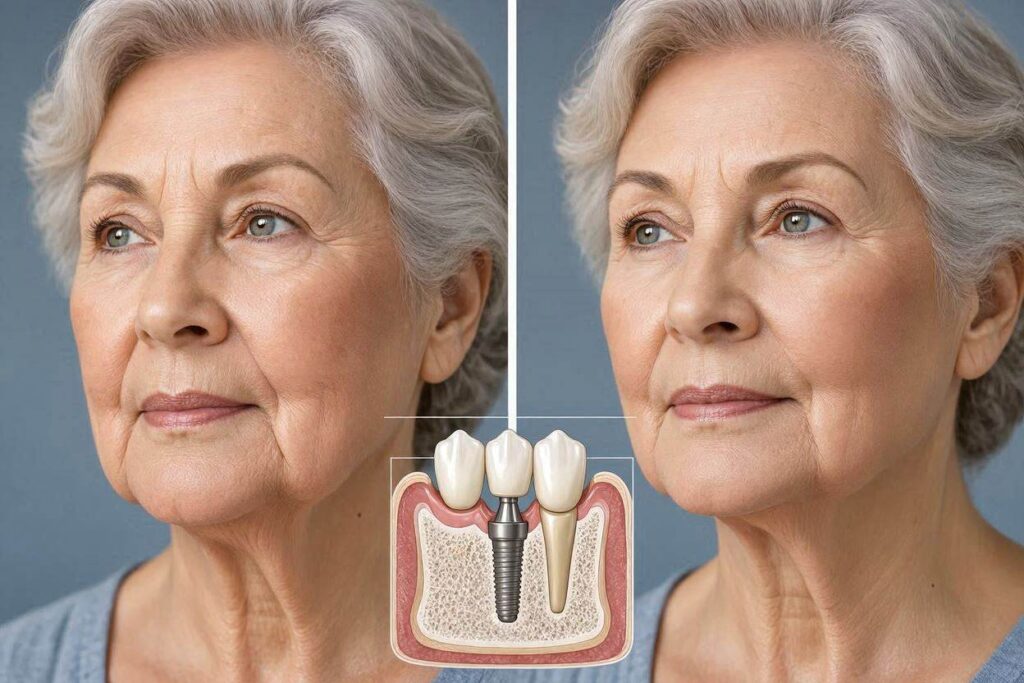
Dental implants do not directly raise jowls. Jowls are caused by skin laxity, loss of facial fat volume, and gravitational descent of soft tissues, processes that dental implants cannot reverse. However, dental implants can indirectly improve the appearance of the lower face by supporting the lips and cheeks, preventing the facial collapse that occurs with tooth loss and bone resorption, and restoring proper vertical facial height. For patients with significant jowling, dental implants alone will not provide the lift that surgical procedures like facelifts offer, but they make an essential contribution to overall facial support and appearance.
Understanding Jowls: What They Are and What Causes Them
Definition
Jowls are the sagging skin and soft tissue that develop along the jawline, typically below the chin and along the lower cheeks. They create a less defined jaw contour and contribute to an aged appearance.
Primary Causes
| Cause | Mechanism |
|---|---|
| Skin aging | Loss of collagen and elastin reduces skin elasticity and firmness |
| Gravity | Over decades, soft tissues descend from the midface toward the jawline |
| Fat volume loss | Facial fat pads shrink and descend with age |
| Genetics | Some individuals are predisposed to jowl formation |
| Sun damage | Accelerates collagen breakdown in skin |
| Weight fluctuations | Repeated gain and loss stretches skin |
| Bone resorption | Loss of jawbone reduces support for overlying soft tissue |
The Bone Connection
The jawbone provides the foundation upon which the soft tissues of the lower face rest. When teeth are present, the alveolar bone that supports them is maintained through the stimulation of chewing forces transmitted through the teeth. When teeth are lost, this bone resorbs. Over years, significant bone volume can be lost, reducing the skeletal support for the overlying skin, muscle, and fat.
This bone loss contributes to the appearance of an aging lower face, but it is only one factor among many. Skin quality, fat distribution, and muscle tone all play larger roles in jowl formation than bone volume alone.
How Tooth Loss Affects Facial Appearance
To understand what implants can and cannot do, you must first understand how tooth loss changes the face.
The Domino Effect of Tooth Loss
| Stage | Change | Facial Appearance Impact |
|---|---|---|
| Single tooth loss | Localized bone resorption at the extraction site | Minimal visible change initially |
| Multiple tooth loss | Broader bone resorption; teeth shifting | Slight changes in lip support |
| Loss of posterior support | Collapse of vertical dimension; deep bite | Lower face height decreases; chin and nose appear closer |
| Complete tooth loss | Extensive bone resorption; facial muscle changes | Significant facial collapse; sunken appearance; jowls worsen |
The “Facial Collapse” Phenomenon
Patients who have been completely edentulous (without teeth) for many years develop a characteristic appearance:
- The lower third of the face shortens
- The lips become thin and inverted
- Deep wrinkles form around the mouth (perioral rhytids)
- The chin rotates forward and upward
- The cheeks lose support and appear hollow
- The jowls sag further due to loss of underlying support
This is not merely a cosmetic issue. Loss of proper facial height affects function: chewing efficiency decreases, speech may change, and the temporomandibular joints may experience altered loading.
What Dental Implants Can Do for Facial Appearance
Dental implants affect facial appearance through multiple mechanisms.
Restore Vertical Dimension
When posterior teeth are missing and replaced by implant-supported restorations, the proper height of the lower face is restored. The distance between the nose and chin increases back to its original dimension. This:
- Reduces the “overclosed” appearance
- Improves lip fullness and support
- Decreases perioral wrinkles
- Provides better support for the cheeks
Preserve and Stimulate Bone
This is the most significant contribution of dental implants to facial support. Implants transmit chewing forces to the surrounding bone, providing the mechanical stimulation that signals the body to maintain bone density. This is the same principle by which natural teeth preserve the alveolar bone.
| Tooth Replacement Method | Effect on Jawbone |
|---|---|
| No replacement | Progressive bone resorption |
| Removable denture | May accelerate bone loss due to pressure on the ridge |
| Tooth-supported bridge | Preserves bone under the bridge but not in the edentulous space |
| Dental implant | Preserves bone through functional stimulation |
Support the Lips and Cheeks
Implant-supported crowns, bridges, and fixed prostheses provide direct support for the lips and cheeks. This is particularly noticeable in the following ways:
- Upper lip support: Implants in the front of the upper jaw prevent the lip from collapsing inward
- Cheek support: Implants in the premolar and molar regions support the cheeks, preventing a hollow appearance
- Lower lip support: Implants in the lower front region support the lower lip position
Provide Stable Prosthesis Retention
For patients with removable dentures, implant-supported overdentures eliminate the need for bulky denture flanges that extend onto the gums for retention. The reduction in prosthesis bulk can improve lip and cheek contours. For patients with fixed implant prostheses, the restoration is contoured specifically to support the facial soft tissues optimally.
What Dental Implants Cannot Do for Facial Appearance
Understanding the limitations prevents unrealistic expectations.
They Cannot Tighten Loose Skin
Dental implants provide skeletal and dental support. They do not affect skin elasticity. If the skin along the jawline has lost its firmness due to aging, sun damage, or genetics, implants will not tighten it. Skin tightening requires treatments that address the skin itself: laser resurfacing, radiofrequency, ultrasound, or surgical facelift procedures.
They Cannot Lift Descended Fat Pads
The buccal fat pads and other facial fat compartments descend with age. This descent is a gravitational phenomenon affecting the soft tissues themselves. Implants in the jawbone do not lift or reposition facial fat.
They Cannot Directly Address Jowls
Jowls are primarily a soft tissue problem occurring in the skin and subcutaneous tissue overlying the jawbone. While restoring proper skeletal support improves the foundation, the jowl tissue itself remains descended. A patient with significant jowling who receives dental implants will still have jowls, though the overall facial appearance may improve.
They Cannot Replace Lost Facial Volume in the Midface
Volume loss in the cheeks and temples, which contributes to an aged appearance, occurs well above the level of the jaw. Dental implants do not address midface volume loss.
The Distinction Between Jowls and Marionette Lines
Patients sometimes confuse jowls with other facial aging changes.
| Feature | Location | Cause | Affected by Implants? |
|---|---|---|---|
| Jowls | Along the jawline; below the chin | Skin laxity, fat descent | Minimally; indirect support only |
| Marionette lines | Corners of the mouth extending downward | Volume loss, skin aging | Somewhat; lip support helps |
| Nasolabial folds | Nose to corners of the mouth | Midface volume loss, skin aging | Minimally |
| Perioral wrinkles | Around the lips | Muscle activity, volume loss | Somewhat; restored lip support may reduce |
Clinical Scenarios: What Patients Can Expect
Scenario 1: Patient with Several Missing Posterior Teeth
A patient missing molars and premolars develops some degree of facial collapse: the lower face height has decreased, the corners of the mouth may turn down, and the cheeks may appear slightly hollow.
What implants can achieve: Implant-supported crowns or bridges restore posterior support, increasing lower face height. The cheeks receive better support. The overall facial appearance improves modestly but noticeably. The jawline may appear more defined, but actual jowl tissue is not lifted.
Scenario 2: Completely Edentulous Patient with Significant Bone Loss
A patient who has worn complete dentures for 15 years presents with significant bone resorption, facial collapse, deep perioral wrinkles, thin lips, and prominent jowls.
What implants can achieve: Implant-supported fixed restorations restore facial height, support the lips, and provide a stable foundation for the prosthesis. The facial collapse is significantly improved. The patient looks younger and healthier. However, the jowls remain. The skin along the jawline is still loose. The improvement in lower face support makes the jowls slightly less prominent, but they are still present.
Scenario 3: Patient with Good Bone but Localized Tooth Loss
A patient missing a single front tooth or a few teeth in one area has minimal facial changes related to tooth loss.
What implants can achieve: The implant restorations restore the dental arch and provide localized support. The effect on overall facial appearance is minimal because the facial changes were minimal to begin with. No change in jowls should be expected.
Combining Implants with Facial Rejuvenation Procedures
For patients seeking both dental restoration and facial rejuvenation, combining treatments can provide comprehensive results.
The Synergistic Approach
| Treatment | What It Addresses |
|---|---|
| Dental implants | Skeletal support, bite height, lip and cheek support, bone preservation |
| Dermal fillers | Volume loss in midface, marionette lines, perioral area |
| Botulinum toxin | Dynamic wrinkles, downturned mouth corners |
| Skin tightening (RF, ultrasound) | Mild to moderate skin laxity |
| Facelift (rhytidectomy) | Significant jowling, neck laxity, descended tissues |
| Neck lift | Excess skin and fat below the jawline |
| Fat transfer | Volume restoration in multiple facial areas |
Treatment Sequence
When combining treatments, the recommended sequence matters:
- Dental implant treatment first: The skeletal foundation should be established before soft tissue procedures. The restored facial height and support provide the correct framework for subsequent rejuvenation.
- Allow healing and adaptation: Wait 3–6 months after final implant restoration delivery for the soft tissues to adapt
- Reassess facial appearance: The facial changes from implant treatment may reduce the extent of additional procedures needed
- Proceed with facial rejuvenation: Surgical or non-surgical treatments address the remaining soft tissue concerns
The Denture vs. Implant Comparison
Comparing what dentures and implant-supported restorations do for facial appearance clarifies the implant advantage.
| Aspect | Conventional Denture | Implant-Supported Fixed Prosthesis |
|---|---|---|
| Facial height support | Adequate when denture is in place | Continuous support |
| Lip support | Provided by denture flange | Provided by prosthesis contour; often more natural |
| Cheek support | Moderate | Better; prosthesis extends to support cheeks |
| Bone preservation | None; may accelerate bone loss | Preserves bone through functional loading |
| Effect on jowls | Minimal; some support when denture in | Slightly better due to improved foundation |
| Stability | May shift; affects appearance | Stable; appearance consistent |
| Palatal coverage (upper) | Full coverage | Usually no coverage; improved taste and sensation |
Conclusion
Dental implants do not raise jowls in the way a facelift or skin-tightening procedure does. Jowls are caused by skin laxity, facial fat descent, and gravitational aging of soft tissues, processes that dental implants cannot reverse. However, dental implants make a significant contribution to overall lower face appearance by restoring proper vertical facial height, preserving jawbone, and supporting the lips and cheeks. For patients with missing teeth, implant-supported restorations prevent or reverse the facial collapse that worsens the appearance of jowling. The best approach for patients concerned about both dental function and facial aging is often a combination of implant-supported tooth replacement and appropriate facial rejuvenation procedures, with the dental foundation established first to provide the correct framework for subsequent soft tissue treatments.
Frequently Asked Questions
Will dental implants make me look younger?
Dental implants can contribute to a more youthful appearance by restoring facial height, supporting the lips and cheeks, and preventing the facial collapse associated with tooth loss and dentures. However, they do not address skin aging, wrinkles, or soft tissue descent.
Can dental implants lift sagging jowls?
No. Dental implants provide skeletal and dental support but do not tighten loose skin or lift descended facial fat. Jowls require treatments targeting the skin and soft tissues for significant improvement.
Do dentures cause jowls?
Dentures do not cause jowls directly, but they do not prevent the bone loss that contributes to reduced facial support. Over many years, denture wearers may experience greater bone resorption than implant patients, potentially worsening the appearance of jowls.
Should I get dental implants before or after a facelift?
Dental implant treatment should generally be completed before facial rejuvenation procedures. The restored dental foundation provides the correct framework for planning and executing soft tissue procedures.
Can anything be done about jowls without surgery?
Non-surgical options for mild to moderate jowling include radiofrequency treatments, ultrasound skin tightening, dermal fillers for jawline contouring, and thread lifts. These treatments do not replicate the results of a surgical facelift but may provide satisfactory improvement in appropriate candidates.
Additional Resources
- American Academy of Cosmetic Dentistry: www.aacd.com
- American Society of Plastic Surgeons: www.plasticsurgery.org
- American College of Prosthodontists: www.prosthodontics.org