What Are Dental Implants That Don’t Require Surgery?
The idea of a dental implant that doesn’t require surgery is incredibly appealing. The phrase itself conjures up a futuristic, painless, and instant solution. If you are anxious about surgical procedures or simply want the fastest, least invasive path, you are likely searching for this very thing. This guide will give you a direct, scientifically honest answer. We must separate the marketing language from the clinical reality. We will explain the concept of “flapless” or minimally invasive implant surgery, which is often what is being described, and why the fundamental biological process of placing an implant into living bone is, by medical definition, a surgical act. We will explore the technologies that make this surgery so refined it can be performed with minimal discomfort, and discuss the non-surgical alternatives that might truly meet your needs.
The Fundamental Reality: All True Dental Implants Require Surgery
Let me be clear from the very beginning. A true dental implant, which is a titanium or ceramic post surgically placed into the jawbone to serve as an artificial tooth root, always requires a surgical procedure. There is no such thing as a medically valid, genuinely non-surgical dental implant. The implant must be placed within a precisely prepared channel in the bone, and the gum tissue must be managed. This act of creating an osteotomy and placing a foreign body into living tissue, by the legal and clinical definitions governed by state dental boards and the FDA, is surgery. Any product or provider claiming to offer a “non-surgical dental implant” is either using a misleading marketing term or is offering something that is not a true endosseous implant.
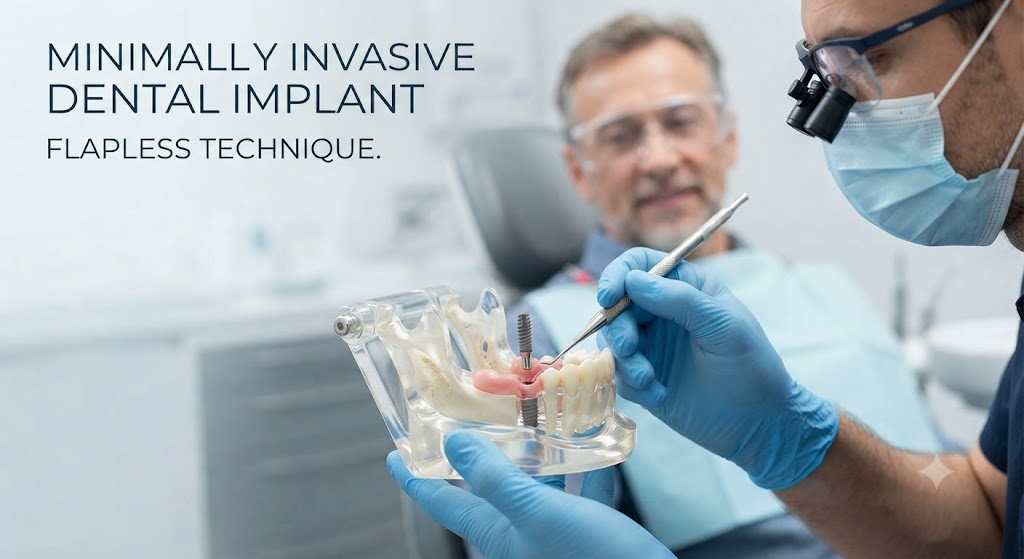
What they are almost always referring to is a concept called “flapless implant surgery” or “minimally invasive implant placement.” In this technique, instead of the surgeon making a long incision in the gum and peeling back a flap of tissue to expose the underlying bone, a small, circular punch of tissue is removed, or a tiny, keyhole incision is made directly over the planned implant site. The surgeon then drills directly through this small opening, places the implant, and the site is allowed to heal with minimal soft tissue disruption. This is still surgery. The patient still receives local anesthesia. A drill is still used. A sterile surgical protocol is still followed. The key difference is the reduced trauma to the gum tissue, which typically results in less post-operative swelling, less pain, and faster healing. It is not non-surgery; it is refined, minimal-access surgery.
Flapless Surgery: The Procedure People Call “No-Surgery”
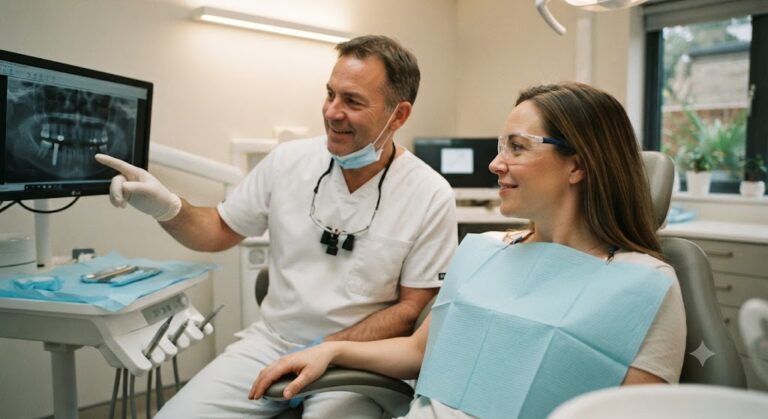
Flapless implant surgery is the procedure that has generated the “no surgery” language in the consumer marketplace. It is a legitimate, evidence-based technique that is appropriate for a select group of patients. The critical enabler of safe flapless surgery is three-dimensional computer-guided planning. The process begins with a Cone Beam CT scan. The surgeon uses specialized implant planning software to create a virtual 3D model of the patient’s jaw. On this digital model, they precisely plan the ideal position, angle, depth, and diameter of the implant, taking into account the underlying bone volume and the location of nerves and sinuses.
Based on this digital plan, a custom surgical guide is fabricated, often with 3D printing. This guide is a rigid plastic stent that fits exactly over the patient’s teeth and gums. It has pre-drilled metal sleeves that correspond to the planned implant position. On the day of surgery, the surgeon fits the guide, administers local anesthetic, and uses a tissue punch to remove a small circle of gum tissue through the guide’s opening. The series of precision drills are then passed through the guide’s sleeves, controlling the depth and angle perfectly. The implant is placed through the same guide. The entire procedure is performed through the small, punched opening. No stitches may even be required. The precision and reduced tissue damage are remarkable, but the critical surgical act of creating an osteotomy in bone has occurred.
The Strict Criteria: Who Qualifies for Flapless, Minimally Invasive Placement
You cannot simply choose to have a flapless implant because you want to avoid a more involved surgery. You must meet strict anatomical criteria. The primary requirement is adequate volume of attached, keratinized gum tissue at the site. This tough, firm gum tissue is necessary for the small punch hole to heal predictably. If the gum tissue is thin and fragile, a traditional flap may be required. Second, and most critically, you must have adequate bone width and bone height. When a surgeon reflects a flap, they can see the bone directly and make real-time adjustments if a concavity or a defect is present. In a flapless, guided surgery, the surgeon is operating “blind,” guided only by the surgical stent. There is no visual confirmation of the bone anatomy. If the bone has a hidden concavity, the drill or implant could perforate the side of the ridge, leading to a serious complication.
Therefore, the ideal candidate for a guided, flapless surgery is a patient with a well-healed, wide, flat ridge of bone and a generous zone of thick gum tissue. This is often the case in the front of the lower jaw, for example. This technique is contraindicated in a patient who needs a simultaneous bone graft, as a flapless approach does not allow the surgeon to place and secure the graft material. The candidacy is determined entirely by the 3D CBCT scan. An ethical surgeon will not let the desire for a “no-surgery” marketing label push them into a flapless procedure on a patient whose anatomy demands a flap for safe, accurate placement and visualization.
Mini Implants: A Different Category, Not a Non-Surgical One
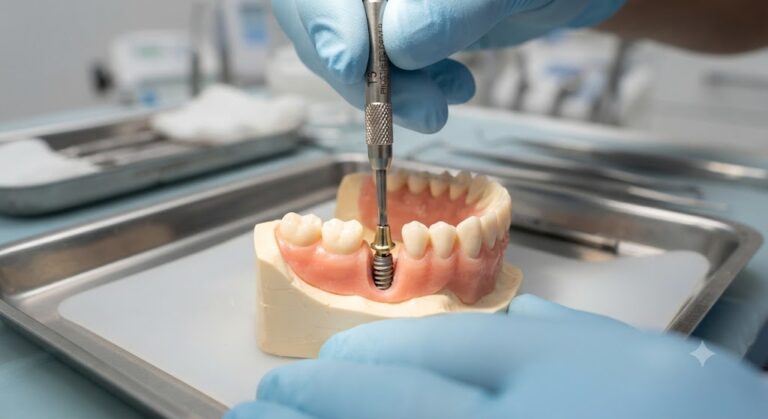
Mini dental implants are sometimes conflated with the idea of a less invasive or non-surgical implant. A mini implant is a one-piece, solid titanium screw with a diameter of less than 3mm, often used to stabilize a lower denture. The insertion process is less invasive than a standard implant because the mini implant is screwed directly into the bone, often through the gum, without a flap and with a much smaller osteotomy. This can sometimes be performed without a formal flap.
However, this is still a surgical procedure. The gum is still pierced, and the implant is anchored into the bone. The patient still receives local anesthesia. The mini implant is a different type of device with different indications. It is not intended for single tooth replacement in most cases and has a different long-term success profile, particularly a risk of mechanical fatigue fracture over time. It is a less invasive surgical option for a specific problem—denture instability—but it is not a non-surgical dental implant.
The True Non-Surgical Alternative: Resin-Bonded Bridges
If you genuinely cannot or will not undergo any surgical procedure, the most conservative, truly non-surgical alternative for replacing a missing tooth is a resin-bonded bridge, also known as a Maryland bridge. This restoration involves a false tooth, usually made of porcelain, with small metal or ceramic “wings” on either side. These wings are bonded with a strong dental adhesive to the back surfaces of the healthy, adjacent teeth. This is a completely non-surgical procedure. No injections, no drilling, no gum tissue disturbance.
The advantages are that it is non-invasive, quick, and much less expensive than an implant. The disadvantages are that it is a less durable solution. The wings can debond over time, and the bridge requires the adjacent healthy teeth to remain untouched, but the bond is mechanical and can fail. It does not replace the root, so it does not prevent the bone loss that will continue to occur in the area of the missing tooth. It is a surface-level replacement. For a patient who is medically compromised and cannot undergo surgery, or for a young person who is waiting for skeletal maturity before an implant, this is an excellent, legitimate, and truly non-surgical option.
Conclusion
A truly non-surgical dental implant does not exist because the placement of a titanium post into living jawbone is inherently a surgical act; however, the minimally invasive, computer-guided flapless technique dramatically reduces soft tissue trauma, allowing for a procedure with minimal bleeding, swelling, and post-operative pain that is sometimes marketed under the misleading “no surgery” label. This refined approach is only safe for a select group of patients with ideal bone and gum anatomy confirmed by a 3D CBCT scan. The only genuinely non-surgical alternatives for a missing tooth are a resin-bonded Maryland bridge or a removable partial denture, neither of which provide the bone-preserving root replacement of an implant.
Frequently Asked Questions
Is the flapless implant procedure painful?
You receive the same profound local anesthesia as a traditional implant. During the procedure, you should feel no sharp pain, only pressure. The post-operative discomfort is typically less than a flap surgery because the tissue is not extensively cut and stitched. Many patients require only over-the-counter pain relievers.
Can I get a flapless implant for a molar tooth?
It is possible if your CBCT scan shows a wide, flat ridge of bone and adequate thick gum tissue. However, the posterior jaw often has thin gum tissue and significant bone concavities, making a flap the safer and more common approach for visualization.
Is a same-day implant the same as a non-surgical implant?
No. Same-day or immediate load implants are often placed using flapless surgery, but the term “same-day” refers to the timing of the crown placement, not the surgical invasiveness. The implant is still surgically placed.
What about robotic implant surgery? Is that non-invasive?
Robotic implant surgery is the newest evolution of guided, flapless surgery. A robotic arm, guided by the digital plan, assists the surgeon in placing the implant with extreme precision. It is still surgery. It simply replaces the static physical guide with a dynamic robotic guidance system.
If a procedure is called “non-surgical,” what should I ask?
Ask the provider, “Are you placing a titanium post into my jawbone? Are you creating a surgical channel in the bone?” If the answer is yes, the procedure is surgical. Ask them to call it “minimally invasive guided surgery” and explain the specific details.
Additional Resource
For a scientific overview of minimally invasive implant surgical techniques, you can explore the resources of the Academy of Osseointegration, a leading international implant dentistry organization. Visit the Academy of Osseointegration