What Size Torx for Dental Implant? The Essential Guide to Implant Screwdrivers
You are in a very specific situation. You are a dentist, a surgical assistant, a lab technician, or perhaps a highly informed patient who needs to understand the precise tooling of a dental implant system. The question “What size Torx for a dental implant?” seems simple, but it opens a door into the world of precision engineering that holds your prosthetic tooth in place. This guide will provide a detailed, technical, yet accessible explanation of the driver interfaces used in implant dentistry. We will focus on the Torx connection, explain why it is not a single size, and map out the drivers used by the major implant manufacturers. This is your essential reference for understanding the tiny, critically important screws that connect an abutment to an implant.
The Prosthetic Screw: A Tiny Component, A Critical Fastener
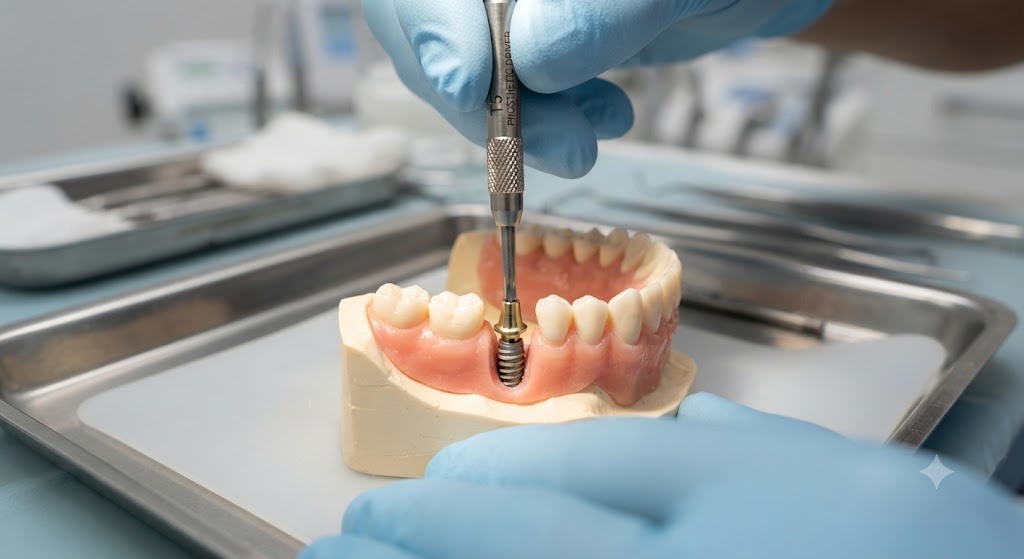
The screw you are asking about is the prosthetic retaining screw. This is the minuscule, precision-crafted fastener that secures the visible dental restoration—either a single crown or a multi-tooth bridge—to the underlying dental implant body. This screw passes through the crown or the abutment and threads into the internal channel of the implant. It is the sole mechanical connection between the patient’s prosthetic tooth and the osseointegrated titanium root. When this screw is tightened to a specific torque value, it clamps the components together and creates a stable, sealed joint. This screw must withstand millions of cycles of chewing forces without loosening or fracturing. The interface at the head of this screw, where the driver engages, is the subject of your question. A stripped or damaged screw head is a catastrophic intraoral complication, as removal becomes extremely difficult. This is why the correct, perfectly fitting driver is non-negotiable.
What is a Torx Drive and Why is it Used in Implant Dentistry?
The term Torx, officially known as a hexalobular internal drive, refers to a specific type of screw head geometry. Instead of a simple hexagonal (hex) recess or a straight slot, a Torx drive has a distinct 6-pointed star-shaped pattern with rounded, lobular corners. The driver bit has perfectly matching lobes. When the driver is inserted into the screw head, the contact is not at the fragile corners of a hexagon, but along the flat, driving surfaces of the lobes. This design has profound engineering advantages that make it ideal for the demanding biomechanics of the mouth. The Torx geometry virtually eliminates cam-out, which is the tendency of a driver to slip out of a screw head under torque, a common and damaging problem with hex drives. It allows for a much higher torque transfer to the screw without damaging the interface. It provides a positive, secure, wobble-free engagement, giving the clinician exceptional tactile feel and control during the critical tightening sequence. Several premium implant manufacturers have adopted the Torx drive for these precise reasons of reliability and precision.
There is No Single Torx Size: The Manufacturer-Specific Reality
The most critical fact for you to understand is that there is no universal standard Torx size for dental implants. You cannot go to a hardware store, buy a standard T5 or T6 Torx driver, and expect it to fit a Straumann or a Nobel Biocare screw. Dental implant manufacturers each develop their own proprietary prosthetic connection, and the screw head geometry is part of that proprietary ecosystem. The size of the Torx lobe, the depth of the recess, the exact angle of the walls, and the diameter of the driver are all controlled and specific. An Straumann Torx driver is engineered to fit a Straumann screw and nothing else. An Astra Tech Torx driver fits an Astra Tech screw. A Zimmer Dental Torx driver fits a Zimmer screw. Using a near-fit, off-brand, or incompatible driver is the single most common cause of a stripped prosthetic screw head.
The Torx sizes in implant dentistry are measured on a micro scale, typically in the T4, T5, and T6 range, which describe drivers with tip-to-tip measurements of a fraction of a millimeter. These drivers are manufactured from high-grade surgical stainless steel with extreme precision tolerances, costing significantly more than an industrial bit. They are integral components of the implant system’s surgical and restorative kit.
A Manufacturer-Specific Torx Size Reference Table
The following table is a practical, clinical reference guide. However, you must always verify with the implant system’s official technical manual, as internal connections and driver specifications can change with new product lines.
| Implant Manufacturer / System | Common Prosthetic Screw Drive | Clinical Notes on the Interface |
|---|---|---|
| Straumann | Torx (Straumann-specific, often termed “Torx-like”) | The internal connection for Bone Level and Tissue Level implants uses a precision Star/Torx drive. Straumann drivers are color-coded and fit with absolute specificity. |
| Nobel Biocare (Conical Connection, Internal) | Hex (predominantly) or Unigrip® (proprietary slotted hex) | Nobel is historically known for the hex. Their newer systems use a tight, friction-fit hex. The Unigrip driver is a unique hybrid. |
| Astra Tech Implant System (Dentsply Sirona) | Torx (Astra Tech-specific) | The Astra Tech restorative driver is a Torx-style interface. It provides a very positive, self-retaining engagement in the screw head. |
| Zimmer Biomet Dental (Certain, Tapered Screw-Vent) | Hex (predominantly) or Torx (on specific systems) | Many Zimmer systems use a large 1.25mm or .062″ hex. Check the specific implant. Some newer lines have adopted a Torx drive. |
| BioHorizons | Hex (predominantly) | The BioHorizons internal connection most commonly uses a .050″ (1.27mm) hex driver. |
| MegaGen (AnyRidge) | Torx (MegaGen-specific) | The AnyRidge system uses a dedicated Torx-style driver for its prosthetic screws. |
| Neoss | Torx (Neoss-specific) | The Neoss implant system explicitly uses a Torx drive for its abutment and prosthetic retaining screws. |
This table demonstrates the lack of interchangeability. A “Torx” in the mouth is not a generic standard. It is a brand-specific engineering specification.
The Clinical Procedure: Selecting and Using the Correct Driver
When a clinician or an assistant prepares for a restorative implant appointment, identifying the implant system is the first and most crucial step. The patient’s implant passport or the original surgical records must be reviewed. The implant brand, type, and platform are identified. Only the corresponding manufacturer’s restorative kit is brought to the operatory. The correct driver tip is selected from the kit. A new, sharp prosthetic screw is taken from its sealed, sterile package.
The technique for seating the driver is critical. The driver tip is gently and passively placed into the screw head. The clinician should feel a solid, positive, bottomed-out engagement without any wobble. The screw is then turned counterclockwise first, a subtle tactile step known as “seeking the thread,” until a small click is felt, indicating the screw’s thread has aligned with the implant’s internal thread. This prevents cross-threading. The screw is then tightened clockwise according to the manufacturer’s recommended torque protocol, usually using a calibrated torque wrench, not a hand driver, to achieve the exact prescribed preload. For a standard abutment screw, this is often in the range of 15 to 35 Ncm. For the final restoration, a small piece of Teflon tape or silicone sealing material is placed over the screw head, and the access hole in the crown is sealed with a tooth-colored composite resin.
What to Do When the Implant System is Unknown
A clinician is sometimes presented with a patient who has an implant of unknown origin. The original dentist has retired, the records are gone, and there is no implant passport. This is a significant restorative challenge. You should never guess and place a driver that “looks like it might fit.” You must identify the implant. This can be done by taking a periapical radiograph and comparing the radiographic silhouette of the implant body and the internal connection to a known implant identification database or service. A surgical loupe or an intraoral camera can be used to visually inspect the internal connection for any laser-etched markings or distinct geometric features. The patient may be referred to a dental laboratory technician who specializes in implant identification. Only when the implant system is positively identified and the dedicated driver is sourced from the manufacturer should the restoration proceed.
The Risk of “Near-Fit” and Aftermarket Drivers
There is a market for generic or universal implant restorative kits. A laboratory or a clinician may be tempted to purchase a kit with a variety of interchangeable bits. The risk of using a near-fit driver is high and clinically grave. A driver that is slightly undersized will not fully engage the lobes of a Torx recess. Under torque, it will apply pressure only to the delicate tips of the star pattern. This will strip the internal geometry of the screw head. The screw is now a tiny, circular, smooth-walled piece of metal at the bottom of a deep hole, with no way to engage it for tightening or removal. Removing a stripped prosthetic screw requires specialized, expensive, and risky rescue kits that involve drilling with a high-speed handpiece under a microscope, with the constant danger of irreversibly damaging the implant’s internal thread. The cost of a branded, genuine restorative driver is a tiny fraction of the cost and stress of managing a stripped screw catastrophe.
Conclusion
The size of the Torx driver for a dental implant is not a universal standard but a proprietary, manufacturer-specific engineering dimension, most commonly found in the micro T4 to T6 range on systems from companies like Straumann, Astra Tech, MegaGen, and Neoss. The correct driver is always the dedicated, precisely machined component from the implant manufacturer’s restorative kit, and never a generic hardware store bit or a near-fit aftermarket substitute. Using the exact matching driver and a calibrated torque wrench is the absolute clinical requirement to avoid the catastrophic complication of stripping the prosthetic screw head, which can turn a routine restoration into a complex, costly retrieval surgery.
Frequently Asked Questions
Can I use a standard electronics Torx T5 screwdriver on a dental implant?
Absolutely not. An industrial T5 driver is manufactured to a different tolerance and material standard. It will not have the precise fit required for a dental implant screw and is very likely to damage the screw head, especially under torque.
What is the most common Torx size used in dentistry?
There is no single most common size. The relevant clinical question is not “what size?” but “for which implant system?” You need the specific driver for the specific implant in your patient’s mouth.
If a screw is a “star drive,” is it always a Torx?
Not necessarily. Some implant manufacturers use a distinctive, multi-lobed internal drive that they may call a “star drive” in their literature. It may be their specific interpretation of a Torx-like geometry. The rule remains: use the driver from that manufacturer’s kit for that implant.
How do I order a replacement driver?
Contact the dental implant manufacturer’s customer service department directly or your dental supply representative. You will need the implant system name and the specific part number for the driver, which is listed in the system’s product catalog. Do not order from a third-party online marketplace where the authenticity and metallurgy of the driver cannot be guaranteed.
What is the torque value for a Torx prosthetic screw?
The torque value is determined by the implant manufacturer for that specific screw and connection, not by the drive type. You must look up the recommended torque in the manufacturer’s Instructions for Use. It is typically in the range of 15 Ncm to 35 Ncm for an abutment screw.
Additional Resource
To understand the engineering principles of the Torx drive system as a fastening technology, you can read the technical information from the official licensor of the Torx brand. Visit the Acument Torx Page