What Goes On Top Of A Dental Implant?
A dental implant is a marvel of modern dentistry, but the titanium post surgically placed in your jawbone is only the foundation. It is the hidden, structural root that lies beneath the gum. The part you see, the part you smile with and chew with, is the sophisticated restoration that goes on top of the implant. Understanding what sits on top of a dental implant is essential to understanding the final aesthetic and functional outcome of your treatment.
This article provides a complete, detailed guide to every component that goes on top of a dental implant. You will learn about the abutment, the different types of implant crowns, the materials used, and how these parts connect to create a tooth that looks, feels, and functions naturally.
The Two Main Components Above the Implant Fixture
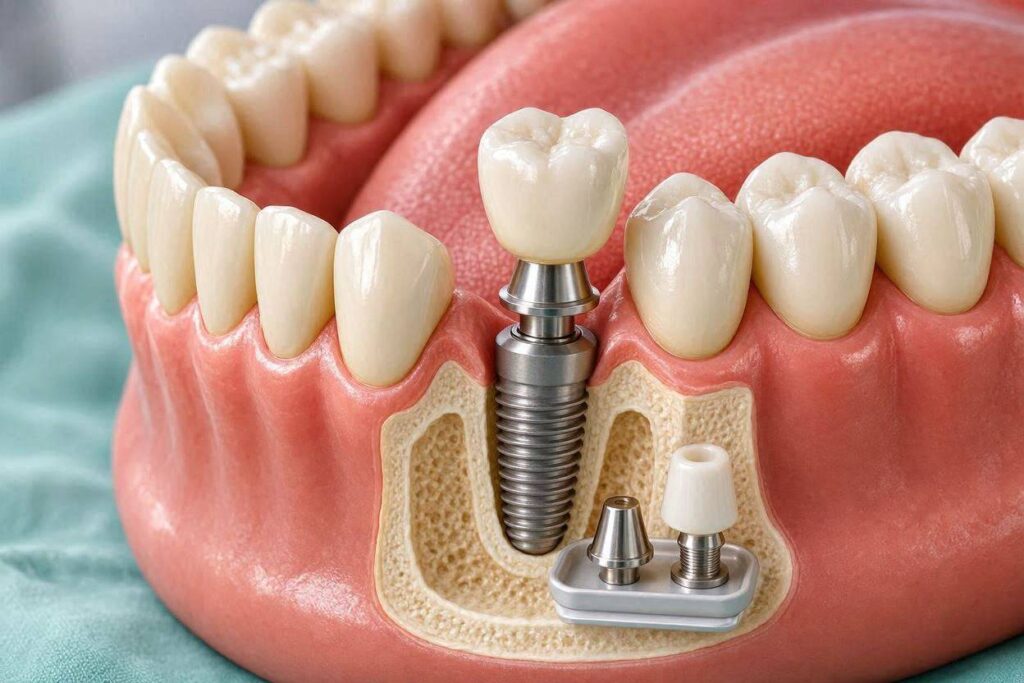
When a patient asks, “What goes on top of a dental implant?”, they are referring to the visible and connective parts of the system. The implant fixture itself is the titanium root embedded in the bone. On top of that, two distinct components complete the restoration.
Component 1: The Abutment (The Connector)
The abutment is the intermediate piece that screws directly into the internal connection of the implant fixture. It is the bridge between the surgical world below the gum and the restorative world above it. Its primary functions are to provide a stable, precision-engineered platform for the crown and to shape and support the gum tissue around the emerging tooth.
Abutments come in two main types:
- Stock (Pre-Fabricated) Abutments: These are mass-manufactured by the implant company in standard sizes and shapes. The dentist selects the closest fit. They are strong and cost-effective but do not perfectly match an individual patient’s gum contours.
- Custom (CAD/CAM) Abutments: This is the modern gold standard for aesthetic cases. The dentist takes a digital scan of the implant’s exact position and the surrounding gum tissue. A custom abutment is then designed on a computer and milled from a solid block of titanium or tooth-colored zirconia. It is perfectly contoured to support the gum tissue in a natural, scalloped shape and to provide an ideal emergence profile for the crown.
The material choice for the abutment is critical. Titanium abutments are the strongest and are ideal for posterior molars. For front teeth, where the abutment might show through thin, translucent gums as a gray shadow, a custom zirconia abutment is used because its white color provides the most natural, lifelike aesthetics.
Component 2: The Implant Crown (The Visible Tooth)
The crown is the topmost part, the prosthetic tooth that you see and use. It is attached to the abutment. An implant crown is not a generic, off-the-shelf tooth. It is a custom-crafted, precision restoration manufactured in a dental laboratory specifically for you.
The Two Ways the Crown Attaches to the Abutment
The connection between the crown and the abutment is a critical design feature with significant clinical implications.
Screw-Retained Crown
The crown is fabricated with a small chimney or access channel running through it. The crown is placed onto the abutment, and a small titanium or gold screw is passed through the channel and torqued down into the abutment. The access hole is then filled with a tooth-colored composite resin.
- Primary Advantage: Retrievability. The crown can be removed by the dentist at any time without damaging it. This allows for inspection, cleaning of the abutment, or replacement of the screw.
- Primary Disadvantage: The screw access hole creates a small aesthetic compromise on the biting surface of a posterior crown, or potentially on the facial surface of an anterior crown, though modern techniques usually manage to place the hole on the back of the front tooth.
Cement-Retained Crown
The abutment is first screwed onto the implant. The crown, which is a hollow cap, is then cemented onto the abutment using a permanent dental cement, similar to a traditional crown on a natural tooth.
- Primary Advantage: Superior aesthetics for front teeth. There is no screw access hole, so the visible surface of the crown is completely pristine and perfectly contoured. The occlusion can also be managed perfectly.
- Primary Disadvantage: The risk of peri-implant disease from residual cement. If excess cement extrudes from the margin below the gum and is not meticulously removed, it acts as a potent foreign body, causing acute inflammation and rapid bone loss. Retrieving the crown for future maintenance usually requires cutting it off and making a new one.
The Materials Used for Implant Crowns
The material that goes on top of your implant is chosen for its strength, biocompatibility, and ability to mimic natural teeth.
Zirconia (Full-Contour and Layered)
Zirconium dioxide is a high-performance ceramic. For posterior molars where forces are extreme, a solid, monolithic zirconia crown is often used for its near-indestructible strength. For anterior teeth, a zirconia framework can be layered with more translucent porcelains by a master ceramist to combine a strong core with a lifelike aesthetic outer layer.
Lithium Disilicate (IPS e.max)
This is a glass-ceramic that offers the highest level of aesthetics available in a single material. It can be milled as a single, solid block. It provides an exceptional combination of strength and a translucency that is extremely close to natural enamel. It is a top choice for single crowns in the aesthetic zone.
Porcelain-Fused-to-Metal (PFM)
The traditional technology. A metal substructure provides a strong base, and porcelain is baked on top. Its aesthetic limitation is the metal core, which blocks light transmission, creating an opaque, sometimes lifeless look. It is still used but has been largely superseded by all-ceramic options in high-aesthetic modern dentistry.
The “Healing Abutment” or “Healing Cap”
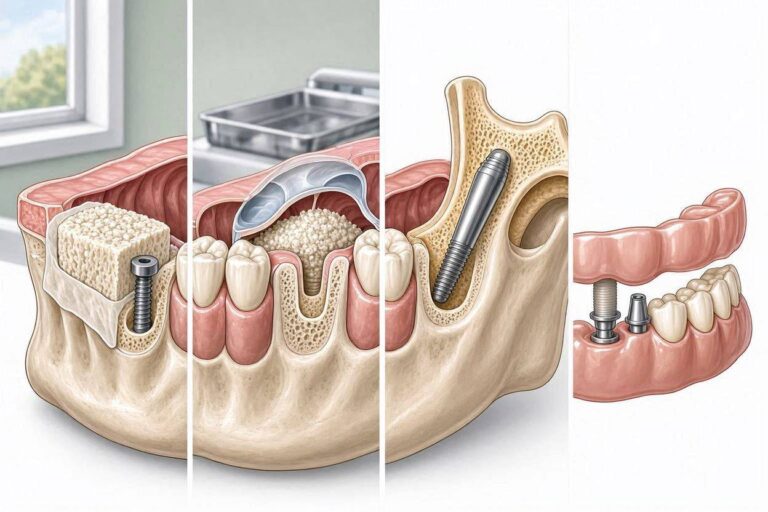
A temporary component called a healing abutment or healing cap goes on top of the implant during the osseointegration phase. It is not the final restoration. It is a small, round, metal or plastic cap that is screwed into the implant at the time of surgery. Its sole purpose is to hold the gum tissue open in a circular shape while the implant heals beneath. After the bone has fused to the implant, the healing abutment is removed, and the permanent custom abutment and crown are placed.
What Goes on Top of Multiple Implants
When multiple implants are placed, what goes on top is a prosthetic superstructure.
- Implant-Supported Fixed Bridge: A multi-unit span of connected ceramic crowns that is cemented or screwed onto two or more implants.
- Full-Arch Fixed Prosthesis (All-on-4): A full arch of acrylic or porcelain teeth on a titanium or zirconia framework. This screws directly into the multi-unit abutments on four to six implants. This is the complete, non-removable set of teeth.
- Implant-Retained Overdenture: A removable denture with special locator inserts that snap onto ball-shaped or locator abutments on top of the implants.
Conclusion
The components that go on top of a dental implant are the abutment, a precision connector post, and the implant crown, the custom-crafted, visible prosthetic tooth. The abutment can be a stock or custom-made piece of titanium or tooth-colored zirconia. The crown is a custom work of dental art, typically milled from a solid block of high-strength, aesthetic ceramic such as layered zirconia or lithium disilicate, and it is attached to the abutment either by a retrievable screw or a permanent cement. These two components together complete the restoration, transforming the hidden titanium root into a fully functional and natural-looking tooth.
FAQ
1. What is the difference between a healing abutment and a permanent abutment?
A healing abutment is a temporary cap used during the healing phase to shape the gum. A permanent abutment is the final, custom-fitted connector that supports the crown for the long term.
2. Which is better, a screw-retained or cemented crown on an implant?
It is a clinical decision. Screw-retained crowns are fully retrievable and avoid the risk of cement disease. Cement-retained crowns offer maximum aesthetics with no screw access hole. The dentist chooses based on the implant’s position and the aesthetic demands.
3. What material is the best for an implant crown?
For back teeth, monolithic zirconia is exceptionally strong. For front teeth, lithium disilicate (e.max) or a custom-layered porcelain crown often provides the best aesthetic match.
4. Can the crown on top of my implant get a cavity?
No. The ceramic crown cannot decay. However, bacterial plaque can still accumulate around the abutment and cause gum disease and bone loss, so cleaning the crown and abutment is as critical as cleaning a natural tooth.
5. How long does the crown on an implant last?
The implant fixture can last a lifetime. The crown is a prosthetic and, like all dental restorations, may need replacement after 10 to 15 years or more due to normal wear and tear.
Additional Resource
For a visual and technical understanding of implant components and restoration types, explore the educational materials available from the Academy of Osseointegration (AO).