Can You Get A Dental Implant In One Day?
The promise is seductive. Walk into a dental office with a failing tooth or a gap in your smile. Walk out the same day with a functional, aesthetic replacement. No months of waiting. No multiple surgeries. No temporary denture. The marketing for “same-day implants” or “teeth in a day” taps into a deep human desire for instant solutions. But the relationship between marketing and reality in same-day implant dentistry is complex. This article provides a clear, honest explanation of what is actually possible, what the term “one day” really means in clinical practice, and who can genuinely benefit from accelerated implant protocols.
Two Different Things: Same-Day Placement and Same-Day Teeth
The first and most important distinction to understand is that “getting an implant in one day” can mean two entirely different things. The confusion between them is the source of much misunderstanding.
Same-Day Implant Placement
This refers to the surgical placement of the implant fixture into the jawbone on the same day that a tooth is extracted. The patient arrives with a failing tooth. The tooth is removed. The implant is placed into the extraction socket. The gum is sutured. The patient leaves with an implant in the bone, but there is no visible tooth yet. The implant must heal for months before a crown is attached.
This is also called immediate implant placement. It is a well-established, scientifically supported protocol for appropriate cases. It reduces the number of surgical procedures and the total treatment time. The patient still waits months for the final restoration, but the implant is already in place, integrating with the bone.
Same-Day Teeth
This refers to the placement of a temporary crown or bridge on the implant on the same day the implant is surgically placed. The patient arrives with a missing or failing tooth and leaves with a fixed, visible tooth attached to the implant. This is called immediate loading or immediate provisionalization.
This is what most patients picture when they hear “teeth in a day.” It is a more demanding protocol than immediate placement alone. It requires the implant to have excellent primary stability at the time of surgery. The temporary restoration must be carefully designed to avoid any occlusal loading that could disrupt osseointegration. The patient must be meticulously compliant with a soft diet and oral hygiene during the healing period.
The Clinical Requirements for Same-Day Teeth
Immediate loading is not a marketing gimmick. It is a legitimate, evidence-based protocol. But it is not appropriate for every patient or every implant. The clinical requirements are stringent.
Primary Stability
The implant must achieve high primary stability, meaning it is mechanically locked in the bone at the time of placement with sufficient torque to resist micromovement. The generally accepted threshold is an insertion torque of at least 30 to 35 Newton-centimeters, and ideally higher. If the implant does not achieve this stability, it cannot be immediately loaded. The surgeon must place a cover screw, bury the implant, and wait for osseointegration before loading.
Primary stability depends on bone density and quality, implant design, surgical technique, and the match between the implant size and the prepared osteotomy. The dense anterior mandible provides better primary stability than the soft posterior maxilla. A tapered implant with an aggressive thread design can achieve higher insertion torque than a cylindrical implant.
Adequate Bone Volume and Quality
The bone must be sufficient to fully encase the implant and provide the necessary stability. Patients with severe bone loss, active infection, or poor bone quality are not candidates for immediate loading.
Controlled Occlusal Forces
The temporary restoration must be adjusted so that it experiences minimal or no contact during chewing. If the patient bites on the temporary tooth with full force, the micromovement can disrupt the delicate process of osseointegration. The tooth is for show, not for chewing, during the healing phase. The patient must understand and accept this limitation.
Patient Compliance
The patient must follow a strict soft diet, avoid chewing on the implant side, maintain excellent oral hygiene, and attend all follow-up appointments. A patient who is unwilling or unable to comply is not a candidate.
The Procedure: What Happens on the Day
The day of same-day implant treatment is a long, carefully orchestrated sequence.
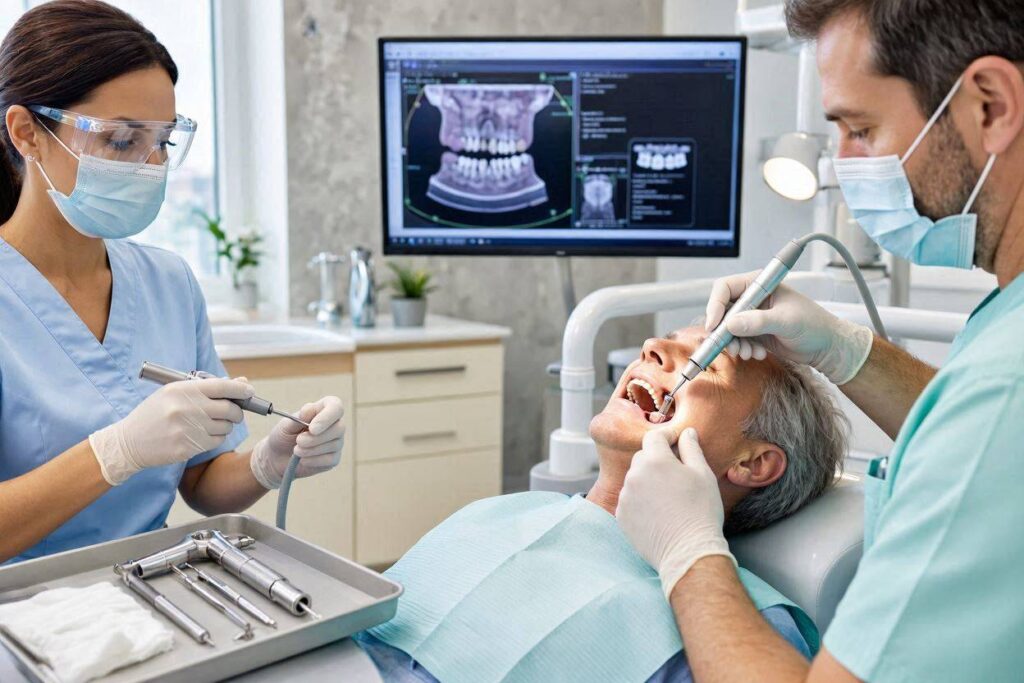
The patient arrives in the morning. If a tooth is to be extracted, it is removed atraumatically, preserving the socket walls and the surrounding bone. The extraction site is thoroughly debrided. The implant osteotomy is prepared, following the precise drilling sequence. The implant is inserted and torqued to the required value. Primary stability is confirmed.
An abutment is attached to the implant. A temporary crown, usually made of acrylic and fabricated either beforehand or chairside, is adjusted and secured to the abutment. The bite is carefully checked and adjusted to ensure the temporary tooth has no functional contact. The patient is given detailed post-operative instructions.
The entire process for a single tooth can take two to three hours. For full-arch cases, where multiple implants are placed and a temporary fixed bridge is attached, the surgery can take four to six hours or more.
The Healing Period: The Hidden Part of “One Day”
The patient leaves with a tooth, but the process is far from complete. The implant must osseointegrate. The temporary restoration is exactly that: temporary. It is made of acrylic, which is softer and less durable than the final ceramic crown. It may not have the ideal contours or the most aesthetic appearance. It is a placeholder that serves a critical function: maintaining the space, guiding soft tissue healing, and providing psychological comfort during the months of healing.
The patient must follow a soft diet for the entire osseointegration period, typically three to six months. Hard, crunchy, or chewy foods are avoided. Chewing on the implant side is prohibited. Oral hygiene must be meticulous but gentle around the surgical site.
Once osseointegration is confirmed, the temporary restoration is removed. A final impression is taken. The permanent abutment and crown are fabricated and delivered. The “one-day” implant becomes a permanent restoration only after this final phase is complete.
Full-Arch Same-Day Teeth: The All-on-Four Protocol
The concept of same-day teeth is perhaps most dramatically realized in the full-arch, All-on-Four protocol. A patient who is losing or has lost all their teeth in an arch can have the remaining failing teeth extracted, four to six implants placed, and a temporary fixed bridge attached on the same day. They leave the office with a full set of functional teeth.
This procedure is life-changing. It is also a major surgical undertaking with a significant recovery. Swelling, bruising, and dietary restrictions apply. The temporary bridge is made of acrylic and is not as strong as the final prosthesis. The patient must be extremely careful during the healing phase. The final, high-strength prosthesis is delivered after osseointegration is complete.
The psychological impact of leaving the office with teeth on the same day is profound. For a patient who has endured years of dental decline, the transformation is immediate and visible. This emotional benefit is a legitimate part of the treatment’s value.
When Same-Day Implants Are Not Possible
Certain clinical scenarios preclude immediate placement or loading. Active infection at the extraction site must be resolved before implant placement. Insufficient bone for primary stability requires grafting and a delayed approach. Poor primary stability at the time of surgery means the implant must be buried and left to heal. Uncontrolled medical conditions that impair healing may make immediate loading too risky. Patient unwillingness to comply with the strict post-operative regimen is a contraindication.
An ethical dentist will not push a same-day protocol when the clinical conditions are unfavorable. The long-term success of the implant is the priority. A patient who insists on immediacy against clinical advice is risking implant failure and the loss of their investment.
The Appeal and the Reality
The appeal of same-day implants is undeniable. The patient avoids the embarrassment of a visible gap. They avoid the discomfort and inconvenience of a removable temporary denture. They feel that they are making progress, that the solution is happening now.
The reality is that same-day implants are a tool in the implantologist’s kit, not a universal solution. They are appropriate for carefully selected patients and specific clinical conditions. The “one day” refers to the day the temporary tooth is placed. The permanent, fully functional restoration still requires months of healing and a final restorative phase. The patient who understands this distinction enters treatment with realistic expectations and is more likely to be satisfied with the process and the outcome.
Conclusion
Getting a dental implant in one day is possible in specific clinical circumstances. Same-day implant placement, where the implant is placed immediately after tooth extraction, is a well-established protocol. Same-day teeth, where a temporary restoration is attached to the implant on the day of surgery, is possible when the implant achieves excellent primary stability and the patient is willing to follow strict post-operative protocols. Full-arch same-day treatment can transform a patient’s smile in a single appointment. However, the “one day” refers to the delivery of a temporary restoration. The final, permanent result still requires months of healing and a separate restorative phase. The patient who is a good candidate, who understands the limitations of the temporary restoration, and who complies with the healing protocol can achieve an excellent outcome through this accelerated approach.
Frequently Asked Questions
Can I eat normally with same-day implant teeth?
No. You must follow a strict soft diet and avoid chewing on the implant side during the entire healing period of three to six months.
Is the same-day tooth the final tooth?
No. It is a temporary acrylic restoration. The final ceramic crown is placed after osseointegration is complete.
How long does the same-day implant procedure take?
A single tooth typically takes two to three hours. Full-arch cases can take four to six hours or longer.
What happens if my implant does not have enough stability for immediate loading?
The implant will be buried under the gum, and you will wait the traditional healing period. The temporary tooth option is not available in that case.
Are same-day implants more likely to fail?
When proper case selection criteria are met, immediate loading success rates are comparable to traditional delayed loading. Poor case selection increases failure risk.
Can any dentist provide same-day implants?
Same-day implant protocols require specific training, experience, and case selection skills. Ask your dentist about their specific training and experience with immediate loading.
Additional Resource:
American Academy of Periodontology – Same-Day Implant Information
https://www.perio.org/consumer/dental-implants