Does NYS Medicaid Cover Dental Implants?
New York State has one of the more robust Medicaid dental programs in the United States. Compared to states that offer only emergency extractions for adults, New York provides a meaningful range of restorative services. This creates a context of hope for low-income residents who need tooth replacement. The question of whether NYS Medicaid covers dental implants arises naturally from this context. The short answer is that routine dental implants are not covered. However, as with many things in healthcare policy, the complete picture is more nuanced. This article explains exactly what NYS Medicaid covers, when an implant might conceivably be covered through a medical pathway, and what alternatives exist for Medicaid recipients who need tooth replacement.
The Adult Dental Benefit in New York Medicaid
New York State Medicaid provides a comprehensive set of dental benefits for enrolled children through the Early and Periodic Screening, Diagnostic, and Treatment mandate and the Child Health Plus program. For adults, the benefit is more limited but still substantial compared to national standards.
NYS Medicaid covers a range of adult dental services, including diagnostic exams and X-rays, cleanings and periodontal treatment, fillings, root canals on anterior teeth and selected posterior teeth, extractions, and full and partial dentures with certain limitations and frequency restrictions.
The inclusion of dentures is significant. Many state Medicaid programs provide no coverage for tooth replacement at all. New York Medicaid recipients can obtain dentures when clinically indicated, subject to prior authorization and specific clinical criteria. However, coverage for dental implants is explicitly excluded from the routine adult dental benefit. Implants are considered a major, elective procedure that exceeds the scope of the state’s obligation to provide basic, medically necessary dental care. A removable denture satisfies the obligation to restore function. A fixed implant-supported restoration is considered beyond what the program must provide.
The Definition of Medical Necessity in NYS Medicaid
The New York State Medicaid program defines medical necessity for dental services in terms of procedures that are required to prevent disease, disability, or pain. A dental implant for routine tooth replacement does not meet this definition when a less expensive alternative, specifically a denture, is available and clinically adequate.
The prior authorization process for major dental services, including dentures, requires the dentist to submit clinical documentation demonstrating that the service is medically necessary. Implants are not on the list of services for which prior authorization can be requested under the dental benefit. The system is designed to deny them.
The Narrow Medical Pathway: Hospital-Based and Reconstructive Surgery
There exists a narrow pathway through which a dental implant might be covered by NYS Medicaid, but it does not run through the dental benefit. It runs through the medical surgical benefit.
When a dental procedure is an integral part of a covered medical service, it may be reimbursable under the medical component of Medicaid. This typically involves hospital-based care for conditions that go beyond routine dental disease.
Examples of situations where implants might be covered include reconstruction of the jaw following traumatic injury, such as a motor vehicle accident or assault. Reconstruction following surgical removal of a tumor or cyst that has destroyed a significant portion of the jaw. Dental rehabilitation for a congenital defect, such as ectodermal dysplasia or cleft palate. Cases where a patient has a documented medical condition that makes denture wear impossible, leading to severe malnutrition and declining systemic health.
These are not routine cases. They involve complex medical conditions managed by oral and maxillofacial surgeons in hospital settings. The implant placement is bundled into the overall reconstructive surgery. Prior authorization is required, and documentation must establish that the implant is medically necessary as part of the larger reconstruction.
The average Medicaid recipient with a missing tooth and healthy adjacent teeth does not qualify for this pathway. It exists for catastrophic, reconstructive situations, not for routine tooth replacement.
Managed Care and the Prior Authorization Maze
Most NYS Medicaid recipients receive their dental benefits through a managed care plan rather than through fee-for-service Medicaid. These plans, such as Healthfirst, Fidelis, EmblemHealth, and others, administer the dental benefit according to their contract with the state.
Managed care plans have their own prior authorization processes and their own dental directors who review requests for major services. A request for an implant that is submitted to a managed care plan under the dental benefit will be denied because implants are not a covered benefit. A request submitted under the medical benefit for a reconstructive case will be evaluated against the plan’s medical necessity criteria.
The patient and the treating provider must be prepared for a bureaucratic process. Prior authorization submissions for complex medical necessity cases must include a comprehensive narrative, diagnostic imaging, photographs, and supporting letters from other medical providers. Initial denial is common, and the appeals process must be pursued. This takes time, persistence, and a provider who is experienced in navigating the managed care system.
Alternatives Available Through NYS Medicaid
The exclusion of implants from routine coverage does not leave a Medicaid recipient without options. The denture benefit is the primary pathway to tooth replacement.
NYS Medicaid covers full and partial dentures. The coverage is subject to clinical criteria and frequency limitations. A full denture may be covered once every eight years, with exceptions for medical necessity. A partial denture may be covered when specific numbers and patterns of missing teeth are present. Relines and repairs are covered.
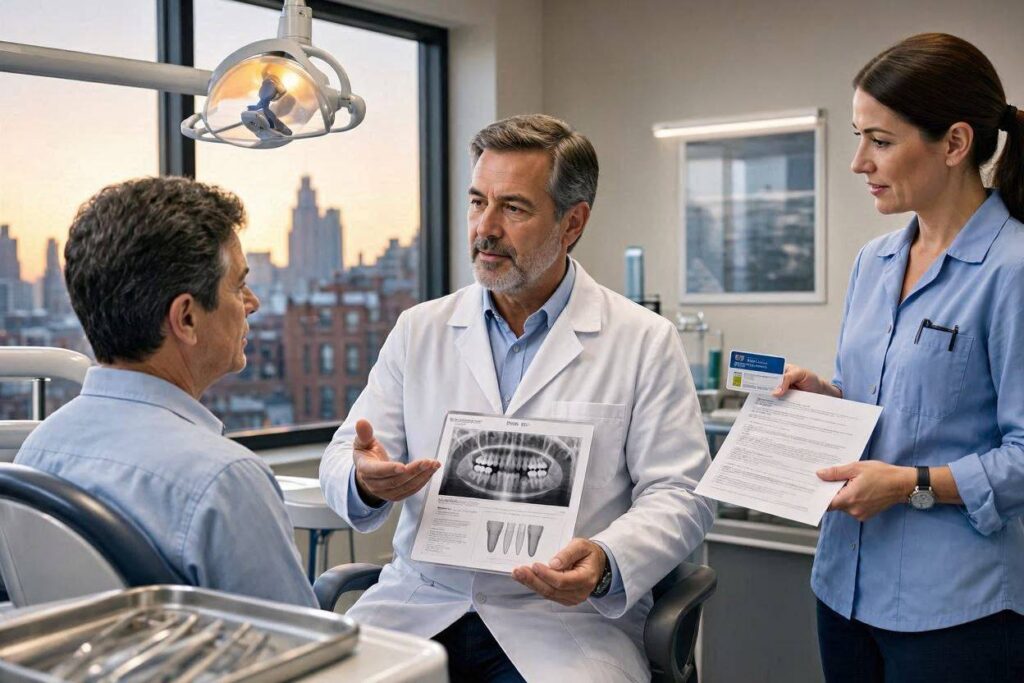
For a Medicaid recipient who needs tooth replacement, the practical sequence is as follows. Find a dentist who accepts NYS Medicaid and is accepting new patients. This is a challenge in itself, as Medicaid dental provider participation is limited. Obtain a comprehensive examination and a treatment plan. If dentures are indicated, the dentist submits a prior authorization request. Once authorized, the denture is fabricated and delivered.
The result is a removable prosthesis, not a fixed implant. It is less stable, less comfortable, and does not prevent bone loss. But it restores function and aesthetics. For a patient with no other financial resources, a well-made denture obtained through Medicaid is a meaningful, life-improving service.
Community Health Centers and Dental Schools
Federally Qualified Health Centers in New York State provide dental services on a sliding fee scale. Many accept Medicaid. Some FQHCs with robust dental programs may offer dentures and basic restorative care at reduced cost for uninsured patients or those with limited Medicaid coverage.
New York is home to several dental schools, including New York University College of Dentistry, Columbia University College of Dental Medicine, Stony Brook University School of Dental Medicine, and the University at Buffalo School of Dental Medicine. These institutions offer implant treatment at reduced fees. A single implant and crown at a dental school might cost $2,500 to $3,500, compared to $4,000 to $6,000 in private practice.
For a Medicaid recipient who has some financial resources, even limited ones, a dental school may offer a pathway to an implant that is more affordable than private practice. The savings are significant, though still substantial for a low-income patient. The trade-off is time and the acceptance of treatment by supervised students or residents.
The Political and Policy Context
The exclusion of dental implants from Medicaid coverage is not unique to New York. No state Medicaid program covers routine implant placement for adults. The policy reflects a judgment about the scope of government responsibility for oral health: relief of pain and infection, restoration of basic function with the least expensive adequate option, and prevention of disease. Implants are considered a high-cost option that exceeds this scope.
Advocates for oral health equity argue that this judgment is shortsighted. Dental implants preserve bone and protect adjacent teeth. They provide superior function and quality of life. They reduce the long-term cumulative cost of repeated conventional restorations. As the evidence for the medical importance of oral health grows, the policy argument for expanding adult dental benefits, including implant coverage in specific circumstances, gains strength. But policy change is slow. The Medicaid recipient today must work within the system that exists, not the one that advocates hope to create.
Conclusion
NYS Medicaid does not cover dental implants as part of its routine adult dental benefit. Implants are excluded as a major, elective procedure. A narrow medical necessity pathway exists for implants placed as part of hospital-based reconstructive surgery for trauma, cancer, or congenital defects, but this does not apply to routine tooth replacement. The covered alternative for tooth replacement is dentures, which NYS Medicaid covers with prior authorization and specific clinical criteria. Patients seeking more affordable implant treatment can explore dental schools, community health centers, and financing options, though the cost remains significant. The system provides a basic level of restorative care, but the gap between what is covered and what is optimal remains wide.
Frequently Asked Questions
Does NYS Medicaid cover any dental implants for adults?
No, not under the routine dental benefit. Implants are excluded. A very narrow medical necessity pathway exists for reconstructive surgery cases.
What tooth replacement options does NYS Medicaid cover?
NYS Medicaid covers full and partial dentures, subject to prior authorization and clinical criteria.
Can I get a dental implant through NYS Medicaid if I have a medical condition that makes dentures impossible?
A case can be made for medical necessity through the medical surgical benefit if the inability to wear dentures is causing documented systemic health problems like severe malnutrition. This is a complex, documentation-intensive process with no guarantee of approval.
How do I find a dentist who accepts NYS Medicaid?
Contact your Medicaid managed care plan for a list of participating dental providers. Be prepared for limited availability and potentially long wait times for appointments.
Can I use NYS Medicaid at a dental school?
Many dental schools accept Medicaid. Contact the school’s patient admissions office to inquire about participation and available services.
What is the best way to get affordable implants if Medicaid will not cover them?
Dental schools offer reduced fees and are the most reliable source of affordable implant care. Financing, dental savings plans, and in-house membership plans at private practices are other options.
Additional Resource:
New York State Department of Health – Medicaid Dental Information
https://www.health.ny.gov/health_care/medicaid/program/dental/