Does The Cost Of Dental Implants Depend On The Tooth?
When you’re missing a tooth, your dentist might recommend a dental implant. It’s the gold standard for tooth replacement—natural-looking, durable, and long-lasting. But when you get the quote, you might notice something curious: the price for a front tooth implant is different from the price for a back tooth implant.
So, does the cost of dental implants really depend on which tooth you’re replacing? The short answer is yes, it often does. The longer answer involves understanding the anatomy of your mouth, the complexity of the procedure, and the materials involved.
A front tooth implant might cost $3,000, while a molar implant could cost $5,000 or more. The difference isn’t arbitrary. It comes down to bone quality, surgical difficulty, aesthetic requirements, and the type of crown needed.
This guide will explain exactly why dental implant costs vary by tooth. We’ll cover the differences between front teeth, premolars, and molars. We’ll look at upper vs. lower jaw, bone grafting needs, and aesthetic considerations. By the end, you’ll understand why your dentist quoted what they did—and how to plan for the cost.
The Basics: What Is a Dental Implant?
Before we dive into tooth-specific costs, let’s review what a dental implant actually is.
A dental implant is a titanium post that replaces the root of a missing tooth. It’s surgically placed into your jawbone. Over a few months, the bone grows around the implant, holding it securely in place. This process is called osseointegration.
Once the implant is stable, your dentist attaches an abutment (a connector) and a crown (the visible tooth replacement). The result looks and works like a natural tooth.
There are three main parts:
- The implant fixture – the titanium screw that goes into your jaw.
- The abutment – the connector that holds the crown.
- The crown – the visible tooth replacement.
When people ask about the cost of a dental implant, they often mean the entire process. But some dentists quote only the fixture. Others quote the full package. Always ask what’s included.
Why Would Implant Costs Vary by Tooth?
You might think a tooth is a tooth. But from a dental perspective, not all teeth are created equal. The location, size, shape, and function of each tooth affect how difficult—and expensive—it is to replace.
Here’s why costs vary:
Bone Quality and Quantity
The bone in your upper jaw is different from the bone in your lower jaw. The bone in the front of your mouth is different from the bone in the back. Some areas have dense, thick bone that holds implants well. Others have soft, thin bone that requires grafting.
Surgical Difficulty
Front teeth are easier to access. Back teeth are harder to reach. The angle of the implant, the proximity to nerves and sinuses, and the depth of the bone all affect surgical complexity.
Aesthetic Requirements
Front teeth are highly visible. The crown must match your natural teeth perfectly. The gum line must look natural. This requires more skill, better materials, and sometimes additional procedures. Back teeth are less visible, so the aesthetic demands are lower.
Sinus and Nerve Considerations
The upper back teeth are close to the maxillary sinus. Placing implants there may require a sinus lift. The lower back teeth are close to the inferior alveolar nerve. Placing implants there requires careful planning to avoid nerve damage.
Crown Type and Size
Molars are larger and bear more chewing force. They need stronger, wider crowns. Front teeth need thinner, more aesthetic crowns. Different materials and sizes mean different costs.
Cost of Dental Implants by Tooth Type
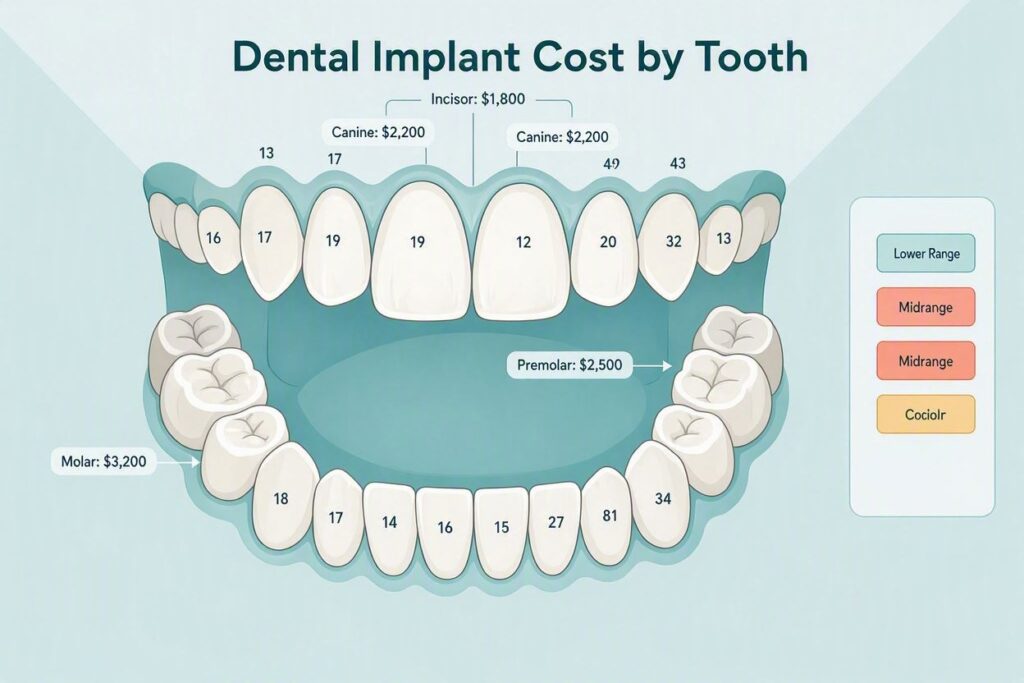
Let’s break down the average costs for different teeth. These prices include the implant fixture, abutment, and crown.
| Tooth Type | Average Cost (US) | Average Cost (UK) | Average Cost (Canada) |
|---|---|---|---|
| Front Tooth (Incisor) | $3,000 – $4,500 | £2,000 – £3,000 | CAD $3,000 – $4,500 |
| Canine | $3,000 – $4,500 | £2,000 – £3,000 | CAD $3,000 – $4,500 |
| Premolar | $3,500 – $5,000 | £2,200 – £3,500 | CAD $3,500 – $5,000 |
| Molar | $4,000 – $6,000 | £2,500 – £4,000 | CAD $4,000 – $5,500 |
| Multiple Adjacent Teeth | $6,000 – $12,000 | £4,000 – £8,000 | CAD $6,000 – $11,000 |
| Full Arch (All-on-4) | $20,000 – $30,000 | £15,000 – £25,000 | CAD $20,000 – $28,000 |
Note: These prices are for standard cases. Complex cases with bone grafting, sinus lifts, or extractions cost more.
Front Teeth vs. Back Teeth: What’s the Difference?
The biggest cost difference is between front teeth and back teeth. Let’s explore why.
Front Teeth (Incisors and Canines)
Front teeth are the most visible. They’re what people see when you smile. That means the crown must look perfect. It must match the color, shape, and translucency of your natural teeth. The gum line must be even and natural.
Challenges:
- High aesthetic demands
- Thinner bone, especially in the upper jaw
- Often requires bone grafting
- Crown must match adjacent teeth perfectly
Typical cost: $3,000 – $4,500
Why it’s less expensive than molars: The implant itself is smaller. The crown is smaller. The surgery is less complex because front teeth are easier to access.
Back Teeth (Premolars and Molars)
Back teeth do the heavy lifting. They grind and crush food. They bear more force than front teeth. That means the implant and crown must be stronger and more durable.
Challenges:
- Harder to access
- Close to sinuses (upper) and nerves (lower)
- May require sinus lift or bone grafting
- Crown must withstand heavy chewing forces
- Larger implant and crown
Typical cost: $4,000 – $6,000
Why it’s more expensive: The implant is larger. The crown is larger and made of stronger materials. The surgery is more complex. Sinus lifts and bone grafts are more common.
Upper Jaw vs. Lower Jaw: Does It Matter?
Yes, it does. The upper and lower jaws have different anatomy, and that affects implant costs.
Upper Jaw (Maxilla)
The upper jaw is less dense than the lower jaw. The bone is softer and thinner. This makes implants harder to place securely. The upper back teeth are also close to the maxillary sinus. If the sinus is large or the bone is thin, a sinus lift is needed.
Sinus lift cost: $1,500 – $4,000
Typical upper jaw implant cost: $4,000 – $6,000 (including sinus lift if needed)
Lower Jaw (Mandible)
The lower jaw is denser and thicker. Implants hold better. But the lower back teeth are close to the inferior alveolar nerve. If the implant is placed too close, it can cause numbness or pain. Careful planning with CT scans is essential.
Nerve repositioning cost: $2,000 – $5,000 (rare)
Typical lower jaw implant cost: $3,500 – $5,500
Note: Lower jaw implants are often slightly cheaper because bone grafting and sinus lifts are less common. But nerve proximity adds complexity.
The Role of Bone Grafting in Implant Costs
Bone grafting is a procedure that adds bone to your jaw. It’s needed when there isn’t enough bone to support an implant. This is common after tooth loss, gum disease, or trauma.
When Is Bone Grafting Needed?
- Front upper teeth: Often needed because the bone is thin.
- Back upper teeth: Often needed because of sinus proximity.
- Back lower teeth: Sometimes needed after extractions.
- Front lower teeth: Less commonly needed.
Types of Bone Grafts
| Graft Type | Source | Cost |
|---|---|---|
| Autograft | Your own bone | $1,000 – $3,000 |
| Allograft | Donor bone | $500 – $2,000 |
| Xenograft | Animal bone | $500 – $1,500 |
| Synthetic | Lab-made material | $400 – $1,200 |
Note: The cost of bone grafting is in addition to the implant cost. It can add $500 to $3,000 to the total.
Sinus Lifts: An Extra Cost for Upper Back Teeth
If you’re missing an upper molar or premolar, you may need a sinus lift. This procedure adds bone to the upper jaw so it can support an implant.
What Is a Sinus Lift?
The maxillary sinus is a hollow space above your upper back teeth. When you lose a tooth, the sinus can expand downward, leaving less bone for an implant. A sinus lift gently raises the sinus membrane and adds bone graft material.
Types of Sinus Lifts
| Type | Description | Cost |
|---|---|---|
| Internal (Closed) | Less invasive, done through the implant site | $1,000 – $2,000 |
| External (Open) | More invasive, done through a side window | $2,000 – $4,000 |
Note: Sinus lifts are most common for upper molars and premolars. Front teeth rarely need them.
Aesthetic Considerations for Front Teeth
Front tooth implants are more than just functional. They’re cosmetic. The crown must match your natural teeth perfectly. The gum line must look natural. This requires:
- Custom shading: The crown is made to match your adjacent teeth.
- Gum contouring: Sometimes the gum needs to be reshaped.
- Temporary crown: You’ll wear a temporary while the implant heals.
- Extra visits: More appointments for adjustments and fittings.
These factors add to the cost. But for most people, it’s worth it. A mismatched front tooth is noticeable. A well-made implant is invisible.
Molars: The Workhorses of Your Mouth
Molars bear the brunt of your chewing forces. They need strong, durable implants and crowns.
Why Molars Cost More
- Larger implant: Molars are bigger, so the implant is wider and longer.
- Stronger crown: Molar crowns are often made of zirconia or metal-ceramic for durability.
- Harder to access: The back of your mouth is harder to reach.
- More force: The crown must withstand up to 200 pounds of pressure.
- Bone quality: The bone in the back of the mouth may be less dense.
Crown Materials for Molars
| Material | Cost | Durability |
|---|---|---|
| Porcelain-Fused-to-Metal | $500 – $1,500 | Good |
| Zirconia | $800 – $2,000 | Excellent |
| Full Metal | $400 – $1,000 | Excellent (but visible) |
Note: Zirconia is the most popular choice for molars. It’s strong, durable, and looks natural.
Premolars: The Middle Ground
Premolars are between the front teeth and molars. They’re used for tearing and crushing food. They’re less visible than front teeth but more visible than molars.
Typical cost: $3,500 – $5,000
Considerations:
- Moderate aesthetic demands
- Moderate chewing forces
- Easier to access than molars
- Sometimes need bone grafting
Multiple Adjacent Teeth: Cost Considerations
If you’re missing several teeth in a row, you have options.
Individual Implants
Each missing tooth gets its own implant. This is the most expensive option but offers the best function and aesthetics.
Cost: $3,000 – $6,000 per tooth
Implant-Supported Bridge
Two implants support a bridge that replaces three or more teeth. This is more affordable than individual implants.
Cost: $6,000 – $12,000 for the bridge
All-on-4 or All-on-6
Four or six implants support a full arch of teeth. This is for people missing all or most of their teeth.
Cost: $20,000 – $30,000 per arch
Cost Comparison Table: Implants by Tooth Position
| Tooth Position | Implant Size | Crown Type | Average Cost |
|---|---|---|---|
| Upper Front | Small | Aesthetic | $3,000 – $4,500 |
| Lower Front | Small | Aesthetic | $3,000 – $4,500 |
| Upper Canine | Small | Aesthetic | $3,000 – $4,500 |
| Lower Canine | Small | Aesthetic | $3,000 – $4,500 |
| Upper Premolar | Medium | Moderate | $3,500 – $5,000 |
| Lower Premolar | Medium | Moderate | $3,500 – $5,000 |
| Upper Molar | Large | Durable | $4,500 – $6,000 |
| Lower Molar | Large | Durable | $4,000 – $5,500 |
Note: Upper molars are often the most expensive because of sinus lift requirements.
What About Wisdom Teeth?
Wisdom teeth are the third molars. They’re usually extracted, not replaced. But if you’re missing a wisdom tooth and want to replace it (rare), the cost would be similar to a molar implant.
Note: Most dentists don’t recommend replacing wisdom teeth with implants unless there’s a specific reason.
Does the Number of Roots Matter?
Natural teeth have different numbers of roots. Front teeth have one root. Premolars have one or two. Molars have two or three. But implants are artificial—they don’t have roots in the same way.
The number of roots in the natural tooth doesn’t directly affect implant cost. However, extracting a multi-rooted tooth is more complex than extracting a single-rooted tooth. That extraction cost is separate from the implant cost.
Extraction cost:
- Single-rooted tooth: $75 – $200
- Multi-rooted tooth: $150 – $400
- Surgical extraction: $200 – $650
Hidden Costs That Vary by Tooth
Some costs are more common for certain teeth.
Upper Front Teeth
- Bone grafting: More common because the bone is thin.
- Gum contouring: Often needed for aesthetics.
- Temporary crown: Essential for appearance.
Upper Back Teeth
- Sinus lift: Often needed.
- Bone grafting: Common.
- CT scan: Essential for planning.
Lower Back Teeth
- Nerve proximity: May require additional imaging.
- Bone grafting: Sometimes needed.
- Larger crown: More material costs.
Does Insurance Cover Implants Differently by Tooth?
Insurance coverage for implants varies by plan, not by tooth. Most plans either cover implants or they don’t. The tooth position doesn’t usually change coverage.
However, some plans may consider front tooth implants as “cosmetic” and exclude them. Others may cover them if they’re medically necessary. Always check your policy.
Tip: Ask your insurance company:
- Are implants covered?
- Is there a difference between front and back teeth?
- What is my annual maximum?
- Do I need pre-authorization?
How to Save Money on Dental Implants
Regardless of which tooth you’re replacing, there are ways to reduce costs.
Get Multiple Quotes
Prices vary widely. Get at least three quotes from different dentists or oral surgeons.
Visit a Dental School
Dental schools offer implant treatment at 30% to 50% off. Students work under supervision.
Ask About Payment Plans
Most clinics offer interest-free plans. You might pay $200 to $400 per month.
Use HSA or FSA Funds
These accounts let you pay with pre-tax dollars, saving you 20% to 30%.
Consider Medical Tourism
Countries like Mexico, Costa Rica, and Thailand offer implants at a fraction of U.S. prices. But do your research.
Look for Discounts
Some clinics offer discounts for:
- Paying in full upfront
- Multiple implants
- Seniors or veterans
- Referrals
Choose a General Dentist for Simple Cases
For straightforward implants, a general dentist may charge less than an oral surgeon.
Real Quotes from Real Patients
“I paid $4,500 for a front tooth implant in New York. The crown was custom-shaded to match my other teeth. It looks perfect.” — Michael T., New York, NY
“My upper molar implant cost $5,800 because I needed a sinus lift. The implant itself was $4,000, and the sinus lift was $1,800.” — Sarah L., Austin, TX
“I had two lower molars replaced with implants in Spain. Each cost €2,200. The same treatment in the UK would have been £3,500 per implant.” — James T., Madrid, Spain
“I went to a dental school in Toronto for a front tooth implant. It cost CAD $2,800. It took longer, but I saved almost $2,000.” — Priya K., Toronto, Canada
These stories show that costs vary by tooth, location, and provider. With research, you can find affordable options.
Frequently Asked Questions About Implant Costs by Tooth
Does the cost of a dental implant depend on the tooth?
Yes. Front teeth are usually cheaper because they’re smaller and easier to access. Molars cost more because they’re larger and harder to reach.
Why are molar implants more expensive?
Molars are larger, bear more force, and are harder to access. They may also require sinus lifts or bone grafting.
Are front tooth implants cheaper?
Yes, usually. Front teeth are smaller, easier to access, and don’t require sinus lifts. However, they have higher aesthetic demands.
Do upper jaw implants cost more than lower jaw implants?
Often, yes. Upper jaw implants may require sinus lifts, which add to the cost.
Is bone grafting always needed?
No. But it’s more common for upper front teeth and upper back teeth.
How much does a sinus lift cost?
A sinus lift costs $1,000 to $4,000, depending on the type and complexity.
Does insurance cover implants for front teeth?
Coverage varies by plan. Some plans consider front tooth implants cosmetic. Check your policy.
Can I get a dental implant for a wisdom tooth?
You can, but it’s rare. Most dentists don’t recommend replacing wisdom teeth.
Are implant costs different for premolars?
Premolars are in the middle. They cost more than front teeth but less than molars.
How can I save money on a molar implant?
Get multiple quotes, visit a dental school, use HSA/FSA funds, and ask about payment plans.
Conclusion: Yes, the Tooth Matters
The cost of a dental implant does depend on the tooth. Front teeth are usually cheaper because they’re smaller and easier to access. Molars cost more because they’re larger, harder to reach, and may require sinus lifts or bone grafting. Upper jaw implants often cost more than lower jaw implants. Understanding these differences helps you plan and budget for your treatment.
Additional Resources
For more information on dental implants and finding a qualified provider, visit the American Academy of Implant Dentistry at aaid.com or the Association of Dental Implantology at adi.org.uk.