Why Are Dental Implants Cheaper Abroad?
The search for affordable dental care has gone global. Every year, hundreds of thousands of people from the United States, Canada, the UK, and Australia pack their bags and travel to countries like Mexico, Costa Rica, Hungary, and Thailand for dental work. The reason is simple: the price. A dental implant that costs $4,000 in New York might cost $1,000 in Tijuana. A full set of veneers that costs $30,000 in London might cost $10,000 in Istanbul.
This massive price difference is the driving force behind the phenomenon known as “dental tourism.” But it leads to an important question: why is there such a dramatic difference in cost? Is the care abroad inferior, or is something else going on?
This guide will break down the economic and structural reasons why dental implants are cheaper abroad. Understanding these factors is essential for anyone considering traveling for dental care. It will help you weigh the potential savings against the potential risks.
The Cost of Doing Business: Overhead Disparities
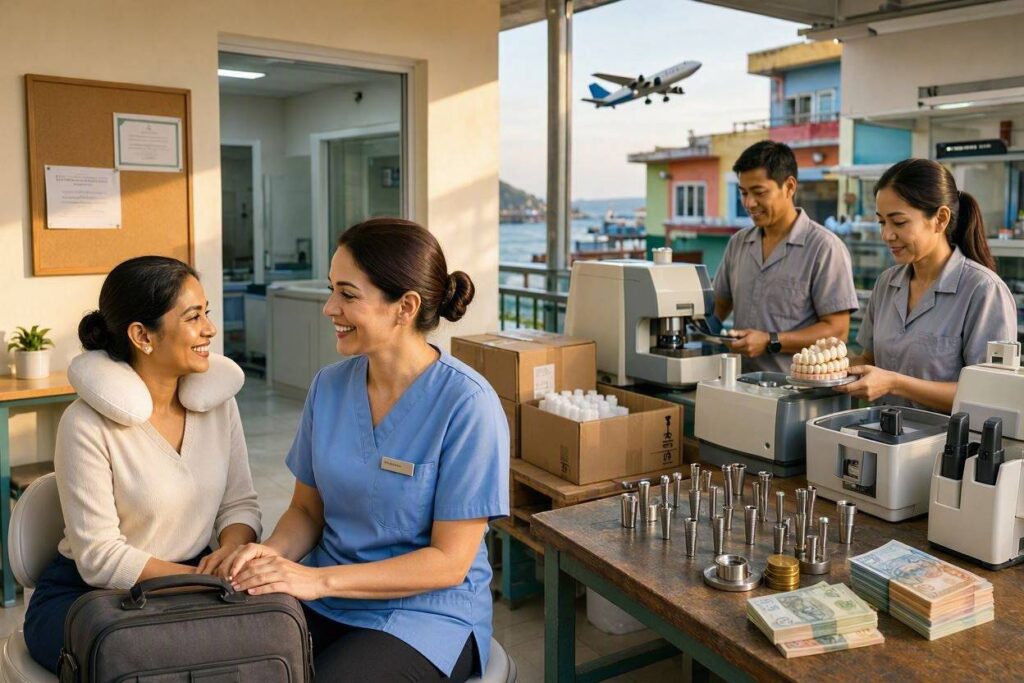
The most significant factor is the cost of running a dental practice. A dental clinic in the United States or Western Europe operates under a massive financial burden that clinics in other countries do not share.
1. Commercial Rent and Real Estate
A dental office in Manhattan, central London, or downtown San Francisco pays an astronomical amount of money for rent every month. This rent is a fixed cost that must be covered by the fees charged to patients. A dental clinic in Costa Rica or Hungary operates in a building where rent is a fraction of the cost. These savings are passed on to the patient.
2. Staff Salaries
Dental assistants, hygienists, and front desk staff in the US and Europe command high wages. In many dental tourism destinations, the cost of living is lower, and therefore, the wages for the same skilled labor are significantly lower. This is not a reflection of skill; it is a reflection of the local economy.
3. Malpractice Insurance
In the US, a dentist or oral surgeon pays tens of thousands of dollars a year for professional liability insurance. This is a huge burden. In many other countries, malpractice insurance is either much cheaper or does not play as dominant a role in the practice’s finances. This single line item can add hundreds of dollars to the cost of every procedure performed in the US.
4. Regulatory Compliance
The US and EU have incredibly strict (and expensive) regulations regarding medical waste disposal, sterilization, and facility accreditation. While these regulations ensure safety, they also add to the cost. Clinics in developing countries may not face the same financial burden for compliance, though top-tier clinics often follow the same international safety standards voluntarily.
The Cost of Education: The Student Debt Factor
This is a uniquely American problem. As discussed in previous articles, a dentist in the US often graduates with $300,000 to $500,000 in student loan debt.
A dentist in Mexico, Costa Rica, or Europe often graduates with little to no debt. Their education was heavily subsidized by the government or was simply much cheaper to obtain.
This staggering difference in debt means that an American dentist must charge high fees just to service their student loans and still make a living. A dentist abroad, free from this debt, can afford to charge much less for the same quality of work.
The Cost of Materials and Lab Work
The titanium posts and porcelain crowns used for dental implants are manufactured by global companies (like Straumann, Nobel Biocare, and Dentsply Sirona). These materials cost roughly the same everywhere in the world.
However, the dental laboratory work is where the savings are found. When you get a crown in the US, it is often made in a local lab by a technician who commands a high salary. In a dental tourism destination, the crown is often made in a local lab where the technician’s wages are lower. The quality of the lab work can be just as high, but the cost is not.
The Price of “Free Market” Healthcare
The US healthcare system (including dentistry) is a complex web of private insurance companies, government programs, and uninsured patients. This system creates price distortion.
As mentioned earlier, dentists who contract with insurance companies must offer deep discounts to be “in-network.” To make up for this lost revenue, they inflate their “list” prices. This means the uninsured patient (the one paying cash) often faces the highest possible price.
In countries that are popular for dental tourism, the system is simpler. The dentist sets a fair market price for their service. The patient pays that price directly. There is no insurance middleman inflating the bill. This transparency leads to lower prices.
Is Cheaper Care Abroad Lower Quality?
This is the central question for anyone considering dental tourism. The answer is: it depends entirely on the clinic.
It is a myth that all dental care abroad is inferior. There are world-class dental clinics in Mexico, Costa Rica, and Hungary that rival any clinic in Beverly Hills or Harley Street. These clinics are modern, spotless, and staffed by highly trained dentists who use the same materials and technology as their counterparts in the US and Europe.
However, there are also low-quality clinics that cut corners. The lack of strict regulatory oversight in some countries means that it is easier for a substandard clinic to operate.
The savings are not because the dentist is worse. They are because the system is cheaper. A top-tier dentist in Costa Rica has the same skills as a top-tier dentist in the US, but their overhead is a fraction of the cost.
The Risks of Dental Tourism (The Hidden Costs)
While the upfront savings are attractive, there are risks that must be considered. These risks can potentially turn a “cheap” implant into a very expensive one.
1. Follow-Up Care
An implant is a process, not a single appointment. It requires months of healing and multiple checkups. If you travel abroad for the surgery, you will have to fly home to heal. Your local dentist will not be familiar with the work done abroad. If there is a complication (like an infection or a failed implant), your local dentist may be hesitant to fix another dentist’s work. You may have to pay out-of-pocket for a new dentist to correct the problem, or you may have to fly back to the original clinic.
2. Language Barriers
While many top dental tourism clinics have English-speaking staff, communication can still be a challenge. Misunderstandings about your medical history or your treatment plan can lead to problems.
3. Recourse and Liability
If a dentist in the US botches a procedure, you can sue for malpractice. The legal system provides a remedy. If a dentist in a foreign country makes a mistake, you have very little legal recourse. Proving negligence across international borders is extremely difficult and expensive.
4. The “Single Visit” Illusion
Some clinics advertise “implants in one day” or “one-week smile makeovers.” While these techniques exist, they are not suitable for all patients. Rushing the process can increase the risk of failure. A proper implant needs time to heal (osseointegration).
How to Evaluate a Clinic Abroad
If you are considering traveling for a cheaper implant, do your homework.
- Look for International Accreditations: The gold standard is JCI (Joint Commission International) accreditation. This means the clinic meets rigorous international healthcare standards.
- Research the Dentist’s Credentials: Where did they train? Are they a member of an international body like the International Congress of Oral Implantologists (ICOI)?
- Read Reviews: Look for independent reviews on platforms like Google, Trustpilot, and specialized dental tourism forums.
- Ask About Materials: A reputable clinic will proudly tell you they use Straumann or Nobel Biocare implants. If they use a no-name brand you cannot verify, be wary.
- Plan for Two Trips: The safest approach is two trips: one for the surgery, and one 3-6 months later for the final crown. This allows for proper healing.
Conclusion
Dental implants are cheaper abroad because the cost of running a business, the burden of student debt, and the insurance middleman are all significantly lower in those countries. The quality of the materials and the skills of the dentist can be equal to what you find at home. However, the savings are not without risk. The lack of follow-up care and legal recourse can be costly. If you choose to go abroad, you must be a meticulous researcher and choose a clinic with verifiable international credentials.
Frequently Asked Questions (FAQ)
Q: How much can I save by getting a dental implant abroad?
A: The savings can be dramatic, often 50% to 70%. A full implant (surgery, abutment, and crown) that costs $4,000 to $6,000 in the US can often be had for $1,200 to $2,000 in a top-tier clinic in Mexico or Costa Rica.
Q: What are the best countries for dental implants?
A: Popular and reputable destinations include Mexico (for US and Canadian patients), Costa Rica, Hungary (for European patients), Thailand, and South Korea. The “best” country depends on where you are traveling from and the clinic itself.
Q: Is it safe to get a dental implant in Mexico?
A: It can be, but you must choose the right clinic. The border towns (like Los Algodones and Tijuana) have a huge dental tourism industry. There are excellent clinics and poor ones. Stick to clinics with strong reviews, modern technology, and accredited dentists.
Q: Will my US dentist fix a problem caused by a dentist abroad?
A: This is a major risk. Many US dentists are reluctant to treat complications from dental work done abroad. They may not know the exact implant system used, and they may be concerned about liability. You must be prepared to pay out-of-pocket for any repairs.
Q: Why is the price of a crown so high in the US when the lab fee is low?
A: The price is not just the lab fee. It includes the dentist’s time, their education, their overhead costs (rent, staff, insurance), and a profit margin. The lab fee is just one component. High student debt and high insurance costs in the US drive the professional fee up significantly.
Additional Resource:
To research dental tourism destinations and connect with clinics, you can explore the resources provided by Patients Beyond Borders: https://www.patientsbeyondborders.com/