How Invasive Is A Dental Implant?
The word “surgery” can trigger anxiety. When you hear that dental implants require a surgical procedure, it is natural to feel a wave of apprehension. You might imagine a dramatic operation in a hospital operating room with a long, painful recovery. This perception of invasiveness is a major reason why some people delay or avoid getting the dental care they need.
The reality of dental implant surgery is often surprising. For a single, straightforward implant, the procedure is remarkably minor. It is typically performed in a dental office, not a hospital. It is usually faster and less traumatic than many other common dental procedures, such as a tooth extraction.
This guide will demystify the process of dental implant surgery. We will explain exactly what “invasive” means in this context, walk you through the steps of the procedure, and compare it to other dental treatments you might be more familiar with.
Defining “Invasive” in Dentistry
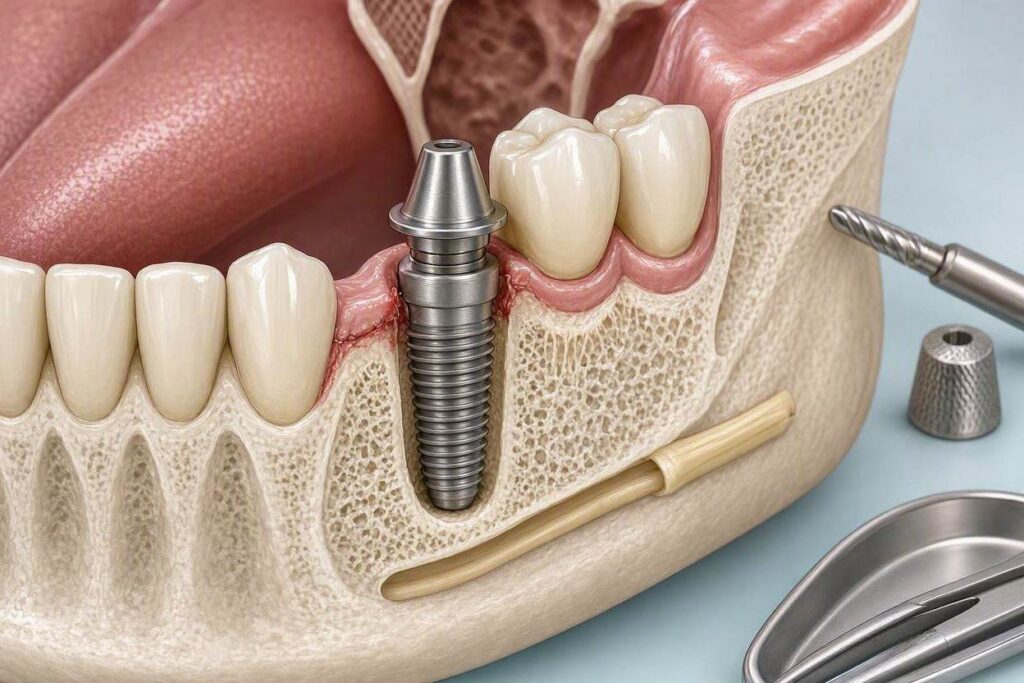
In medical terms, a procedure is considered “invasive” if it involves making a cut (incision) in the body or inserting a medical device. By this strict definition, a dental implant is an invasive procedure. It involves an incision in the gum and the placement of a titanium post into the bone.
However, invasiveness is a spectrum. It is helpful to compare a dental implant to other surgical procedures.
- Minimally Invasive: A small cut, little trauma, quick recovery. Think of a mole removal or a dental filling (which is technically invasive because it involves drilling).
- Moderately Invasive: A larger cut, more tissue manipulation, a few days of downtime. This is where most single dental implants fall.
- Highly Invasive: Major surgery, general anesthesia, significant blood loss, weeks of recovery. Think of a hip replacement or open-heart surgery.
When compared to major medical surgery, a single dental implant is a relatively minor, minimally invasive procedure.
The Step-by-Step Process: What Actually Happens
Understanding the mechanics of the surgery can dispel a lot of fear. Here is what a standard, single-tooth implant placement looks like.
1. Anesthesia
The area is completely numbed with local anesthetic. You will not feel any pain. If you have chosen sedation, this is administered as well.
2. The Incision
The surgeon makes a small incision in the gum to expose the underlying bone. For a “flapless” procedure (which is increasingly common), a small “punch” may be used instead of a large incision, resulting in even less trauma.
3. Drilling the Osteotomy
This is the core of the procedure. The surgeon uses a series of precisely sized drills to create a hole (called an osteotomy) in the jawbone. The drills are used sequentially, from small to large, to gradually widen the hole to the exact diameter of the implant. This is a controlled, gentle process. The bone is not “smashed” or “broken.” It is meticulously prepared.
4. Placing the Implant
The titanium implant fixture is carefully screwed into the prepared hole. The surgeon checks to ensure it is stable and in the correct position.
5. Placing the Healing Cap or Cover Screw
A small cap is placed on top of the implant to protect it during the healing phase.
6. Suturing
The gum is stitched closed over the implant. The stitches may be dissolvable or may need to be removed in a week or two.
The entire procedure for a single implant typically takes 30 to 60 minutes. That is it.
The “Invasiveness” of the Recovery
The post-operative experience is often the part that worries people the most. Here is what to expect.
- Bleeding: There will be some minor bleeding or oozing for the first day. This is normal.
- Swelling: Some swelling is expected. It peaks around day 2 or 3 and then subsides. Applying an ice pack to the cheek helps.
- Pain: The pain is usually manageable with over-the-counter medications like Ibuprofen. It is often described as less painful than a tooth extraction.
- Diet: You will need to eat soft foods for a few days to a week.
Downtime: Most people can return to work the next day. You should avoid strenuous exercise for a few days.
Comparing the Invasiveness to Other Procedures
To put it in perspective, let’s compare a single implant to a tooth extraction.
| Feature | Tooth Extraction | Single Dental Implant |
|---|---|---|
| Anesthesia | Local | Local |
| Trauma to Tissue | High (ripping and tearing of ligaments) | Low to Moderate (precise drilling) |
| Post-Op Pain | Often moderate to high | Usually mild to moderate |
| Recovery Time | 1-2 weeks for full socket healing | 3-6 months for bone integration (but functional recovery is faster) |
Many patients who have had both procedures report that the implant was easier to recover from. The extraction is a more violent event, while the implant is more controlled.
When is an Implant More Invasive?
It is important to be honest. Not all implant cases are simple. The invasiveness of the procedure increases with the complexity of the case.
More invasive scenarios include:
- Bone Grafting: If you need a bone graft before or during the implant placement, the surgery is more involved. The surgeon must harvest bone (from your own body or use donor material) and place it in the defect. This means more incisions and more suturing.
- Sinus Lifts: For implants in the upper back jaw, a sinus lift may be needed. This involves lifting the sinus membrane and placing bone beneath it. This is a more delicate procedure.
- Multiple Implants: Placing 4-6 implants for a full-arch restoration is a longer, more complex surgery.
For these cases, the surgeon may recommend stronger sedation (like IV sedation), and the recovery will be more substantial.
The “Hidden” Invasiveness: The Time Commitment
While the surgery itself is not highly invasive, the overall treatment time is long. This is a different kind of “invasiveness” that patients must be prepared for.
The process is not a one-and-done visit.
- Surgery (Day 1).
- Healing (3-6 months of waiting).
- Abutment placement (minor procedure).
- Crown placement (1-2 appointments).
You are committing to a process that takes several months from start to finish. This is not due to pain or difficulty, but due to the biology of bone healing. It takes time for the bone to fuse to the titanium.
Conclusion
A single dental implant is a surgical procedure, but it is a minimally invasive one. It is a far cry from the major, dramatic surgery that many people imagine. The procedure is quick, performed under local anesthesia, and involves less trauma than a tooth extraction. The main “invasiveness” of the implant process is the time required for healing, not the surgery itself. Understanding this reality can help you overcome the fear and move forward with the best solution for your missing tooth.
Frequently Asked Questions (FAQ)
Q: Is a dental implant more invasive than a root canal?
A: Yes. A root canal is performed entirely inside the tooth and does not involve cutting the gum or drilling into the bone. An implant is a surgical procedure that does involve the gum and bone. However, both are performed with local anesthesia and are well-tolerated by patients.
Q: Will I need general anesthesia for a dental implant?
A: No. General anesthesia is rarely needed for a single implant. Local anesthesia is sufficient to eliminate pain. Sedation (like IV sedation) is an option for relaxation, but you are not fully unconscious.
Q: How long does the surgery take for one implant?
A: For a straightforward case, the surgical placement takes about 30 to 60 minutes. This includes the time for the anesthesia to take effect and the suturing.
Q: Can I drive myself home after the surgery?
A: If you only had local anesthesia, yes, you can drive yourself home. If you had oral or IV sedation, you must have a driver.
Q: Is there a lot of bleeding during implant surgery?
A: No. The surgeon works in a controlled area. The bleeding is minimal and is managed with suction. After the procedure, you will have some minor oozing for the first 24 hours.
Additional Resource:
To see an animated video of the implant process, you can visit the patient education section of the American Association of Oral and Maxillofacial Surgeons (AAOMS): https://myoms.org/