Can Someone With Dentures Get Implants?
Millions of people wear dentures. For many, they are a source of frustration. The slipping, the clicking, the inability to eat certain foods—it takes a toll on quality of life. Many denture wearers assume that their fate is sealed. They believe that once you have dentures, you are stuck with them forever.
This is a myth. The reality is that people with dentures are excellent candidates for dental implants. In fact, this is one of the most common and transformative applications of implant technology.
Whether you have been wearing dentures for five months or fifty years, you may be able to upgrade to the stability and comfort of implant-supported teeth. This guide will explore the options available to denture wearers, the challenges of transitioning, and what you can expect from the process.
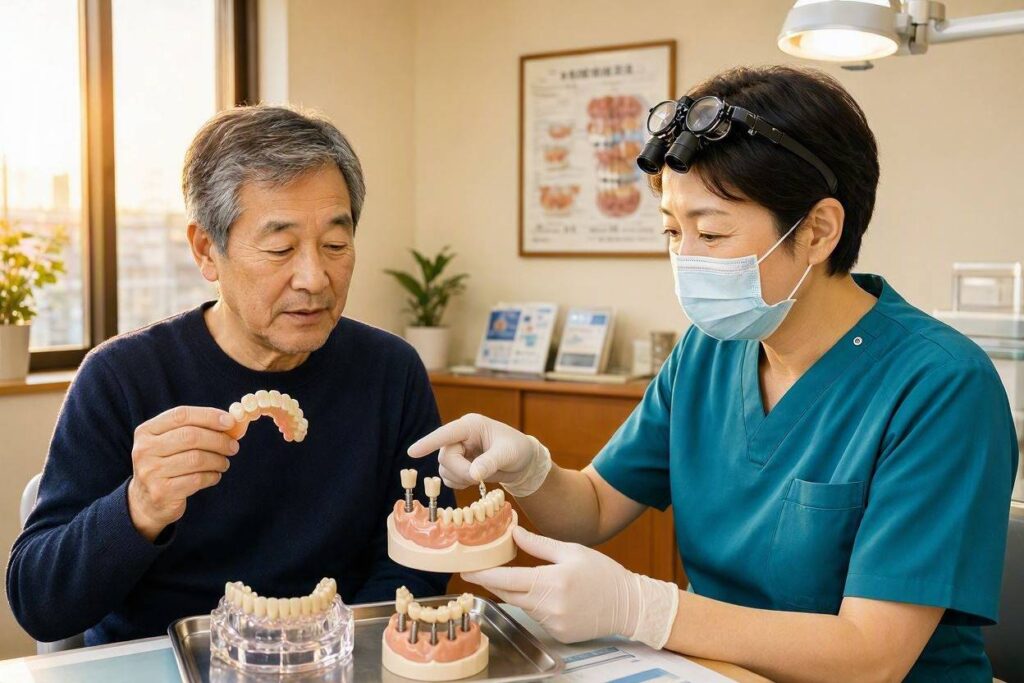
The Challenge: Bone Loss from Denture Wear
The biggest hurdle for a long-time denture wearer is not the denture itself; it is the bone underneath it.
As we have discussed, when teeth are lost, the jawbone begins to resorb (shrink). The roots of the teeth are no longer there to stimulate the bone. A traditional denture rests on the gums and does not stimulate the bone. In fact, the pressure of a denture can actually accelerate bone loss over time.
This leads to a common problem: a denture wearer may not have enough bone left to support a standard dental implant.
- The longer you have worn dentures, the more bone you have likely lost.
- The lower jaw is often affected more severely than the upper jaw.
However, this does not mean you are out of options. It means you may need a preliminary procedure to rebuild the bone.
The Solution: Bone Grafting
A bone graft is a surgical procedure that adds bone material to a deficient area of the jaw. This new bone acts as a scaffold, encouraging your body to grow new bone cells and rebuild the lost volume.
For a denture wearer, a bone graft may be necessary before the implant can be placed. This adds time and cost to the treatment, but it makes the implant possible. In some cases, specially designed short implants can be used to avoid the need for a graft.
Option 1: The “Snap-On” Denture (Implant-Retained Overdenture)
This is the most popular and affordable option for denture wearers.
- How it works: As few as two dental implants (for the lower jaw) or four implants (for the upper jaw) are placed strategically in the jawbone. These implants are fitted with special attachments (like Locators). Your denture is then modified (or a new one is made) with corresponding sockets on its underside. The denture “snaps” onto the implants.
- The Benefits: The denture is held firmly in place. It will not slip or rock. You can eat a much wider variety of foods. You remove the denture at night for cleaning.
- The Cost: This is significantly cheaper than a fixed bridge (like All-on-4).
Option 2: Fixed Bridge (All-on-4 or All-on-6)
This is the premium option for denture wearers who want a permanent, non-removable solution.
- How it works: Four to six implants are placed in the jawbone. A full arch of beautiful, fixed teeth is permanently attached to these implants. You cannot remove them. They function and feel like natural teeth.
- The Benefits: Maximum stability. No need to remove them. They look and feel the most natural.
- The Cost: This is a major investment, typically $20,000 to $40,000 per arch.
The Transition Process: What to Expect
If you decide to make the switch from dentures to implants, here is a general overview of the journey.
1. Consultation and Evaluation
You will see a dentist or oral surgeon. They will take a 3D X-ray (CBCT scan) to evaluate the quality and quantity of your jawbone. This is the most important step. It determines if you need a bone graft.
2. Planning
The dentist will design your treatment plan. This will outline the number of implants needed, the type of restoration (snap-on denture or fixed bridge), the timeline, and the cost.
3. Bone Grafting (If Needed)
If your bone is insufficient, a graft will be performed. This adds 3-6 months to the timeline.
4. Implant Placement
The implants are surgically placed.
5. Healing Period
You must wait 3-6 months for the bone to fuse to the implants. During this time, you will continue to wear your old denture (often modified with a soft liner to protect the implants).
6. Final Restoration
The new denture or fixed bridge is fabricated and attached to the implants.
The Benefit: Reversing the Damage
Getting implants after years of denture wear is not just about convenience; it is about health. Once the implants are placed, they begin to stimulate the jawbone. This stops the resorption process. The bone is preserved. For many patients, the implants even help to restore some of the facial structure that had been lost, reducing the sunken-in look that often accompanies long-term denture wear.
Is It Ever Too Late?
The simple answer is no. Even if you have been wearing dentures for decades and have significant bone loss, there are advanced techniques to help you.
- Zygomatic Implants: These are very long implants that anchor into the cheekbone (zygoma) instead of the jawbone. They are used for patients with severe bone loss in the upper jaw who are not candidates for bone grafting.
- Nerve Repositioning: In the lower jaw, the nerve can sometimes be surgically moved to allow for implant placement in areas with limited bone height.
These are complex procedures, but they are available.
Conclusion
The transition from dentures to implants is a life-changing journey. The belief that denture wearers cannot get implants is false. While long-term denture wear often leads to bone loss, procedures like bone grafting and advanced implant designs have made it possible for almost anyone to enjoy the stability and comfort of implant-supported teeth. The key is to find a skilled dental professional who can evaluate your unique situation and guide you through the process.
Frequently Asked Questions (FAQ)
Q: Can I use my existing denture with new implants?
A: Sometimes. If your current denture is relatively new and in good condition, it can often be retrofitted to snap onto the implants. This saves you the cost of a new denture. If the denture is old or worn, a new one is recommended.
Q: How many implants do I need to stabilize my lower denture?
A: The standard minimum is two implants for a lower denture. These are placed in the front of the jaw. More implants (3 or 4) can provide even greater stability.
Q: Will I still have to use denture adhesive with implant-supported dentures?
A: No. The implants provide the retention. You will not need any adhesive or glue to keep the denture in place.
Q: Is the surgery more difficult for a denture wearer?
A: The surgery itself is similar. The main difference is the planning. The dentist must work around the limitations of the existing bone. If a bone graft is needed, the overall treatment is more involved.
Q: Can I get implants if I have a gag reflex?
A: Yes. This is a common reason people struggle with traditional dentures. A fixed bridge (All-on-4) is an excellent solution because it eliminates the need for a bulky denture that covers the palate.
Additional Resource:
To learn more about the All-on-4 treatment concept for denture wearers, you can visit the official All-on-4 website: https://www.allon4.com/