Are Implant Supported Dentures Worth It?
You are sitting in the dental chair. You have just been told that your remaining teeth are failing, or perhaps you have been struggling with a loose, uncomfortable traditional denture for years. The dentist begins to talk about “implant supported dentures.”
Then you see the price.
Your heart sinks. You think: “Is this really worth it? Is my quality of life really going to improve that much?”
This is one of the most significant financial and medical decisions you can make. It is natural to be skeptical. We are conditioned to be wary of expensive upgrades.
So, are implant supported dentures worth it? For the vast majority of patients who can afford them, the answer is a resounding yes. But “worth it” is subjective. It depends on your budget, your physical pain, your emotional state, and your expectations.
This guide will break down the true value of implant supported dentures. We will look beyond the marketing gloss and examine the hard realities of living with and without them. We will help you decide if the investment justifies the outcome.
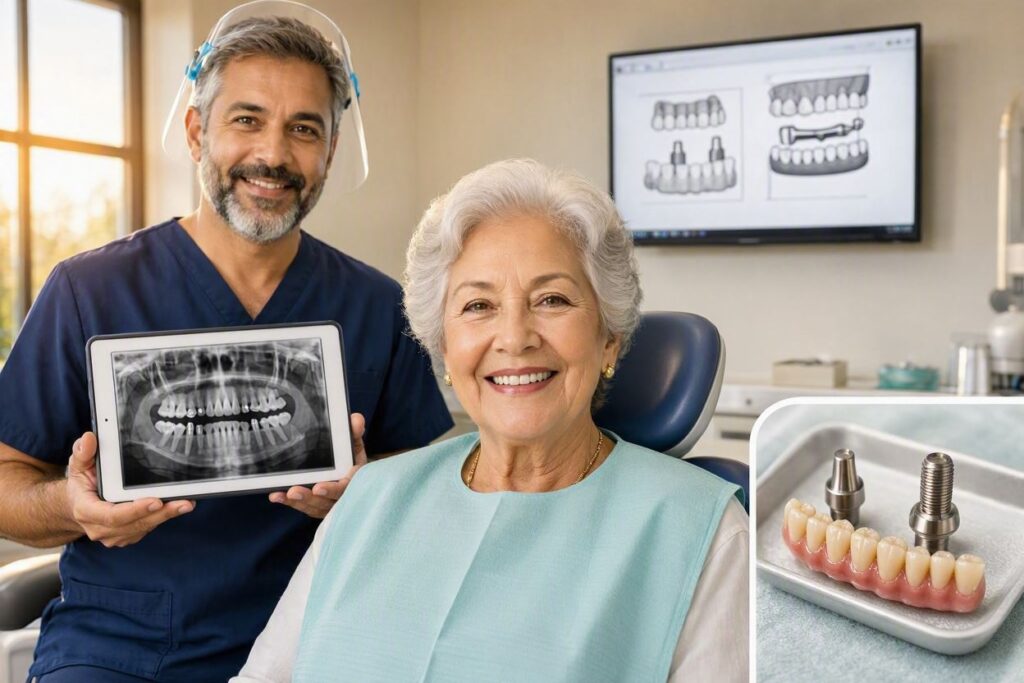
The “Hidden Costs” of Traditional Dentures
To understand if implants are worth it, you have to understand the true cost of not getting them. A traditional denture might cost $1,500. It seems cheap. But the financial and physical costs over a lifetime paint a very different picture.
The Physical Toll: Bone Loss
When teeth are removed, the body stops sending nutrients to the jawbone in that area. The body thinks the bone is no longer needed. It begins to reabsorb the bone.
This is called resorption. It is relentless.
What this means for you:
- Your jaw shrinks.
- Your chin moves closer to your nose.
- Your face collapses inward, giving you the “witch’s chin” or “sunken face” look associated with the elderly.
- Traditional dentures actually accelerate this process because they press down on the bone, restricting blood flow.
The Friction and Pain
A traditional lower denture floats on a sea of saliva and muscle. It is not anchored. Every time you chew, swallow, or talk, the denture moves. It rubs against your thin gum tissue.
The result:
- Chronic sore spots and ulcers.
- The need for sticky, unpleasant adhesives (which cost money every month).
- The embarrassment of a denture “popping” out of place.
The “Denture Diet”
You do not realize how much you love food until you cannot eat it.
- Corn on the cob? Impossible.
- A juicy steak? Difficult and exhausting.
- A crisp apple or raw carrots? Often too risky.
People with traditional dentures often silently give up these foods. They switch to soft, processed foods. This leads to poor nutrition, weight gain (from carbs), and a diminished joy in life. Meals become a chore, not a pleasure.
The Value Proposition: What You Actually Get
Now, let’s look at what the $15,000 to $30,000 actually buys you with an implant supported denture.
1. You Are Buying Your Jawbone Back
This is the medical reason. Implants are the only dental restoration that stops bone loss. The titanium post mimics a tooth root. When you chew, the force travels down the implant into the bone. The body interprets this as “work is being done here” and maintains the bone density.
You are not just buying teeth; you are buying the structural integrity of your face. You are preventing the premature aging that comes with dentures.
2. You Are Buying Bite Force
A study published in the Journal of Oral Rehabilitation found that patients with implant supported dentures have a bite force that is 300% to 500% greater than patients with traditional dentures.
With a traditional denture, you might bite with 5 to 10 pounds of pressure. With implants, you can bite with 30 to 50 pounds. This is the difference between mashing a banana and eating a crusty piece of bread.
3. You Are Buying “Mental Peace”
This is often overlooked by budget calculators. Imagine waking up in the morning and not having to worry about your teeth.
- You do not have to put glue in your mouth.
- You do not have to worry about a date or a business meeting where your teeth might slip.
- You do not have to hide your smile in photos.
Psychologists refer to “denture anxiety.” It is a real phenomenon where people withdraw from social life because they are terrified of their teeth failing them in public. Implant dentures remove this anxiety almost entirely. They feel like your teeth, not a foreign object.
The Cost Analysis: Long-Term Investment vs. Short-Term Savings
Critics of implant dentures often point to the high upfront cost. They are correct—it is a lot of money. But let’s do a comparative math breakdown over 20 years.
| Expense Category | Traditional Denture (Lower Arch) | Implant Supported Denture (Lower Arch) |
|---|---|---|
| Initial Cost | $1,500 | $18,000 |
| Adhesives (Paste/Pads) | $20/month ($4,800 over 20 yrs) | $0 |
| Relines (due to bone loss) | $300 every 2 years ($3,000) | $0 (No bone loss) |
| Replacement Dentures | Every 5-7 years ($4,500) | Potential replacement of bridge after 15 yrs ($4,000) |
| Nutritional Impact | High (processed foods, more illness) | Low (better diet, fewer GI issues) |
| Total Estimate | $13,800+ | $22,000 |
When you look at the maintenance, the gap narrows significantly. The traditional denture is a “cheap” product that you have to keep paying for. The implant denture is an expensive product that maintains its value.
Important Note: This table does not factor in the cost of pain, lost enjoyment of food, and social embarrassment. If you put a price tag on happiness, the traditional denture becomes the most expensive option by far.
When Are They NOT Worth It?
To be fair and realistic, we must admit that implant dentures are not the right choice for everyone. There are specific situations where the surgery is not worth the risk or the money.
1. Smokers
Smoking constricts blood vessels. It prevents the body from healing. The success rate for implants in heavy smokers drops dramatically. If you are a heavy smoker and refuse to quit, you are likely to lose the implants to infection. In this case, the money is wasted.
2. Uncontrolled Diabetics
Diabetes affects the immune system and the small blood vessels. If your blood sugar is constantly high, your gums will not heal, and the bone will not fuse to the implant. You are setting yourself up for failure. You must get your diabetes under control first.
3. Patients on Certain Medications
Some medications, particularly bisphosphonates (used to treat osteoporosis) and some cancer drugs, can cause a condition called osteonecrosis of the jaw (dead bone). If you are on these medications, the risk of the bone dying after surgery is too high. It is absolutely not worth it.
4. The “Cheap” Route
If you are going to a foreign country or a “discount” clinic to get implants placed by an inexperienced provider to save $5,000, it might not be worth it. Failed implants are a nightmare. You end up paying to have them removed, paying for bone grafts to repair the damage, and paying again to have them redone correctly. You pay twice for the same procedure.
The Emotional Return on Investment
We cannot ignore the psychological aspect. Dentists often report that after the final delivery of the implant denture, patients cry. They cry because they forgot what it felt like to have solid teeth.
Real-World Testimonials (Common Themes):
- “I ate a salad for the first time in 10 years.”
- “I laughed out loud without covering my mouth.”
- “My grandchildren saw me smile for the first time without me looking like I was in pain.”
- “I feel 20 years younger.”
These are not just platitudes. These are the reasons people pay the money. You cannot put a price on being able to kiss your spouse without taking your teeth out first. You cannot put a price on self-respect.
Making the Decision
If you are still on the fence, ask yourself these three questions:
- Can I afford the initial cost without going into financial ruin?
If the answer is yes, the decision is easy. - Am I willing to quit smoking and brush my teeth meticulously?
Implants are not “set and forget.” They require cleaning. If you are lazy about hygiene, the $20,000 investment will rot away. - What is my quality of life worth?
Imagine your next 10 years. Do you want to eat soup and mashed potatoes? Or do you want to eat steak and apples?
The Verdict
Are implant supported dentures worth it?
If you are a healthy candidate and you value your comfort, appearance, and nutrition, yes, they are worth every penny. They are a long-term investment in your health that pays dividends every single day.
They are not a luxury item. They are a functional prosthetic that restores a basic human function: eating. For those who have suffered the pain and embarrassment of traditional dentures, the cost of implants is a small price to pay for getting your life back.
Do not compare the cost of implants to the cost of dentures. Compare the value of implants to the cost of suffering.
Frequently Asked Questions
Q: Can I get implant dentures if I have no bone left?
A: Perhaps. You may need a bone graft. This is a procedure where artificial or donor bone is placed in the area to build it up. It adds to the cost and healing time, but it often makes implants possible.
Q: Do implant dentures ever look fake?
A: Poorly made ones do. High-quality dentures use multiple layers of porcelain and acrylic to mimic natural teeth and gums. They are custom tinted to match your skin and facial structure. If you pay for quality lab work, they should be indistinguishable from natural teeth.
Q: How painful is the recovery?
A: The first 48 hours involve swelling and soreness, managed well with medication. Most patients compare the pain to having a tooth extracted. It is a deep soreness, not a sharp, agonizing pain. You can usually return to work in a day or two.
Q: Can I sleep with my implant dentures in?
A: If you have a “fixed” (screw-retained) denture, yes, you cannot remove it. If you have a “snap-on” denture, it is usually recommended to remove it at night to clean it and let your gums rest, just like with traditional dentures.
Additional Resource:
For an independent look at the psychology of tooth loss and the benefits of oral rehabilitation, visit the National Institutes of Health (NIH) at https://www.nih.gov/.