What Is Morse Taper In Dental Implants?
When you research dental implants, you will encounter technical terms. Dentists and manufacturers talk about “abutments,” “platforms,” and “connections.” One term that often comes up is “Morse taper.” This sounds complex, but it is actually a simple and elegant engineering concept. This leads to a practical question: “What is Morse taper in dental implants?” The answer involves understanding how the implant post connects to the crown. This guide will explain the Morse taper connection, why it was developed, and the benefits it offers for the long-term health of your implant.
The Basic Problem: Connecting Two Pieces
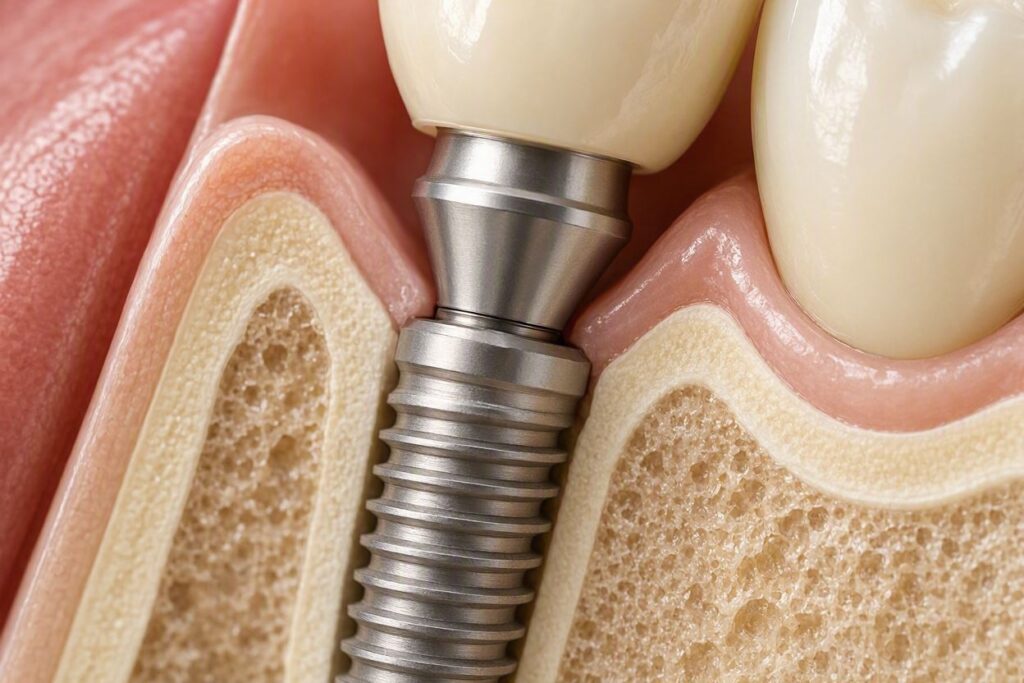
A standard dental implant is a two-piece system. There is the implant post, which is placed in the bone. And there is the abutment, which is the connector piece that attaches to the post and holds the crown.
The challenge is this: how do you securely connect these two pieces?
For many years, the standard was an external hex connection. This meant the top of the implant post had a hexagonal (six-sided) shape sticking up. The abutment had a matching hexagonal hole. The abutment sat on top of the implant and was secured with a screw.
This system worked, but it had problems:
- Micro-movement: There was often a small gap between the abutment and the implant. Under chewing forces, the abutment could rock slightly. This micro-movement could lead to screw loosening.
- Bacterial Leakage: The gap between the abutment and the implant was a perfect hiding place for bacteria. This could lead to inflammation and bone loss.
- Stress on the Screw: The screw took most of the biting force, which could cause it to fracture.
The Morse taper connection was designed to solve these problems.
The Morse Taper: A Mechanical Principle
The Morse taper is not a dental invention. It is a mechanical engineering principle that has been used for over 150 years. It was invented by Stephen A. Morse in the 1860s for use in machine tools.
A Morse taper is a type of connection where a cone-shaped male part fits into a matching cone-shaped female socket. The key is the angle of the taper. It is very slight—typically around 1 to 3 degrees.
When the two parts are pressed together, the friction between the two surfaces creates a very strong and stable lock. This is called “mechanical locking” or “cold welding.” The two pieces become essentially one.
Think of it like a cork in a wine bottle. The slight taper of the cork allows it to be pressed firmly into the bottle, creating a tight seal. The harder you push, the tighter it gets.
How Morse Taper Works in Dental Implants
In a dental implant, the Morse taper connection is internal. This means the socket (the female part) is inside the implant post. The abutment has the cone-shaped (male) part that fits into it.
When the dentist places the abutment into the implant and tightens the screw, the two tapered surfaces come into intimate contact. This creates:
1. A Friction-Fit Lock:
The abutment is wedged into the implant. This provides exceptional stability. The abutment does not rock or move.
2. A Bacterial Seal:
The tight fit between the two surfaces creates a barrier that bacteria cannot penetrate. This is a huge advantage. It minimizes the risk of inflammation and bone loss around the implant.
3. A Stable Platform:
The forces of chewing are distributed more evenly. The friction lock shares the load with the screw, reducing the risk of screw loosening or fracture.
The Benefits of a Morse Taper Connection
Choosing an implant with a Morse taper connection offers several advantages over older connection types.
1. Reduced Risk of Screw Loosening
This was a common problem with external hex connections. The abutment screw would come loose over time. This required a visit to the dentist to tighten it. The Morse taper’s friction lock dramatically reduces this risk.
2. Better Preservation of Bone
The tight seal prevents bacteria from leaking out of the implant-abutment junction. This reduces inflammation in the surrounding bone. Studies have shown that Morse taper implants often exhibit less bone loss over time compared to other connection types.
3. Improved Aesthetics
Because the connection is internal and stable, the dentist has more control over the shape of the gum tissue. This allows for a more natural-looking emergence profile for the crown.
4. Platform Switching
Morse taper designs often incorporate “platform switching.” This means the abutment is narrower than the implant platform. This shifts the inflammatory cell infiltrate away from the bone, further preserving bone levels.
A Comparison of Connection Types
| Feature | External Hex Connection | Internal Hex Connection | Morse Taper Connection |
|---|---|---|---|
| Design | Hexagon on top of implant. | Hexagon inside implant. | Cone-shaped fit inside implant. |
| Stability | Moderate | Good | Excellent |
| Bacterial Seal | Poor | Moderate | Excellent |
| Screw Loosening | Common | Occasional | Rare |
| Bone Preservation | Lower | Moderate | High |
| Aesthetics | Good | Good | Excellent |
What This Means for You, the Patient
Why should you care about this technical detail? Because it affects the long-term success and health of your implant.
When you choose an implant with a Morse taper connection, you are choosing a design that:
- Is less likely to have mechanical problems.
- Is less likely to cause inflammation and bone loss.
- Is more likely to provide a stable, long-lasting foundation for your new tooth.
Most modern, reputable implant brands use some form of internal connection, and many use the Morse taper design. It is a mark of quality engineering.
A Prosthodontist’s Explanation
“I switched to using Morse taper implants years ago. The difference is remarkable. I rarely see a loose screw anymore. And the bone levels around the implants are much more stable over the long term. It is a small engineering detail that makes a huge clinical difference.” – Dr. Robert Evans, DDS, Prosthodontist
Important Notes for Readers
- Ask Your Dentist: When you are discussing implant options, ask your dentist what type of connection the implant uses. A reputable dentist will be happy to explain.
- Not All Tapers Are the Same: Different manufacturers have slightly different variations of the Morse taper. However, the basic principle is the same.
- The Brand Matters: Choose a well-known, reputable implant brand. These companies have invested in research and development to optimize their designs.
- The Dentist’s Skill Matters Too: Even the best implant design can fail if it is placed incorrectly. Choose a skilled and experienced surgeon.
The Bottom Line
The Morse taper in dental implants is a type of internal connection that uses a cone-shaped fit to lock the abutment into the implant post. It creates a friction-fit that is incredibly stable and provides an excellent bacterial seal. This design offers significant advantages, including a reduced risk of screw loosening, better preservation of bone, and improved aesthetics. It is a key feature of modern, high-quality dental implants and contributes significantly to their long-term success.
Frequently Asked Questions (FAQ)
Q: Are Morse taper implants more expensive?
A: They are often associated with premium implant brands, which may be slightly more expensive. However, the long-term benefits often outweigh the small difference in initial cost.
Q: Can any dentist place a Morse taper implant?
A: The surgical placement is very similar to other implant types. However, the restorative phase (attaching the abutment) requires specific training and tools. A dentist familiar with the system is essential.
Q: Is the Morse taper connection visible in the mouth?
A: No. The connection is completely internal. It is hidden below the gum line. All you see is the natural-looking crown.
Q: Does the Morse taper connection ever fail?
A: While it is very reliable, no system is perfect. In rare cases, the abutment can still become loose or the connection can fail. However, the incidence is significantly lower than with older connection types.
Additional Resource
For a more technical explanation of implant-abutment connections and their clinical implications, you can consult the Journal of Prosthodontics: https://www.thejpd.org/