Why Dental Implants Are The Best?
If you are missing a tooth, you are faced with a decision that will affect the rest of your life. You can choose to live with the gap, you can get a removable denture, you can get a bridge, or you can get a dental implant. While every option has its place, the dental community overwhelmingly agrees on one thing: dental implants are the best solution for replacing missing teeth.
But why? What makes a titanium post so much better than the alternatives? The answer goes far beyond just filling a gap. It touches on bone health, quality of life, longevity, and even the health of your other teeth.
This guide will break down the compelling reasons why dental implants have earned their reputation as the “gold standard” of tooth replacement.
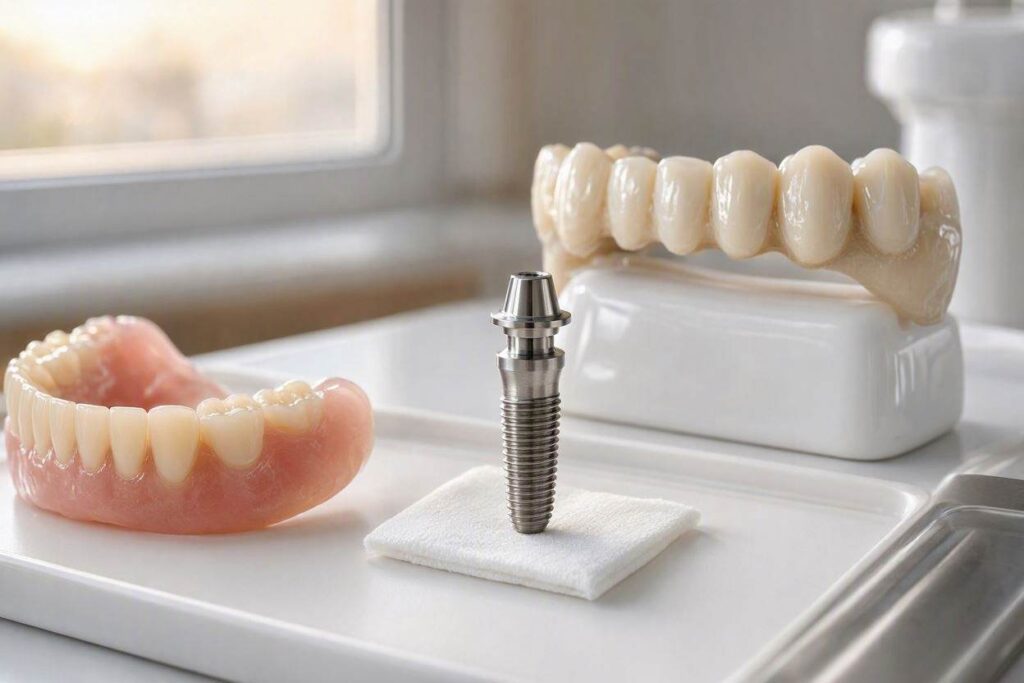
Reason 1: They Are the Only Option That Replaces the Root
This is the most critical biological difference between implants and other options. A natural tooth has a crown (the part you see) and a root (the part in the bone). The root serves a vital purpose: it stimulates the jawbone.
When you chew, the pressure travels down the root and into the bone. This pressure tells the body, “This area of the jaw is being used, keep it strong.” The body responds by maintaining bone density.
When you lose a tooth, you lose that stimulation. The body begins to resorb (dissolve) the bone in that area because it thinks it is no longer needed. This is why people who have been missing teeth for many years develop a sunken, aged look in their face.
Dentures and Bridges do NOT replace the root. They sit on top of the gums. The bone underneath continues to shrink.
Dental Implants DO replace the root. The titanium post is placed into the bone. When you chew on the implant, the force travels down the post and stimulates the bone, just like a natural root. This prevents bone loss.
This is the single biggest medical advantage of an implant. It preserves your facial structure and prevents the aging effect of tooth loss.
Reason 2: They Protect Your Healthy Teeth
A traditional dental bridge works by “bridging” the gap between two teeth. To do this, the dentist must grind down (shave) the two perfectly healthy teeth on either side of the gap. These teeth are then fitted with crowns to support the fake tooth in the middle.
This means you are permanently damaging two good teeth to replace one missing one. These prepared teeth become more susceptible to decay and fracture. If one of them fails, you lose even more teeth.
A dental implant stands alone. It is placed directly into the gap. It does not touch, lean on, or damage the adjacent teeth. This is minimally invasive dentistry at its finest. You are fixing the problem without creating new problems for your other teeth.
Reason 3: Unmatched Longevity and Durability
When you pay for a dental restoration, you want it to last. Here is how the options stack up:
- Dentures: Last 5-7 years on average. They need to be relined or replaced as the bone shrinks.
- Bridges: Last 10-15 years on average. They fail when the supporting teeth decay or the porcelain fractures.
- Dental Implants: The titanium post can last a lifetime. The crown on top lasts 10-15 years (or longer) before it might need replacement due to wear.
While the upfront cost of an implant is higher, the long-term value is undeniable. A bridge might need to be replaced two or three times over your lifetime, costing you more money and more time in the dental chair. An implant is a “one and done” procedure for the post.
Reason 4: Restoring 100% of Your Chewing Power
Quality of life is often measured in simple pleasures, like enjoying a meal. Denture wearers know this struggle all too well.
- Denture Bite Force: Patients with full dentures often have only 10-15% of their natural chewing ability. Eating steak, apples, or corn on the cob becomes difficult or impossible.
- Bridge Bite Force: A bridge restores more function, but you still have to be careful with sticky or hard foods that could pull the bridge off.
- Implant Bite Force: Because the implant is fused to the bone, it restores nearly 100% of your natural bite force.
With an implant, you do not have to think about what you eat. You just eat. You can bite into an apple, chew a tough piece of meat, and enjoy your food without fear of your tooth slipping or breaking.
Reason 5: The Comfort and Convenience Factor
Dentures are removable. They can slip, click, and rub against the gums, causing sore spots. They require special cleaning solutions and must be taken out at night. For many people, dentures are a constant reminder that they are missing their teeth.
Dental implants are fixed. They feel exactly like natural teeth because they are anchored in the bone. There is no clicking, no slipping, and no need for adhesives. You brush them, floss them, and treat them just like the rest of your teeth. You often forget they are even there.
Reason 6: Aesthetics That Match Nature
Modern implant crowns are works of art. A skilled ceramist can create a crown that perfectly matches the color, shape, and translucency of your surrounding teeth. Because the implant is placed precisely into the bone, the “emergence profile” (how the tooth comes out of the gum) looks incredibly natural.
Unlike a bridge, which can look like a row of connected teeth, an implant looks like a single, distinct tooth growing out of the gum. No one will be able to tell which tooth is the implant.
Reason 7: It Prevents Shifting of Teeth
Nature abhors a vacuum. When you have a gap in your teeth, the adjacent teeth begin to drift and tip into the space. The tooth in the opposite jaw can also “super-erupt” (grow out of its socket) because it no longer has a partner to bite against.
This shifting can lead to bite problems, jaw pain, and difficulty cleaning. By placing an implant in the gap, you maintain the alignment of your entire mouth. The implant acts as a place-holder, keeping the neighboring teeth in their correct positions.
The Verdict: Why Settle for Less?
When you look at the evidence, the choice becomes clear.
If you want a cheap, temporary fix that might damage your other teeth or shrink your jawbone, a denture or bridge might work. But if you want a solution that restores your mouth to its natural state—preserving bone, protecting teeth, and restoring full function—there is only one choice: a dental implant.
It is an investment in your health, your appearance, and your future.
Conclusion
Dental implants are the best because they replace the root, preventing bone loss and preserving facial structure. They do not damage adjacent teeth like bridges do, they last a lifetime (compared to 10-15 years for bridges), and they restore nearly 100% of chewing power. Combined with natural aesthetics and the convenience of feeling like real teeth, they offer the highest quality of life for patients with missing teeth.
Frequently Asked Questions (FAQ)
1. Are dental implants really better than a bridge?
For most people, yes. The main advantage of a bridge is that it is cheaper and faster. However, a bridge requires damaging the two healthy teeth next to the gap, and it does not prevent bone loss. An implant is more conservative (doesn’t touch other teeth) and preserves bone. In the long run, the implant is usually the better health choice.
2. Why is bone preservation so important?
When your jawbone shrinks, it changes the shape of your face. Your lips lose support, your chin rotates forward, and you develop wrinkles around the mouth. This is the “sunken” look associated with old age. Bone loss also makes it harder to get implants in the future. Preserving bone is about preserving youth and function.
3. Can you tell the difference between an implant and a real tooth?
No. A well-made implant restoration is virtually indistinguishable from a natural tooth. The color is matched, the shape is custom, and the crown emerges from the gum line naturally. In fact, patients often forget which tooth is the implant.
4. Are there any downsides to dental implants?
The main downsides are cost and time. The process takes 3-6 months (or longer), and the upfront investment is significant. It also requires a surgical procedure. However, for most patients, the long-term benefits far outweigh these short-term hurdles.
5. What happens if I do nothing about a missing tooth?
Doing nothing is the worst option. The tooth behind the gap will tip forward, the tooth above will drop down, and the bone will melt away. This makes it much harder and more expensive to fix the problem later. Ignoring a missing tooth can turn a simple implant case into a complex one requiring bone grafts and orthodontics.