The Cost Of A Brand-New Dental Bridge?
Losing a tooth is a stressful event. It affects your smile, your ability to chew, and the alignment of the surrounding teeth. When deciding how to fill that gap, most patients weigh two main options: a dental implant or a dental bridge.
While implants are often hailed as the gold standard, they involve surgery and a higher price tag. For many, a brand-new dental bridge offers the perfect balance of affordability, speed, and durability. But what is the actual cost of a brand-new dental bridge?
The answer depends on the materials used, the number of teeth being replaced, and where you live. This guide will break down the types of bridges available, realistic pricing expectations, hidden costs, and how to decide if a bridge is right for your budget and health.
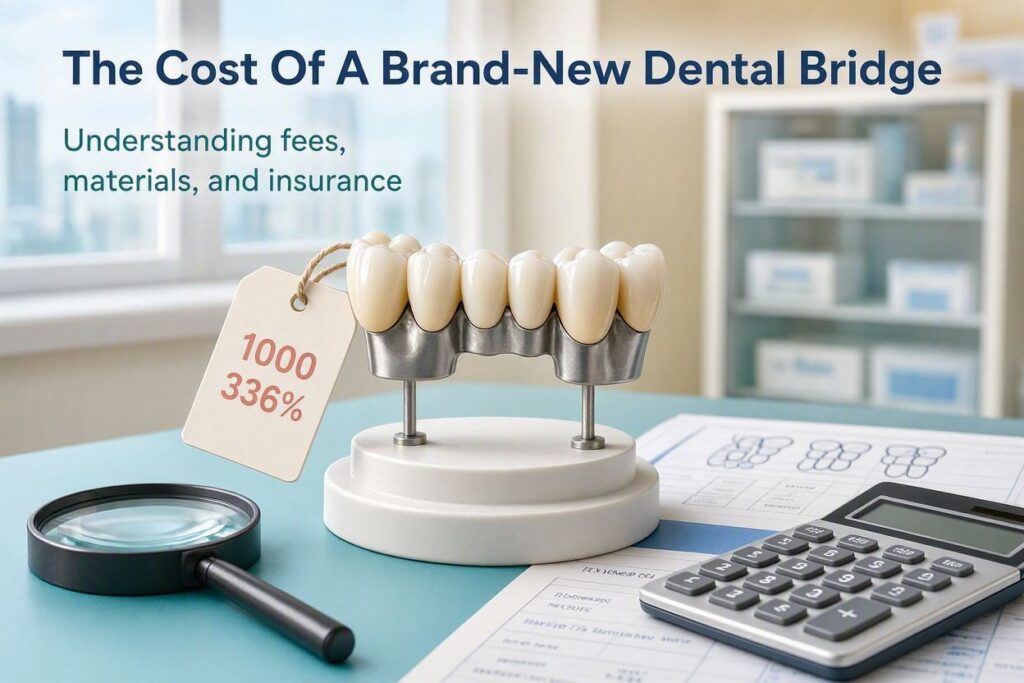
What is a Dental Bridge?
Before diving into the price list, it helps to understand what you are paying for. A dental bridge is a fixed prosthetic device that literally “bridges” the gap created by one or more missing teeth.
It consists of two main components:
- The Abutments: These are the anchoring teeth on either side of the gap. They are usually capped with crowns.
- The Pontic: This is the false tooth (or teeth) that sits in the gap, attached to the crowns.
Because it is cemented into place, a bridge is permanent. Unlike dentures, you cannot remove it for cleaning.
Types of Dental Bridges and Their Costs
The cost of a brand-new dental bridge varies significantly based on the material used to craft the prosthetic and the number of units (teeth) involved. Here is a breakdown of the most common types available on the market today.
1. Porcelain Fused to Metal (PFM) Bridges
This is the traditional and most common type of bridge. It consists of a metal substructure (usually a base metal alloy or gold) covered with tooth-colored porcelain.
- Aesthetic Level: Good, but the metal base can sometimes show through as a dark line at the gumline, especially if the gums recede over time.
- Durability: Very high. The metal framework makes it incredibly strong, making it suitable for back molars where chewing forces are greatest.
- Cost: For a 3-unit bridge (replacing one missing tooth), expect to pay between $2,000 and $3,500.
2. Full Porcelain or Ceramic Bridges (Zirconia)
These are the modern, high-aesthetic options. Materials like Zirconia or Emax are milled from solid blocks of ceramic. They contain no metal.
- Aesthetic Level: Excellent. They mimic the translucency of natural teeth perfectly.
- Durability: Very high. Modern Zirconia is virtually unbreakable, though older ceramic types could chip.
- Cost: Due to the expensive materials and lab work, a 3-unit all-ceramic bridge typically costs $2,500 to $4,500.
3. Maryland Bridges (Resin-Bonded)
This is a more conservative option, often used for replacing front teeth that do not experience heavy chewing forces. Instead of filing down the adjacent teeth for crowns, a Maryland bridge has “wings” that bond to the back of the neighboring teeth.
- Aesthetic Level: High for front teeth, but less secure for back teeth.
- Durability: Moderate. They have a higher rate of debonding compared to traditional bridges.
- Cost: Significantly cheaper because less dentist time is required. Expect $1,500 to $2,500.
4. Cantilever Bridges
This type is used when there is only one natural tooth next to the gap to serve as an anchor.
- Usage: Rarely used today due to the leverage forces it places on the single anchor tooth, which can cause damage.
- Cost: Similar to traditional bridges, usually $2,000 to $3,500.
The Price Breakdown: Why Are Bridges So Expensive?
You might wonder why a bridge costs thousands of dollars when it is just a bit of ceramic. The fee you pay covers several distinct components.
1. The Preparation Visit (Prep)
The dentist must numb the area and file down the healthy “abutment” teeth to make room for the crowns. This is a delicate process. If the tooth is filed incorrectly, the nerve can die, leading to a root canal. This preparatory work often accounts for a significant portion of the fee (roughly 30-40%).
2. The Laboratory Fee
Bridges are custom-made. The dentist takes an impression (or a digital scan) and sends it to a dental laboratory. A skilled technician then fabricates the bridge by hand or with CAD/CAM machines. Lab fees vary; a high-end ceramist in a big city charges much more than a standard lab. This usually accounts for 30-50% of the total cost.
3. The Temporaries and Fitting
You will need a temporary bridge for two weeks while the lab works. The final fitting (cementation) also requires specific bonding agents.
Cost Comparison by Region
Location is a major driver of dental pricing. Here is a look at how the cost of a standard 3-unit porcelain bridge fluctuates.
| Location | Average Cost (3-Unit Bridge) | Notes |
|---|---|---|
| United States (National Avg) | $3,500 – $4,500 | High overheads and insurance-driven markets push prices higher. |
| United Kingdom (Private) | £1,800 – £2,500 | NHS may cover a metal bridge for posterior teeth, but private is standard for aesthetics. |
| Australia | $3,000 – $5,500 | Costs are comparable to the US due to high standards of care. |
| Mexico / Costa Rica | $800 – $1,500 | Popular “dental tourism” destinations. Quality can be excellent, but you must account for travel. |
| Thailand / India | $600 – $1,200 | Very low labor costs. Hospitals are often accredited to international standards. |
Bridges vs. Implants: The Financial Perspective
When weighing the cost of a brand-new dental bridge, you must compare it to the alternative: a dental implant.
Initial Cost:
- Bridge: Usually cheaper upfront.
- Implant: Usually $3,000 – $6,000 per tooth.
Long-Term Cost (10-15 Years):
- Bridge: The average lifespan is 10-15 years. The teeth holding it up are susceptible to decay and gum disease. If one of the anchor teeth fails, the entire bridge must be replaced, and you may need new dental work.
- Implant: The titanium post can last a lifetime. The crown on top may need replacement after 15 years, but the post remains intact. It prevents bone loss.
Expert Insight: “A bridge is a great option for someone who wants a fixed tooth quickly and doesn’t want surgery,” says a practicing prosthodontist. “However, patients must understand that a bridge connects three teeth together. You must be diligent with flossing underneath it, or you risk losing the anchor teeth.”
Does Insurance Cover Dental Bridges?
Yes, but usually only for a portion.
Dental Insurance (USA):
Most dental PPOs classify bridges under “Major Restorative” care.
- Coverage: Typically 50% of the cost.
- Waiting Periods: You usually must be insured for 12 months before major coverage kicks in.
- Annual Maximums: Most plans cap total yearly payouts at $1,500. This means if your bridge costs $4,000, insurance might pay $1,500 (their max), leaving you with a $2,500 bill.
Health Funds (Australia):
“Major Dental” coverage applies here too. Annual limits usually range from $800 to $2,000.
Discount Plans:
If you do not have insurance, consider dental savings plans. You pay an annual fee (e.g., $100) to join a network, and the dentist agrees to charge you 15-50% less than their standard fee.
How to Save Money on a Bridge
If the price is daunting, consider these strategies to reduce the burden:
1. Dental Schools
Universities with dental programs offer significant discounts (often 40-60% off private fees). You are treated by a senior student under the direct supervision of a licensed specialist. The trade-off is time: appointments are long, and treatment requires multiple visits.
2. Dental Tourism
As the table above shows, getting a bridge in Mexico or Costa Rica can save you thousands. However, this is only viable if you live near the border or were already traveling. If a bridge made in another country cracks, your local dentist might not repair it; they may force you to replace it.
3. In-House Membership Plans
Many small private practices now offer “membership plans.” You pay a monthly fee (e.g., $30/month), and in return, you get free cleanings and a 15% discount on all restorative work, including bridges.
4. Negotiate a Payment Plan
Don’t be afraid to ask the front desk if they accept payment plans. Many clinics use third-party financing like CareCredit (US) or Afterpay (AU), which offer interest-free periods (e.g., 12 months). This doesn’t lower the price, but it spreads the pain.
The Procedure: What to Expect
Understanding the process helps you appreciate the cost.
Visit 1: Preparation
The dentist numbs the area. The two adjacent teeth are shaped and reduced in size. An impression is taken. Temporary bridge is placed.
The Lab Phase
This takes 2-3 weeks. You must be careful not to eat sticky foods that might dislodge the temporary.
Visit 2: Fitting
The temporary is removed. The new bridge is tried in. The dentist checks the bite, the color, and the fit. If everything is perfect, it is cemented permanently.
Visit 3 (Optional): Adjustment
Sometimes, the bridge is slightly “high” (touching the opposing teeth too early). You may need to go back a week later for a quick bite adjustment, which is usually free.
The Verdict: Is It Worth the Investment?
Despite the high cost, a brand-new dental bridge remains one of the most cost-effective methods for replacing a missing tooth.
It restores your ability to chew properly, preventing jaw stress. It prevents the surrounding teeth from tipping into the empty space (which would create a cascade of bite problems). And it restores your confidence.
While implants offer a longer lifespan, the technology and materials used in modern bridges mean that if you brush and floss correctly, your bridge can last 15 years or more.
FAQ
Q: How long does a dental bridge last?
A: On average, 10 to 15 years. However, if the supporting teeth remain healthy and you maintain good oral hygiene, modern Zirconia bridges can last upwards of 20 years.
Q: Is getting a bridge painful?
A: No. The procedure is performed under local anesthetic. You may experience some mild sensitivity on the prepared teeth for a few days after the numbness wears off, similar to a filling.
Q: Can a bridge be done in one day?
A: Yes. Some clinics have CEREC machines that mill ceramic crowns and bridges in-house. This eliminates the 2-week lab wait and the second appointment, though the cost is generally the same or slightly higher.
Q: What happens if the tooth under the bridge gets a cavity?
A: This is the biggest risk. If an anchor tooth decays, the bridge must usually be cut off to access the decay. Often, the bridge is ruined and needs to be remade. This is why using a floss threader under the bridge daily is non-negotiable.
Additional Resource
For information on finding accredited labs and understanding material differences, visit the American College of Prosthodontists: prosthodontics.org
Conclusion
In summary, the cost of a brand-new dental bridge varies between $2,000 and $4,500 depending on the material and location. While the initial price is lower than an implant, patients must commit to strict hygiene to protect their investment. Ultimately, a bridge remains a reliable, aesthetically pleasing, and financially accessible solution for tooth loss.