ADA Code for Porcelain Fused to Metal Crown
When a patient walks out of your operatory with a new crown, the clinical artistry is only half the battle won. The other half happens at the front desk, where a single wrong digit on a claim form can mean the difference between full reimbursement and a frustrating denial. In the world of dental billing, precision isn’t just a virtue; it’s a financial necessity.
This brings us to one of the most frequently used, yet often misunderstood, codes in restorative dentistry: the ADA code for a porcelain fused to metal crown. If you have ever paused before checking that box, wondering if you selected the right code, you are not alone. I have spoken to thousands of dental professionals who share the same moment of hesitation.
This guide isn’t a dry, academic breakdown of numbers. Think of it as a conversation with a colleague who has navigated the labyrinth of CDT codes for years. We will walk through exactly what code D2750 covers, when to use it, the critical distinctions between it and all-ceramic alternatives, and the documentation strategies that safeguard your practice against audits. By the time you finish reading, you will have a masterful command of not just the code, but the entire context surrounding it.
The Core Definition: What is ADA Code D2750?
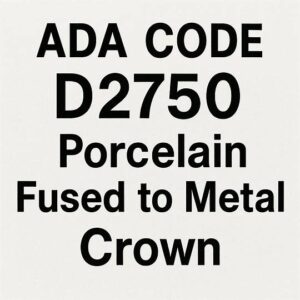
Let’s strip away the complexity and look at the definition straight from the Code on Dental Procedures and Nomenclature (the CDT manual). The ADA code for a porcelain fused to metal crown is D2750.
Specifically, the official nomenclature describes it as a “crown – porcelain fused to high noble metal.” It is critical to note the exact wording here. We are not talking about a general metal. The D2750 designation specifies a substrate of high noble metal.
This metal must, by definition, contain at least 60% noble metal content—gold, platinum, palladium—and at least 40% of that must be gold. This isn’t semantics. If the underlying metal does not meet this threshold, the code changes. For a porcelain fused to a predominately base metal substrate (less than 25% noble metal), you must drop down to code D2751. For a crown that uses noble metal (25% to 60% noble content), the correct code is D2752.
Why does this distinction matter? Because high noble metal alloys behave differently in the mouth. They offer superior biocompatibility, better bonding to the porcelain layer, and a more predictable long-term marginal fit compared to base metal alternatives. Payers know this. They also know high noble alloys cost the laboratory significantly more. Consequently, some payers scrutinize D2750 claims heavily, looking for opportunities to downgrade the reimbursement to the base metal rate if documentation doesn’t solidly confirm the substrate used.
Clinical Context: Why Porcelain Fused to Metal Still Matters
In an era dominated by the marketing of lithium disilicate and zirconia, you might wonder why we dedicate so much time to discussing a metal-based restoration. The reality is that porcelain fused to metal crowns remain a cornerstone of posterior restorative care. They haven’t disappeared; they’ve just been refined.
The reason is mechanical durability. A well-fabricated PFM crown offers a blend of compressive strength from the metal coping and aesthetic versatility from the superficial ceramic layer. For a second molar where occlusal forces approach or exceed 200 psi, I still see many seasoned clinicians reaching for a high noble metal substrate. The metallic substructure flexes slightly under load, protecting the brittle ceramic overlay from catastrophic fracture in a way that a fully rigid monolithic zirconia crown might not.
Furthermore, the biocompatibility of high noble alloys is unmatched. Tissue response around well-finished PFM margins is often remarkably calm, even in patients who exhibit sensitivity to less expensive alloys. From a billing perspective, understanding the clinical “why” allows you to defend the code you select with confidence. You aren’t just picking D2750 because it’s familiar; you are picking it because the material properties specifically serve the patient’s occlusal and biological needs.
The Nitty-Gritty: Inclusions and Exclusions of D2750
A clear understanding of what a code packages together prevents ethical missteps and claim rejections. The D2750 crown code isn’t just for the physical crown placed on the tooth. It is a bundled procedure code.
What D2750 Includes:
-
The final impression or digital scan acquisition for the crown.
-
The laboratory fee associated with fabricating the high noble metal coping and layering the porcelain.
-
All necessary adjustments to the restoration at the delivery appointment.
-
A three-dimensional custom wax-up used to create the indirect restoration.
-
The cementation of the final crown using permanent luting cement.
-
Post-delivery occlusal adjustments done within the standard global period (typically 30 to 90 days, depending on the payer).
What D2750 Excludes:
-
Any core buildup required to create adequate retention and resistance form (that’s D2950).
-
Pin retention associated with that buildup (D2951).
-
The initial evaluation, which is billed under a separate diagnostic code such as D0140.
-
Endodontic therapy performed on the tooth (coded from the D3000 series).
-
Crown lengthening performed surgically to expose sound tooth structure (coded from the D4000 series).
-
Temporary crowns (D2970), which are billed separately and we will discuss in depth later.
A common billing error occurs when a practice attempts to bundle a pin buildup into D2750 to simplify the claim. I caution against this. If you perform a separate, identifiable service beyond the scope of the crown preparation itself, you must bill for it separately, with its own documentation, or you leave significant revenue on the table and create a record that doesn’t match the clinical notes.
Comparative Analysis: PFM vs. All-Ceramic Codes
The most frequent dilemma at the front desk involves picking between the PFM family and the all-ceramic family. For posterior teeth, this often comes down to D2750 versus D2740 (crown – porcelain/ceramic substrate).
| Feature/Code | D2750 (PFM High Noble) | D2740 (All-Ceramic) | D2752 (PFM Noble) |
|---|---|---|---|
| Substrate Material | Metal containing ≥60% noble elements; ≥40% gold. | Predominantly ceramic (e.g., lithium disilicate, zirconia). | Metal containing ≥25% noble elements. |
| Aesthetic Potential | Good; a metal margin may show at the gingiva. | Excellent; translucency mimics natural tooth structure. | Similar aesthetic limitation as D2750. |
| Clinical Strength | Excellent for high-stress posterior areas. | Monolithic zirconia is extremely strong; layered ceramic can chip. | Very good but may vary by alloy. |
| Laboratory Cost | Higher than base metal; lower than high-end pressed ceramic. | Varies widely by material (zirconia vs. e.max). | Moderate; priced between base and high noble. |
| Payer Preference | Viewed as a standard of care; rarely denied as “cosmetic.” | Often subject to cosmetic exclusions on posterior teeth. | Often viewed as an acceptable alternative to D2750. |
| Biocompatibility | Excellent for high noble gold alloys. | Excellent; metal-free, no corrosion risk. | Acceptable, but may trigger sensitivity in some patients. |
Many PPO plans include a “least expensive professionally acceptable treatment” clause. For a posterior tooth, the carrier’s stance often classifies a PFM as the standard of care, while an all-ceramic crown may be deemed an “aesthetic upgrade.” In these scenarios, if you place a D2740 crown and the plan only covers a D2750 alternative, the payer processes the claim as D2750, applies the downgrade, and leaves the patient responsible for the price difference. Transparency here is vital. Tell the patient before you seat the crown that their plan downgrades the code.
“I’ve learned that a five-minute conversation about downgrades before treatment prevents five months of collection headaches after treatment.” — A veteran dental office manager
The Downgrade Dilemma: When Payers Alter Your Code
The term “downgrade” sends a ripple of frustration through any dental team. It occurs when an insurance carrier alters the procedure code you submitted to a less expensive alternative code. In the context of crowns, the downgrade path almost always flows toward a full metal restoration or a base metal PFM.
A payer might downgrade D2750 to D2790 (full cast high noble metal crown) or D2751 (porcelain fused to base metal crown). Their logic, embedded in their policy fine print, is that if a full metal crown would restore function, they won’t cover the aesthetic porcelain component. This happens most frequently when D2750 is used on a third molar or a mandibular second molar where the carrier argues that aesthetics aren’t a functional requirement.
Your defense against a downgrade rests on medical necessity and documentation. If you placed a PFM instead of a full cast metal crown because the patient has a documented nickel allergy that precludes base metal, state this clearly in your notes and your narrative. If the opposing dentition is a restored ceramic surface, note that a metal occlusal surface would cause excessive wear. The payer processes hundreds of thousands of claims algorithmically; your narrative is the human interruption that forces a reviewer to consider the specifics.
Step-by-Step Claim Submission Guide
Submitting a clean claim for D2750 requires more than checking a box. A methodical approach eliminates 80% of the errors that lead to delayed payment.
Step 1: Verify Active Coverage and Group Number.
Before the patient sits down, confirm that their plan is active. I have seen practices seat a crown only to discover the patient’s coverage termed out the previous month. This is a dangerous financial position to be in.
Step 2: Determine the History of the Tooth.
Is this an initial placement or a replacement? Payers frequently apply a five-year or seven-year frequency limitation on crown replacement. Check the last date of service for the same tooth, even if it was placed by another practice. You can often find this in the carrier’s history portal.
Step 3: Radiographic Documentation.
Attach the periapical or bitewing radiograph showing the reason for the crown. If the tooth has recurrent decay extending beyond what an onlay could repair, the radiograph must demonstrate this. A narrative is helpful, but an image is definitive.
Step 4: Confirm the Substrate.
The laboratory invoice must clearly state “high noble metal” and specify the alloy composition. Attach a de-identified copy of the lab slip if the claim requires it. The code D2750 carries the specific weight of that “high noble” definition.
Step 5: Enter the Correct Date of Service.
The date of service for D2750 is the cementation date—the day the permanent crown is delivered and seated. This is not the preparation date.
Step 6: Narrate with Precision.
In box 35 (or the equivalent electronic field), include a concise narrative. For example: “Caries extending to the distolingual cusp, undermining more than 50% of the remaining tooth structure. Preparation completed with adequate ferrule. High noble PFM crown delivered to restore function. Patient declines extraction.”
Step 7: Attach Supporting Information.
If an intraoral photograph captures the fracture or decay that necessitated the crown, include it. The more clinical evidence you provide upfront, the less likely a claims examiner is to request additional information or issue a denial.
Necessary Documentation to Protect Your Claim
I want to share a hard truth: an audit is not necessarily a sign that you have done something wrong. Often, it’s a random algorithmic flag. What determines the outcome of that audit is the quality of your notes. For a D2750 crown, your documentation must tell the story of clinical necessity without ambiguity.
Your clinical notes should include a clear narrative of the patient’s chief complaint. What is broken? Is there sensitivity? A statement like “Patient reports sharp pain when chewing on the lower right” immediately contextualizes the radiograph.
Objectively measure the remaining tooth structure. A note stating “Cracked mesiolingual cusp” is weak. A note stating “Isolated fracture of the mesiolingual cusp extending subgingivally 1.5mm, with a remaining ferrule of 2mm circumferentially after buildup” is unassailable. Mention the decision-making process. If you chose D2750 over an all-ceramic option because of a heavy bruxism pattern evidenced by severe wear facets on the anterior teeth, document that bruxism observation. This ties the material choice directly to the diagnosis.
Also, retain the laboratory prescription form. In the event of a material-specific audit, the lab slip is the definitive proof that a high noble alloy was used and billed. If your lab uses generic descriptions like “PFM crown” on their invoices, ask them to be more specific. The invoice should ideally read “Fabricate D2750 high noble PFM.”
Navigating Alternative Benefit Clauses
Almost every dental benefits contract contains an alternative benefit clause. It allows the payer to cover a less expensive procedure than the one submitted, provided that the alternative meets professionally recognized standards of care. This clause is the legal mechanism behind the downgrade we discussed earlier.
Here is how it often plays out for D2750. A plan might state that for posterior teeth distal to the canines, coverage is limited to the allowance for a full cast metal restoration. They apply this clause to D2750, recode the claim as D2790, and calculate your payment based on that fee schedule. The difference, which can be substantial, becomes the patient’s financial responsibility.
This clause can feel unfair to the provider who believes a PFM is the minimum standard of care. However, it is a contractually agreed-upon feature of the plan the patient (or their employer) selected. Your primary role here is an educator. You must inform the patient, ideally via a signed financial agreement before the prep appointment, that their plan contains this downgrade. Show them the estimated patient portion. If they know beforehand, acceptance of the financial responsibility is much smoother.
Understanding Frequency Limitations
Frequency limitations are another source of claim rejections for D2750. A plan will rarely pay for a replacement crown on the same tooth within a five-to-seven-year window unless specific criteria are met.
The payer’s logic is that a crown is a durable medical device intended to last a minimum of five years. If you are replacing a crown placed three years ago, the automated system will flag it. To bypass this limitation, you must demonstrate that the failure of the existing crown was not due to normal wear and tear.
A valid reason for early replacement includes recurrent, non-restorable caries that has undermined the tooth at the margin of the existing crown. Another is a traumatic fracture of the tooth and crown complex where a repair is impossible. Aesthetic dissatisfaction alone, however, will not override a frequency limitation. Your narrative in this case must focus purely on the pathological process. “New mesial decay under crown margin, extending 3mm subgingivally. Crown is not salvageable and not a candidate for repair. Recommend replacement.”
Geographic Pricing Variations and Lab Fee Disclosure
The ADA code D2750 does not set a fee; it identifies a procedure. The fee you charge is a business decision influenced by your laboratory costs, your overhead, and the UCR (usual, customary, and reasonable) rates in your zip code. What I frequently see in metropolitan areas on the coasts is a UCR for D2750 that can be 40% higher than in some rural regions of the Midwest. This discrepancy is a direct reflection of the cost of doing business and the local lab market.
However, some PPO plans operate with a national fee schedule that ignores these geographic realities. If you are in-network, you are bound by that fee. This is why analyzing a PPO fee schedule before signing a contract is so important. Run your top 30 codes, including D2750, and calculate the annual impact. If the plan’s allowance for a high noble PFM barely covers your lab bill for a base metal substructure, participating in that network could be a recipe for financial loss.
A note on lab fee disclosure: In rare instances, a payer may request your lab invoice to verify the type of alloy used. While you are never required to accept only the lab fee as reimbursement, providing a redacted invoice for a high noble case can speed up the resolution of a downgrade dispute. Just ensure you never give the payer the impression that your fee is simply a markup of the lab cost; your clinical service, expertise, and overhead are the core of your fee.
The Relationship Between D2750 and Core Buildups
One of the most vexing questions in restorative billing is, “When can I bill a core buildup separately with D2750?” The answer hinges on whether the buildup is a distinct procedure restoring lost tooth structure.
A core buildup, coded as D2950, is indicated when a significant portion of the clinical crown is missing. It’s not simply a foundation under a crown; it’s a restoration that replaces missing dentin to create a shape that can retain a crown. If the entire clinical crown is present and you simply need to shape it for a crown, including a pin or small amalgam in the chamber, this is usually considered part of the crown preparation and not a billable buildup.
To bill D2950 alongside D2750, you must have documentation of the pre-operative condition. I recommend taking an intraoral photograph showing the amorphic blob of composite or amalgam immediately after you’ve placed it, alongside the missing tooth structure. The note should read: “Tooth #30 presented with loss of the distolingual and distal marginal ridge, with greater than 50% of the coronal structure absent. Amalgam build-up with pin retention placed to restore form and provide sufficient ferrule for indirect restoration.”
Submitting a claim for D2750 and D2950 on the same date of service without supporting documentation will almost certainly trigger a request for additional information and potentially bundle the buildup payment into the crown fee.
Recementation and Repair: Adjunctive Codes
A crown rarely simply falls off for no reason. When a patient presents with a debonded D2750 crown, the appropriate code is usually D2920, recement crown. However, if the underlying tooth structure has fractured and the crown can no longer be seated passively, recementation is not the correct code; you are now addressing a more complex failure.
For a repair of the porcelain on a PFM crown, where the metal substructure is intact, the code is D2980, crown repair necessitated by a restorative material failure. This is a common scenario on anterior PFMs where a small chip of incisal porcelain has fractured. The repair involves a bonding agent and composite overlay. I caution against using a repair code when a metal margin has been exposed. A repair that does not restore the full contour or seal of the restoration is merely a palliative measure. If the restoration is compromised, replacement is often the only long-term solution, and billing a repair repeatedly on a crown that requires replacement can be viewed as unbundling.
Crowns on Implants: A Different Code Set
I often see confusion between a crown placed on a natural tooth and one placed on an implant fixture. The code D2750 applies strictly to a natural tooth. For an implant-supported crown, you must use codes from the D6000 series.
An implant-supported crown that is porcelain fused to high noble metal is coded as D6060. An implant-supported crown that is porcelain fused to base metal falls under D6061, and one with a noble metal substrate is D6062. The distinction mirrors the natural tooth code hierarchy but is applied to the abutment-supported or implant-level interface. Do not use D2750 for an implant restoration. Not only will the claim be rejected, but it also creates confusion in the patient’s treatment history regarding which teeth are natural and which are implants.
Temporary Crowns: D2970 and Its Role
The code for a temporary crown, whether prefabricated or custom-fabricated, is D2970. The key differentiator in billing D2970 successfully is that it is not simply part of the permanent crown procedure. It is a separate service that provides interim protection, stabilization, and function.
Some plans include the allowance for a temporary crown within the global fee for D2750. Some plans allow it to be billed separately on the preparation date. The most effective strategy is to bill D2970 on the date of the preparation. If the payer bundles it, they will process the claim with $0.00 for the temporary and still pay the final crown fee later. But if you never bill it, you guarantee you’ll never receive a separate allowance for the materials and time spent.
If the patient returns for an additional temporary because the final crown delivery was delayed for several weeks beyond the normal window (and it was not due to your schedule), some practices bill a recementation of the temporary. I advise caution here, as most payers consider the maintenance of the temporary as part of the global treatment package.
Billing for Prefabricated vs. Custom Components
Within the D2750 family, there is another layer of specificity concerning the post and core used. If you use a prefabricated post in conjunction with a core buildup, you do not bill for the post separately. The placement of the prefabricated post is bundled into the D2950 core buildup code.
However, if a laboratory fabricates a custom cast post and core (usually made of a metal alloy) that will receive the D2750 crown, the code is D2952. This code is not for the crown itself but for the substructure foundation. In these cases, the claim shows D2952 (post and core) on the preparation date, and later D2750 on the cementation date. This is a critical nuance. A custom cast post is a separate, laboratory-intensive procedure distinct from a direct buildup.
The Impact of PPO Contracts on Your Reimbursement
The contractual relationship you have with a payer dictates almost every aspect of billing D2750. Fee-for-service practices bill their full fee, and the patient is responsible for the balance after the carrier’s check is sent to the policyholder. A PPO practice, however, agrees to a contracted fee schedule. This means that for D2750, you cannot bill the patient for any amount above the contracted in-network fee, outside of their deductible and co-insurance.
What happens if a PPO patient insists on a D2750 crown but their plan only covers an amalgam buildup and a base metal crown? This is where a properly executed “Refusal of Payment for Non-Covered Services” form is essential. Because the material upgrade from base metal to high noble metal is not a covered benefit, and because you are in-network, you can only charge the patient for the differential if they have signed this form acknowledging that the specific additional cost is for a non-covered service. Without that signature, you may be accused of balance billing.
Review your PPO contract language carefully. Some contracts explicitly state that a high noble PFM is the standard, and base metal is the alternative, thereby covering D2750 without a downgrade. Others do the opposite. You must know which type of contract you hold.
Medicare and Medical Billing Crossovers
For patients over 65, a purely dental claim might not be the only pathway. While traditional Medicare excludes most routine dental care, some Medicare Advantage plans carry a dental rider. If your D2750 procedure is a component of a larger medically necessary treatment plan—for instance, rebuilding a jaw after a traumatic accident or as part of head and neck cancer reconstruction—the medical side may come into play.
In these crossover cases, you would still code the dental procedure as D2750 on the dental claim form. However, you might need to attach a medical diagnosis code that justifies the treatment. This is extraordinarily rare for an isolated crown but does occur in hospital-based dental practices. The key rule remains: the procedure code is D2750; the diagnosis code must align with the medical necessity narrative.
Handling Denials: A Practical Rebuttal Letter Framework
A denial for D2750 is not the end of the road. It is an invitation to advocate for your clinical judgment. A well-written appeal letter often reverses a downgrade. Here is a framework that has consistently produced results.
Subject Line: Appeal for D2750 – [Patient Name] – [ID#] – Tooth [#]
Opening Paragraph:
State the facts without emotion. “This letter is a formal request for reconsideration of the adverse determination on the above-referenced claim for a porcelain fused to high noble metal crown (D2750) on tooth number 30.”
Clinical Findings Paragraph:
Describe the tooth’s condition. “Upon clinical and radiographic examination, tooth number 30 displayed a mesiodistal crack extending from the marginal ridge through the pulp chamber floor. A buildup was required to achieve a ferrule of 2mm. The tooth is terminal in the quadrant and will absorb full masticatory force.”
Medical Necessity for Material Paragraph:
Address the specific substrate choice. “A full cast metal crown (D2790), while an alternative, was contraindicated. The opposing arch contains porcelain restorations, and the use of a cast metal occlusal surface would result in rapid and excessive wear of the opposing dentition, creating a risk of future fracture. The high noble alloy substructure was chosen to ensure precise marginal adaptation, minimizing the risk of recurrent decay, which has been a documented issue in this patient’s medical history.”
Request and Enclosures:
“I respectfully request the downgrade to D2790 be reversed and the claim be re-processed as D2750. Enclosed please find the periapical radiograph, the laboratory prescription confirming high noble metal content, and the clinical photographic documentation of the crack.” End with a statement that you are available for a peer-to-peer review.
Important Note: When a payer requests a “peer-to-peer” review, they are offering you a phone call with their dental consultant. This is often a pivotal moment. Before the call, have the radiographs and laboratory invoice in front of you. Speak confidently about the ferrule, the alloy choice, and the risk of catastrophic failure if a less conservative material was used. Be collegial, not confrontational. Peer-to-peer calls frequently result in an immediate overturn of the downgrade.
Pediatric and Mixed Dentition Considerations
Using D2750 on a pediatric patient is unusual but not unheard of. In a mixed dentition case, where a permanent first molar has erupted but is severely hypocalcified, a stainless steel crown is typically the standard of care due to the interim nature of the treatment. However, in cases of amelogenesis imperfecta or a fully erupted permanent tooth in an adolescent nearing adulthood, a permanent D2750 crown might be the only answer.
When submitting this for a patient under the age of 16, a payer will almost certainly pause. You will need to document why a large composite restoration or a preformed metal crown is not appropriate. The narrative should state, “Tooth #19 is a fully erupted permanent molar in a 15-year-old patient with complete apical closure. A prefabricated crown would not restore the interproximal contact and occlusal anatomy necessary for long-term maintenance of the arch. A definitive D2750 restoration has been placed to avoid extraction and space loss.”
The Future of PFM Coding in a Digital Era
As dentistry moves toward digital workflows and monolithic restorations, some predict the decline of the PFM code. I see it not as a decline, but a specialization. The practices using D2750 frequently now are often those engaged in complex full-mouth rehabilitation, where an operator prefers the flexural characteristics of a metal substructure layered with feldspathic porcelain for an anterior bridge framework.
The CDT code set is updated annually by the ADA’s Code Maintenance Committee. While we have seen the addition of codes for adhesive wing bridges and new ceramic categories, D2750 remains stable. It remains the benchmark for a hybrid restoration. The one upcoming change that may affect the code is the push toward more granular material reporting. We may eventually see codes that require specification of the exact alloy brand or composition in a sub-field. Currently, though, D2750 remains a workhorse code, and mastering it remains essential.
A Detailed Clinical Case Study: From Prep to Payment
Let’s walk through a realistic case to illustrate the entire workflow.
The Patient:
A 52-year-old woman presents with a fractured distolingual cusp on tooth #31. The tooth is vital and has a large existing amalgam.
Clinical Evaluation:
The radiograph shows the fracture extends to the level of the alveolar crest on the distal, but a sound ferrule of 2mm remains after sounding the bone. The opposing tooth, #2, has a functional ceramic onlay. The treatment plan is to remove the existing amalgam, perform a bonded composite core buildup, and restore with a porcelain fused to high noble metal crown.
Coding Sequence on Prep Day:
-
D2950: Core buildup, including any pins.
-
D2970: Temporary crown (prefabricated, relined).
The narrative for this date details the removal of the fractured segment and the rationale for the buildup: “Without a buildup, the preparation lacks a distal wall necessary for crown retention; the buildup is a distinct and necessary procedure to restore lost tooth structure.”
Laboratory Phase:
The lab prescription calls for a high noble PFM with a 40% gold substrate. The lab invoice is filed in the patient’s chart and a scanned copy attached to the digital record. The specific lab description reads “High Noble 40% Au PFM #31.”
Cementation Day:
The permanent crown is tried in. Marginal fit is verified with an explorer and bitewing radiograph. The occlusion is adjusted. The patient is comfortable. The temporary crown was removed, and the tooth was cleaned and cemented with resin-modified glass ionomer cement.
The Claim Submission:
-
Tooth #31.
-
D2750. Date of service: Cementation day.
-
Fee: $1,350 (UCR-based).
-
Attachments: Bitewing radiograph (cementation), lab invoice, and pre-operative photo of the fracture.
-
Narrative: “Caries excavation and removal of fractured distal segment on #31. 2mm ferrule achieved after bonded buildup. High noble PFM (lab invoice attached) cemented. Opposing ceramic restoration contraindicates a full cast metal occlusal surface.”
The Payer Response:
The carrier processes the claim but applies a downgrade to D2790, stating “A full cast crown could have been placed.” They pay $780, leaving a patient balance of $570.
The Appeal:
The office manager submits an appeal pointing to the attached documentation, specifically the note about the opposing porcelain surface and the patient’s documented history of moderate bruxism. The letter states that a full metal crown would pose an unacceptable risk of severe wear to the maxillary arch, creating a higher long-term cost to the plan. The appeal is accepted, and the remaining balance is paid.
This case study encapsulates the non-clinical work that supports every D2750 chairside procedure. It shows that the code is just the beginning; the narrative, documentation, and persistence are what secure the correct reimbursement.
Frequently Asked Questions
Q: Can I bill D2750 for a crown that is only partially porcelain, say a metal occlusal with a buccal porcelain facing?
A: If the restoration has a porcelain component fused to a high noble metal substrate, D2750 is appropriate. The extent of the ceramic coverage does not change the code, as long as the substrate meets the high noble definition. However, if the lab uses a noble metal, it becomes D2752.
Q: What if my lab uses a “ceramic under metal” technique? Does the code change?
A: The code does not change based on the manufacturing technique. If the substrate is high noble metal and porcelain is applied, it remains D2750.
Q: My software defaults to D2750 for any PFM. Is that correct?
A: No. You must verify the lab prescription manually. Defaulting to D2750 without checking the alloy could lead to an incorrect claim. If a base metal alloy is used, the correct code is D2751.
Q: Is there a separate code for a PFM crown with a zirconia framework?
A: A zirconia framework is not a metal; it is a ceramic. Therefore, this restoration is coded from the all-ceramic series, typically D2740, not the PFM series.
Q: Can I bill D2750 if a previous D2750 crown was placed on the same tooth 4 years ago but has failed?
A: Yes, but you will need to document the specific clinical failure, such as recurrent decay making the restoration non-restorable. A radiograph and a narrative explaining the pathological process are mandatory to override the typical 5-year frequency limitation.
Additional Resources
For the most current, legally binding code definitions, the primary resource is the American Dental Association’s official publication, the CDT Code.
-
Resource Link: ADA’s CDT Code Book & Official Coding Resources
This volume is updated annually and contains the precise nomenclature, descriptors, and coding guidelines that payers reference. When you encounter a dispute over a definition, your first and final authority is the current year’s CDT manual.
Conclusion
The ADA code for a porcelain fused to metal crown is D2750, but its effective use extends far beyond a simple form entry. It demands a verifiable high noble alloy substrate, a clear distinction from all-ceramic alternatives, and rigorous documentation to defend against payer downgrades. By mastering the clinical nuances that justify this material choice and building a system of robust claim narratives, a practice ensures its billing matches the clinical excellence delivered. Ultimately, precise coding turns a restorative procedure into a transparent, successful financial transaction.
Disclaimer:
This article is for informational and educational purposes only and does not constitute medical, legal, or billing advice. Procedure codes and payer policies vary by state, carrier, and specific plan contracts, and they change annually. Always verify the current CDT manual definitions and your specific contract terms with each insurance carrier. This content does not establish a doctor-patient or professional consultancy relationship, and it has not been authored or endorsed by the American Dental Association.