Are Dental Implants Secure And Reliable?
You are considering a significant investment in your mouth. You want to know that the solution will work. You do not want to spend thousands of dollars on something that might fail. The question you are asking is fundamental: Are dental implants secure and reliable?
The short answer is yes. Dental implants are one of the most successful and predictable procedures in modern medicine. They have a proven track record spanning over 50 years. When placed correctly and maintained properly, they offer a level of security and reliability that no other tooth replacement option can match.
This guide will explore the science behind their reliability, the factors that ensure their security, and the rare circumstances where they might fail.
The Evidence: What the Data Says
Let’s start with the numbers. The reliability of dental implants is not based on opinion; it is based on decades of peer-reviewed research.
- Long-Term Success Rate: Studies consistently show that dental implants have a 10-year survival rate of over 95%.
- 20-Year Data: Even at the 20-year mark, survival rates remain above 90% in most studies.
- Comparison to Other Treatments: Traditional dental bridges have a 10-year survival rate of approximately 85%. Root canals have a similar success rate. Dental implants outperform both.
Why are they so reliable?
The secret lies in the material and the biology.
The Titanium Factor
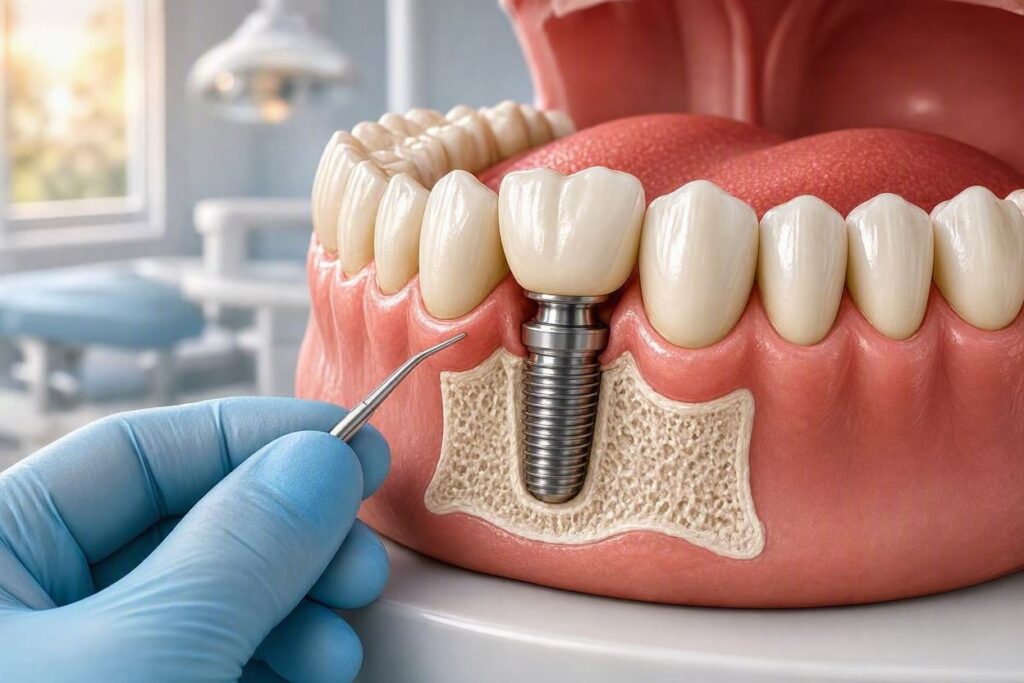
Dental implants are typically made of commercially pure titanium or a titanium alloy. Titanium is unique because it is biocompatible. The human body does not recognize it as a foreign invader. It does not trigger an immune response or rejection.
The Osseointegration Process
When titanium is placed into living bone, the bone cells actually grow onto the surface of the metal. This process is called osseointegration. The bone and the implant become physically fused.
This fusion creates a bond that is incredibly strong. It is strong enough to withstand the forces of chewing, which can reach hundreds of pounds per square inch.
What Makes an Implant “Secure”?
The security of an implant depends on three pillars: the surgery, the restoration, and the maintenance.
1. Surgical Precision
A secure implant starts with proper placement. This is where technology plays a critical role.
- 3D Cone Beam CT Scanning: This imaging technology allows the dentist to see the exact anatomy of your jawbone, nerves, and sinuses. It enables them to place the implant in the optimal position, avoiding dangerous structures.
- Surgical Guides: Many dentists use 3D-printed surgical guides. These are custom-made stents that fit over your teeth and direct the drill to the exact planned location. This eliminates guesswork.
- The Dentist’s Skill: Experience matters. A skilled surgeon knows how to handle bone quality variations and unexpected anatomy.
2. The Restoration (The Crown or Bridge)
The implant is the root. The crown is the tooth. The connection between them must be secure.
- The Abutment Screw: The crown is attached to the implant using a small screw. This screw is tightened to a precise torque (measured in Newton centimeters). If it is too loose, the crown will wobble. If it is too tight, the screw can fracture.
- Cement vs. Screw-Retained: As discussed in earlier articles, screw-retained crowns are often preferred because they allow for easy retrieval if maintenance is needed. Cement-retained crowns offer better aesthetics but are harder to remove.
3. The Long-Term Maintenance
An implant is not a “set it and forget it” device. Its long-term security depends on the health of the surrounding gum and bone.
- Peri-Implantitis: This is the implant equivalent of gum disease. If plaque builds up around the implant, it causes inflammation. If left untreated, the inflammation destroys the bone holding the implant. This is the number one cause of late implant failure.
- Bite Forces: If you grind your teeth, the excessive force can loosen the screw or crack the porcelain.
When Do Implants Fail? The Reliability Limits
While the success rate is high, implants are not perfect. They can fail. Understanding why helps you minimize your risk.
Early Failure (Within the First Year)
This usually means the bone did not fuse to the implant.
Causes:
- Smoking: Nicotine constricts blood vessels, starving the bone of oxygen and nutrients.
- Infection: Bacteria entered the surgical site.
- Overheating: If the drill was not cooled properly during surgery, it can damage the bone cells.
- Poor Bone Quality: If the bone is too soft or too thin, it cannot stabilize the implant.
Late Failure (After Years of Success)
This usually means the bone was lost due to infection or overload.
Causes:
- Poor Hygiene: The patient did not clean the implant.
- Bite Changes: The opposing teeth shifted, putting uneven pressure on the implant.
- Systemic Disease: The patient developed uncontrolled diabetes or another condition that affected healing.
How Reliable Are They Compared to Alternatives?
Let’s compare the security of implants to the other options.
| Feature | Dental Implant | Traditional Bridge | Removable Denture |
|---|---|---|---|
| Stability | Excellent (fused to bone) | Good (attached to teeth) | Poor (floats on gums) |
| Bone Preservation | Yes | No | No (accelerates bone loss) |
| Longevity | 25+ years (often lifetime) | 10-15 years | 5-8 years |
| Failure Rate (10 years) | < 5% | ~ 15% | High (varies) |
| Impact on Adjacent Teeth | None | Requires grinding down healthy teeth | None (but causes gum irritation) |
The Verdict on Reliability:
The dental implant is the most secure and reliable option because it is independent. It does not rely on neighboring teeth for support. It does not rely on suction or adhesive. It is anchored directly into the skeleton.
The “Fear Factor”: Addressing Common Concerns
Some patients worry that the implant will “fall out” or “break.” Let’s address these fears.
Can an implant fall out?
A healthy, integrated implant cannot fall out. It is fused to the bone. You could not pull it out with your fingers. The only way to remove it is with surgical tools.
What might fall out?
The crown (the white tooth part) can sometimes come off if the cement fails or the screw breaks. This is a mechanical failure, not a failure of the implant itself. It is usually a simple fix.
Can an implant break?
The titanium fixture is incredibly strong. It is highly unlikely to break under normal chewing forces. However, the porcelain crown can chip or crack, just like a natural tooth.
The Verdict
Are dental implants secure and reliable?
Yes. They are the gold standard for tooth replacement. Their success rates are higher than most other medical procedures. They provide a level of stability and security that allows you to eat, speak, and smile with total confidence.
However, their reliability depends on you. You must choose a skilled dentist who uses proper imaging and techniques. You must commit to meticulous daily cleaning. You must attend regular maintenance visits.
If you do your part, your dental implant can last a lifetime. It is a secure, reliable investment in your health and well-being.
Frequently Asked Questions
Q: What is the success rate of dental implants?
A: The long-term success rate is typically between 92% and 98%, depending on the location in the mouth and the patient’s health.
Q: Can I get an MRI with dental implants?
A: Yes. Dental implants are made of non-magnetic materials (titanium or zirconia). They will not be pulled out by the MRI machine. However, they can sometimes distort the image of the brain or neck on the scan.
Q: Do dental implants set off metal detectors at airports?
A: Generally, no. Dental implants are small and made of titanium, which is non-ferromagnetic. They usually do not trigger airport security detectors.
Q: How often do I need to see the dentist after getting an implant?
A: You should see your dentist at least once a year for a check-up, and often twice a year for professional cleanings. Patients with a history of gum disease may need to be seen every 3 months.
Additional Resource:
For more information on the long-term outcomes of dental implants, visit the International Congress of Oral Implantologists: https://www.icoi.org/.