Are Full Mouth Dental Implants Safe?
The decision to replace all of your teeth is a major life event. It is not a decision you make lightly. You are looking at a significant financial investment and a surgical procedure that involves your entire mouth. It is perfectly reasonable to feel a mix of hope and fear.
The most important question you can ask is: Are full mouth dental implants safe?
The short answer is yes, with caveats. Full mouth dental implants are a highly successful, routine procedure in modern dentistry when performed by a qualified professional on a healthy patient. However, “safe” does not mean “risk-free.” No surgery is without risk.
The danger often lies not in the implants themselves, but in the patient’s health, the skill of the surgeon, and the planning involved.
This guide will break down the safety profile of full mouth implants. We will look at the success rates, the real risks, the potential complications, and the steps you can take to ensure your safety.
The Safety Record: What the Numbers Say
First, let’s look at the data. Dental implants have been studied extensively for decades.
- The Implant Fixture Success Rate: Studies consistently show that the titanium posts placed in the bone have a 92% to 98% success rate over 10 years.
- The Bridge/Prosthesis Success Rate: The fake teeth attached to the implants have a slightly lower success rate because they experience mechanical wear. The “teeth” part usually has an 85% to 90% success rate over 10 years, meaning some patients may need repairs for chipped or broken teeth.
Why is this safety profile so high?
The human body loves titanium. It is one of the few metals the body does not reject. The bone grows directly onto the surface, locking it in place. This biological process is predictable and reliable.
The Surgical Risks: What Can Go Wrong?
While success is common, you need to be aware of the potential complications. A patient who is informed is a patient who can make good choices.
1. Infection
This is the most common immediate risk with any surgery. The mouth is full of bacteria. When you cut into the gums and drill into the bone, there is a risk of introducing bacteria into the surgical site.
- Symptoms: Swelling, pain, fever, pus, and a bad taste in the mouth.
- Treatment: Antibiotics and, in severe cases, draining the infection.
- Prevention: A clean surgical environment, pre-surgical mouth rinses, and following post-operative instructions.
2. Nerve Damage
Your lower jaw contains the inferior alveolar nerve. This nerve gives feeling to your lower lip, chin, and teeth. If an implant is placed too deep or in the wrong position, it can damage this nerve.
The consequence:
- Permanent numbness or tingling (paresthesia) in the lip or chin.
- In severe cases, difficulty speaking or drooling.
How is this prevented?
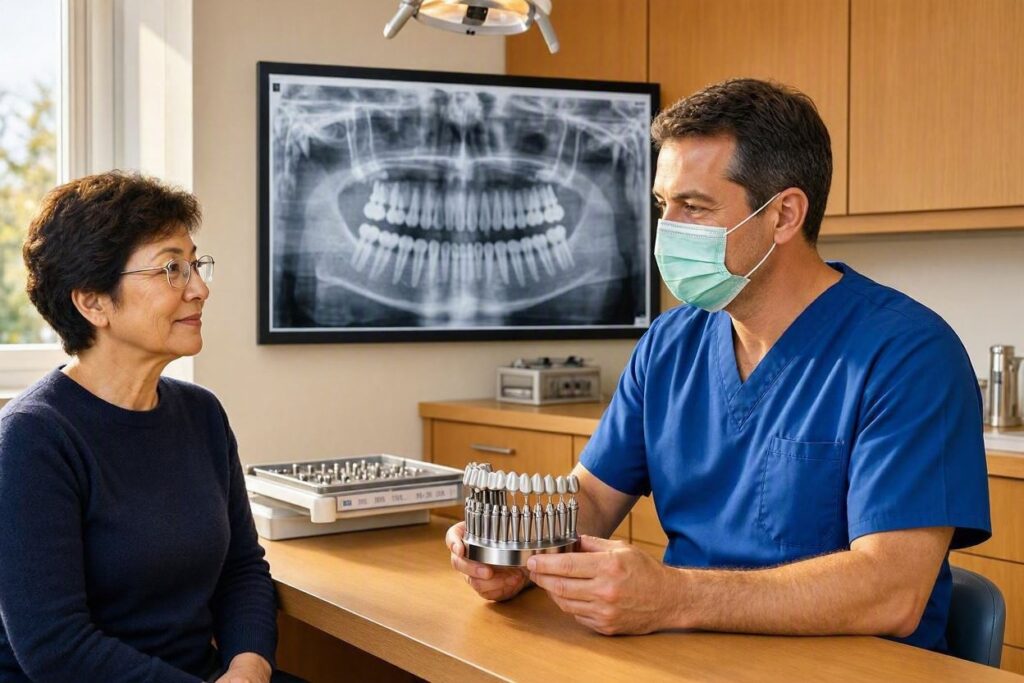
This is where technology saves you. A dentist must use a 3D Cone Beam CT scan before surgery. This scan shows the exact location of the nerve canal. It allows the dentist to plan the implant placement to avoid it by a safe margin. If a dentist tries to do full mouth implants without a 3D scan, they are putting you at risk.
3. Sinus Issues (For Upper Implants)
The upper jaw is located directly below the sinus cavities. If the bone in the upper jaw is thin (which is common after tooth loss), the implant can protrude into the sinus cavity.
The consequence:
- Chronic sinus infections.
- Sinus pain and pressure.
The solution:
A procedure called a sinus lift. The dentist gently pushes the sinus membrane up and places bone graft material underneath it. This creates enough bone to safely place the implant. This is a standard, safe procedure but adds to the recovery time.
4. Excessive Bleeding
Patients with bleeding disorders or those taking specific blood thinners (like Warfarin or Eliquis) are at higher risk of bleeding during and after surgery.
The solution:
Your dentist must do a thorough medical history review. You may need to coordinate with your medical doctor to pause or adjust your blood thinners before surgery. You should never stop medication without your doctor’s approval.
The Long-Term Risks: Safety After Healing
The surgery might go perfectly, but the safety of the implants depends on what happens in the months and years after.
1. Peri-Implantitis (The Silent Killer)
This is the most significant long-term risk. It is the “gum disease” of implants. Just as plaque can destroy the bone around natural teeth, it can destroy the bone around implants.
Unlike natural teeth, implants do not have a ligament to fight off bacteria. Once bacteria get under the gum around an implant, they can travel straight down to the bone.
The danger:
Peri-implantitis is often painless in the early stages. You might not notice it until the bone is already badly damaged. If the bone is lost, the implant loses its support and becomes loose. It may eventually fall out.
The prevention:
This is your responsibility. Meticulous cleaning is non-negotiable. You must use water flossers, interdental brushes, and see your hygienist regularly. If you are not willing to clean your teeth thoroughly, full mouth implants are not safe for you.
2. Mechanical Failure (Breaking)
Full mouth restorations (like All-on-4) are complex mechanical devices. The teeth are often screwed into a titanium bar.
- Screw Loosening: Very common. The screws holding the bridge can vibrate loose over years of chewing. This requires a dentist visit to tighten.
- Fracture: If you grind your teeth heavily, you can crack the acrylic teeth or even the titanium bar.
These failures are not dangerous to your health, but they are inconvenient and costly.
The “Am I A Candidate?” Safety Checklist
Your personal health status is the biggest factor in determining how safe the procedure is for you.
| Health Condition | Safety Status | Why It Matters |
|---|---|---|
| Smoking | High Risk | Nicotine restricts blood flow. Bone healing requires blood. Implant failure rates are double in smokers. |
| Uncontrolled Diabetes | High Risk | High blood sugar impairs the immune system and healing. |
| Healthy Gums | Low Risk | Essential for stable long-term healing. |
| Adequate Bone Volume | Low Risk | You need enough bone to hold the implant. If not, you need a graft. |
| Grinding (Bruxism) | Moderate Risk | Can put too much force on the implants and restorations. |
| Osteoporosis Medication | High Risk | Certain IV bisphosphonates can cause bone death in the jaw (osteonecrosis). |
Important Note: Age is not a major risk factor. A healthy 80-year-old is often a better candidate than a diabetic 40-year-old who smokes. Health quality matters more than age.
How to Ensure Your Safety: A Patient’s Guide
If you decide to proceed, here is how you minimize your risks.
1. Choose the Right Provider
This is the most important decision you will make. Do not choose a dentist based on a billboard or a discount coupon.
- Credentials: Ask where they trained. Did they do a residency in Oral Surgery or Prosthodontics? Are they a Fellow of the American Academy of Implant Dentistry?
- Volume: Ask how many full mouth cases they have done. Experience matters. You want a dentist who does this every week, not once a month.
2. Demand a 3D Scan
If the office does not have a Cone Beam CT scanner, leave. It is the standard of care for full mouth reconstruction. It is the only way to plan safe implant placement.
3. Be Honest About Your Medical History
Do not hide your smoking habit or your medications from the dentist. You are not trying to impress them. You are trying to keep yourself safe. Withholding information can lead to catastrophic surgical failures.
4. Get a Second Opinion
This is a large financial and medical investment. It is entirely reasonable to pay for a consultation with another dentist to confirm the diagnosis and the treatment plan. If two dentists disagree wildly, get a third opinion.
The Verdict
Are full mouth dental implants safe?
Yes. The technology and the success rates are excellent. The vast majority of patients who get full mouth implants experience a dramatic improvement in their quality of life without serious complications.
However, they are only safe if the patient is healthy, the dentist is skilled, and the planning is meticulous. The greatest dangers are untreated periodontal disease, smoking, and “discount” clinics that skip the necessary diagnostic steps.
If you are willing to invest in a qualified professional and commit to a strict hygiene routine, full mouth dental implants are a safe and life-changing solution.
Frequently Asked Questions
Q: Can I die from dental implant surgery?
A: The risk of death from routine dental implant surgery is astronomically low. Complications from anesthesia or a severe, untreated infection are possible but extremely rare in a medical setting with proper screening.
Q: How long does the surgery take for full mouth implants?
A: The actual surgery to place four to six implants in one arch usually takes between 1.5 to 3 hours. If you are having extractions and bone grafts at the same time, it can take longer.
Q: Is it safer to get implants in the upper or lower jaw?
A: The lower jaw usually has denser bone and fewer anatomical risks (no sinuses). The lower jaw typically has a higher success rate than the upper jaw. The upper jaw requires more skill to avoid the sinuses and nasal cavity.
Q: What is the failure rate of full mouth implants?
A: For the implants themselves (the screws), the long-term success rate is over 90%. However, for the bridge attached to them, roughly 1 in 10 patients will need some form of repair or replacement within 10 years due to wear or breakage.
Additional Resource:
For medical guidelines and safety data on dental implants, visit the U.S. Food and Drug Administration (FDA): https://www.fda.gov/.