Dental Prosthetic Services: What Are They?
Dental prosthetic services encompass the entire field of replacing missing teeth and restoring damaged oral structures with artificial devices. These services range from a single tooth crown to a complete replacement of every tooth in both arches. A dental prosthetist, whether a general dentist, a prosthodontist, or a clinical dental technician, combines biological knowledge, material science, and artistic skill to fabricate a prosthesis that restores function, phonetics, and aesthetics. This guide provides a comprehensive exploration of every major category of dental prosthetic service.
The Scope and Philosophy of Prosthetic Dentistry
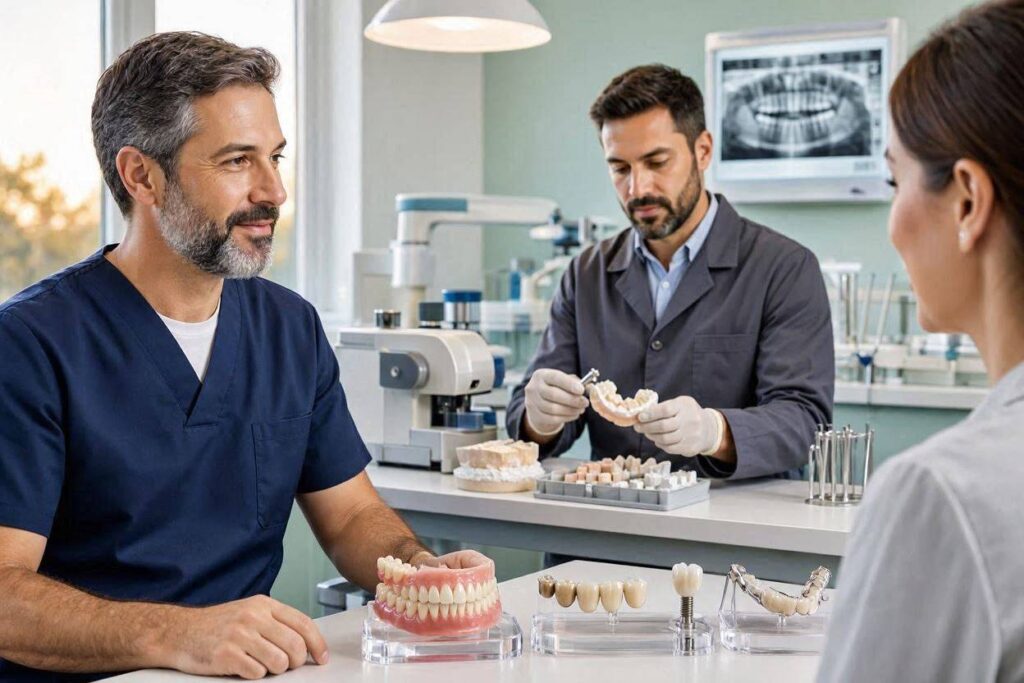
Prosthetic dentistry is founded on the principle that tooth loss is a pathological state with cascading consequences. When a tooth is lost and not replaced, the adjacent teeth drift and tilt into the empty space. The opposing tooth over-erupts, searching for a contact. The jawbone in the edentulous area resorbs, shrinking in both height and width over time. This process destabilizes the entire occlusal scheme. A dental prosthesis halts this destructive cascade by filling the space and restoring the functional balance.
The specialty that focuses most intensively on this field is prosthodontics. A prosthodontist is a dentist who, after dental school, completes three additional years of advanced training in the restoration and replacement of teeth. They are the recognized experts in complex full-mouth rehabilitation, implant-supported prostheses, and the management of congenital oral defects. However, general dentists provide the majority of routine prosthetic services, including single crowns, conventional bridges, and removable partial and complete dentures.
Fixed Prostheses: The Permanently Cemented Restoration
A fixed prosthesis is a restoration that is permanently cemented or screwed onto prepared natural teeth or dental implants. The patient cannot remove it. This category represents the gold standard in tooth replacement because it most closely mimics the feel, function, and stability of natural teeth.
Single Tooth Crowns
A crown, or cap, is a fixed prosthetic that completely covers the visible portion of a damaged tooth above the gum line. It is indicated when a tooth has lost too much structure from decay or fracture to support a simple filling. The dentist reduces the outer surface of the tooth by a precise amount, creating a tapered abutment shape. An impression, either physical or digital, captures this preparation, and a laboratory fabricates the crown from porcelain, lithium disilicate, zirconia, or a metal-ceramic combination. The finished crown is cemented or bonded onto the prepared tooth, restoring its shape, strength, and function.
Dental Bridges
A dental bridge is a fixed prosthesis that replaces one or more missing teeth by crowning the natural teeth on either side of the gap. These supporting teeth, called abutments, carry the load of the missing tooth, called the pontic. The bridge is a single unit. The abutment crowns and the pontic are fused together in the laboratory. The entire bridge is then cemented onto the prepared abutment teeth, closing the edentulous space with a fixed, non-removable solution. A traditional bridge requires the irreversible reduction of healthy tooth structure on the abutment teeth. This is its primary biological cost, and it drives the modern preference for implant-supported restorations whenever anatomically and financially possible.
Implant-Supported Crowns and Bridges
A dental implant is a titanium or zirconia fixture surgically placed into the jawbone, where it fuses with the bone in a process called osseointegration. It serves as an artificial tooth root. A single implant can support a single crown, replacing a missing tooth without touching the adjacent healthy teeth. This is the most conservative and biomechanically ideal prosthetic service for a single tooth loss. Two or more implants can support an implant bridge, replacing multiple missing teeth with a fixed restoration that is completely self-supporting. The implant prosthesis is the current highest standard of care in fixed prosthodontics.
Removable Prostheses: The Patient-Removable Appliance
A removable prosthesis is a dental appliance that replaces missing teeth and can be taken out of the mouth by the patient for cleaning and sleeping. It is a more cost-effective solution than a fixed bridge or implants and is the only option when the edentulous span is too large to support a fixed restoration or when the remaining abutment teeth are too compromised.
Complete Dentures
A complete denture replaces all of the teeth in a single arch. It is a pink acrylic base that sits on the residual gum ridge and palate (for an upper denture) and holds a full set of artificial teeth. Retention on an upper complete denture comes primarily from a suction seal against the palate. Retention on a lower complete denture is a constant challenge because the floor of the mouth and the tongue constantly move and dislodge the appliance. Lower complete dentures are notorious for being loose and uncomfortable. This prosthetic service requires a high level of patient adaptation.
Removable Partial Dentures
A removable partial denture replaces several missing teeth in a partially edentulous arch. It clasps onto the remaining natural teeth with metal or flexible plastic hooks for retention. The framework is typically cast from a strong, lightweight cobalt-chromium alloy, with a pink acrylic base and artificial teeth attached. A flexible, metal-free version made from a thermoplastic nylon material is a popular alternative for its aesthetic clasps and comfort, though it is less durable and less repairable than a cast metal framework. The partial denture restores chewing function, prevents drifting of the remaining teeth, and provides a budget-conscious prosthetic option.
Overdentures and Implant-Retained Dentures
A complete denture can be dramatically stabilized by placing a small number of dental implants into the jaw and attaching the denture to them. An implant-retained overdenture uses locator attachments, ball attachments, or a bar system to snap the denture firmly into place. The patient can still remove the denture for cleaning, but when it is in the mouth, the implants lock it down. The difference in chewing confidence and quality of life between a conventional floating lower denture and an implant-retained lower denture is transformational. This service is a highly effective bridge between a fully removable and a fully fixed prosthetic solution.
Maxillofacial and Specialized Prosthetic Services
Prosthetic dentistry extends beyond routine tooth replacement into the realm of maxillofacial prosthetics, a subspecialty that rehabilitates patients with acquired or congenital defects of the head and neck. This is the most advanced and personalized form of dental prosthetic service.
Obturators and Surgical Prostheses
An obturator is a custom prosthesis that closes a defect in the hard or soft palate. It is most commonly required after a surgical resection for oral cancer, where a portion of the maxilla has been removed, creating an open communication between the mouth and the nasal cavity or sinus. The obturator bulb extends into the defect, sealing it to restore speech, prevent fluid leakage into the nose, and allow comfortable swallowing. A surgical obturator is placed immediately at the time of surgery. A definitive obturator is fabricated months later, after complete tissue healing and remodeling.
Craniofacial and Auricular Prostheses
A maxillofacial prosthetist also fabricates prostheses to replace missing facial structures. An auricular prosthesis replaces an ear lost to trauma or cancer surgery. An orbital prosthesis replaces an eye and the surrounding eyelids. A nasal prosthesis replaces a nose. These are hand-painted, ultra-realistic silicone prostheses that are custom sculpted to match the patient’s skin tone, texture, and contralateral facial anatomy. They are retained with medical-grade skin adhesives or osseointegrated craniofacial implants anchored into the skull bone.
The Digital Workflow in Modern Prosthetic Services
The traditional prosthetic workflow of impression, plaster model, and lost-wax casting is being transformed by digital technology. An intraoral scanner captures a precise three-dimensional optical impression of the prepared tooth or the edentulous arch, eliminating the need for physical impression material. The digital file is used to design the prosthesis in CAD software. The final restoration is then fabricated by a CAM process, either subtractive milling from a solid block of ceramic or additive 3D printing of a resin or metal framework. This digital workflow increases precision, reduces laboratory time, and improves the material predictability of the final prosthesis.
Conclusion
Dental prosthetic services encompass a complete spectrum from single-unit fixed crowns and implant-supported restorations to removable partial and complete dentures, as well as highly specialized maxillofacial prostheses for acquired defects. The choice between a fixed and a removable prosthesis involves a balance of biological cost, biomechanical stability, aesthetics, and financial investment. The modern digital workflow is enhancing the precision and efficiency of every category, making prosthetic dentistry a dynamic and technologically sophisticated field that restores not just teeth, but the fundamental human functions of eating, speaking, and smiling with confidence.
Frequently Asked Questions
Q: What is the difference between a prosthodontist and a general dentist?
A: A prosthodontist is a dentist who has completed three additional years of full-time accredited specialty training in the restoration and replacement of teeth. They handle complex full-mouth reconstructions, implant-supported full-arch prostheses, and cases with significant bite or aesthetic challenges.
Q: Is a dental implant considered a prosthetic service?
A: The surgical placement of the implant is an oral surgical service. The crown, bridge, or denture that attaches to the implant is the prosthetic service. The two phases are separate but closely coordinated.
Q: How long does a dental bridge last?
A: A well-made dental bridge, supported by healthy abutment teeth and cleaned meticulously under the pontic with floss threaders, can last 10 to 15 years or longer. Its lifespan is limited primarily by the risk of decay on the abutment teeth.
Additional Resource
For authoritative information on the specialty of prosthodontics and finding a board-certified specialist, the following professional organization is the definitive source.
- American College of Prosthodontists: gotoapro.org