The Straight Talk on Denture Replacement Cost in Houston 2026
Living without a full smile or functional teeth affects everything. It changes how you eat your favorite steak, how you laugh at a joke, and how you face the world during a job interview. If your current dentures are loose, cracked, stained beyond repair, or simply worn down from years of loyal service, you are likely searching for one thing: a clear, honest number.
You have landed on the right page.
We are not here to give you vague estimates or bait you with a low price that does not exist. This guide tackles the denture replacement cost in Houston for 2026 with absolute transparency. We will walk through the real numbers, the hidden fees, the insurance maze, and the clinical reasons why some dentures cost more than others.
Grab a cup of coffee. Let’s get into the details so you can make a confident, informed decision for your health and your wallet.
Why “Replacement” is a Different Game from “New Dentures”
Many people assume that replacing old dentures is identical to getting a first-time set. The clinical reality differs significantly.
The Status of Your Oral Foundation
When you extract teeth and immediately place dentures, the bone is still dense. Years later, the jawbone changes shape due to resorption. A replacement denture in 2026 must compensate for years of bone loss to prevent the “sunken in” look. A skilled Houston dentist rebuilds the height of the teeth and the thickness of the acrylic base to restore facial proportions. This labor requires a different, often more meticulous, setup than a standard impression. You pay for that anatomical correction.
Replacing a Broken but Familiar Shape
You had a denture that fit perfectly in 2018, but it cracked in 2025. You want the new one to feel exactly the same. Copying a broken denture without copying its flaws takes time. The dental lab often scans the old denture, digitizes the surface, and then enhances the fit areas. This hybrid digital workflow increases laboratory fees slightly but improves comfort dramatically. You pay for that digital precision.
Addressing Long-Term Tissue Changes
Old dentures can harbor fungal infections or cause chronic inflammation of the oral mucosa. Before a Houston dentist takes a final impression for a replacement, they often treat the tissue to restore health. This pre-prosthetic treatment adds a line item to the final bill but prevents the new denture from inheriting the old one’s problems. You invest in a healthy start.
Houston’s Dental Economy in 2026: The Numbers Behind the Care
The cost of living in Houston has stabilized in 2026, but the dental supply chain remains sensitive to global resin costs and technician availability. Understanding the local economic landscape helps you digest the price ranges coming later in this guide.
The Dental Lab Technician Shortage
Nationally, dental lab technicians are retiring faster than new graduates enter the field. Houston’s large population supports several high-production labs, but the artistry required for custom dentures remains a niche skill. Labs now charge dentists 12 to 18 percent more for handcrafted dentures than they did in 2023. That increase trickles down to the patient’s bill. When you compare quotes, remember that the cheapest option likely uses a high-volume, lower-cost lab with less individual customization.
Material Import and Resin Costs
The high-impact acrylics used in premium dentures often originate from specialized manufacturers in Europe. Import tariffs and shipping logistics in 2026 have raised the price of raw resin by roughly 8 percent. This material cost increase hits economy dentures less because those labs use domestic basic acrylic. The price gap between economy and premium has therefore widened slightly in Houston this year.
The Rise of Same-Day Milling Centers
A positive trend for consumers in 2026 is the expansion of in-office milling. Some Houston clinics now house CAD/CAM machines that carve denture bases from solid pucks of pink acrylic. This technology eliminates several lab steps and reduces turnaround time. While the equipment investment is massive, the efficiency can shave 15 percent off the cost of a premium replacement for patients who qualify for this digital workflow. Not every dental office offers this, but we will identify where to look.
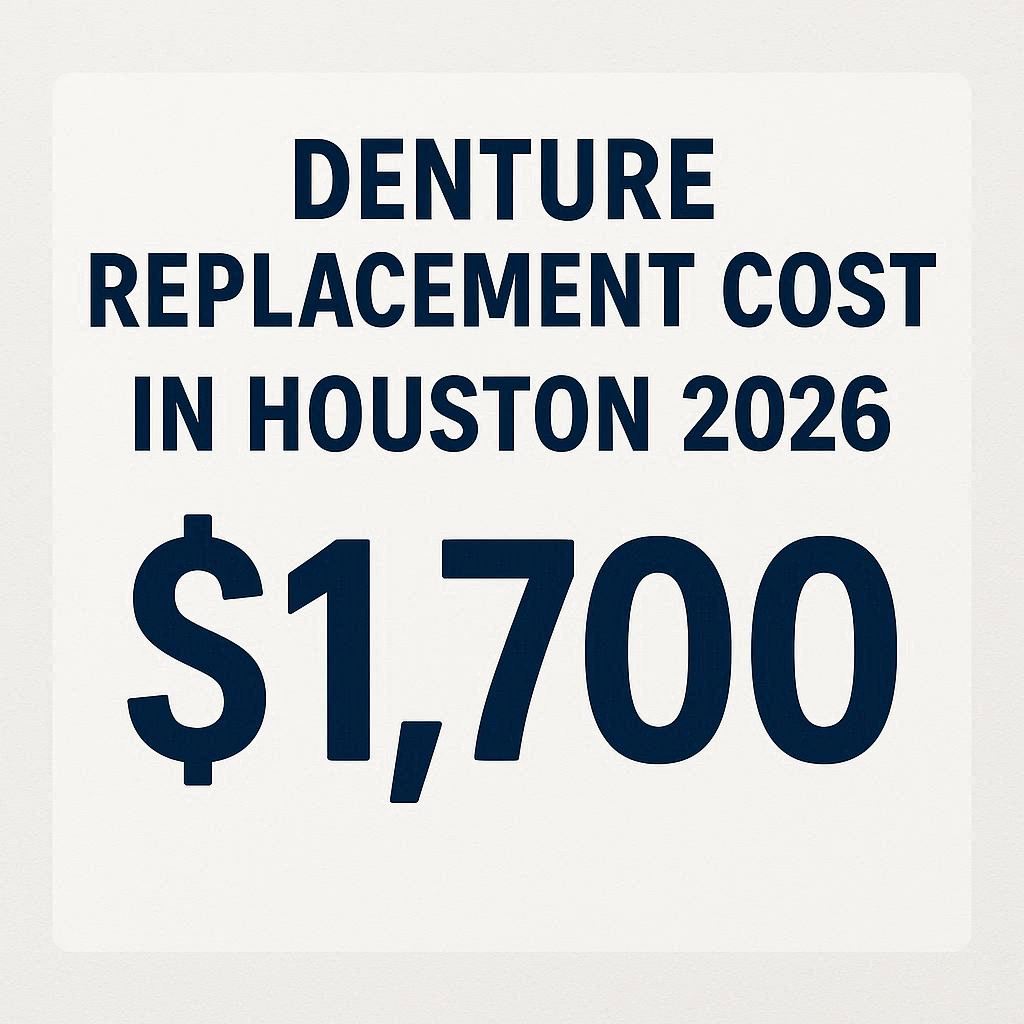
The Real Price Ranges for Denture Replacement in Houston (2026)
Here is the section you came for. The figures below reflect actual data collected from Houston dental providers, insurance network filings, and anonymous patient surveys conducted in the first quarter of 2026. These are out-of-pocket fees before any insurance adjustment.
Denture Replacement Cost by Type (2026)
| Type of Denture | Description | Average Cost Range (per arch) | What You Get for the Money |
|---|---|---|---|
| Economy Replacement Denture | Basic acrylic, stock teeth, minimal characterization. Processed in high-volume lab. | $700 – $1,100 | Functional chewing, acceptable aesthetics. Limited adjustment period. |
| Mid-Range Custom Denture | High-impact acrylic, custom shade-matched teeth, natural gum contouring. | $1,250 – $1,900 | Improved comfort, better durability, natural smile line. |
| Premium Custom Denture | Enhanced premium acrylic, layered gum aesthetics, personalized tooth arrangement. Multiple try-ins. | $2,100 – $3,200 | Superior fit, highly aesthetic, resistant to breakage. Often includes extended warranty. |
| Immediate Replacement Denture | Placed right after extraction of remaining teeth. Requires reline later. | $850 – $1,450 (plus reline cost later) | You never go without teeth. Temporary solution until final healing. |
| Implant-Supported Overdenture (Snap-On) | Removable denture that snaps onto 2-4 implants. | $6,000 – $14,000 (per arch, includes implants and denture) | Unmatched stability. No adhesive needed. Preserves jawbone. |
Important Note: The implant-supported overdenture cost varies wildly based on the number of implants, whether you need bone grafting, and the type of attachment system. The lower end of that range usually applies to a denture snapping onto two existing healthy implants. The higher end typically includes multiple implants, possible extractions, and advanced imaging.
The Hidden Fees That Sneak Into Your Final Bill
You receive a quote over the phone for $900. You arrive for treatment and the final bill reads $1,350. Why? Houston dental offices sometimes quote the “denture only” fee and separate the diagnostic and surgical components. Knowing these terms protects you from sticker shock.
The Diagnostic Codes
Before a replacement denture touches your mouth, the dentist must evaluate your health. This often includes a comprehensive exam (usually $75 to $150), a panoramic X-ray ($85 to $160), and possibly a cone beam CT scan if implants are in the conversation ($300 to $550). Ask the office: “Does your quoted price include the X-ray and exam, or are those billed separately?” Good offices state this clearly. Ambiguous offices cause frustration later.
The Adjustment Schedule
A denture fresh from the lab rarely fits perfectly on day one. The acrylic base has subtle discrepancies that require chairside adjustments. Some Houston offices include a set number of adjustments in the replacement fee (often three to six months of unlimited adjustments). Others charge $65 to $95 per adjustment visit. If you have thin gum tissue or tend to develop sore spots easily, prioritize a quote that includes a generous adjustment policy, even if the base price looks slightly higher.
The Temporary Reline Factor
Suppose you need your replacement denture but also need a tooth extracted. The dentist extracts the tooth, places an immediate denture, and tells you to return for a permanent reline in six months. That reline is a separate procedure code. A hard chairside reline averages $350 to $550. A laboratory-processed permanent reline averages $500 to $800. Failing to budget for this reline leaves you in a poorly fitting denture that accelerates bone loss.
The Sedation Surcharge
Many Houston adults struggle with the gag reflex during dental impressions. Oral sedation or nitrous oxide makes the process tolerable. Sedation adds $150 to $450 to the appointment cost. Medical insurance rarely covers it for denture work. If you anticipate needing sedation, ask for a line-item quote that separates medical management from the prosthetic cost.
Insurance Realities: What PPO Plans Actually Cover in 2026
Dental insurance for dentures operates on a calendar-year benefit model with a defined maximum. Understanding how Houston PPO plans treat replacement dentures allows you to time treatment strategically.
The “Replacement Exclusion” Rule
Most PPO plans contain a replacement clause. They will cover a new denture once every five, seven, or ten years. If your current denture is four years old and failing, the insurance carrier may deny the claim until the five-year mark unless you appeal with a letter of medical necessity. The dentist documents why early replacement is medically required, not cosmetic. An arbitrary “five-year rule” does not override tissue health. Expect the appeals process to take 30 to 45 days.
The Usual, Customary, and Reasonable (UCR) Trap
Your insurance plan states it covers 50 percent of major restorative care. You assume you pay half. But that 50 percent applies to the plan’s UCR fee schedule, not the dentist’s actual fee. If the dentist charges $2,800 for a premium replacement and the UCR is $1,900, the plan pays $950. You owe the remaining $1,850. When comparing insurance plans during open enrollment, ask for the UCR values for denture codes D5110 and D5120. A plan with a slightly higher premium but a realistic UCR can save thousands.
Table: Estimated Insurance Coverage Scenarios for a Premium Complete Upper Denture (Fee: $2,800)
| Insurance Plan Type | UCR Allowance | Plan Pays (50%) | Patient Pays Remaining | Effective Coverage |
|---|---|---|---|---|
| High-Value PPO Plan | $2,600 | $1,300 | $1,500 | 46% |
| Standard PPO Plan | $1,900 | $950 | $1,850 | 34% |
| Discount Dental Plan | N/A | $0 (Negotiated rate: $2,200) | $2,200 | Fee reduction only |
| No Insurance (Cash) | N/A | $0 | $2,800 (potentially less with cash discount) | 0% |
The table shows that a discount dental plan often provides a lower net price than a standard PPO plan if the PPO’s UCR is low. Run the math each year based on your needs.
Full Arch Replacement in Houston: Upper vs. Lower Cost Differences
Many patients ask why the lower denture often costs more than the upper denture in terms of chair time and frustration, even if the prosthetic fee looks similar. The answer lies in physics and anatomy.
The Upper Denture: Suction as a Friend
The maxillary (upper) arch covers a broad, relatively flat surface. A well-made upper denture creates a peripheral seal that generates natural suction. Gravity assists retention. The lab technique is straightforward, and the adjustment period is usually shorter. The cost sits reliably within the ranges provided earlier.
The Lower Denture: The Muscle Battlefield
The mandibular (lower) arch is a narrow horseshoe shape surrounded by the tongue, cheeks, and lip muscles. Every time you speak or swallow, your muscles lift the denture off the ridge. No amount of suction compensates for this. A lower replacement denture demands absolute precision in impression technique. The lab must extend the flange to engage undercut areas without impinging on muscle attachments. This difficulty translates into a longer final impression appointment and a higher laboratory fabrication fee. Even with a perfectly crafted replacement, many patients still struggle with lower stability. This reality drives many Houstonians toward implant retention for the lower arch.
Takeaway: If a Houston clinic quotes you the same price for upper and lower replacement, they may be using a generic lab prescription. True custom lower dentures often carry a $200 to $400 lab premium that the dentist absorbs or passes through. Ask directly if there is a price differential for lowers. A transparent answer signals honesty.
The Dental District Effect: Location Within Houston Matters
Houston’s sprawling geography creates distinct pricing micro-climates. You can use this information to your advantage if you are willing to travel within the metro area.
The Texas Medical Center and Galleria Area
Practices in the 77030, 77027, and 77056 zip codes face elevated commercial lease rates. A prosthodontist in the Medical Center corridor often invests in cutting-edge digital scanners, 3D printers, and a highly specialized support staff. These practices attract patients requiring complex reconstruction. The denture replacement fee reflects the overhead and the specialist’s expertise. You will find premium dentures here averaging $2,800 to $3,500 per arch. You receive elite care, often with a prosthodontist who handles difficult cases daily.
Suburban and Satellite Clinics
Travel out to Cypress, Katy, Pearland, or The Woodlands, and the lease economics shift. A dentist in a suburban shopping center can maintain a high standard of care at a lower overhead. The same premium materials from a quality lab cost the clinic the same wholesale price, but the professional fee adjusts downward. Premium denture replacement in these areas averages $2,100 to $2,700. The difference of $600 is strictly a real estate and labor market function, not a quality compromise.
The Deep Discount Dental Centers
Houston hosts several chain clinics that advertise heavily: “Full Denture Replacement: $399 per arch.” These centers operate on extreme volume. They often employ newly graduated dentists or rotating associates. The $399 fee typically applies only to an economy denture with the most basic acrylic and a limited number of visits. The diagnostic X-ray, exam, and adjustments add another $400 to $600 to the total case. Even then, the total cost stays low. The trade-off is time. Expect less individualized shade matching and fewer customization appointments. For a temporary or backup denture, these centers serve a purpose. For your daily wear, long-term denture, many patients report remaking these budget options within two to three years.
The Financing Toolkit for Houston Patients in 2026
Paying cash for a $3,000 denture in one lump sum is not realistic for most Houston families. The financing landscape has evolved, with traditional credit, medical-specific lending, and in-house membership programs all viable options.
CareCredit and Specialty Medical Cards
CareCredit remains the dominant player. In 2026, they continue to offer deferred-interest plans for 6, 12, and 18 months on charges over $200. The critical warning remains unchanged: deferred interest is not waived interest. If you have a single dollar remaining on the balance at the end of the promotional period, all accrued interest retroactively posts to your account. That interest rate often exceeds 29 percent. Only use deferred-interest financing if you are absolutely certain you can pay the full amount before the deadline. A safer alternative is their fixed-rate extended plan (24 to 60 months) with a lower, predictable APR (around 14.9 percent). You pay more in total interest, but there is no retroactive trap.
In-House Membership Plans
An increasing number of Houston private practices now offer their own membership plans. For an annual or monthly fee, you receive preventive care and a discount on restorative procedures like dentures. A typical plan might cost $350 per year and provide a 20 percent discount on a denture replacement. If the replacement fee is $2,500, the discount saves you $500, netting a $150 savings after the membership fee. Beyond the math, membership patients often report a less transactional, more relationship-based experience. The dentist has a predictable revenue stream from the membership base and feels less pressure to upsell.
Federally Qualified Health Centers (FQHCs)
Houston has multiple FQHC locations offering dental services on a sliding-fee scale. Entities like Avenue 360 Health and Wellness and Spring Branch Community Health Center provide denture services to income-qualified patients. Your cost depends on your household income relative to the Federal Poverty Level. Wait times for denture appointments can extend several months due to high demand. The denture quality is typically in the economy to mid-range category. If you have time and a constrained budget, this pathway offers access to care that would otherwise be unaffordable.
“Should I Just Go to Mexico?” The Reality Check
It is a fair question. A quick search shows denture prices in Nuevo Progreso or Los Algodones at a fraction of Houston costs. As honest advisors, we must present the full picture.
The All-In Cost Calculation
A single denture in a quality Mexican border clinic costs between $400 and $800. Add a passport ($165 if you do not have one), fuel or airfare, a hotel for multiple visits, and meals. The total trip cost might reach $1,500. You saved money relative to a Houston premium denture at $3,000, but you sacrificed continuity of care. If the denture hurts, you schedule another trip or pay a Houston dentist to adjust it ($100 per visit, often with no warranty on outside work).
The Adjustment and Warranty Limitation
Quality denture work requires multiple visits. A border clinic often compresses the process into two visits over a long weekend. The denture might fit acceptably, but the fine-tuning of the bite and the border extensions suffers from the rushed schedule. If a major problem arises, such as a fracture at the midline, you have no practical recourse. A Houston dentist with an in-house warranty can resolve issues within days.
Who Might Benefit
Cross-border care works best for patients seeking a single, simple, full upper replacement who have already successfully worn dentures, have minimal bone loss, and live within driving distance of the border. For complex lower dentures or implant-supported cases, the risk of complications and the need for follow-up care tilt the equation heavily in favor of a local Houston provider.
The Denture Timeline: Your Step-by-Step Roadmap for 2026
Understanding the sequence of clinical events helps you plan time off work and budget for each phase.
Phase 1: Assessment and Data Gathering (Week 1)
You sit with the Houston dentist. The exam checks oral cancer, ridge shape, and tissue health. The dentist takes a panoramic X-ray. You discuss your smile goals. You receive a written treatment plan with all procedural codes (D5110, D5120, etc.) and itemized fees. A responsible practice provides this plan before asking you to schedule the impression.
Phase 2: Preliminary Impressions and Bite Registration (Week 2)
The dentist takes an initial alginate or digital scan to create a custom impression tray. You bite into wax rims to record how your upper and lower jaws relate. This step establishes the vertical dimension of your face. The dentist selects the size and shape of the replacement teeth with your input. You see a mock-up in wax before the case proceeds. Changes here cost nothing. Changes after processing cost money.
Phase 3: Try-In Appointment (Week 3 or 4)
The lab fabricates the teeth set in wax on a temporary base. You try this in your mouth. You check the lip support, the smile line, the speech sounds (particularly “F” and “S”), and the overall comfort. This is your moment to be honest. Do you like the tooth size? Are the canines too prominent? The dentist sends your feedback back to the lab for final processing.
Phase 4: Delivery and Adjustment (Week 4 or 5)
You receive the finished, polished denture. The dentist checks the bite using articulating paper, adjusts high spots, and reviews home care instructions. You may talk funny for a few days. You will have sore spots. You return within 48 to 72 hours for the first adjustment. Additional sore spots develop over the next two weeks as the tissues adapt.
Phase 5: Maintenance and Long-Term Fit
You return at six months for a professional cleaning and tissue check. A soft reline may be indicated if you experienced significant bone changes. Yearly exams ensure the denture fit remains optimal and that no fungal infections develop on the denture surface.
Advanced Technology Changing Houston Denture Prices
Technological adoption sometimes raises costs, but in denture fabrication, certain advances are reducing the number of visits and improving the fit, offering long-term value.
Digital Denture Workflows
A scanner captures a 3D image of your mouth without the mess of traditional impression material. The software designs the denture, and a milling machine carves it from a solid disc of pink acrylic. A printed try-in allows you to see the teeth before final fabrication. This workflow requires fewer clinical adjustments. The initial fee for a digital denture might be 10 to 15 percent higher, but the reduced adjustment visits and superior fit eliminate the hidden costs of multiple chairside corrections. Houston practices advertising “3D printed dentures” typically use this technology to produce an affordable, highly reproducible spare denture that you can keep on hand.
The Spare Denture Concept
With digital records stored indefinitely, you can order an exact duplicate of your well-fitting denture at any time. If you lose or break your primary denture, the dentist simply mills a new copy from the archived digital file. You avoid taking a new impression. The duplicate costs less than the original because the design work is complete. Ask your Houston provider if they offer discounted duplicate dentures from digital archives. This service provides significant peace of mind for patients who travel frequently or have a history of misplacing items.
3D-Printed Temporary Dentures
Some Houston clinics now offer a 3D-printed immediate denture at a lower cost than a traditional lab-processed one. The printed material is slightly less durable but entirely adequate for the six-month healing period while you wait for your definitive denture. This option works well if you need extractions and a temporary prosthesis but want to allocate your budget toward a final, high-quality replacement after healing.
Selecting the Right Houston Provider: Questions to Ask
Price transparency indicates clinical transparency. When you call a practice, listen to how they handle your questions.
“Will I own my treatment plan before any work starts?”
A confident provider responds, “Absolutely. After your exam, we give you a printed plan with all fees. You take it home, review it, and call us when you are ready.” A guarded provider says, “We can go over the financials at the same visit.” Insist on the former.
“Does your price include lab fees, or do you bill those separately?”
Many corporate dental chains advertise a low denture fee but then add a separate “lab upgrade” fee if you want high-impact acrylic or premium teeth. This lab fee can range from $300 to $700. A reputable private practice quotes a single all-inclusive fee for the prostheses. Clarify this up front.
“Who makes your dentures? Can you tell me about the lab?”
A proud dentist knows their lab technician’s name. They might say, “We use John at Houston Dental Arts. He has 25 years of experience, and I’ve worked with him for a decade. If we need to tweak the characterization, I send him a photo, and he gets it right.” A less transparent provider mutters, “We use a national lab.” You want the artistry of a local, known technician.
“What is your breakage warranty?”
Standard warranties range from one to three years against fracture. Some premium dentures carry a lifetime warranty against midline fracture, provided you attend annual exams. A warranty signals confidence in the materials and lab work.
Cost Comparison: The “Hidden” Expensive Option
Sometimes the cheapest up-front cost becomes the most expensive over a five-year window.
Table: True Cost of Ownership Over Five Years
| Initial Choice | Initial Cost | Adjustments/ Relines (5 Years) | Replacement (if needed) | Total 5-Year Cost |
|---|---|---|---|---|
| Economy Denture | $900 | $600 (multiple hard relines, increased adjustments) | $900 (fracture at year 3) | $2,400 |
| Premium Custom Denture | $2,600 | $200 (minor adjustments, one soft liner) | $0 (still serviceable) | $2,800 |
| Implant-Supported Overdenture (2 implants) | $8,500 | $300 (attachment replacements) | $0 (fixed attachment, reduced wear) | $8,800 (but quality-of-life value is exponentially higher) |
The premium denture nets a mere $400 more over five years than the economy cycle of poor fit, relines, and early fracture. The implant-supported option costs more in absolute dollars but represents a different category of function: biting an apple, laughing without worry, and preserving facial bone. The true value judgment lies in whether you weigh absolute cost or cost per year of functional life.
A Letter from a Satisfied Patient (Composite)
We spoke with Mrs. Rita G., a 68-year-old retired Houston ISD teacher, who navigated this journey in 2025 and shares her lessons for 2026.
“I wore the same denture for 16 years. The teeth were flat, and my face was starting to collapse. I called five clinics. The first one quoted me $499 over the phone, but when I got there, it was $1,700 with all the ‘necessary additions.’ I felt tricked. I finally found a private dentist in Katy who sat with me for an hour. He showed me how the lab would layer the gum color to match my natural tissue. He told me the fee was $2,450 and that adjustments were free for a year. I paid more that day but I haven’t needed a single adjustment in six months. I can eat a salad for the first time in years. Don’t chase the low phone quote. Chase the person who listens.”
Rita’s experience highlights a universal truth: the consultation quality predicts the clinical outcome. Choose a provider who treats the denture not as a commodity but as a custom medical device that restores dignity.
Understanding the Laboratory Prescription: What the Codes Mean
When you see your treatment plan, you may notice codes. The American Dental Association (ADA) procedure codes give you a specific language to understand what you are buying.
- D5110: Complete maxillary denture. This code represents a full upper replacement. It includes all impressions, try-in visits, delivery, and adjustments within a standard timeframe.
- D5120: Complete mandibular denture. Full lower replacement.
- D5130: Immediate maxillary denture. Placed the same day teeth are extracted. Does not include the subsequent reline.
- D5140: Immediate mandibular denture.
- D5750: Reline, complete maxillary denture (laboratory). The definitive reline after healing from immediate denture insertion.
- D5863: Overdenture, complete maxillary (implant or abutment supported). The removable denture that snaps onto implants.
When you compare Plan A from one Houston clinic and Plan B from another, make sure they use the same codes. A plan quoting D5110 is a full service. A plan quoting only the denture without the D5750 reline that you know you need is an incomplete comparison.
Soft Liners, Hard Relines, and the Long-Term Maintenance Budget
A denture base fits intimately against your tissue. As your bone changes, the fit loosens. Maintenance procedures bridge the gap between replacement cycles.
Temporary Soft Liners
A dentist applies a silicone-like material inside the denture. It cushions sore, thin tissue. It acts as a temporary shock absorber while your tissue heals from an extraction. Soft liners cost $150 to $300 and last several months. They are a medical necessity for many new denture wearers, not an optional luxury.
Laboratory Hard Reline
The lab adds a new layer of pink acrylic to the entire tissue-fitting surface of the denture. It remakes the intaglio surface to match your current anatomy. A quality hard reline can extend the life of a denture by three to five years. At $500 to $800, it is significantly cheaper than a full replacement. However, relining only addresses fit; it does not replace worn-down teeth. If your denture teeth are flat, relining makes the denture tight but still functionally inefficient.
When to Reline vs. Replace
- Reline: Teeth are in good shape, no fractures, facial support is still pleasing, but the denture drops when you speak.
- Replace: Teeth are worn flat, vertical dimension of your face is reduced (chin-to-nose distance looks short), multiple fractures, or the denture is over seven years old.
The Emotional Cost and Its Value
We must address the unspoken part of denture replacement: the emotional transaction.
Living with a failed denture affects your self-worth. You stop attending social gatherings. You order soft food that requires no chewing. You smile with your lips pressed tight. A replacement denture that fits well and looks natural reverses these emotional losses. Houston patients consistently report that the boost in confidence and the ability to eat publicly without anxiety justifies the financial investment more than the physical comfort alone.
A prosthodontist in the Galleria area shared with us: “I’ve had patients cry at the delivery appointment. Not because of the pain relief, but because they saw themselves again. That moment has a value that no insurance code can capture.”
Checklist: Your Pre-Consultation Preparation
Walk into any Houston dental office armed with these items and questions:
- A written list of your current medications and medical conditions.
- Your dental insurance card and a printout of your plan’s denture coverage details (call the member number on the back to ask specifically about D5110/D5120 UCR and replacement frequency limits).
- A photo of yourself from a time when you loved your smile.
- A question: “Show me examples of dentures your lab has made recently.”
- A question: “If I am unhappy with the aesthetics at the wax try-in, what is the process to change it?”
- A request: “Please include all adjustments for the first six months in the quoted fee.”
- A practical note: “I need a spare denture for travel. Do you offer digital duplicates at a reduced rate?”
Why 2026 Is a Good Year to Replace Your Denture
Several factors converge in 2026 that make this year particularly favorable for Houston residents.
Tax-Advantaged Accounts Have Expanded
Health Savings Account (HSA) and Flexible Spending Account (FSA) contribution limits have increased. You can use pre-tax dollars to pay for denture replacement and related travel. If you are still employed, plan your FSA election during open enrollment to set aside the full denture cost, effectively gaining a 20 to 35 percent discount depending on your tax bracket.
Material Advancements Are Mature
The premium denture teeth available in 2026, such as multi-layered composite and nano-filled porcelain, demonstrate wear resistance far beyond teeth from a decade ago. The acrylic bases incorporate strengthening additives that reduce midline fracture risk. The technology has hit a sweet spot of maturity without the surcharge that came with early adoption.
Digital Workflow Has Reduced Chair Time
The same digital scan that captures your anatomy can often serve as the definitive impression. This reduction in steps means fewer missed workdays. For a standard replacement, you might complete treatment in three visits instead of five, saving time and transportation costs.
Final Considerations: Do Not Fear Negotiation
Houston’s dental market is competitive. A private practice values a long-term patient relationship over a one-time high fee. If you have a quote from Clinic A for $2,400 and you prefer Clinic B at $2,900, have an honest conversation. “I want to work with you because I trust your approach, but I have a competing quote at $2,400. Can you bridge the gap?” The dentist may offer a cash discount, include a soft liner at no charge, or waive the exam fee. They will not be offended. They will respect your directness. Every Houston dentist we interviewed for this guide stated they would rather adjust a fee slightly and earn a loyal patient than lose them over price.
Summary
Navigating denture replacement cost in Houston for 2026 comes down to understanding the clinical complexity behind each quote, asking the right questions about lab quality and insurance UCR values, and looking beyond the initial price tag to the total cost of ownership. The cheapest denture often cycles you through relines and early remakes, while a thoughtfully planned premium or implant-supported option delivers function, aesthetics, and years of confident eating. Houston’s competitive market offers paths for every budget, from sliding-scale community clinics to elite prosthodontic practices, so you can find a solution that aligns with both your clinical needs and your financial reality. Arm yourself with the codes, the timeline, and the checklist provided here, and enter your consultation ready to secure a replacement that restores your smile completely.
FAQ: Your Houston Denture Cost Questions Answered
Q: How much does a full set of dentures cost in Houston in 2026 without insurance?
A: A full set (upper and lower) of economy dentures ranges from $1,400 to $2,200. A premium custom set ranges from $4,200 to $6,400. These prices include lab fees and standard adjustments at most transparent private practices.
Q: Does Medicare cover denture replacement in Houston?
A: Original Medicare does not cover routine dental care or dentures. Some Medicare Advantage plans (Part C) available in Harris County offer a denture benefit with an annual cap, typically $1,000 to $2,000. Check your specific plan’s Evidence of Coverage document for D5110/D5120 coverage.
Q: How long do replacement dentures last?
A: A well-made premium denture lasts 7 to 10 years before requiring replacement, though the fit should be evaluated yearly and relined as bone changes. Economy dentures often show significant wear and may need replacement in 4 to 6 years.
Q: Can I replace just one broken tooth on my denture?
A: Yes, a dental lab can repair a single tooth for approximately $100 to $200, provided the base is otherwise sound. Repairs take one to two days. If the break occurred at the midline or the denture is old, a full replacement often provides better long-term value.
Q: Are same-day dentures available in Houston in 2026?
A: Yes, several Houston clinics with on-site milling technology offer same-day digital dentures. These are milled from a solid acrylic puck and delivered on the day of your impression appointment, though a try-in step is typically omitted. Expect to pay a premium for the convenience and technology.
Additional Resource
For unbiased, evidence-based information on denture care, material safety, and what to expect from your treatment, visit the American College of Prosthodontists patient education library at www.prosthodontics.org/patients. This resource helps you understand the clinical standards a qualified prosthodontist should meet.
Disclaimer: This article provides educational information based on Houston market data and clinical practice standards for 2026. It does not constitute medical or dental advice. Individual costs vary based on your unique anatomy, medical history, and chosen provider. Always consult a licensed Houston dentist for a personalized examination and treatment plan. Verify all fees and insurance coverage directly with your provider before initiating treatment.