How Long Does It Take To Get All-On-4 Dental Implants
If you are missing most or all of your teeth, you have probably heard about the All-on-4 treatment concept. It sounds almost too good to be true. A full arch of fixed teeth. Only four implants. And you walk out with a smile on the same day.
But here is the question everyone asks first: *how long does it take to get All-On-4 dental implants from start to finish?*
The honest answer is not a single number. The entire journey—from your very first phone call to eating a crunchy apple with your final teeth—usually takes between 5 to 8 months. However, in some cases, it can stretch to 12 months or more.
Do not worry. The majority of that time is healing. You are not walking around without teeth. In fact, most people receive a fixed set of temporary teeth on the same day as surgery.
This guide will walk you through every single step. You will learn what happens behind the scenes, why healing takes time, and how you can avoid common delays. Let us begin at the very beginning.
Understanding the All-On-4 Concept (And Why Timing Matters)
Before we break down the timeline, it helps to understand what All-on-4 actually is. This is not the same as getting a single implant. It is full-mouth reconstruction.
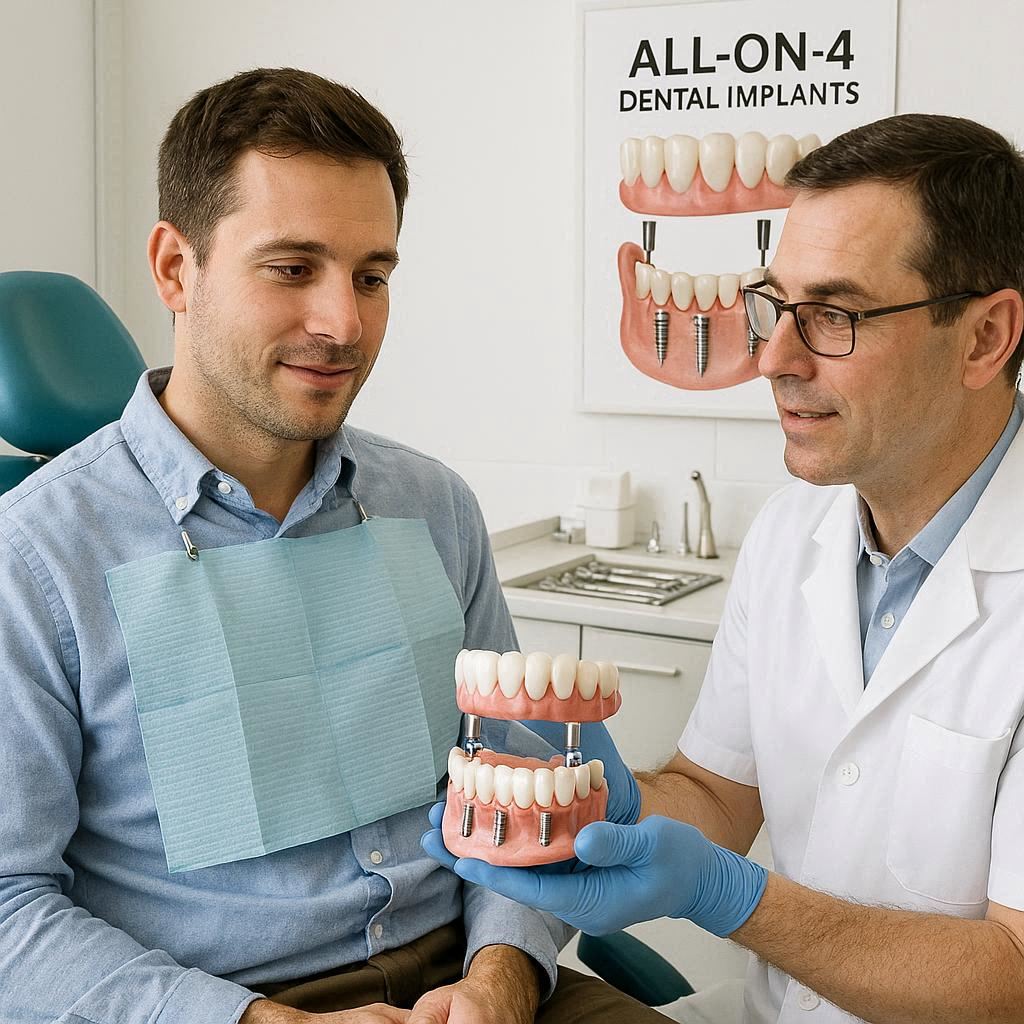
The name “All-on-4” means exactly what it says. Four dental implants are placed in your upper or lower jaw. These implants support a fixed bridge of either 10 to 14 teeth. You do not remove them at night. They feel like natural teeth.
Why four implants? Because the back two implants are tilted. This tilted design allows the dentist to use existing bone, even if some bone loss has occurred. Many patients avoid bone grafting because of this clever engineering.
Here is the most important thing to understand: The process is divided into two main phases.
- The surgical phase – Implants are placed, and a temporary bridge is attached.
- The restorative phase – Your final, permanent teeth are designed and fitted.
Between these two phases, several months of healing are required. This healing period is non-negotiable. It is what makes your implants strong enough to chew on for decades.
Important note: Every patient is unique. The timeline I describe here represents average cases. Your dentist may recommend a different schedule based on your bone density, medical history, and oral health.
The Complete Timeline: At a Glance
For those who want a quick answer, here is a summary table. Keep reading for detailed explanations of each step.
| Phase | Typical Duration | What Happens |
|---|---|---|
| Initial Consultation | 1 to 2 hours | Exams, scans, treatment planning |
| Preparatory Work | 1 to 6 weeks (if needed) | Extractions, bone grafting, or treatment of gum disease |
| Surgery Day | 2 to 4 hours per arch | Implant placement + temporary teeth attached |
| Initial Healing | 1 to 2 weeks | Soft food diet, minor discomfort, follow-up visit |
| Osseointegration Period | 4 to 6 months | Bone fuses to implants; temporary teeth function normally |
| Final Impressions | 1 to 2 hours | Digital or physical scans for the permanent bridge |
| Fabrication of Final Teeth | 2 to 4 weeks | Lab creates your custom zirconia or acrylic bridge |
| Final Fitting | 1 to 2 hours | Permanent teeth are screwed or cemented into place |
Total estimated time: 5 to 8 months.
Now, let us explore each phase in detail. You will learn what can speed things up and what can slow things down.
Phase 1: The Initial Consultation (1 to 2 Hours)
Your timeline begins the moment you decide to explore All-on-4. The first appointment is often the longest single visit. It is also one of the most important.
During this consultation, your implant dentist will perform several tasks.
- Medical history review. You will discuss any medications, allergies, or chronic conditions like diabetes.
- Intraoral examination. The dentist looks at your gums, remaining teeth, and overall oral health.
- 3D imaging (CBCT scan). This is a cone beam CT scan. It creates a three-dimensional model of your jaw bones, nerves, and sinuses.
- Discussion of goals. You will talk about the look, feel, and function you want.
By the end of this visit, your dentist will tell you one of three things:
- You are a good candidate for immediate surgery.
- You need preparatory treatments (extractions, bone grafting, or gum treatment).
- All-on-4 is not right for you.
Why this matters for your timeline: If you are already wearing dentures and have healthy bone, you might schedule surgery within two weeks. If you need bone grafting, add two to six months.
Phase 2: Preparatory Treatments (1 Week to 6 Months)
This is where timelines can vary widely. Not everyone needs preparatory work. But many people do. After all, most patients seeking All-on-4 have lived with missing or failing teeth for years.
Common Preparatory Procedures
Tooth Extractions
If you have remaining natural teeth, they usually need to be removed. In the All-on-4 procedure, extractions often happen on the same day as implant placement. This saves time. However, if you have active infection or abscesses, your dentist may extract the teeth first and let the area heal for four to six weeks before placing implants.
Bone Grafting
One of the original goals of All-on-4 was to avoid bone grafting by tilting the back implants. That works for many people. But not everyone. If you have severe bone loss in the front of your jaw, a small graft may be necessary.
- Minor grafting (adding bone particles to small defects): adds 4 to 6 weeks.
- Major sinus lift or block grafting: adds 4 to 9 months.
Treatment of Gum Disease
Active periodontal disease must be treated before implants are placed. Bacteria around implants cause a condition called peri-implantitis, which can lead to implant failure. Treating gum disease typically adds 4 to 8 weeks.
Removal of Failing Dentures
If you wear dentures that do not fit well, you may need a temporary reline or new denture to wear during the healing phase. This is a minor adjustment that adds one to two weeks.
A realistic word of advice: Do not rush the preparatory phase. I know waiting is frustrating. But placing implants into infected or weak bone is like building a house on mud. The house will fall. Be patient. Your future smile depends on it.
Phase 3: Surgery Day (2 to 4 Hours per Arch)
Finally, the big day arrives. This is the day most people think of when they ask, *how long does it take to get All-On-4 dental implants?* The surgery itself is surprisingly fast.
Here is what happens.
You will receive anesthesia. Most patients choose IV sedation. You will be conscious but deeply relaxed. Some people fall asleep. You will feel no pain.
The dentist then:
- Removes any remaining teeth (if not already done).
- Places the four implants into precise positions.
- Attaches a multi-unit abutment to each implant.
- Takes an impression or digital scan.
- Fits a temporary, fixed bridge onto the abutments.
You will wake up with teeth. They are not your final teeth, but they look natural. You can smile, speak, and eat soft foods immediately.
Total surgery time:
- One arch (upper or lower): 2 to 2.5 hours.
- Both arches (full mouth): 3.5 to 4.5 hours.
Same-Day Teeth: What You Need to Know
The temporary bridge is made of acrylic (a strong plastic) or a metal-reinforced resin. It is designed to:
- Protect the healing implants.
- Let you smile normally.
- Allow you to eat a soft diet.
- Maintain your jaw shape and facial height.
Important limitations of same-day teeth:
- You cannot chew hard or crunchy foods.
- The temporary bridge may need adjustment or repair.
- It will feel bulkier than your final teeth.
Do not expect perfection on day one. That comes later. The temporary bridge is a functional placeholder, not the final masterpiece.
Phase 4: Initial Healing (First 1 to 2 Weeks)
The first two weeks after surgery are critical. Your body is working hard. The implants are stabilizing. Your gums are sealing around the abutments.
What to Expect
Days 1 to 3: Swelling and mild discomfort are normal. You will take prescribed or over-the-counter pain medication. Stick to cold liquids, smoothies, yogurt, and protein shakes. Apply ice packs to your face.
Days 4 to 7: Swelling decreases. You can introduce warm, soft foods like mashed potatoes, scrambled eggs, oatmeal, and soup. Do not use a straw. Do not spit forcefully. Do not smoke.
Days 8 to 14: You feel much better. You return to the dentist for a suture removal and check-up. The dentist will ensure the temporary bridge is not putting excess pressure on the implants.
Common Questions During Initial Healing
Can I take the temporary teeth out?
No. These are fixed temporary teeth. Only your dentist can remove them.
What if a temporary tooth breaks?
Call your dentist immediately. The temporary bridge can usually be repaired chairside. If you ignore a broken tooth, the remaining stress may damage an implant.
When can I sleep normally?
You can sleep on your side after the first week. Many dentists recommend sleeping with your head elevated for the first three to five days to reduce swelling.
Phase 5: The Osseointegration Period (4 to 6 Months)
This is the longest phase. It is also the most important. Many patients try to rush this step. Do not.
Osseointegration (OSS-ee-oh-in-teh-GRAY-shun) is the process where your jawbone grows directly onto the surface of the titanium implants. Think of it like this: the bone and the implant become one solid structure.
Why This Takes So Long
Bone grows slowly. For lower (mandibular) implants, the standard waiting time is four months. For upper (maxillary) implants, it is often five to six months. Upper jawbone is softer and less dense than lower jawbone.
During this time, you wear your temporary bridge. You can eat most soft foods. You can smile, talk, and live normally. However, you must avoid:
- Chewing ice, nuts, hard candies, or crusty bread.
- Biting into apples, corn on the cob, or ribs.
- Using your teeth as tools to open packages.
Follow-Up Appointments
Your dentist will schedule check-ups approximately every six to eight weeks. At these visits, the dentist will:
- Check for mobility in the implants.
- Examine the gum tissue for signs of infection.
- Adjust the temporary bridge if it feels loose.
- Take X-rays to monitor bone growth.
What Can Delay Osseointegration?
Several factors can extend this healing period from four months to six or even eight months.
- Smoking. Nicotine constricts blood vessels, slowing bone healing.
- Uncontrolled diabetes. High blood sugar impcribes bone formation.
- Zoledronic acid (bone-strengthening drugs). These medications severely impair osseointegration.
- Poor oral hygiene. Gum disease around healing implants can cause failure.
- Grinding or clenching (bruxism). Excessive forces prevent stable bone growth.
If any of these apply to you, your dentist may recommend a longer healing period. Some patients need up to eight months before moving to the final teeth phase.
A note of encouragement: I know six months sounds like a long time. But consider this. After these months of healing, your implants will likely last 20, 30, or even 40 years. A few months of patience is a small price to pay for decades of confident eating and smiling.
Phase 6: Final Impressions (1 to 2 Hours)
The day has finally arrived. Your dentist takes a new X-ray or CBCT scan to confirm that all four implants are fully integrated. Once osseointegration is confirmed, you move to the restorative phase.
How Final Impressions Work
The dentist removes your temporary bridge. Don’t worry—this does not hurt. The implants are stable and covered with small healing caps.
The dentist then takes highly precise impressions. There are two methods.
Method 1: Traditional impression material. A special tray with silicone-like putty is placed over the implants. This putty hardens into an exact mold of your mouth.
Method 2: Digital scanning. A small wand is moved around your mouth. It captures thousands of images per second, creating a 3D computer model. Digital scans are faster and often more accurate.
After the scan, the dentist records three critical pieces of information:
- Bite registration. How your upper and lower jaws come together.
- Shade selection. The color of your new teeth.
- Molding of the gums. The pink part of your final bridge that looks like natural gum tissue.
All of this information is sent to a dental laboratory.
Temporary Teeth Removed? What Now?
If your temporary bridge was healthy and clean, some dentists will reline it and place it back on the implants while the lab works. Others will give you a standard removable denture for two to four weeks. Do not worry. You will not be without teeth.
Phase 7: Fabrication of Your Final Teeth (2 to 4 Weeks)
Now the laboratory takes over. Skilled dental technicians build your permanent bridge. This is not a mass-produced product. It is custom-made for your mouth.
Materials Used for Final All-on-4 Bridges
Two main materials are used today.
| Material | Durability | Appearance | Cost | Best For |
|---|---|---|---|---|
| Acrylic (PMMA) | Moderate (3-7 years) | Good | Lower | Budget-conscious patients; temporary use |
| Zirconia | Excellent (15+ years) | Excellent | Higher | Permanent bridge; patients who grind teeth |
| PEEK (Polyether ether ketone) | Good (5-10 years) | Moderate | Moderate | Patients with metal allergies |
Most patients today choose monolithic zirconia. It is incredibly strong (stronger than natural tooth enamel). It resists staining and chipping. And it looks beautiful.
What Happens in the Lab
- CAD design. The lab imports your digital scan into computer-aided design software. They design the bridge tooth by tooth.
- CAM milling. The design is sent to a milling machine. A solid block of zirconia is carved into your bridge.
- Sintering. The milled bridge is fired in a furnace at over 1,500°C. This gives zirconia its final strength and color.
- Glazing and staining. Technicians add realistic colors, translucency, and surface texture.
- Quality control. The bridge is checked for fit, bite, and aesthetics.
Fabrication takes two to four weeks. Complex cases (such as full-mouth reconstruction with custom gum shading) may take five weeks.
Phase 8: Final Fitting and Delivery (1 to 2 Hours)
You have arrived at the finish line. This appointment is exciting and usually emotional. After months of waiting, you see your final smile.
The process is straightforward.
- Your temporary bridge is removed.
- The permanent bridge is tried in your mouth.
- You and your dentist check:
- Fit on the abutments.
- Bite alignment.
- Color and shape.
- Speech comfort.
- Small adjustments are made (polishing, bite balancing).
- The bridge is permanently screwed into the implants.
- Screw access holes are filled with tooth-colored composite.
- Final photographs are taken for your records.
You are done. You leave with teeth that feel remarkably natural. They do not move when you chew. They do not click or rock. They are part of you.
What to Expect After the Final Fitting
On the first day, your mouth may feel slightly different. The final bridge is usually thinner and smaller than the temporary. Your tongue may touch the back of your teeth differently. This resolves in a few days.
You can now eat:
- Crunchy vegetables and fruits.
- Steak and other firm meats.
- Nuts and seeds (but be reasonable).
- Crusty bread and pizza.
You should still avoid:
- Chewing ice or hard candy.
- Opening packages with your teeth.
- Biting fishing line or thread.
Your new teeth are strong, but they are not indestructible. Treat them like natural teeth, not tools.
Comparing All-on-4 to Other Tooth Replacement Options
To give you perspective, here is how the All-on-4 timeline compares to other common solutions.
| Procedure | Total Time | Number of Surgeries | Temporary Teeth | Longevity |
|---|---|---|---|---|
| All-on-4 | 5-8 months | One surgery | Yes (fixed) | 20+ years |
| Traditional Implants (Single) | 4-7 months | One to two surgeries | Removable denture | 20+ years |
| Implant-Supported Overdenture | 4-6 months | One surgery | Yes (removable) | 10-15 years |
| Traditional Removable Denture | 4-6 weeks | None | N/A | 5-8 years |
| Fixed Bridge (Teeth Supported) | 2-3 weeks | None | Yes (temporary bridge) | 10-15 years |
As you can see, All-on-4 is not the fastest option. Traditional dentures are much quicker to fabricate. But dentures do not stop bone loss. They slip and click. Many people find them uncomfortable.
All-on-4 takes longer up front, but it delivers a permanent solution that feels like your own teeth.
Factors That Can Shorten or Extend Your Timeline
No two patients are the same. Here are the most common factors that change how long it takes to get All-on-4 dental implants.
Factors That Speed Up the Timeline
Good bone density. If your CBCT scan shows excellent bone volume, you may skip all preparatory grafting. This can reduce your total time to as little as 4 to 5 months.
Only one arch. Replacing just the upper or just the lower teeth takes less surgical time and often heals faster than both arches.
Digital workflow. Some advanced clinics use same-day CAD/CAM milling. They can fabricate a final-quality hybrid bridge while you wait. This compresses the final phase from weeks to hours. Not all patients qualify, and this technology is expensive.
No extractions. If you already have no teeth, the surgery is simpler and healing may be slightly faster.
Factors That Slow Down the Timeline
Heavy smoking. Smokers have significantly higher implant failure rates. Many dentists require smoking cessation for three months before and six months after surgery. This alone adds 9 months to your timeline.
Uncontrolled medical conditions. Diabetes, autoimmune disorders, and osteoporosis medications can double healing times.
Bone grafting. As mentioned earlier, major grafting adds 4 to 9 months.
Infection. If an implant shows signs of peri-implantitis during healing, treatment can add 2 to 3 months.
Laboratory delays. High-quality dental labs are often busy. In peak seasons, fabrication can take 5 to 6 weeks instead of 2 to 4.
Realistic expectation: Most patients fall into the 6 to 7 month range. Do not believe anyone who promises you final, permanent teeth in two weeks. That is not possible. Bone healing is biology. Biology cannot be rushed.
What About “Teeth in a Day” Claims?
You have seen the advertisements. “Teeth in a Day!” “Same-day smile!” These headlines are technically true, but they are also misleading.
Here is the reality.
Yes, you can receive a fixed bridge on the same day as your implant surgery. That is real. That is the temporary bridge we discussed in Phase 3.
But those are not your permanent teeth. The advertisement does not explain that you will return in four to six months for the final bridge.
What “Teeth in a Day” typically includes:
- Removal of failing teeth.
- Placement of four implants.
- Attachment of a temporary acrylic bridge.
What “Teeth in a Day” does NOT include:
- Your final zirconia bridge.
- The completed osseointegration period.
- Long-term warranty or final bite adjustment.
I am not saying these clinics are dishonest. The phrase is just marketing shorthand. As long as you understand the full timeline, you can make an informed decision.
If a clinic promises you can eat steak on your new teeth within a week, walk away. That is not realistic. That is dangerous.
Recovery and Healing: A Week-by-Week Guide
Let me paint a clearer picture of what your daily life looks like during the five to eight month journey.
Week 1: The Recovery Week
- Diet: Liquids and pureed foods only.
- Pain: Moderate. Controlled with medication.
- Activity: Rest. No exercise. No bending over.
- Speech: Slight lisp from temporary bridge. Improves daily.
- Sleep: Sleeping upright recommended.
Weeks 2 to 4: Getting Back to Normal
- Diet: Soft foods (eggs, pasta, fish, cooked vegetables).
- Pain: Minimal. Most stop pain meds after day 5.
- Activity: Light walking. No heavy lifting.
- Speech: Normal for most people.
- Sleep: Back to normal sleeping positions.
Months 2 to 4: The Quiet Healing Phase
- Diet: Soft to medium-firm foods. Still avoiding hard items.
- Pain: None.
- Activity: Full exercise permitted after week 6.
- Appointments: Quick check-ups every 6-8 weeks.
- Emotional state: Most patients feel impatient. This is normal.
Months 5 to 6: The Home Stretch
- Diet: Same restrictions. You are so close.
- Appointments: Final impressions and try-in appointments.
- Emotional state: Excitement builds.
- Preparation: You may be asked to stop eating dark-colored foods or coffee before shade matching.
Month 7 or 8: Delivery and Beyond
- Diet: Full diet allowed after final bridge is cemented.
- Maintenance: Regular hygiene appointments every 6 months.
- Lifestyle: Eat, smile, laugh, live. You are done.
Maintaining Your All-on-4 Bridge for Maximum Longevity
Once you have invested five to eight months in your new smile, you want it to last. Here is how to protect your investment.
Daily Cleaning Is Mandatory
Even though your bridge does not come out, food and bacteria can still get underneath it. You will need special tools.
- Super floss or implant floss. This floss has stiff ends that you thread under the bridge.
- Water flosser (Waterpik). Use this daily on a medium setting to flush out debris.
- Single-tufted brush. A small brush cleans around the abutments.
Professional Maintenance Schedule
| Interval | Procedure |
|---|---|
| Every 6 months | Hygiene cleaning, X-rays, exam |
| Every 12 months | Check screw retention torque |
| Every 3-5 years | Polishing of acrylic (if applicable) |
| Every 5-10 years | Possible reline of acrylic (if worn) |
Signs Something Is Wrong
Contact your implant dentist immediately if you notice:
- A clicking or movement when you chew.
- Food packing under the bridge that you cannot clean.
- Red, swollen, or bleeding gums around implants.
- A metallic taste or bad breath that does not resolve.
- Visible cracks or chips in the bridge.
Most minor issues (chipped teeth, loose screws) can be repaired in one short appointment. Major issues (implant failure, broken bridge) require more time.
Frequently Asked Questions (FAQ)
1. Can I get All-on-4 in one day for both arches?
Yes. You can have surgery on both your upper and lower jaws in a single appointment. The surgery takes approximately 3.5 to 4.5 hours. You will receive two temporary bridges that day.
2. How long does it take to get All-On-4 dental implants if I need bone grafting?
Add four to nine months to the standard timeline. The grafting must heal and integrate before implants are placed. Total time can reach 12 to 14 months.
3. Will I be without teeth at any point?
No. Your temporary bridge is placed on the same day as surgery. It stays in your mouth until your final bridge is ready. You are never toothless during the process.
4. How long do the temporary teeth last?
Temporary acrylic bridges are designed to last four to eight months. With careful use (soft diet, no grinding), they can last up to a year. They are not meant for long-term use.
5. Is the final bridge permanent?
Yes and no. The implants are permanent (designed for life). The bridge can be replaced if it wears out or breaks. Zirconia bridges often last 15 to 20 years or longer.
6. How long does it take to get All-On-4 dental implants covered by insurance?
Insurance pre-authorization takes two to six weeks. Most dental insurance plans cover only a portion of implant treatment. Medical insurance may cover the surgical portion if tooth loss resulted from an accident or medical condition.
7. Can I speed up healing with supplements?
Vitamin D, calcium, and protein support bone healing. Some dentists recommend these. However, no supplement can safely reduce the osseointegration period below four months. Do not take anything without your dentist’s approval.
8. What happens if an implant fails during healing?
Implant failure occurs in approximately 2 to 5% of cases. If an implant fails, your dentist will remove it, allow the area to heal (2 to 3 months), and place a new implant. This adds approximately six months to your total timeline.
9. How long after All-on-4 can I eat normally?
You can eat a full, unrestricted diet only after your final bridge is delivered. That is typically five to eight months after surgery. Before that, stick to soft to medium-firm foods.
10. Is the process faster for the lower jaw only?
Slightly. Lower jawbone is denser. Osseointegration may be confirmed at four months instead of five to six months. You might save four to eight weeks compared to the upper jaw.
Additional Resource
For a deeper dive into the costs, pros and cons, and alternative treatments, I recommend visiting the American Academy of Implant Dentistry’s patient education page.
👉 Link: https://www.aaid.com/patient-resources/
This non-profit organization provides unbiased, evidence-based information about dental implants. You can also find a directory of qualified implant dentists near you.
Conclusion
So, how long does it take to get All-On-4 dental implants? The complete journey from first consultation to final permanent teeth takes between 5 and 8 months for most patients. The majority of this time is passive healing (osseointegration), during which you wear a functional temporary bridge. While you cannot rush bone healing, the long-term result—a fixed, natural-feeling smile that lasts decades—is well worth the wait.
Disclaimer: This article is for informational purposes only and does not constitute medical or dental advice. Every patient is unique. Consult a qualified implant dentist for a personalized treatment plan and accurate timeline based on your specific oral health conditions. The author and publisher are not liable for any outcomes resulting from the use of this information.