How Much Do Braces Cost In Different Nations?
The world of orthodontics is not confined by borders. In an increasingly globalized society, people move for work, study, or retirement, and they often wonder how the cost of living—and specifically healthcare—compares to their home country. Additionally, the rise of “dental tourism” has made patients curious about the price of braces abroad.
The cost of braces varies dramatically from country to country. These differences are driven by economic factors, the cost of education for dentists, government subsidies, and the local cost of living. This guide provides a global comparison of orthodontic costs, analyzing the reasons behind the price gaps and offering insight into where you can get the best value.
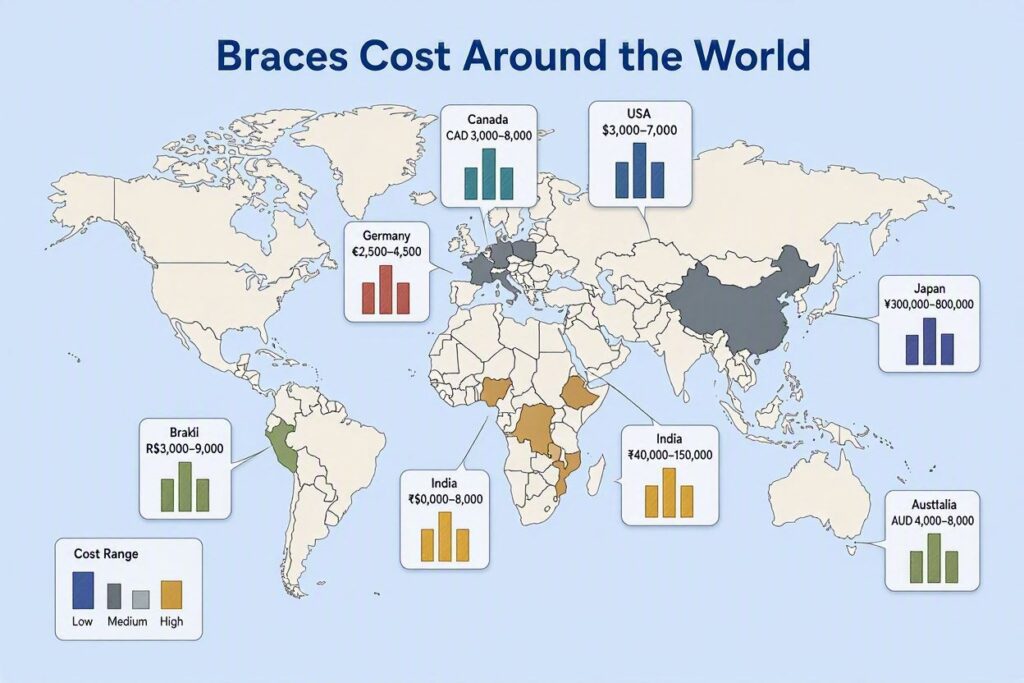
The Global Price Index for Braces
To compare prices accurately, we must use a standardized metric. For this guide, we will look at the average cost for standard traditional metal braces for a 12-18 month treatment in US Dollars (USD). This is the most common treatment in every country.
Here is a snapshot of how different nations stack up.
The High-Tier (Most Expensive)
These are countries with high GDPs, high labor costs, and strict regulatory standards.
- United States: $4,000 – $7,500.
- Australia: $4,500 – $8,000 AUD (approx. $3,000 – $5,500 USD).
- Canada: $3,500 – $7,000 CAD (approx. $2,600 – $5,200 USD).
- United Kingdom (Private): £2,500 – £4,500 (approx. $3,000 – $5,500 USD).
- Germany (Private): €4,000 – €7,000 (approx. $4,300 – $7,500 USD).
The Mid-Tier (Moderate)
These are developed nations with lower overheads or significant government subsidies.
- Japan: ¥500,000 – ¥1,000,000 (approx. $3,500 – $7,000 USD). Note: Often covered by national insurance for children.
- South Korea: ₩4,000,000 – ₩8,000,000 (approx. $3,000 – $6,000 USD).
- Spain: €2,500 – €4,500 (approx. $2,700 – $4,800 USD).
- Singapore: SGD $4,000 – $8,000 (approx. $3,000 – $6,000 USD).
The Low-Tier (Most Affordable)
These are developing nations or countries with a lower cost of living. These are the targets of dental tourism.
- Mexico: $1,500 – $3,500 USD.
- Thailand: $1,500 – $3,000 USD.
- India: $800 – $2,000 USD.
- Turkey: $1,000 – $2,500 USD.
- Colombia: $1,000 – $2,000 USD.
Why Do Prices Vary So Much?
The disparity in cost is not random. It is rooted in economics and healthcare systems.
1. The Cost of Dental Education
In the United States, a dentist graduates with an average of $300,000 in student loan debt. To pay off that debt and still earn a living, they must charge high fees.
In contrast, in countries like India or Mexico, dental education is heavily subsidized or is far less expensive. Graduates enter the workforce with little to no debt, allowing them to charge much lower prices while maintaining a good standard of living.
2. Operational Overhead
This includes rent, staff salaries, insurance, and utilities.
- In New York or London: Renting a dental office can cost $10,000 – $50,000 per month.
- In Bogota or Istanbul: Renting a similar space might cost $1,000 – $5,000 per month.
This difference is passed directly onto the patient.
3. Malpractice Insurance
In the US, orthodontists pay astronomical sums for malpractice insurance. In some countries, this cost is negligible. This overhead has to be recouped through higher fees.
4. Government Regulation and Tariffs
The cost of importing braces (brackets, wires) can be high in some countries. Furthermore, the cost of regulatory compliance (FDA in the US, CE marking in Europe) adds to the price of the materials.
The “Value” of Healthcare Systems
The structure of a nation’s healthcare system is often more important than the raw price.
1. Universal Healthcare Systems (UK, Germany, Canada, Spain)
- The Benefit: Children and teens often receive orthodontic treatment for free or at a heavily reduced cost if the case is severe enough (like the KIG system in Germany or the NHS in the UK).
- The Drawback: Adults usually have to pay privately, and the prices, while lower than the US, are still significant. Waiting lists for public treatment can be years long.
2. The US Model (Insurance-Driven)
- The Benefit: High-quality care and many options.
- The Drawback: The financial burden falls heavily on the individual. Insurance is often tied to employment, and coverage for adults is limited.
3. Pay-As-You-Go (Developing Nations)
- The Benefit: Very low prices.
- The Drawback: Regulation can be lax. You must do your research to ensure the clinic is safe and hygienic.
A Deeper Dive into Dental Tourism for Braces
For expensive treatments like braces, traveling abroad (dental tourism) is a growing trend.
The Logic:
If you need braces in the US and you do not have insurance, you might pay $6,000. If you fly to Mexico, you might pay $2,500 for the braces. Even with the cost of a flight and a hotel, you could save money.
- But wait: Braces are not a “one-and-done” procedure. You need monthly adjustments. Traveling to Mexico every month for a year is not practical or cheap.
- The Reality: Dental tourism works best for single-visit procedures like crowns or implants. It rarely works for orthodontics unless you are moving to the country anyway.
The “Lingual” and “Aligner” Exception:
Some international clinics offer “remote monitoring” for clear aligners. You visit the clinic once to get scanned, they send you the aligners in the mail, and you send photos of your teeth every few weeks. This is making cross-border orthodontics more feasible.
Important Note for Travelers: “If you start orthodontic treatment in a foreign country and something goes wrong when you are back home, a local orthodontist may refuse to touch it. They do not know the system, the brackets, or the wires. You are often starting over from scratch.” – Dr. Emma Laing, DDS, orthodontist and global health advocate.
A Comparative Table: Braces Cost and Quality
| Country | Average Cost (Metal Braces) | Quality of Care | Insurance/Subsidy | Best For |
|---|---|---|---|---|
| USA | $4,000 – $7,500 | Excellent | Moderate (Employer plans) | Those with insurance. |
| UK | $3,000 – $5,500 (Private) | Excellent | High (NHS for kids) | Residents with children. |
| Germany | $4,300 – $7,500 (Private) | Excellent | Very High (GKV for kids) | Residents under public insurance. |
| Mexico | $1,500 – $3,500 | Good (in tourist zones) | Low | Cash-payers near the border. |
| Thailand | $1,500 – $3,000 | Good (in major cities) | Low | Expats and tourists. |
| India | $800 – $2,000 | Variable | Low | Budget travelers. |
| South Korea | $3,000 – $6,000 | Excellent (Tech-forward) | High (National Insurance) | Those wanting tech (Invisalign, digital). |
The Cost of “Invisible” Braces Globally
Metal braces are the baseline. What about Invisalign or other clear aligners?
- US: $4,000 – $8,000.
- UK: £3,000 – £5,000.
- South Korea: $2,500 – $5,000. (South Korea is known for cheap, high-quality digital dentistry).
- Brazil: $2,000 – $4,000. (Brazil is a global leader in cosmetic dentistry).
How to Choose Where to Get Braces
Your decision should not be based solely on price. Consider the following:
- Your Residency Status: If you live in a country with public healthcare (like Germany or the UK), and you are a child or a teen, your local system is almost certainly the best deal.
- The Type of Braces: If you need complex jaw surgery or lingual braces, you probably want to be near your provider. If you want simple Invisalign, a remote or international provider might work.
- The Cost of Failure: If something breaks or you have an emergency, being able to drive across town to your orthodontist has massive value. This “convenience premium” justifies the higher price in developed nations.
Conclusion
The cost of braces varies from under $1,000 in India to over $7,000 in the United States, driven by labor costs, education debt, and regulation. While dental tourism offers tempting savings, orthodontics requires ongoing supervision, making local treatment a more practical choice for most patients. Residents in countries with universal healthcare often benefit from significant subsidies for children.
Frequently Asked Questions (FAQ)
1. Which country has the cheapest braces in the world?
Generally, India and the Philippines offer the lowest prices for private orthodontics, with metal braces often costing under $1,500.
2. Are braces cheaper in Mexico or Costa Rica?
They are similar. Costa Rica is known for having very high standards of care for dental tourism and slightly higher prices than Mexico, but both are significantly cheaper than the US.
3. Can I use my US insurance in another country?
Usually not. Most US PPO plans do not have international coverage. Some international clinics will give you a “Superbill” to file a claim for reimbursement, but you will likely have to pay upfront.
4. Are the materials used in other countries the same?
In reputable clinics, yes. You will see brands like 3M, Ormco, and Invisalign used worldwide. A cheap clinic might use generic brackets that are less precise.
5. Why are braces so expensive in Australia?
Australia has a very high cost of living, high wages for dental professionals, and strict regulatory standards, all of which drive up the price of healthcare.
Additional Resource
For global information on orthodontics and to find certified orthodontists worldwide, visit the World Federation of Orthodontists: https://www.wfo.org/