How Much Does A Crown Cost In Australia?
You need a dental crown. Maybe you’ve cracked a tooth on a piece of hard candy. Perhaps you’ve just had a root canal and need to protect what’s left. Or you have a large filling that’s finally worn out. Whatever the reason, you’re now facing a decision—and a bill.
If you live in Australia, you’re probably wondering: How much will this actually cost?
Australia has a unique dental landscape. There’s no universal public dental scheme for adults. Medicare doesn’t cover most dental work. Private health insurance plays a big role. And prices vary dramatically from city to city, dentist to dentist.
In this comprehensive guide, we’ll break down everything you need to know about dental crown costs in Australia. We’ll look at real prices across the states and territories, explain what affects costs, compare materials, and help you understand your insurance coverage. We’ll also cover payment plans, how to save money, and what to expect during the process.
What Is a Dental Crown?
Before we talk money, let’s make sure we’re clear on what a crown actually is.
A dental crown is a custom-made cap that covers a damaged or weakened tooth. It restores the tooth’s shape, size, strength, and appearance. Once cemented in place, it becomes the tooth’s new outer surface.
Crowns are used for:
- Protecting a weak tooth from breaking
- Restoring a broken or worn-down tooth
- Covering a tooth after root canal treatment
- Holding a dental bridge in place
- Covering a dental implant
- Improving the appearance of a discolored or misshapen tooth
A crown is a significant investment. But it can save a tooth that would otherwise need to be extracted. And with proper care, it can last 10-15 years or more.
Types of Crowns Available in Australia
Australian dentists offer the full range of crown materials.
Porcelain crowns are the most natural-looking. They’re made entirely of ceramic and can be color-matched to your other teeth. They’re ideal for front teeth.
Porcelain-fused-to-metal (PFM) crowns have a metal base with porcelain fused on top. They’re strong and look good, though the metal can sometimes show at the gum line.
Gold crowns are made of gold alloy. They’re extremely durable and gentle on opposing teeth. They’re usually used for back teeth where appearance matters less.
Zirconia crowns are made from a strong, white ceramic. They’re very durable and look natural. They’re becoming increasingly popular in Australia.
Composite crowns are made from resin. They’re less expensive but also less durable. They’re usually a temporary solution.
The Big Question: How Much Does a Dental Crown Cost in Australia?
Now let’s get to the numbers.
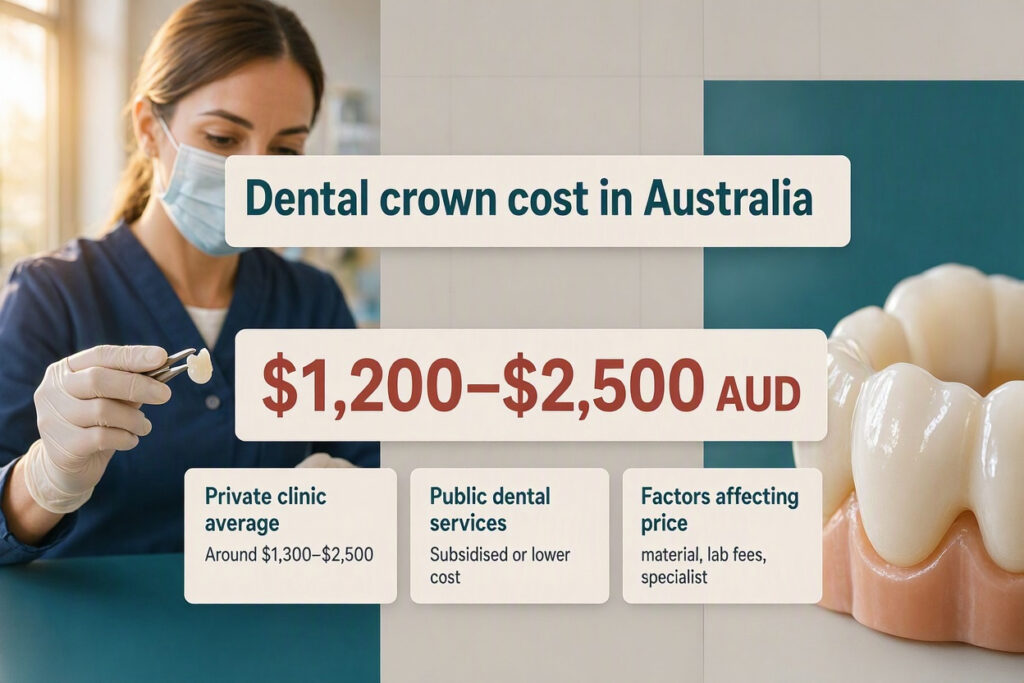
Dental crown prices in Australia typically range from $800 to $3,000 per crown. The average is around $1,400 to $2,000.
Here’s a breakdown by material:
| Type of Crown | Low End | Average | High End |
|---|---|---|---|
| Composite | $800 | $1,000-$1,300 | $1,800 |
| Porcelain-fused-to-metal | $1,000 | $1,400-$1,800 | $2,500 |
| All-porcelain | $1,200 | $1,500-$2,000 | $2,800 |
| Zirconia | $1,300 | $1,600-$2,200 | $3,000 |
| Gold | $1,200 | $1,500-$2,000 | $2,800 |
These prices usually include:
- Consultation and examination
- X-rays
- Tooth preparation
- Impressions
- Temporary crown
- Final crown
- Fitting and adjustments
Some dentists charge separately for each step. Always ask for a written treatment plan with itemized costs.
Why Prices Vary in Australia
You might get quotes of $1,000 from one dentist and $2,500 from another. Here’s why:
Location: A crown in Sydney costs more than one in regional Queensland. Overhead costs, demand, and local economies all play a role.
Dentist’s experience: A seasoned prosthodontist charges more than a newly qualified general dentist.
Materials: Zirconia and gold cost more than composite. The lab fees also vary.
Complexity: A simple crown on a healthy tooth costs less. A crown after root canal treatment, or on a tooth with little structure left, costs more.
Lab quality: High-quality dental labs charge more. But they also produce better-fitting, more natural-looking crowns.
Additional procedures: You may need a root canal, a post, or gum treatment before the crown. These add to the cost.
Dental Crown Costs by State and Territory
Australia is a large country with diverse markets. Here’s what you can expect to pay in different states and territories.
| State/Territory | Average Crown Cost (PFM) | Average Crown Cost (Zirconia) |
|---|---|---|
| New South Wales (Sydney) | $1,500 – $2,000 | $1,800 – $2,500 |
| Victoria (Melbourne) | $1,400 – $1,900 | $1,700 – $2,400 |
| Queensland (Brisbane) | $1,300 – $1,800 | $1,600 – $2,200 |
| Western Australia (Perth) | $1,300 – $1,800 | $1,600 – $2,200 |
| South Australia (Adelaide) | $1,200 – $1,700 | $1,500 – $2,100 |
| Tasmania (Hobart) | $1,200 – $1,700 | $1,500 – $2,100 |
| Australian Capital Territory (Canberra) | $1,400 – $1,900 | $1,700 – $2,400 |
| Northern Territory (Darwin) | $1,500 – $2,000 | $1,800 – $2,500 |
Why the Difference?
Sydney and Melbourne have the highest costs. Rent, staff salaries, and insurance are more expensive. Demand for cosmetic dentistry is also high, which drives up prices.
Brisbane and Perth offer a middle ground. Prices are moderate, and competition keeps them in check.
Adelaide and Hobart tend to be more affordable. The cost of living is lower, and so are dental fees.
Darwin and Canberra have higher costs due to their remote locations and higher cost of living.
What Affects the Cost of a Dental Crown in Australia?
Let’s look at the factors that determine what you’ll pay.
1. The Material
This is the biggest factor.
- Composite: $800-$1,800
- Porcelain-fused-to-metal: $1,000-$2,500
- All-porcelain: $1,200-$2,800
- Zirconia: $1,300-$3,000
- Gold: $1,200-$2,800
2. Your Location
As shown above, prices vary by state and city. Urban areas cost more. Rural areas cost less.
3. The Dentist’s Qualifications
A general dentist might charge $1,500 for a crown. A prosthodontist might charge $2,500 or more. The extra cost reflects advanced training and expertise.
4. The Complexity of Your Case
If your tooth needs:
- Root canal treatment: $500-$1,500
- A post and core: $300-$600
- Gum contouring: $300-$700
- Bite adjustment: $150-$400
The total cost increases.
5. The Dental Lab
Some dentists use high-end labs that produce exceptionally natural crowns. Others use budget labs. The lab fee is part of what you pay.
6. Temporary Crown
Most dentists provide a temporary crown while your permanent one is being made. This is usually included in the price, but some charge extra.
7. Sedation or Anaesthesia
If you’re anxious, you may opt for sedation. This adds $300-$800 to the cost.
8. Private Health Insurance
If you have private health insurance, your out-of-pocket cost will be lower. But coverage varies.
Does Insurance Cover Dental Crowns in Australia?
Dental insurance in Australia works differently from many other countries. Let’s break it down.
Medicare
Medicare does not cover dental crowns for adults. It covers some dental services for children through the Child Dental Benefits Schedule (CDBS), but crowns are not included.
Private Health Insurance
Private health insurance is the main way Australians cover dental costs. There are two types of policies:
Hospital cover: Covers treatment in hospitals. Doesn’t cover dental.
Extras cover: Covers dental, optical, physiotherapy, and other services. This is what you need for dental crowns.
How Extras Cover Works
- You pay a monthly premium.
- You may have a waiting period (usually 2-12 months for major dental).
- You pay a co-payment for each procedure.
- The insurer pays a benefit, up to a annual limit.
Typical Coverage
- Preventive care (cleanings, exams): 100% covered
- Basic care (fillings, extractions): 80% covered
- Major care (crowns, bridges, root canals): 50% covered
Annual Limits
Most extras policies have annual limits, often $1,000 to $2,000. Once you hit that limit, you pay 100% out of pocket.
Waiting Periods
Most policies have waiting periods for major dental. You might have to wait 12 months before a crown is covered.
What If You Don’t Have Insurance?
You’ll pay the full cost. But many Australian dentists offer payment plans or discounts for uninsured patients. Ask about these options.
How to Save on a Dental Crown in Australia
You don’t have to pay full price. Here are practical ways to reduce your costs.
1. Get Multiple Quotes
Prices vary. Get at least three quotes before deciding.
2. Consider a Dental School
Australian dental schools offer discounted treatment performed by supervised students. Savings can be 30-50%.
- University of Sydney School of Dentistry
- University of Melbourne Dental School
- University of Queensland School of Dentistry
- University of Western Australia Dental School
- Griffith University School of Dentistry
3. Ask About Payment Plans
Many Australian dentists offer in-house financing. You can spread the cost over several months. Some plans are interest-free.
4. Use a Health Fund
If you have private health insurance, use it. Choose a fund with good major dental coverage.
5. Join a Dental Membership Plan
Some Australian dentists offer in-house membership plans. You pay a monthly or annual fee and get discounted treatments.
6. Choose a Less Expensive Material
Composite or PFM crowns cost less than zirconia or gold. They may not last as long, but they’re a good budget option.
7. Negotiate
It never hurts to ask. Some dentists offer discounts for upfront payment or multiple crowns.
8. Time It Right
If you have insurance with an annual limit, use it before the year ends. You can also spread treatment across two calendar years to maximize benefits.
9. Consider Dental Tourism
Some Australians travel to Thailand, Bali, or other destinations for dental work. But consider the risks: follow-up care is difficult, and quality varies.
10. Prevent Problems
The best way to save is to avoid needing a crown. Brush, floss, and get regular checkups. But if you already need one, don’t delay. Problems get worse over time.
The Process: What to Expect When Getting a Crown in Australia
Understanding the process helps you plan and budget.
Step 1: Consultation and Examination
Your dentist examines your tooth. They take X-rays and discuss your options. You’ll get a treatment plan and a quote.
Time: 30-45 minutes
Step 2: Tooth Preparation
Your dentist reshapes your tooth to make room for the crown. This is done under local anaesthesia.
Time: 30-60 minutes
Step 3: Impressions
Your dentist takes a mould of your tooth and the opposing teeth. This goes to the dental lab.
Time: 15-30 minutes
Step 4: Temporary Crown
A temporary crown is fitted to protect your tooth while the permanent one is made.
Time: 15-30 minutes
Step 5: Lab Fabrication
The lab creates your custom crown. This takes 1-2 weeks.
Time: 1-2 weeks
Step 6: Fitting
Your dentist tries on the crown. They check the fit, colour, and bite. Then they cement it in place.
Time: 30-60 minutes
Total Timeline
From start to finish, expect 2-4 weeks. Some Australian dentists offer same-day crowns using CAD/CAM technology, but these may cost more.
Same-Day Crowns in Australia
Same-day crowns are becoming popular in Australia. Using CAD/CAM technology, your dentist can design, mill, and fit a crown in a single appointment.
How It Works
- Your tooth is prepared.
- A digital scan is taken.
- The crown is designed on a computer.
- A milling machine creates the crown from a ceramic block.
- The crown is fitted and cemented.
Cost
Same-day crowns typically cost $1,800 to $3,000. The convenience comes at a premium.
Pros
- Single appointment
- No temporary crown
- Immediate results
Cons
- Higher cost
- Not all dentists offer it
- May not be suitable for complex cases
Important Notes for Readers
Get Everything in Writing: Always request a written treatment plan with itemized costs. Verbal quotes mean nothing if there’s a dispute.
Ask About Guarantees: Some dentists offer warranties on their crown work. Ask what’s covered and for how long.
See a Specialist if Needed: If your case is complex, consider seeing a prosthodontist. They have advanced training in crowns and bridges.
Maintain Good Oral Hygiene: Crowns require the same care as natural teeth. Brush, floss, and see your dentist regularly.
Avoid Hard Foods: Don’t chew ice, hard sweets, or other tough objects. They can crack your crown.
Wear a Mouthguard: If you grind your teeth, protect your crown with a night guard.
Be Patient: A good crown takes time. Don’t rush the process.
Ask About Maintenance: Crowns need periodic checkups and may need replacement after 10-15 years. Ask about these costs upfront.
Frequently Asked Questions
How much does a dental crown cost in Australia?
A dental crown in Australia costs between $800 and $3,000, depending on the material, your location, and your dentist’s experience. The average is around $1,400 to $2,000.
Does Medicare cover dental crowns?
No. Medicare does not cover dental crowns for adults. It covers some dental services for children through the Child Dental Benefits Schedule, but crowns are not included.
Does private health insurance cover crowns?
Most extras policies cover a portion of crown costs. You may have a waiting period and an annual limit. Check your policy.
Can I get a crown at a dental school in Australia?
Yes. Australian dental schools offer discounted treatment performed by supervised students. Savings can be 30-50%.
How long does a crown last?
With proper care, a crown can last 10-15 years or more. Zirconia and gold crowns may last longer.
Does a crown hurt?
The procedure is done under local anaesthesia, so you won’t feel pain. You may have some sensitivity afterward, which usually settles.
Can I whiten my teeth after getting a crown?
Yes, but the crown won’t whiten. If you whiten your natural teeth, the crown may no longer match. It’s best to whiten before getting a crown.
What happens if my crown falls off?
Save the crown and call your dentist. They can usually re-cement it. Don’t try to glue it back yourself.
How do I find a good dentist in Australia?
Look for:
- Recommendations from friends or family
- Positive online reviews
- Before-and-after photos
- Transparent pricing
- A willingness to answer your questions
What if I can’t afford a crown?
Consider:
- Dental schools
- Payment plans
- Health funds
- Saving up
- Dental tourism
Are same-day crowns as good as traditional crowns?
Same-day crowns are convenient and can be just as good. But they require expensive equipment, so they may cost more.
How much does a root canal cost in Australia?
A root canal in Australia costs $500 to $1,500, depending on the tooth. This is often needed before a crown.
What’s the best crown material for back teeth?
Gold and zirconia are the most durable for back teeth. PFM is also a good option.
What’s the best crown material for front teeth?
All-porcelain and zirconia are the best for front teeth because they look the most natural.
Can I get a crown if I have gum disease?
You need to treat gum disease before getting a crown. Otherwise, the crown may fail.
How do I care for my crown?
Brush and floss regularly. Avoid hard foods. Wear a mouthguard if you grind your teeth. See your dentist for regular checkups.
What if my crown feels too high?
Call your dentist. They can adjust the bite. Don’t try to fix it yourself.
Can I eat normally with a crown?
Yes, but avoid very hard or sticky foods. Crowns are strong, but they’re not indestructible.
How much does a temporary crown cost?
Temporary crowns are usually included in the total crown cost. If charged separately, they cost $150 to $400.
Does the Child Dental Benefits Schedule cover crowns?
No. The CDBS covers basic dental services for children, but not crowns.
Can I use my superannuation to pay for a crown?
In some cases, you may be able to access your superannuation early for medical expenses. Check with your super fund.
What is the Australian Dental Association’s fee guide?
The ADA publishes a fee guide that dentists can use as a reference. However, dentists are not required to follow it. Fees vary.
How do I complain about a dentist in Australia?
Contact the dental practice first. If you’re not satisfied, contact the Australian Health Practitioner Regulation Agency (AHPRA) or your state’s health complaints commission.
Conclusion
Dental crown costs in Australia range from $800 to $3,000, with the average around $1,400 to $2,000. Prices vary by state, material, and dentist. Sydney and Melbourne are the most expensive cities. Adelaide and Hobart are more affordable. Medicare doesn’t cover crowns for adults, but private health insurance can help. With payment plans, dental schools, and careful planning, a crown can be within reach.
Additional Resources
For more information on dental crowns and finding a dentist in Australia, visit the Australian Dental Association at ada.org.au.