what is the average price of full mouth dental implants
Deciding to restore your entire smile with dental implants is a life-changing choice. It is also a significant financial investment.
If you have been searching online, you have probably seen prices ranging from $15,000 to $90,000. That is a huge gap. It can feel confusing and frustrating.
You want a clear, honest answer. You want to know what you will actually pay.
This guide will give you a realistic breakdown of the average price of full mouth dental implants. We will look at different treatment types, hidden fees, and smart ways to budget. No confusing jargon. Just real talk to help you make the best choice for your health and your wallet.
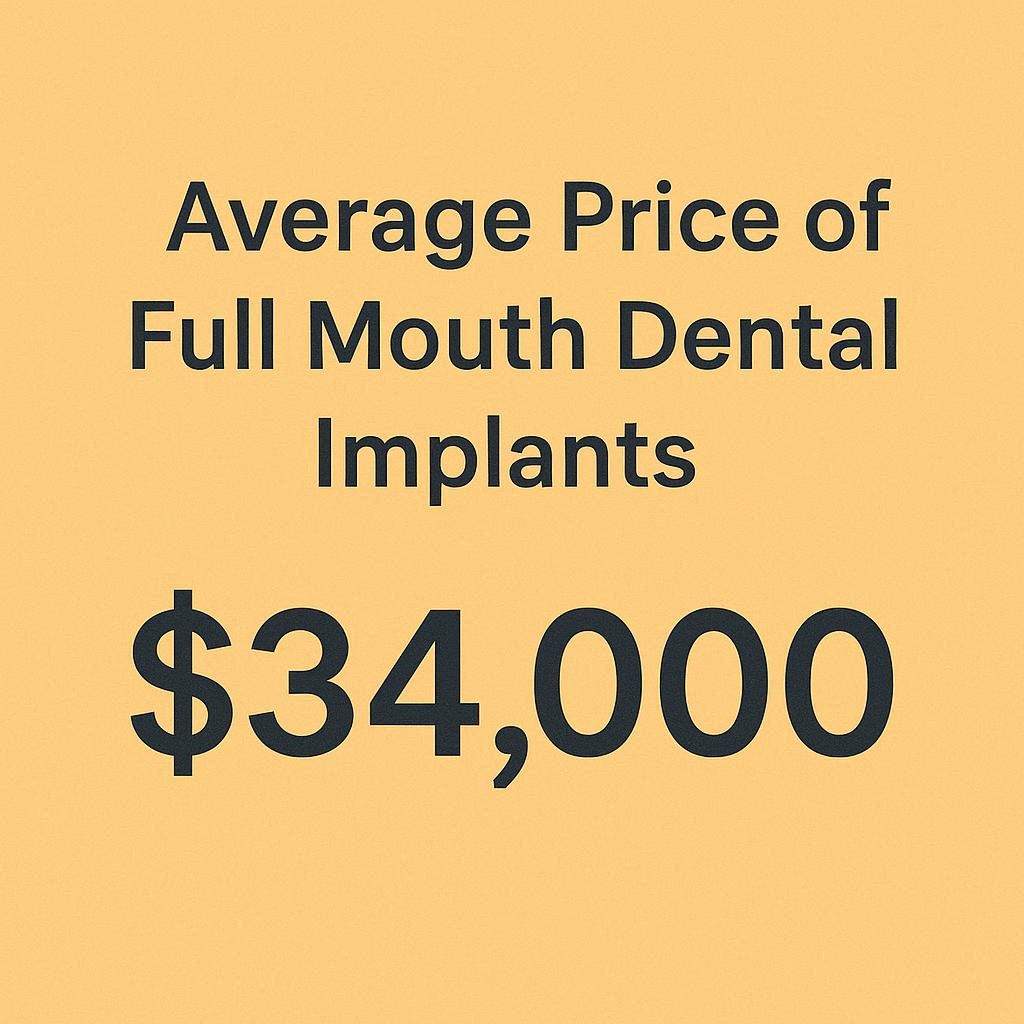
Why the Price of Full Mouth Dental Implants Varies So Much
Let us start with the big question. Why does the cost change so dramatically from one dental office to another?
The short answer is that “full mouth dental implants” is not one single product. It is a custom surgical plan. Your mouth is unique. Your bone density, gum health, and specific needs will directly change the final bill.
Think of it like buying a car. A basic used car and a luxury SUV both get you from point A to point B. But the price, features, and long-term value are completely different. The same logic applies here.
The Three Main Types of Full Mouth Implant Solutions
To understand the price, you first need to know which solution your dentist is recommending.
Here is the honest breakdown.
1. Traditional Full Mouth Implants (Individual Crowns)
This is the gold standard. It uses 6 to 8 implants on the top arch and another 6 to 8 on the bottom arch. Each implant supports an individual crown.
- What it feels like: The closest thing to natural teeth.
- Cost: Highest on the scale.
- Time: 6 to 12 months.
2. Implant-Supported Fixed Dentures (All-on-4 or All-on-6)
This is the most popular modern solution. It uses just 4 or 6 implants per arch. These implants support a full bridge of 12 to 14 teeth. You do not remove this bridge. It stays fixed in your mouth.
- What it feels like: Very stable, but slightly bulkier than individual crowns.
- Cost: Mid-to-high range.
- Time: 4 to 8 months.
3. Implant-Retained Overdentures
This uses 2 to 4 implants per arch. The implants snap onto a special denture. You can remove the denture for cleaning.
- What it feels like: More stable than regular dentures, but can still move slightly.
- Cost: Lowest of the three options.
- Time: 3 to 5 months.
The Real Average Price of Full Mouth Dental Implants (2026 Data)
Now, let us look at the numbers. These are national averages in the United States. Keep in mind that prices in major cities like New York or Los Angeles will be higher. Rural areas may be lower.
Here is a clear table to help you compare.
| Treatment Type | Average Price Per Arch (Top or Bottom) | Average Total Price (Full Mouth) |
|---|---|---|
| Implant-Retained Overdentures | $4,500 – $8,000 | $9,000 – $16,000 |
| All-on-4 / All-on-6 Fixed Bridges | $12,000 – $20,000 | $24,000 – $40,000 |
| Traditional Individual Implants (6-8 per arch) | $18,000 – $35,000 | $36,000 – $70,000 |
Important Note: The table above shows the base price. It usually includes the surgery, the implant parts, and the final teeth. However, it often does not include extra procedures. Read the next section carefully.
What Is Usually NOT Included in the Average Price
This is where many people get surprised. The quoted price for full mouth dental implants is rarely the final price you pay.
You must ask your dentist this exact question: “What is not included in this quote?”
Here are the most common additional costs.
Bone Grafting and Sinus Lifts
When you lose teeth, the jawbone shrinks. For an implant to be successful, you need enough bone. Many people do not have enough.
- Bone graft: Adds new bone material to your jaw. Price: $500 – $3,000 per area.
- Sinus lift: Adds bone to the upper back jaw near your sinuses. Price: $1,500 – $3,000 per side.
If you have been missing teeth for years, expect to pay for these procedures.
Tooth Extractions
If you still have failing teeth, they must come out before implants go in.
- Simple extraction: $75 – $300 per tooth.
- Surgical extraction (for broken teeth): $200 – $600 per tooth.
Some all-on-4 packages include extractions. Always check.
Temporary Teeth
During the healing period, you need something to smile with. Some dentists include a temporary denture. Others charge extra. A temporary set can cost $500 – $2,000.
Final Teeth Material
The final bridge or crown can be made from different materials.
- Acrylic: Lower cost, but can wear down or stain. Included in most budget packages.
- Zirconia: Very strong, natural looking, and long lasting. It usually costs $5,000 – $10,000 more per arch.
CT Scan and Surgical Guides
Modern implant surgery uses a 3D CT scan for safety and precision. This scan is rarely included in the low advertised prices. Expect to pay $300 – $1,000.
Breaking Down the Costs by Procedure Step
It helps to see where every dollar goes. A full mouth implant case involves many different professionals and materials.
Here is a list of what you are paying for.
- The Implant Fixtures (the screw in the bone): $300 – $600 each. A full mouth uses 8 to 16 implants.
- The Abutments (connector pieces): $200 – $600 each.
- The Final Teeth (crowns or bridge): $500 – $3,000 per tooth, or $8,000 – $20,000 per bridge.
- The Oral Surgeon’s Fees: $2,000 – $5,000 for surgical time.
- The Prosthodontist’s Fees (making the teeth): $3,000 – $10,000 for design and fitting.
- Anesthesia or Sedation: $500 – $1,500 for the whole case.
- Follow-up Visits and Adjustments: Usually included, but confirm this.
When you add all of these up, it becomes clear why a full mouth restoration is a major medical procedure. It is not just “buying teeth.” It is paying for years of training, advanced technology, and premium materials.
Low-Cost Options and Dental Tourism
You have probably seen ads for $7,000 full mouth implants in countries like Mexico, Costa Rica, or Turkey.
Is this real?
Yes, the price is real. But you must understand the trade-offs.
The Pros of Dental Tourism
- You can save 50% to 70% compared to US prices.
- Some clinics are modern and use the same brands as US dentists.
- You can combine the procedure with a vacation.
The Cons of Dental Tourism
- No easy follow-up care. If an implant fails or a tooth breaks, you cannot easily go back.
- Different standards. Not all countries have the same infection control or training requirements.
- Language barriers. Miscommunication about your goals can lead to poor results.
- Travel stress. Healing from major surgery on a long flight is not comfortable.
A Realistic Suggestion: If you consider dental tourism, stay for at least 10 to 14 days after surgery. This allows you to handle any immediate problems. Also, find a local dentist at home who agrees to see you for emergencies before you travel.
How to Pay for Full Mouth Dental Implants
Few people have $30,000 in cash ready for dental work. That is normal. Here are the most common ways people pay for this treatment.
1. Dental Insurance
Most dental insurance plans are not helpful here. They usually cap out at $1,500 to $2,000 per year. That is a drop in the bucket.
However, if your missing teeth are due to an accident or a medical condition, your medical insurance might cover part of the surgery. Ask your provider about “oral surgery benefits.”
2. Dental Savings Plans
This is not insurance. It is a membership plan. You pay an annual fee (around $100 to $300) and get 15% to 50% off dental procedures. Many implant specialists accept these plans.
3. Health Savings Account (HSA) or Flexible Spending Account (FSA)
This is a smart way to pay. You use pre-tax dollars for medical expenses. If you have an HSA or FSA, you can use it for the entire implant procedure. This saves you 20% to 40% right away.
4. In-House Financing and Payment Plans
Many dental offices work with companies like CareCredit, Alphaeon, or LendingClub. These offer medical credit cards or loans.
- Promotional periods: 6 to 24 months with no interest if paid in full.
- Long-term plans: 3 to 7 years with interest rates from 5% to 18%.
Always read the fine print. If you miss a payment on a no-interest plan, you may be charged all the back interest.
5. Dental Schools
This is the lowest cost option in the US. Dental schools need patients for their residents to train on.
- Cost: Often 40% to 60% less than a private practice.
- Time: Much longer. A 3-hour procedure might take 6 hours.
- Quality: Very high. Every step is checked by experienced faculty.
Search for “dental school implant clinic” in your state.
The Hidden Value: Why Price Should Not Be Your Only Guide
It is natural to look for the cheapest option. But with dental implants, the cheapest price can become the most expensive mistake.
Here is why.
- Implant failure. If a low-quality implant fails, removing it and fixing the bone costs thousands.
- Poor aesthetics. Teeth that are the wrong shape, color, or size. You will look at them every day.
- Hard to clean. Badly designed bridges trap food and lead to gum disease.
- No long-term warranty. A budget clinic may not exist in five years.
A reputable dentist charges more because they use proven implant brands like Straumann, Nobel Biocare, or Zimmer. They give you a written warranty. They see you for follow-up care.
Think of this as a 20 to 30 year investment. Spreading a high-quality $40,000 case over 30 years equals about $1,333 per year. That is about $111 per month for a fully functional, beautiful smile.
Can you put a price on being able to eat an apple? Or laugh without covering your mouth?
Questions You Must Ask Your Dentist Before Signing Anything
You are about to make a major decision. Go to at least two or three consultations. Bring a notebook. Ask these exact questions.
- “Is this quote a global fee, or are there separate charges for surgery, parts, and the final teeth?”
- “Does this price include all temporary teeth from start to finish?”
- “What brand of implants do you use? Do you offer a warranty on the implants and the teeth?”
- “What happens if an implant fails within the first year? Who covers the cost of replacement?”
- “Do you do the surgery yourself, or do you bring in an outside surgeon?”
- “What type of material is the final bridge? Acrylic or zirconia?”
- “Are bone grafts, sinus lifts, and extractions included in this price?”
- “How many full mouth implant cases have you completed in the last two years? Can I see before and after photos?”
A confident, ethical dentist will answer every question clearly. If they get defensive or rush you, walk away.
A Realistic Timeline of the Process and Payments
Understanding the timeline helps you plan your budget. You do not pay everything on day one.
Month 1: Consultation and Planning
- You pay for the CT scan and consultation ($300 – $1,000).
- You receive a full treatment plan with the total price.
Month 2: Preliminary Work (if needed)
- You pay for extractions, bone grafts, or sinus lifts ($2,000 – $8,000).
Month 3: Implant Surgery Day
- You pay the surgical fee, implant parts, and temporary teeth (often 50% of the total cost).
Months 4 to 7: Healing
- No major payments. Your bone fuses to the implants (osseointegration).
Month 8: Final Teeth Placement
- You pay the remaining 50% for the final bridge or crowns.
Month 9 and Beyond: Follow-up
- Minor fees for adjustments or cleanings (usually $100 – $300 per visit).
This phased payment schedule makes the process easier to manage. You are not writing one giant check on the first day.
Conclusion
The average price of full mouth dental implants ranges from $24,000 for an All-on-4 solution to $70,000 for traditional individual implants. However, the final cost depends on your bone health, material choices, and location. Always plan for extra procedures like bone grafts and remember that the cheapest option often leads to the highest long-term expense.
Frequently Asked Questions (FAQ)
1. Does Medicare or Medicaid cover full mouth dental implants?
Original Medicare does not cover dental implants. Some Medicare Advantage plans (Part C) offer limited dental benefits. Medicaid coverage varies by state and usually only covers implants for patients under 21 or with specific medical needs.
2. How long do full mouth dental implants last?
With proper home care and regular dental cleanings, the implants themselves can last 20 years to a lifetime. The final teeth (crowns or bridges) typically last 10 to 15 years before needing replacement.
3. Is the All-on-4 procedure painful?
The surgery is performed under sedation or local anesthesia, so you feel no pain during the procedure. Most patients report mild to moderate soreness for 3 to 5 days after, similar to having a tooth pulled. Over-the-counter pain medication usually manages this well.
4. Can I get full mouth implants if I have bone loss?
Yes, in most cases. Your dentist will recommend bone grafting or a sinus lift to build up the bone first. In severe cases, special implants called zygomatic implants (which anchor into the cheekbone) can be used.
5. Why do some clinics advertise $15,000 for a full mouth?
These advertisements are usually for implant-retained overdentures on just one arch (top or bottom), not both. Or they are a promotional price for a very basic package that excludes the final teeth, extractions, and bone grafts. Always request a written, itemized quote.
6. What is better: All-on-4 or individual implants?
Individual implants are better for long-term health and ease of cleaning, but they cost more and take longer. All-on-4 is excellent for patients who want a faster, more affordable solution and are willing to accept a slightly bulkier bridge. Your bone condition will also determine which is possible.
Additional Resource
For a deeper dive into comparing different implant brands and finding an accredited specialist near you, visit the American Academy of Implant Dentistry (AAID) patient resources page. They offer a free “Find a Dentist” tool and downloadable guides about treatment options.