What Is The Cost Of Braces At Marquette?
The journey to a straighter smile is an exciting one, but it also involves a series of important decisions. Where will you receive your treatment? Who will be your orthodontist? What type of braces will you choose? These questions are intertwined, and the answers will shape your experience and your budget.
For many individuals and families, particularly those in the Midwest, the name “Marquette” carries significant weight. It is a name associated with quality education, clinical excellence, and a commitment to serving the community. When it comes to orthodontics, this association often leads people to explore the option of receiving treatment through Marquette University’s School of Dentistry.
This raises a very specific and practical question: What is the cost of braces at Marquette? The answer requires an understanding of the unique environment that a university dental school provides. This comprehensive guide will explore the costs associated with getting braces at Marquette University, compare them to private practice, and explain the pros and cons of choosing a dental school for orthodontic care.
Understanding the Marquette Advantage: The Dental School Model
Marquette University, located in Milwaukee, Wisconsin, is home to a renowned School of Dentistry. It is a training ground for the next generation of dental professionals. This educational mission is the key to understanding its pricing structure.
The Difference Between a Dental School and a Private Practice
In a private orthodontic practice, you are treated by a licensed, experienced orthodontist. The fees you pay reflect their expertise, the overhead of running a private business, and the market rate for services in that area.
A dental school operates on a different model.
- The Providers: Your primary care is provided by dental students or residents (graduate students) who are specializing in orthodontics.
- The Supervision: Every step of the treatment is closely supervised by licensed, experienced faculty orthodontists. These are often the very professors who write the textbooks and lead the field.
- The Cost: Because the care is provided by students in a learning environment, the fees are significantly lower than those in a private practice. The lower cost is a trade-off for the additional time required for appointments and the fact that your provider is still in training.
What Is The Cost Of Braces At Marquette? A Realistic Estimate
So, what can you expect to pay for braces at the Marquette University School of Dentistry? While prices are always subject to change, we can provide a realistic range based on typical dental school pricing models.
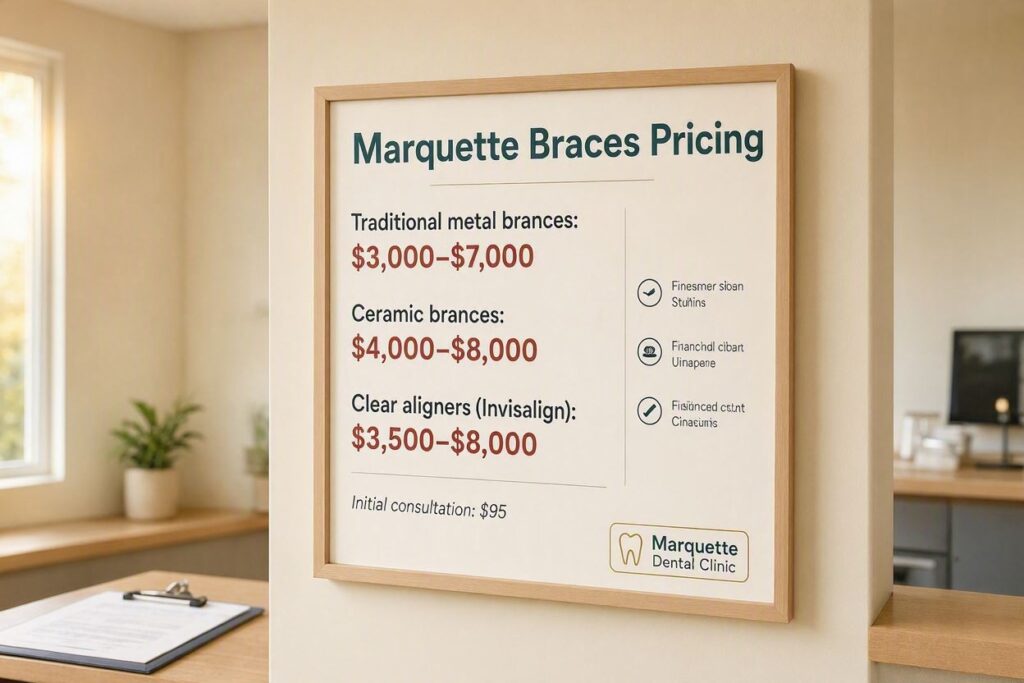
- Estimated Cost Range: $2,500 to $4,500
This is a significant savings compared to the average private practice cost in Wisconsin, which typically falls between $4,000 and $7,000.
The Cost Advantage Explained
The savings you see at Marquette are not because you are receiving “cheaper” care. You are receiving care that is subsidized by the educational mission of the university. The value proposition is simple: you provide a learning opportunity for a future orthodontist, and in return, you receive a reduced rate.
What Does the Fee Include?
Just like in a private practice, the comprehensive fee at Marquette covers the entire course of treatment. It typically includes:
- Diagnostic Records: All x-rays, photographs, and impressions needed to plan your treatment.
- The Appliance: The braces themselves (metal, ceramic, or aligners if applicable).
- All Adjustment Appointments: Every visit to tighten or adjust your braces for the duration of treatment.
- Retainers: The retainers you receive at the end of treatment.
- Emergency Visits: Repairs for broken brackets or poking wires.
The Marquette Experience: What to Expect as a Patient
Choosing a dental school is a different experience from going to a private office. It is essential to understand what this entails before you commit.
The Application and Waitlist Process
Due to the lower cost, dental schools are often in high demand. The first step is typically to call the orthodontic clinic to inquire about becoming a patient. You will likely be placed on a waitlist. The wait time can vary from a few months to over a year, depending on the demand and the type of cases they are looking for (for teaching purposes).
The Screening Appointment
Once you are selected from the waitlist, you will attend a screening appointment. This is an evaluation to determine if your case is a good fit for the educational needs of the residents. They are looking for a variety of cases, from simple to complex. If accepted, you will move forward to the records appointment.
The Time Commitment
This is the most significant trade-off. Appointments at a dental school take longer than in a private practice.
- Why: The resident must perform the work, and then a faculty member must come over to check every step. This check-and-verify process is crucial for quality control but adds time to each visit.
- What to Expect: Plan for appointments to be 1.5 to 2 hours long. Adjustments may not be as quick as a 20-minute visit at a private office.
- Schedule: Appointment times are often less flexible. You may have fewer options for early morning or evening slots.
Weighing the Pros and Cons: Is Marquette Right for You?
To make an informed decision, you need to weigh the benefits against the potential drawbacks.
The Advantages
- Significant Cost Savings: This is the primary driver. You can save 30-50% on the cost of orthodontic treatment.
- High-Quality Care: You are being treated by a team. The resident is highly motivated and up-to-date on the latest techniques, and the supervising faculty are experts in the field. You effectively get “two sets of eyes” on your case.
- Comprehensive Treatment Planning: Cases are reviewed by a board of faculty members, ensuring a thorough and well-considered treatment plan.
The Disadvantages
- Longer Appointments: The process is slower and more methodical.
- Less Schedule Flexibility: You must fit into the academic calendar.
- Student Turnover: The resident treating you will eventually graduate. While a new resident will take over your case under the same faculty supervision, the transition can feel disruptive.
- The Waitlist: You may have to wait a significant amount of time to even be screened.
“For a patient who is on a budget and has the time and patience, a dental school is a phenomenal resource. The quality of care is exceptional. The main thing is the time commitment. If you need to be in and out quickly, it’s not for you. But if you value the savings, it’s worth it.” — A Common Perspective from Dental Professionals
Comparing Marquette to Other Options in the Milwaukee Area
To fully understand the value, let’s compare the cost of braces at Marquette to other options in the Milwaukee area.
| Option | Average Cost | Key Features |
|---|---|---|
| Marquette University | $2,500 – $4,500 | Lowest cost. Longer appointments. Supervised students. |
| Private Orthodontist | $4,000 – $7,000 | Highest cost. Short appointments. Flexible schedule. |
| Corporate Dental Chain | $3,500 – $6,000 | Mid-range cost. May have high turnover of staff. |
| Other Dental Schools (e.g., UW-Madison) | $2,500 – $4,500 | Similar to Marquette, but requires travel to Madison. |
Private Practice in Milwaukee
If you choose a private practice in the Milwaukee area, you are paying for convenience and experience. A private orthodontist can often offer more advanced technologies (like digital scanning) and a more personalized experience.
Frequently Asked Questions (FAQ)
1. Does Marquette offer Invisalign or clear aligners?
Yes. The orthodontic residents are trained in clear aligner therapy and it is often offered as a treatment option, depending on the case.
2. Who exactly will be putting on my braces?
Your braces will be placed by an orthodontic resident—a dentist who is completing a 2-3 year specialty residency in orthodontics. A faculty member who is a certified orthodontist will supervise and check their work.
3. Is the quality of care as good as a private practice?
Yes. The care is excellent. Because it is a teaching environment, every decision is checked and re-checked. The downside is not the quality, but the speed and convenience.
4. How do I get on the waitlist at Marquette?
You should call the Marquette University School of Dentistry’s orthodontic clinic directly. They will ask for your information and contact you when a screening appointment becomes available.
5. Will my dental insurance still cover my treatment at Marquette?
Yes. You can still use your dental insurance benefits. The total cost is lower to begin with, so your insurance may cover a larger percentage of the treatment. Your out-of-pocket cost will be even lower.
6. Do I need a referral from my general dentist?
While not always required, a referral from your general dentist is a good idea. It ensures that your overall dental health (e.g., no untreated cavities) is stable before you begin orthodontic treatment.
Additional Resource
For more information on the orthodontic program and patient services, visit the official Marquette University School of Dentistry website.
Conclusion
The cost of braces at Marquette University is significantly lower than at a private practice, typically ranging from $2,500 to $4,500, offering a valuable opportunity for budget-conscious patients. This lower cost comes with the trade-off of longer appointment times and a less flexible schedule, as treatment is provided by supervised orthodontic residents. For those willing to invest the extra time, Marquette provides access to high-quality, expertly supervised orthodontic care at a fraction of the standard price.