What Is The Cost Of Zirconia Crowns?
When it comes to restoring a damaged tooth, the material you choose matters. For decades, the standard options were porcelain fused to metal (PFM) or gold. But in recent years, a new champion has emerged in the world of restorative dentistry: Zirconia.
Zirconia crowns have become incredibly popular for their unique combination of strength, durability, and aesthetics. But this premium performance comes with a premium price tag. If your dentist has recommended a crown, you are likely researching your options and wondering what a Zirconia crown will cost. This guide will break down the pricing, explain the different types of Zirconia, and help you decide if it is worth the investment.

What is a Zirconia Crown?
Zirconia is a type of ceramic material known as zirconium dioxide. It is incredibly hard and resistant to fracture. In dentistry, it is milled from a solid block using advanced CAD/CAM (Computer-Aided Design/Computer-Aided Manufacturing) technology.
There are two main categories of Zirconia crowns, and they have different costs:
- Traditional (Layered) Zirconia: This involves a strong Zirconia core that is layered with porcelain on the outside to improve the aesthetics. While it looks good, the porcelain layer can sometimes chip off over time.
- Full-Contour (Monolithic) Zirconia: This is made entirely from a single block of Zirconia. It is virtually indestructible. Modern “multilayer” or “high-translucency” Zirconia blocks (like BruxZir or Katana) are designed to look incredibly natural without needing a fragile porcelain coating.
The Average Cost of a Zirconia Crown
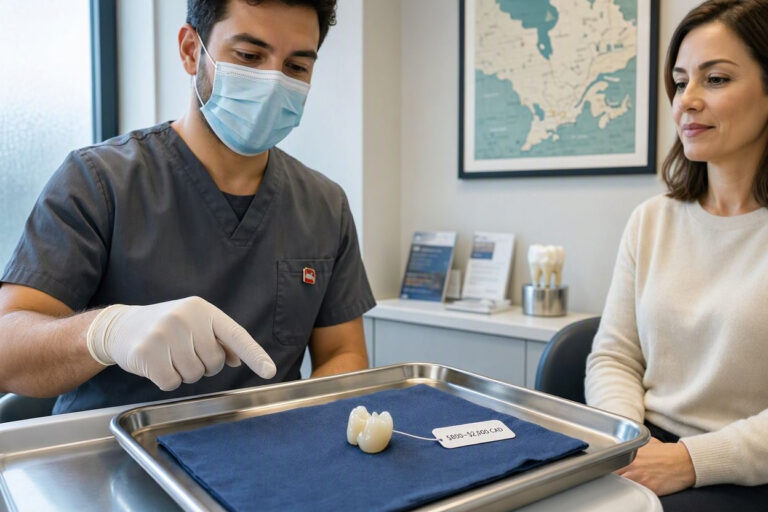
In the United States, the cost of a Zirconia crown typically ranges from $1,000 to $2,500 per tooth. The national average sits around $1,500.
This price is comparable to, or slightly higher than, a standard porcelain fused to metal (PFM) crown, but usually less than a pure E-max (lithium disilicate) crown, which is prized for its aesthetics in the front of the mouth.
To understand the true total cost, you must remember that this price usually covers just the crown itself. The total “cost of treatment” includes several other components.
Breaking Down the Total Cost of Treatment
The dental crown is the final product, but the process to get there involves multiple steps and fees.
1. The Examination and Consultation
Before you agree to treatment, the dentist must examine the tooth.
- Cost: $50 – $150.
- Purpose: To determine if the tooth is salvageable and if a crown is the right treatment.
2. Diagnostic X-Rays
An x-ray is crucial to see the health of the tooth root and the surrounding bone.
- Cost: $25 – $100.
3. Core Build-Up
If a large portion of the natural tooth is missing due to decay or fracture, the dentist must “build up” the tooth with filling material so the crown has something to grip onto.
- Cost: $200 – $500.
4. The Zirconia Crown
This is the main event.
- Cost: $1,000 – $2,500.
5. The Dental Lab Fee
Some dentists bundle the lab fee into the crown price, while others itemize it. The lab is where the crown is custom-milled to fit your exact bite.
- Cost: $200 – $400 (if itemized separately).
Total Estimated Cost for One Zirconia Crown:
In a straightforward case with no root canal: $1,200 – $2,800.
In a complex case requiring a root canal and core build-up: $2,000 – $4,500+.
Why Does Zirconia Cost More Than a Basic Crown?
If a basic metal crown is cheaper, why is Zirconia more expensive? The answer lies in the technology.
1. The Milling Process
Unlike a PFM crown, which is cast in a mold, a Zirconia crown is milled from a pre-sintered block. This requires the dentist or lab to have access to a highly precise milling machine (often costing $100,000+) and the software to design the crown digitally.
2. Material Science
The raw Zirconia blocks are expensive. Brands like BruxZir, Katana, and Lava have spent millions on research and development to create blocks that are both strong and beautiful.
3. No Need for a Second Material
Unlike PFM, which requires two materials (metal and porcelain), Full-Contour Zirconia is one piece. This actually simplifies the manufacturing but requires the block itself to be perfect.
A Cost Comparison Table: Zirconia vs. Other Materials
| Crown Material | Average Cost (per tooth) | Strength | Aesthetics | Best Used For |
|---|---|---|---|---|
| Full Gold Alloy | $1,000 – $2,500 | Excellent | Poor (very visible) | Back molars, heavy grinders. |
| PFM (Porcelain Fused to Metal) | $800 – $1,400 | Good | Good (may show dark line) | Back teeth, budget-conscious. |
| Zirconia (Monolithic) | $1,000 – $2,500 | Superior | Very Good (improving every year) | Back teeth, bruxers, anyone wanting strength. |
| E-max (Lithium Disilicate) | $1,200 – $2,000 | Good | Superior (most translucent) | Front teeth, aesthetic zones. |
Important Note for Patients: “If a patient is a grinder or a clencher, or if they are replacing a molar, Zirconia is almost always my first choice. It can withstand forces that would shatter other ceramics. The cost is justified by the longevity.” – Dr. Lee Ann Brady, DMD, Director of Education at the Pankey Institute.
Does Dental Insurance Cover Zirconia Crowns?
Insurance coverage for Zirconia is a common source of confusion.
The “Downgrade” Clause
Most dental insurance plans operate on a “Least Expensive Alternative Treatment” (LEAT) or “Downgrade” policy. This means the insurance company will only pay the benefit amount for the cheapest material that would do the job (usually a full metal crown).
How This Works in Practice:
- Let’s say your dentist charges $1,800 for a Zirconia crown.
- Your insurance plan covers “Major” services at 50%.
- However, the insurance company’s “allowed amount” for a basic metal crown is only $1,200.
- The insurance will pay 50% of $1,200, which is $600.
- You are responsible for the remaining $1,200 (the difference between the Zirconia price and the insurance payment).
In this scenario, the insurance coverage is the same whether you get a $1,200 metal crown or an $1,800 Zirconia crown. You pay the difference for the “upgrade” to the better material.
Is a Zirconia Crown Worth the Extra Money?
When deciding if the cost is worth it, consider the lifespan and the function of the tooth.
The Case for Zirconia:
- Unmatched Durability: Zirconia is virtually unbreakable. If you are hard on your teeth (clenching, grinding, chewing ice), Zirconia is the only material that guarantees it will not crack.
- Biocompatibility: Zirconia is metal-free. For patients with metal allergies or sensitivities, this is essential.
- Conservation of Tooth Structure: Because Zirconia is so strong, the dentist often does not need to shave down as much of the natural tooth compared to a PFM crown.
- Longevity: A well-made Zirconia crown can easily last 15 to 20 years or a lifetime.
The Case Against Zirconia:
- Aesthetics: While much better than it used to be, full-contour Zirconia can sometimes look slightly more “opaque” (less translucent) than E-max or natural teeth. For a single front tooth, a skilled cosmetic dentist might prefer E-max to match the light transmission of the adjacent natural teeth.
- Hardness: It is so hard that if the bite is not perfect, it can wear down the opposing natural tooth over time. This is why precision in the lab is critical.
How to Save Money on a Zirconia Crown
The cost of a Zirconia crown can be managed with a few smart strategies.
- Shop Around (But Compare Quality): Get quotes from 2-3 dentists. Ask specifically: “What brand of Zirconia are you using?” and “Are you using a local lab or a high-end national lab?” A cheaper crown from a discount lab might not fit as well.
- Dental Schools: You can get a Zirconia crown at a dental school for 50-70% off. The cost might be $500 – $800. The trade-off is that the appointment will take 2-3 hours, and a student will do the work (under close supervision).
- Use an HSA or FSA: If you have a Health Savings Account (HSA) or Flexible Spending Account (FSA), use it. These accounts use pre-tax dollars, giving you an immediate 20-30% discount on the procedure.
- Negotiate a Payment Plan: Most dental offices offer third-party financing (like CareCredit) with 0% interest for 12-18 months. This allows you to get the better material now and pay it off over time without interest.
Conclusion
The cost of a Zirconia crown generally ranges from $1,000 to $2,500 per tooth, positioning it as a premium restorative option. Its superior strength and biocompatibility make it an excellent long-term investment, especially for back teeth and patients who grind their teeth. While insurance may downgrade the benefit, the extended lifespan of Zirconia often makes it a better value than cheaper materials over time.
Frequently Asked Questions (FAQ)
1. Are Zirconia crowns safe?
Yes. Zirconia has been used in medicine for decades (for hip replacements) and is highly biocompatible. It does not corrode and is safe for patients with metal allergies.
2. Can a Zirconia crown be whitened?
No. Like all ceramic crowns, Zirconia is stain-resistant but cannot be bleached. If you want whiter teeth, you must do the whitening before the dentist matches the color of the crown.
3. Does a Zirconia crown hurt?
The procedure requires local anesthesia, just like a standard crown. You should not feel pain during the preparation. You may have some temporary sensitivity afterward.
4. What is the difference between BruxZir and regular Zirconia?
BruxZir is a specific brand of solid monolithic Zirconia made by Glidewell Labs. It is known for being extremely strong. “Regular” Zirconia often refers to layered or aesthetic Zirconia. BruxZir is usually marketed for heavy grinders.
5. How long does it take to get a Zirconia crown?
If the dentist has a CEREC machine (an in-office milling unit), you can have the crown designed, milled, and placed in a single visit (about 2 hours). If they use a dental lab, it usually takes 1-2 weeks to get the crown back.
Additional Resource
For more information on the science and benefits of Zirconia restorations, visit the American College of Prosthodontists: https://www.gotoapro.org/