What Is The Typical Cost Of Braces?
The decision to get braces is a significant one. It is an investment in your smile, your oral health, and your self-confidence. For many, it is a journey that has been years in the making. Whether you are a parent considering braces for your child or an adult finally ready to address a smile that has bothered you for a lifetime, the question of cost is almost always the first and most pressing concern.
Unlike a routine dental filling or a simple extraction, braces are a major financial commitment. The price is not a single, fixed number. It is a variable figure that shifts based on a complex interplay of factors. This can make it difficult to budget and plan. You might hear a friend quote one price and be shocked when your orthodontist quotes another.
This comprehensive guide is designed to cut through the confusion. We will provide a realistic, honest breakdown of the typical cost of braces. We will explore the different types of braces, the factors that drive the price up or down, and the strategies you can use to make this life-changing treatment more affordable. Our goal is to equip you with the knowledge you need to navigate the financial landscape of orthodontics with confidence.
The Big Picture: So, What Is The Typical Cost?
Let’s address the main question head-on. What can you realistically expect to pay for braces?
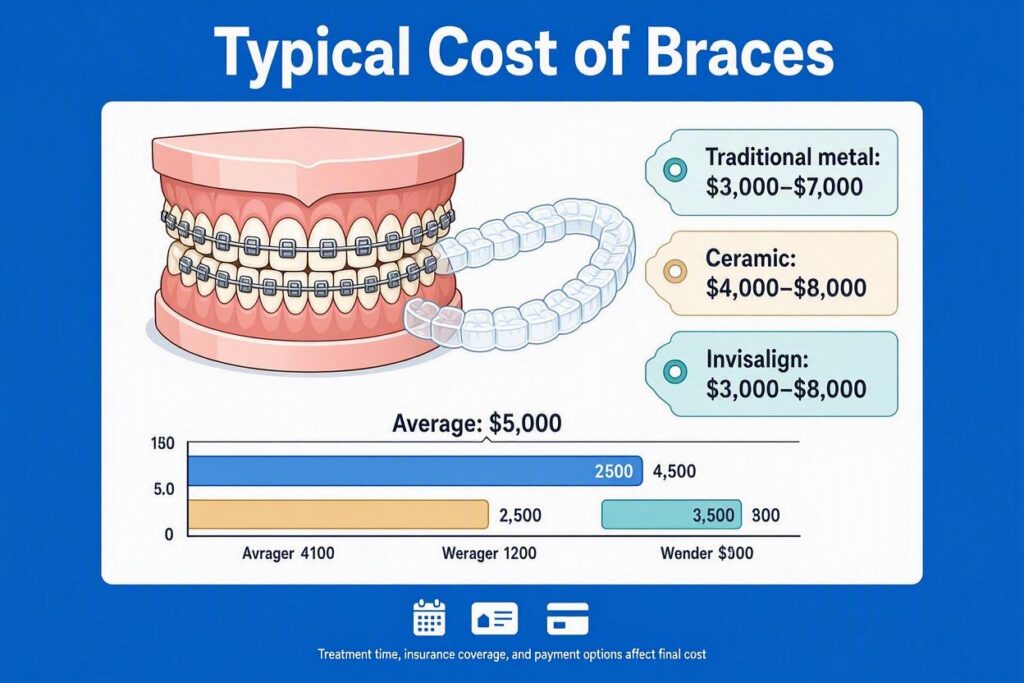
In the United States, the typical cost for a full course of orthodontic treatment with traditional braces falls within a broad range. You should expect to budget between $3,000 and $7,500. The national average, the figure you will see cited most often, is around $5,000 to $6,000.
It is crucial to understand that this is a comprehensive fee. This is not just the cost of the metal brackets glued to your teeth. This fee covers the entire process from start to finish. We will explore what is included in this fee in detail later in this article.
A Quick Cost Comparison by Brace Type
The type of braces you choose has a significant impact on the final price. Here is a quick overview to give you a frame of reference.
| Type of Braces | Average Cost Range | Key Characteristics |
|---|---|---|
| Metal Braces (Traditional) | $3,000 – $7,000 | The most common and most affordable. Durable and highly effective. |
| Ceramic Braces (Clear) | $4,000 – $8,000 | Brackets are tooth-colored. More discreet but slightly more fragile and expensive. |
| Lingual Braces | $8,000 – $13,000 | Placed on the back of teeth. Completely invisible but the most expensive and difficult to clean. |
| Self-Ligating Braces (e.g., Damon) | $3,800 – $8,000 | Uses a specialized clip instead of elastic bands. May result in fewer appointments. |
The choice of appliance is one of the primary levers you can pull to manage the cost.
Deconstructing the Fee: What Exactly Are You Paying For?
To understand why braces cost what they do, you need to see beyond the physical appliance. The fee you pay is for a comprehensive service that unfolds over one to three years. When you sign a contract with an orthodontist, you are hiring a specialist to manage a complex, long-term medical treatment.
Here is a breakdown of what your typical orthodontic fee includes:
1. The Orthodontist’s Expertise
An orthodontist is not just a general dentist. After completing dental school, they undergo an additional two to three years of specialized residency training focused solely on tooth movement and jaw alignment. You are paying for this advanced, specialized knowledge. This expertise is what ensures your treatment is not only effective but also safe.
2. Diagnostic Records and Treatment Planning
Before you even get your braces on, a significant amount of work goes into planning your treatment. This includes:
- Digital X-rays: To see the position of your teeth, roots, and jawbone.
- Photographs: To document the current state of your smile.
- Digital Scans or Impressions: To create an accurate model of your teeth.
- The Treatment Plan: The orthodontist analyzes all this data to create a custom, step-by-step plan for your case.
3. All Materials and Appliances
This is the obvious part. Your fee covers the brackets, wires, bands, and any other appliances you may need, like palatal expanders. It also covers all the replacement parts if a bracket breaks.
4. All Office Visits and Adjustments
You will visit the orthodontist every 4-8 weeks for adjustments. These appointments are where the wires are tightened or changed to continue guiding your teeth. The entire schedule of visits for the duration of your treatment (often 18-36 months) is included in your upfront fee.
5. Emergency Visits
If a wire pokes your cheek or a bracket comes loose, you will need to schedule an extra appointment. These repair visits are almost always included in your comprehensive fee.
6. Retention Phase
The day your braces come off is not the end of the journey. To prevent your teeth from shifting back, you will need retainers. The cost of your first set of retainers, as well as the initial follow-up appointments to check their fit, is typically included in the overall fee.
The Major Factors That Influence the Price
We have established the broad range. Now, let’s delve into the specific variables that determine where your treatment will fall within that range. Understanding these factors will help you make sense of the quotes you receive.
1. Complexity of Your Case
This is the most significant factor. The cost of your braces is directly related to the amount of work required.
- Simple Case: A patient with minor crowding or a small gap may only need braces for 6-12 months. This would be on the lower end of the cost spectrum.
- Moderate Case: A patient with moderate crowding, a slight overbite, or other common issues will likely fall in the middle of the range.
- Complex Case: A patient with a severe overbite, underbite, crossbite, impacted teeth, or significant jaw misalignment will be at the higher end. These cases require more complex mechanics, more appointments, and a longer treatment time.
2. Your Geographic Location
The cost of living in your area has a direct impact on the cost of your braces. Orthodontists in major metropolitan areas or on the coasts have higher overhead costs (rent, staff salaries, insurance) than those in the Midwest or rural areas. This cost is passed on to the patient. Braces in New York City or San Francisco will almost certainly cost more than braces in a small town in Ohio.
3. The Age of the Patient
- Children and Teens: Treatment is often slightly less expensive because their jaws are still growing. This growth can be harnessed to correct issues more efficiently.
- Adults: Adult treatment can be more complex. The bones have stopped growing, and adults may have other dental issues (like worn teeth or gum disease) that complicate the process. Adult braces can sometimes take longer and cost more.
4. The Type of Practice
- Corporate Dental Chain: Large dental chains may offer lower prices due to their volume and purchasing power. However, you may see a different orthodontist at each visit.
- Private Practice: A solo practitioner or a small group practice often provides a more personalized experience and consistent care, which may come at a slightly higher price.
A Deeper Look at Insurance: How Much Will It Help?
Dental insurance can be a powerful tool to reduce your out-of-pocket cost, but it is essential to understand how it works. Orthodontic coverage is often separate from the dental coverage you use for cleanings and fillings.
Understanding Orthodontic Coverage
- Lifetime Maximum: Most policies have a lifetime maximum benefit for orthodontics. This is a set dollar amount (e.g., $1,500 or $2,000) that the policy will pay over your entire lifetime. Once you use it, it is gone.
- Percentage Coverage: The policy will typically cover a percentage of the total cost (often 50%) up to that lifetime maximum. So, if your braces cost $6,000 and your policy has a 50% coinsurance with a $2,000 maximum, your insurance will pay $2,000, and you will be responsible for $4,000.
- Age Limits: Many policies only cover orthodontic treatment for dependents under a certain age (often 19). Adult coverage is less common but is becoming more available.
Important Note: Before you begin treatment, ask your orthodontist’s office to submit a “pre-treatment estimate” to your insurance company. This will give you a clear, written statement of exactly what your policy will pay.
Strategies to Make Braces More Affordable
The price tag can be daunting, but you should not give up hope. There are several effective strategies to make orthodontic care financially accessible.
1. In-Office Payment Plans
This is the most common method. Almost all orthodontic offices offer flexible, in-house payment plans. You will typically pay a small down payment, and the remaining balance is spread out over the course of your treatment in equal monthly installments. The best part? These plans are almost always interest-free. This makes a large sum very manageable. A $5,000 treatment over 24 months is just over $200 a month.
2. FSA/HSA Accounts
Flexible Spending Accounts (FSAs) and Health Savings Accounts (HSAs) are excellent tools. They allow you to use pre-tax dollars to pay for qualified medical expenses, which includes orthodontic treatment. This can effectively save you 20-30% on the cost of treatment.
3. Dental Schools
If you live near a university with a dental school, this is worth exploring. Orthodontic residents perform the work under the direct supervision of experienced, licensed orthodontists. The cost is typically 30-50% lower than a private practice. The downside is that appointments are longer and less flexible.
4. Discount Dental Plans
These are not insurance. They are membership programs where you pay an annual fee to access a network of dentists who have agreed to charge discounted rates. These plans can offer 10-25% off orthodontic treatment.
5. Charitable Organizations
For families with financial hardship, there are organizations that provide access to orthodontic care. The most well-known is Smiles Change Lives, which connects eligible children with orthodontists who volunteer their services.
The Cost of Invisalign vs. Braces: A Brief Note
No discussion of orthodontic costs is complete without mentioning clear aligners like Invisalign. The cost of Invisalign has become very competitive with traditional braces.
- Average Cost of Invisalign: $3,500 to $8,000
For simple to moderate cases, Invisalign can now be comparable in price to braces. For complex cases, traditional braces are often still more effective and may be the recommended option. This is a decision best made in consultation with an orthodontist.
Frequently Asked Questions (FAQ)
1. Why is there such a wide range in cost?
The range exists because no two smiles are the same. The complexity of your case, your location, and the type of appliance you choose all create significant price variations.
2. Is it cheaper to get braces from a general dentist?
Sometimes. Some general dentists offer orthodontic treatment, particularly Invisalign. The cost may be lower, but they do not have the specialized training of an orthodontist. For complex cases, a specialist is almost always the better choice.
3. Do I have to pay for the entire treatment upfront?
No. In fact, most people do not. In-house payment plans are the standard practice in the industry.
4. Will I need to see my regular dentist while I have braces?
Yes. It is essential to continue seeing your general dentist for cleanings and checkups every six months while you are in braces. This helps prevent cavities and gum disease around the brackets.
5. Are braces worth the cost?
For most people, the answer is a resounding yes. Straight teeth are not just about aesthetics. They are easier to clean, which reduces your risk of decay and gum disease. A correct bite also prevents abnormal wear on your teeth and can alleviate jaw pain.
6. What happens if I move during treatment?
This is a good question to ask your orthodontist before starting. Some will be able to refer you to a colleague in your new city. You will likely have to settle the remaining balance with your current orthodontist and negotiate a new fee with the new one.
Additional Resource
For a trusted guide on orthodontic treatment options and financing, visit the American Dental Association’s patient-focused website, MouthHealthy.
Conclusion
The typical cost of braces in the United States ranges from $3,000 to $7,500, with the final price determined by case complexity, location, and the type of appliance chosen. This comprehensive fee covers everything from diagnosis and all office visits to the retainers you receive at the end of treatment. By understanding what is included and utilizing tools like insurance and payment plans, this significant investment in your long-term health and confidence can be made financially manageable.