Why Do Dental Implants Fail In Smokers?
You smoke. You know it is not good for your health. You have heard that smoking affects your teeth and gums. Now you need a dental implant, or you have one that is in trouble, and your dentist has told you that smoking is a major risk factor. You want to understand exactly why smoking threatens implants, how significant the risk really is, and what you can do about it.
The relationship between smoking and dental implant failure is one of the most thoroughly documented associations in implant dentistry. Smokers face a significantly higher risk of implant failure than non-smokers, and the biological reasons for this are well understood. This guide explains the science in plain language, quantifies the risk, and provides practical, honest guidance for smokers considering implants or struggling with implant problems.
The message of this article is not judgmental. It is factual. You deserve to know the reality so you can make informed decisions about your health and your dental care.
The Statistics: How Much Does Smoking Increase Implant Failure Risk?
The numbers are stark. Research consistently demonstrates that smokers have higher implant failure rates than non-smokers.
The Overall Failure Rate Comparison
The success rate of dental implants in healthy non-smokers is very high, above 95 percent over ten years in most studies. In smokers, the failure rate is roughly two to three times higher. Some studies report failure rates in heavy smokers of 10 to 20 percent, compared to 2 to 5 percent in non-smokers.
The risk is dose-dependent. The more cigarettes smoked per day and the longer the smoking history, the higher the risk. Light smokers, those smoking fewer than ten cigarettes daily, have intermediate risk between non-smokers and heavy smokers. Heavy smokers, those smoking more than twenty cigarettes daily, have the highest risk.
The Location Matters
Implants in the upper jaw fail more frequently in smokers than implants in the lower jaw. The maxillary bone is less dense than the mandibular bone, and the reduced blood supply caused by smoking compounds this natural disadvantage. Implants in the posterior maxilla, the back of the upper jaw where bone is least dense, have the highest failure rate in smokers.
Early Failure versus Late Failure
Smoking increases both early and late implant failure. Early failure occurs before or shortly after the crown is placed, when the implant fails to integrate with the bone. This is more common in smokers. Late failure occurs after the implant has been in function for years, typically due to peri-implantitis, the destructive inflammatory process around the implant. Smoking is a major risk factor for peri-implantitis.
The Biological Reasons Smoking Causes Implant Failure
The statistics tell you that smoking is dangerous for implants. The biology tells you why. Understanding these mechanisms explains why quitting or reducing smoking can make a dramatic difference.
Impaired Blood Flow and Vasoconstriction
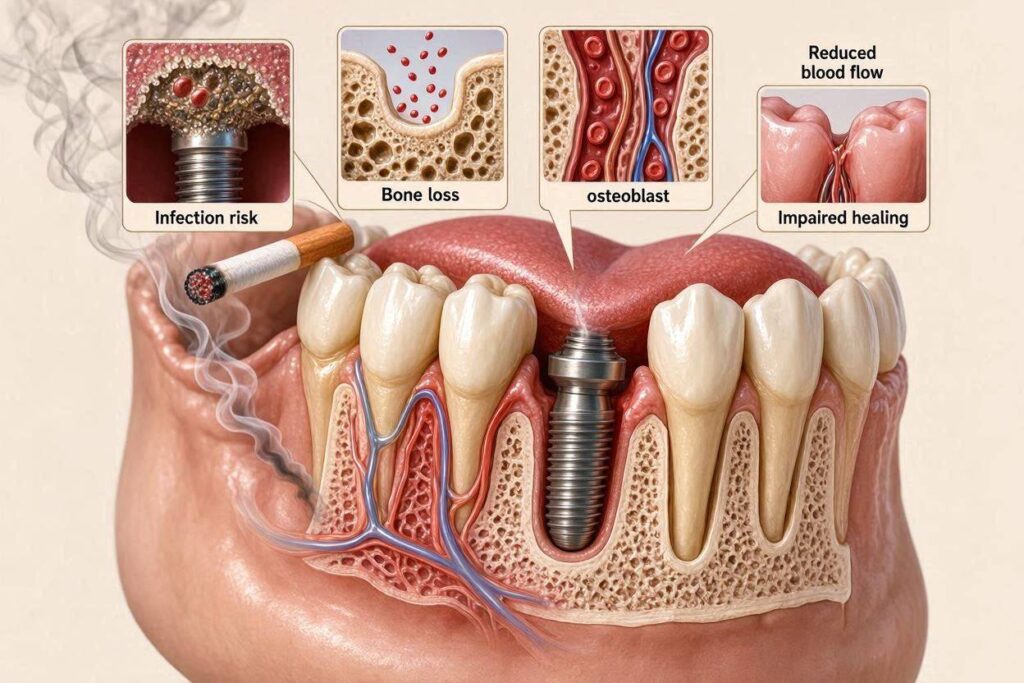
Nicotine is a potent vasoconstrictor. It causes blood vessels to narrow, reducing the flow of blood to tissues throughout the body, including the gums and jawbone. This effect occurs within minutes of inhaling cigarette smoke and persists for some time after each cigarette.
The surgical placement of an implant creates a wound. Healing that wound requires an adequate blood supply. Blood delivers oxygen, nutrients, and the cells needed for tissue repair and new bone formation. When blood flow is reduced, healing is slower and less complete. The bone cells responsible for osseointegration, the fusion of the implant with the jawbone, cannot function optimally in a low-oxygen environment.
Carbon monoxide from cigarette smoke compounds the problem. It binds to hemoglobin in red blood cells more strongly than oxygen does, reducing the oxygen-carrying capacity of the blood. Tissues that are already receiving less blood due to vasoconstriction are also receiving blood that carries less oxygen.
Impaired Immune Response
Smoking suppresses the immune system’s ability to fight infection. The white blood cells that patrol the body, identifying and destroying bacteria, are less effective in smokers. The chemical signals that coordinate the immune response are disrupted.
The mouth is a bacteria-rich environment. Even in a clean mouth, millions of bacteria live on the teeth, gums, and tongue. The surgical placement of an implant creates a portal of entry for these bacteria into the underlying bone. In a non-smoker, the immune system rapidly contains any bacterial invasion, and the surgical site heals without infection. In a smoker, the impaired immune response may allow bacteria to establish an infection at the implant site, preventing osseointegration and causing early failure.
After the implant is restored, the risk of infection continues. The gum attachment around an implant is less robust than around a natural tooth, and bacteria can penetrate more easily. A smoker’s compromised immune system is less able to control the low-grade bacterial challenge at the implant-gum interface, setting the stage for peri-implantitis.
Impaired Wound Healing
Wound healing is a complex biological process involving inflammation, new tissue formation, and tissue remodeling. Smoking disrupts every phase of this process. The inflammatory phase, which normally clears debris and bacteria from the wound, is prolonged and less effective. The proliferative phase, in which new blood vessels and connective tissue form, is blunted by the reduced oxygen supply and the direct toxic effects of cigarette chemicals on healing cells.
Fibroblasts, the cells that produce collagen and other structural proteins essential for wound closure, function poorly in smokers. The epithelial cells that close the wound surface migrate more slowly. The overall result is delayed wound closure, weaker scar tissue, and a greater susceptibility to wound breakdown.
For an implant patient, impaired wound healing means that the surgical site heals more slowly, the risk of wound dehiscence, where the incision opens, is higher, and the quality of the soft tissue seal around the implant is inferior.
Direct Toxicity to Bone Cells
The chemicals in cigarette smoke, including nicotine, cotinine, and a host of other compounds, have direct toxic effects on bone cells. Osteoblasts, the cells responsible for forming new bone, are inhibited by nicotine. Their proliferation, differentiation, and function are all impaired. Nicotine also affects osteoclasts, the cells that resorb bone, disrupting the balanced bone remodeling that is essential for osseointegration and long-term implant stability.
Studies have shown that nicotine reduces the expression of growth factors and bone morphogenetic proteins that are essential for new bone formation. The cellular machinery of bone healing is gummed up by the chemical assault of tobacco smoke.
Heat and Chemical Irritation
The physical act of smoking exposes the oral tissues to heat and to thousands of chemical compounds. The heat from inhaled smoke irritates the delicate gum tissues around the implant. The chemicals in the smoke, including tar and various carcinogens, bathe the oral tissues in a toxic soup. The localized effect of smoke on the peri-implant tissues adds a constant low-level insult that the body must contend with.
Dry Mouth and Altered Oral Environment
Smoking reduces salivary flow, leading to a drier mouth. Saliva is the body’s natural cleanser for the oral cavity. It buffers acids, washes away food debris, and contains antimicrobial compounds. Reduced salivary flow allows bacteria to proliferate, plaque to accumulate, and the pH of the mouth to become more acidic. These conditions favor the development of peri-implant disease.
The Effect of Smoking Cessation on Implant Outcomes
The good news is that the negative effects of smoking on implant outcomes are at least partially reversible. Patients who quit smoking can significantly improve their chances of implant success.
Short-Term Cessation Around Surgery
Even temporary smoking cessation around the time of implant surgery can improve outcomes. Studies have shown that patients who stop smoking for a period before and after surgery have better healing and lower complication rates than those who continue to smoke through the surgical period.
A common recommendation is to stop smoking at least one week before implant surgery and to remain smoke-free for at least four to eight weeks after surgery, the critical period for initial healing. During this time, blood flow improves, oxygen levels rise, and the immune system begins to recover. The body’s healing capacity is markedly better after even a short smoke-free interval.
Long-Term Cessation and Peri-Implantitis Risk
For long-term implant health, sustained smoking cessation provides the greatest benefit. Former smokers have a lower risk of peri-implantitis than current smokers, though their risk may remain slightly elevated compared to never-smokers. The longer the period since quitting, the more the risk profile approaches that of a non-smoker.
The vascular and immune changes caused by smoking are not permanent. The body has a remarkable capacity to heal when the ongoing insult of tobacco smoke is removed. Patients who quit smoking permanently after implant placement give their implants the same chance of long-term survival as implants placed in non-smokers.
The Hard Truth About Quitting
Quitting smoking is difficult. Nicotine is highly addictive, and the behavioral and social aspects of smoking are deeply ingrained. Patients who are not ready or able to quit should not be shamed or denied care. Instead, they should be informed about the risks and supported in whatever harm reduction they can achieve.
Reducing the number of cigarettes smoked daily, even without quitting entirely, reduces risk proportionally. Switching to nicotine replacement therapy, while not risk-free, eliminates the carbon monoxide and the thousands of other chemicals in cigarette smoke, addressing some but not all of the biological mechanisms of implant failure.
Should Smokers Get Dental Implants?
The elevated risk of failure does not mean that smokers should be denied implants. It means that smokers should be fully informed and that their implant treatment should be planned and managed with the increased risk in mind.
Informed Consent
A smoker considering implants deserves an honest conversation about the risks. The dentist should explain the statistics, the biological reasons for the increased failure rate, and the steps the patient can take to reduce risk. The patient can then make an informed decision about whether to proceed and under what conditions.
Risk Mitigation Strategies
Several strategies can help mitigate the risk for smokers who choose implant treatment. Meticulous oral hygiene before and after surgery is essential. A pre-surgical antibacterial rinse protocol, such as chlorhexidine, can reduce the bacterial load in the mouth. The surgeon may use an antibiotic prophylaxis regimen to reduce infection risk.
The implant surgeon may choose a slightly longer implant, a slightly wider implant, or an implant with a surface designed to promote faster osseointegration, all in an effort to compensate for the impaired healing environment. The surgeon may allow a longer healing period before loading the implant, giving the bone more time to integrate before the forces of chewing are applied.
After the implant is restored, more frequent professional maintenance visits are indicated. A smoker with implants should see the dentist or hygienist every three to four months for monitoring and cleaning, rather than every six months. This allows early detection and treatment of peri-implant mucositis before it progresses to peri-implantitis.
Alternative Options
For a heavy smoker with multiple risk factors, a removable partial denture or a conventional bridge may be a more appropriate choice than an implant. These alternatives do not involve the surgical placement of a foreign body into the bone and are not subject to the same failure mechanisms. They may not be the ideal restoration, but they are safe and functional.
The Role of the Dentist
The dentist has a responsibility to the smoking patient that goes beyond simply placing the implant or refusing to do so.
Education and Support
The dentist should educate the patient about the risks in a clear, non-judgmental way. The dentist should offer resources for smoking cessation, including referral to a smoking cessation program, information about nicotine replacement therapy, and supportive counseling. The dental office can be an effective setting for smoking cessation intervention because the oral health consequences of smoking are visible and immediate.
Individualized Treatment Planning
A blanket policy of refusing implants to all smokers is not evidence-based. The risk is not uniform. A young, healthy smoker with excellent oral hygiene and a few cigarettes a day is at lower risk than an older smoker with a heavy habit, other medical conditions, and poor oral hygiene. The dentist should evaluate the individual patient’s overall risk profile and make a clinical judgment about the appropriateness of implant treatment.
Documentation
Given the elevated risk, the dentist should document the discussion of smoking-related risks thoroughly in the patient’s record. The informed consent for implant treatment should specifically address the increased failure risk associated with smoking. This documentation protects both the patient and the dentist, ensuring that the patient was informed and that the decision to proceed was made with full knowledge.
Conclusion
Smoking causes dental implant failure through multiple well-understood biological mechanisms, including nicotine-induced vasoconstriction that reduces blood flow and oxygen delivery to healing tissues, impaired immune function that increases infection risk, direct toxicity to bone-forming cells, and chronic heat and chemical irritation of the peri-implant tissues. Smokers face a failure rate two to three times higher than non-smokers, with the risk increasing with heavier smoking. Temporary cessation around the time of surgery and long-term quitting significantly improve outcomes. Smokers can receive implants successfully with risk mitigation strategies, including enhanced oral hygiene, antibiotic protocols, more frequent maintenance, and honest informed consent.
Frequently Asked Questions
How long before implant surgery should I stop smoking?
Ideally, stop at least one week before surgery and remain smoke-free for at least four to eight weeks after surgery. This allows blood flow and oxygen levels to improve during the critical initial healing period.
Are e-cigarettes or vaping safer for implants than traditional cigarettes?
E-cigarettes do not contain the tar and carbon monoxide of combustible cigarettes, but they still deliver nicotine, which causes vasoconstriction. The long-term effects of vaping on implant outcomes are not well studied. Vaping is probably less harmful than smoking but is not risk-free.
Can a dentist refuse to place an implant because I smoke?
A dentist can decline to provide elective treatment if they believe the risk of failure is unacceptably high. However, most dentists will discuss the risks and work with the patient on risk mitigation rather than issuing a blanket refusal.
If I quit smoking after implant failure, can I get a replacement implant?
Yes, quitting smoking dramatically improves the prognosis for a replacement implant. After the failed implant is removed and the site has healed, a new implant placed in a non-smoking patient has the same good prognosis as any other implant in a non-smoker.
Does smoking affect the healing of bone grafts for implants?
Yes, smoking impairs the healing of bone grafts just as it impairs implant osseointegration. Smokers undergoing bone grafting have higher rates of graft failure and complications.
Additional Resource:
For free smoking cessation resources, including quit plans and counseling, visit https://smokefree.gov or call 1-800-QUIT-NOW.