Full Upper Arch Dental Implants Cost: A Complete Guide for 2026
Deciding to restore your entire upper set of teeth is a big step. It is not just about smiling again. It is about eating your favorite foods, speaking clearly, and feeling confident.
If you have been searching online for “full upper arch dental implants cost,” you have probably seen numbers ranging from $3,000 to $30,000. That is a huge gap. It can feel confusing and frustrating.
Let us clear up that confusion today.
This guide gives you a realistic, honest, and detailed look at what you will actually pay. We will break down every single factor, from the type of implant to your geographic location. No hidden surprises. No unrealistic promises. Just the facts you need to plan your budget.
Understanding the Full Upper Arch Procedure
Before we talk about money, let us quickly understand what a full upper arch implant actually is. This helps you see where your investment goes.
Unlike dentures that sit on top of your gums, implants are small titanium posts surgically placed into your jawbone. They act as artificial tooth roots. After a healing period, a fixed bridge or denture is attached to these posts.
Think of it like building a house. The implants are the concrete foundation. The abutments are the connectors. The final teeth are the beautiful structure you see.
A full upper arch typically replaces all 12 to 14 teeth on your upper jaw. Most people receive between four and eight implants per arch. This is often called “All-on-4” or “All-on-6” treatment.
The Realistic Price Range for Full Upper Arch Implants
Let us get straight to the numbers. This is the question everyone asks.
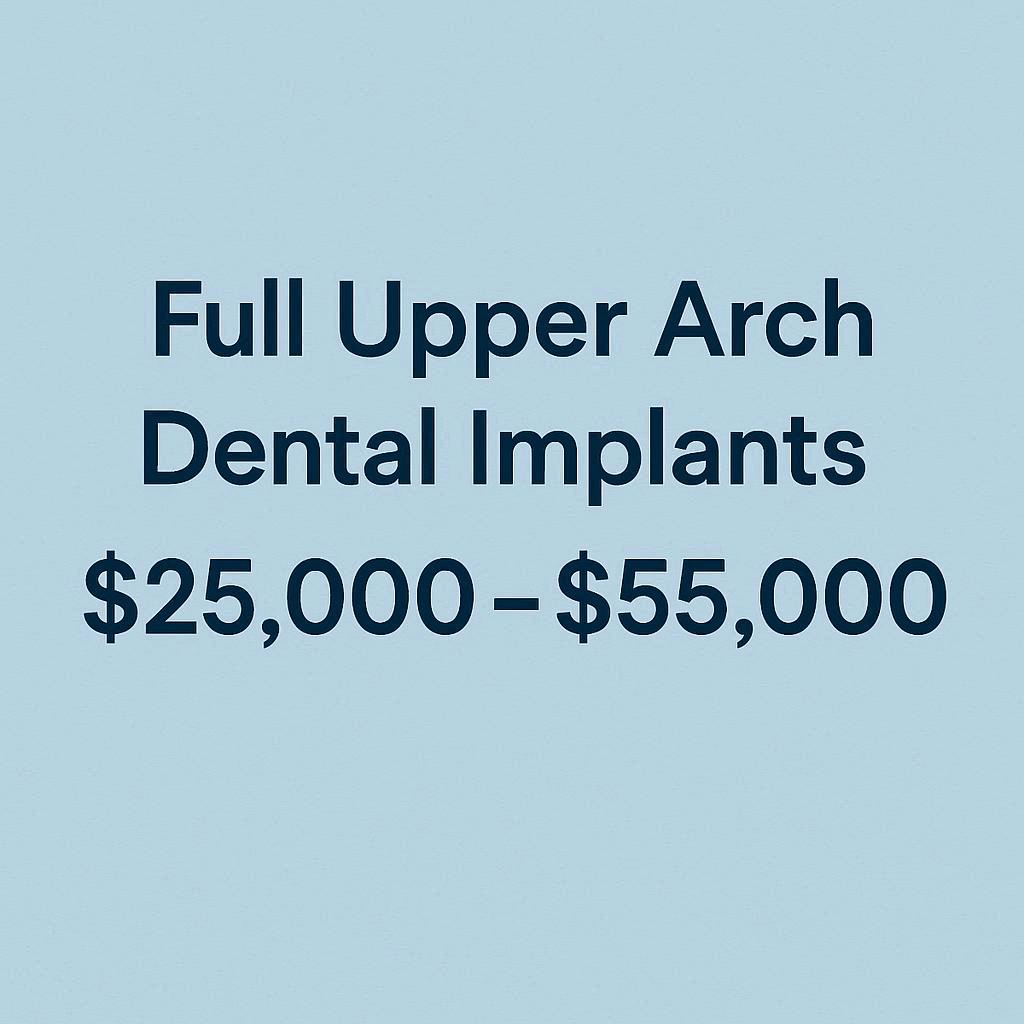
The total cost for a full upper arch dental implant system generally falls into three main tiers.
| Type of Implant Solution | Average Total Cost (USD) | Key Features |
|---|---|---|
| Budget / Economy Implants | $7,000 – $12,000 | Basic materials. Standard acrylic teeth. Fewer implants (4). Shorter warranty. |
| Mid-Range Implants | $15,000 – $22,000 | High-quality titanium. Zirconia or premium acrylic. 6 implants. Longer warranty. |
| Premium / High-End Implants | $25,000 – $30,000+ | Top brand implants (Nobel Biocare, Straumann). Full zirconia bridge. Lifetime warranty. |
Important Note: These prices are for the entire treatment. This includes surgery, implants, temporary teeth, the final bridge, and most follow-up appointments. But always ask for a complete breakdown.
A price below $7,000 for an entire upper arch should raise a red flag. It likely means lower-quality materials, an inexperienced provider, or hidden fees waiting to surprise you later.
Breaking Down the Full Upper Arch Dental Implants Cost Components
Why is the price so high compared to dentures? Because you are paying for several complex services. Each part adds value and longevity.
1. The Initial Consultation and Imaging
Every journey starts here. Your dentist needs to see your bone structure. This involves:
- 3D CBCT scan: This is a special x-ray that creates a 3D model of your jaw. It costs between $300 and $500.
- Treatment planning software: Your dentist uses digital tools to map out exactly where each implant goes.
2. Bone Grafting or Sinus Lifts (Very Common)
Here is a reality check. Many people who need a full upper arch have been missing teeth for years. Without tooth roots, the jawbone shrinks.
If your bone is too thin or soft, you cannot place implants directly. You need a bone graft or a sinus lift. This adds significant cost.
- Minor bone graft: $500 – $1,500 per site.
- Major bone graft (block graft): $2,000 – $3,500.
- Sinus lift: $1,500 – $3,000 per side.
Realistic advice: Over 60% of upper arch implant patients need some form of bone grafting. Do not be surprised if your estimate includes this.
3. The Implant Fixtures (The Posts)
These are the actual titanium screws. Prices vary by brand. Premium brands like Straumann or Nobel Biocare cost more but have decades of research behind them.
- Economy implants (DIO, Hiossen): $300 – $500 per implant.
- Premium implants (Straumann, Nobel): $600 – $1,000 per implant.
For a full arch with six implants, you are looking at $1,800 to $6,000 just for the posts.
4. The Abutments
These are small connectors that attach the final teeth to the implants. A full arch often uses specialized multi-unit abutments.
- Cost per arch for abutments: $1,000 – $2,500.
5. The Temporary Prosthesis
After surgery, you cannot wait months without teeth. Your dentist will give you a temporary fixed bridge. It looks okay but is not as strong as the final one.
- Cost: $1,000 – $2,500.
6. The Final Teeth (The Bridge)
This is what everyone sees. You have two main choices here.
- Acrylic (PMMA) teeth over a titanium frame: More affordable. Looks good but can wear down or stain over time. Cost: $3,000 – $6,000 per arch.
- Full Zirconia: Incredibly strong. Stain-resistant. Feels like natural teeth. Looks stunning. Cost: $7,000 – $12,000 per arch.
7. Surgical Fees and Anesthesia
You are paying for the surgeon’s skill. This is not the place to look for discounts. Anesthesia options also affect price.
- Local anesthesia (you are awake, but numb): Included in most surgical fees.
- IV sedation (you are asleep but breathing on your own): $500 – $1,000.
- General anesthesia (hospital setting): $1,500 – $3,000.
Hidden Costs You Must Ask About
A good dentist gives you a transparent quote. But sometimes, small fees appear later. Protect yourself by asking these questions.
- Extractions: Do you still have failing teeth on top? Removing each tooth can cost $150 – $300 per tooth. For a full arch, that is $1,800 – $3,600.
- Temporary denture during healing: Some clinics include a temporary prosthesis. Others make you pay extra.
- Final adjustments: Does the price cover your follow-up adjustments for one year? Or do you pay per visit?
- Warranty: What happens if an implant fails or a tooth chips? A good warranty covers replacement. A bad one leaves you paying again.
- Travel costs: If you go to a dental tourism destination, add flights, hotels, and missed work days.
Full Upper Arch Implants vs. Traditional Dentures: A Cost Comparison
You might wonder if implants are worth the higher upfront price. Let us compare the long-term reality.
| Factor | Traditional Upper Denture | Full Upper Arch Implants |
|---|---|---|
| Initial Cost | $1,500 – $3,000 | $15,000 – $30,000 |
| Lifespan | 5 – 10 years (often less) | 20+ years (often lifetime) |
| Maintenance | Relines every 1-2 years ($200 each). New denture every 5-7 years. | Regular checkups. Professional cleaning. |
| Bone Loss | Continues. Jaw shrinks over time. | Stops. Preserves your bone. |
| Comfort | Moves. Covers palate. Can be painful. | Fixed. No palate coverage. Feels natural. |
| Eating Ability | Limited. Avoid sticky or hard foods. | Almost normal. Eat steak, apples, corn. |
| 10-Year Total Cost | $6,000 – $10,000 (with replacements) | $15,000 – $30,000 (one time) |
The bottom line: Dentures seem cheaper now. But over ten or twenty years, the cost difference shrinks. And you cannot put a price on comfort and confidence.
Factors That Influence Your Final Price
Every mouth is different. Your final bill depends on these personal factors.
Your Jawbone Health
More bone loss means more grafting. More grafting means higher cost. A patient with strong, healthy bone might save $5,000 compared to someone needing extensive grafts.
The Number of Implants
Four implants (All-on-4) cost less than six implants (All-on-6). However, six implants distribute force better. They offer more security if one implant ever fails.
The Brand and Material Quality
You can find cheap implants online. But your dentist chooses brands with clinical studies. Ask which brand they use. Research it.
Geographic Location
Prices vary wildly by city and country.
- Small town USA: $12,000 – $18,000 per arch.
- Major city (NYC, LA, Chicago): $20,000 – $30,000+ per arch.
- Mexico (dental tourism): $6,000 – $10,000 per arch.
- Eastern Europe (Hungary, Poland): $5,000 – $8,000 per arch.
- Costa Rica: $7,000 – $12,000 per arch.
A word of caution on dental tourism: You can save money. But if you have a problem after returning home, your local dentist may charge full price to fix it. Always factor in travel costs and aftercare logistics.
The Provider’s Experience
An experienced prosthodontist or oral surgeon charges more than a general dentist. This is a good thing. Implant surgery requires precision. Paying for expertise reduces your risk of failure.
- General dentist with implant training: Lower cost, but variable skill level.
- Board-certified oral surgeon or prosthodontist: Higher cost, but maximum safety and results.
Insurance and Payment Options
Can you use dental insurance? Yes, but with limitations.
Dental Insurance Coverage
Most PPO plans offer some coverage for implants. However, do not expect them to pay for everything.
- Annual maximums: Most plans cap benefits at $1,000 – $2,000 per year. That is a small fraction of the total.
- Missing tooth clause: Some plans do not cover implants if the tooth was missing before the policy started.
- Medical insurance: If your tooth loss is due to an accident or medical condition (like cancer), your medical plan might cover part of the cost. This is rare but worth exploring.
Flexible Spending Accounts (FSA) and Health Savings Accounts (HSA)
These are your best friends. You can use pre-tax dollars to pay for implants. If you are in a 30% tax bracket, this saves you about 30% on the total cost.
Example: A $20,000 procedure paid with HSA funds could save you $6,000 in taxes.
Payment Plans and Financing
Most implant clinics offer financing. Here are common options.
- CareCredit: A healthcare credit card. Offers 6, 12, or 18 months of no interest if paid in full.
- Alphaeon Credit: Similar to CareCredit. Longer terms available.
- In-house payment plans: Some clinics let you pay in 3 or 4 installments. Rare for the full amount.
- Personal loan: A credit union or online lender (SoFi, Upstart) can offer fixed rates over 3-5 years.
The Step-by-Step Process and When You Pay
Understanding the timeline helps you prepare your wallet.
Step 1: Consultation (Pay $200 – $500)
You pay for the exam and CBCT scan. This is usually not covered by insurance.
Step 2: Preparatory Work (Pay $1,500 – $5,000)
If you need extractions or bone grafting, you pay before the implant surgery.
Step 3: Implant Surgery (Pay 50% of the total)
Most clinics ask for half the remaining balance on the day of surgery.
Step 4: Healing Period (3 to 6 months)
You wear your temporary teeth. No major payments here, except for follow-up checks.
Step 5: Final Bridge Placement (Pay remaining 50%)
When your implants have fused to the bone (osseointegration), you return for the final teeth. You pay the balance.
Questions to Ask Before You Sign Anything
Walk into your consultation with this list. Write down the answers.
- “Is the final price all-inclusive, or are extractions, grafts, and temporary teeth separate?”
- “What brand of implants do you use, and how long is the warranty?”
- “What happens if an implant fails? Do I pay again for surgery and a new bridge?”
- “Do you offer sedation, and what is the cost?”
- “Can I speak to a past patient who had the same procedure?”
- “Is the final bridge acrylic or zirconia? Which is included in this quote?”
- “How many full arch implant surgeries have you personally done?”
A confident, honest dentist answers these questions immediately. If you feel rushed or receive vague answers, walk away.
Real Patient Scenarios and Their Costs
Let us look at three realistic examples. Names are changed, but prices are real.
Scenario 1: Sarah, 58 years old – Minimal Bone Loss
- Location: Suburban Texas
- Condition: Worn-out bridge. Healthy bone.
- Procedure: All-on-6 with zirconia bridge.
- Extractions: 6 teeth ($1,200)
- Implants (6): Premium brand ($4,200)
- Bone graft: None needed.
- Temporary bridge: ($1,500)
- Final zirconia bridge: ($8,500)
- Surgeon fee & sedation: ($3,000)
- Total: $18,400
Scenario 2: Michael, 65 years old – Significant Bone Loss
- Location: Chicago, Illinois
- Condition: Worn dentures for 15 years. Severe bone shrinkage.
- Procedure: All-on-4 with acrylic bridge.
- Extractions: 10 remaining teeth ($2,500)
- Bone graft: Major block graft and sinus lift ($4,500)
- Implants (4): Mid-range brand ($2,000)
- Temporary bridge: ($1,800)
- Final acrylic bridge: ($4,500)
- Surgeon fee & IV sedation: ($3,500)
- Total: $18,800
Note how Michael paid a similar total to Sarah, but for a lower-quality final bridge, because he needed expensive grafting.
Scenario 3: Linda, 52 years old – Dental Tourism in Mexico
- Location: Los Algodones, Mexico (near Arizona border)
- Condition: Failing teeth. Moderate bone loss.
- Procedure: All-on-6 with premium zirconia.
- Full treatment package: ($9,000)
- Flights from Seattle: ($400)
- Hotel for 10 nights (two trips): ($1,200)
- Meals and transport: ($600)
- Local follow-up care in the US: ($1,000 estimate for future checks)
- Total: $12,200
Linda saved about $8,000 compared to a US clinic. She is happy with her results. But she knows that if a problem arises, she must travel back to Mexico or pay a US dentist out of pocket.
How to Get the Best Value (Not Just the Lowest Price)
Value is different from price. The cheapest implant today could become the most expensive repair tomorrow.
Here is how to maximize your value.
- Choose experience over cost. A surgeon who does 100 implant cases per year is better than one who does 10.
- Prioritize zirconia for the upper arch. The upper arch handles less chewing force than the lower, but zirconia still resists staining and cracking better than acrylic.
- Ask about a lifetime warranty. Some premium clinics offer a lifetime guarantee on implants and the bridge if you come for annual checkups.
- Consider a teaching hospital. Major universities with dental schools offer lower prices. Residents perform the work under expert supervision. Prices can be 30-40% lower.
- Combine with an HSA. If you have an HSA, use it. The tax savings are real.
Common Myths About Full Upper Arch Implant Costs
Let us bust some myths that confuse patients.
Myth 1: “Dental implants are completely covered by insurance.”
Reality: Almost never. Most insurance pays a small portion, if anything. Treat insurance as a helpful discount, not a solution.
Myth 2: “You can get a full arch for $3,000.”
Reality: Not with quality materials and a skilled dentist. That price might cover one or two implants, not a full arch. Avoid clinics advertising prices that seem too good to be true.
Myth 3: “Once you pay, you are done forever.”
Reality: Implants need maintenance. You still need professional cleanings and annual x-rays. Budget $200 – $500 per year for implant maintenance.
Myth 4: “Everyone needs bone grafting.”
Reality: Not everyone. But many do, especially if you have worn a denture for years. Only a CBCT scan can tell you for sure.
Is a Full Upper Arch Right for You?
This procedure is life-changing, but it is not for everyone.
You are a good candidate if:
- You have lost most or all upper teeth.
- You have enough bone (or are willing to get a graft).
- You do not smoke heavily (smoking increases failure risk).
- You can afford the investment or access financing.
- You want a fixed solution you never remove.
You might consider alternatives if:
- You have uncontrolled diabetes or a serious autoimmune disease.
- You take bisphosphonates (bone medications) for osteoporosis.
- You prefer a lower upfront cost and accept the limits of dentures.
- You have severe financial constraints.
Alternative options include:
- Traditional denture with implant snaps (overdenture): 2-4 implants to snap a denture in place. Cost: $6,000 – $12,000.
- Removable partial denture: For those with some healthy teeth left. Cost: $1,500 – $3,000.
- Fixed bridge on natural teeth: If your existing teeth are strong. Cost: $4,000 – $8,000 per bridge.
Maintaining Your Investment
Once you have paid for your new smile, protect it.
- Clean daily: Use a water flosser (Waterpik) and super floss to clean under the bridge.
- No chewing ice or pens: Implants are strong, but the teeth can chip.
- Regular dental visits: Your dentist needs to check the implants and screw connections every 6-12 months.
- Night guard if you grind: Teeth grinding (bruxism) can damage acrylic bridges. A custom night guard costs $500 but saves your $10,000 bridge.
Conclusion
The full upper arch dental implants cost typically ranges from $15,000 to $30,000 in the United States. This investment covers surgery, materials, and the expertise needed for a permanent, natural-feeling smile. While dentures cost less upfront, implants offer better function, bone preservation, and long-term value. Always get a detailed, written quote, ask about hidden fees, and prioritize the provider’s experience over the lowest advertised price.
Frequently Asked Questions (FAQ)
1. How long do full upper arch dental implants last?
With proper care and regular checkups, the titanium implants can last a lifetime. The final bridge (teeth) typically lasts 10-20 years for acrylic and 20+ years for zirconia before needing replacement.
2. Is the procedure painful?
You will receive anesthesia or sedation, so you feel no pain during surgery. Afterward, most patients report mild to moderate discomfort for a few days, similar to a tooth extraction. Over-the-counter pain relievers usually manage it well.
3. Can I get full upper arch implants if I have bone loss?
Yes, in most cases. Your dentist can perform bone grafting or a sinus lift to rebuild lost bone. This adds cost and time (3-9 months of healing), but it makes implant placement possible for almost everyone.
4. How long does the entire process take?
From initial consultation to final bridge, expect 6 to 12 months. The longest part is the 3-6 month healing period where the implants fuse to your bone. You wear temporary teeth during this time.
5. Can I eat normally with upper arch implants?
Yes. After full healing, you can eat almost everything, including steak, apples, nuts, and corn. You only need to avoid extremely hard foods like ice or hard candy that could chip the teeth.
6. What happens if one implant fails?
If you have an All-on-4 or All-on-6 design, the remaining implants usually support the bridge. Your dentist will remove the failed implant and may place a new one. A good warranty should cover this, but always confirm before surgery.
7. Does Medicare or Medicaid cover dental implants?
Original Medicare does not cover dental implants. Some Medicare Advantage plans (Part C) offer limited dental benefits. Medicaid coverage varies by state, but few states cover implants for adults.
Additional Resource
For a deeper look into patient experiences, before-and-after photos, and clinic reviews, visit the American Academy of Implant Dentistry (AAID) patient education page.
👉 Click here to access the AAID patient resource center – This official resource helps you find accredited implant dentists and explains the science behind successful implants.