What Is 3 on 6 Dental Implants?
If you have been researching ways to replace multiple missing teeth, you have likely seen confusing terms like “all-on-4,” “fixed hybrids,” or “3 on 6.” It is easy to feel lost.
Let me simplify things for you right away.
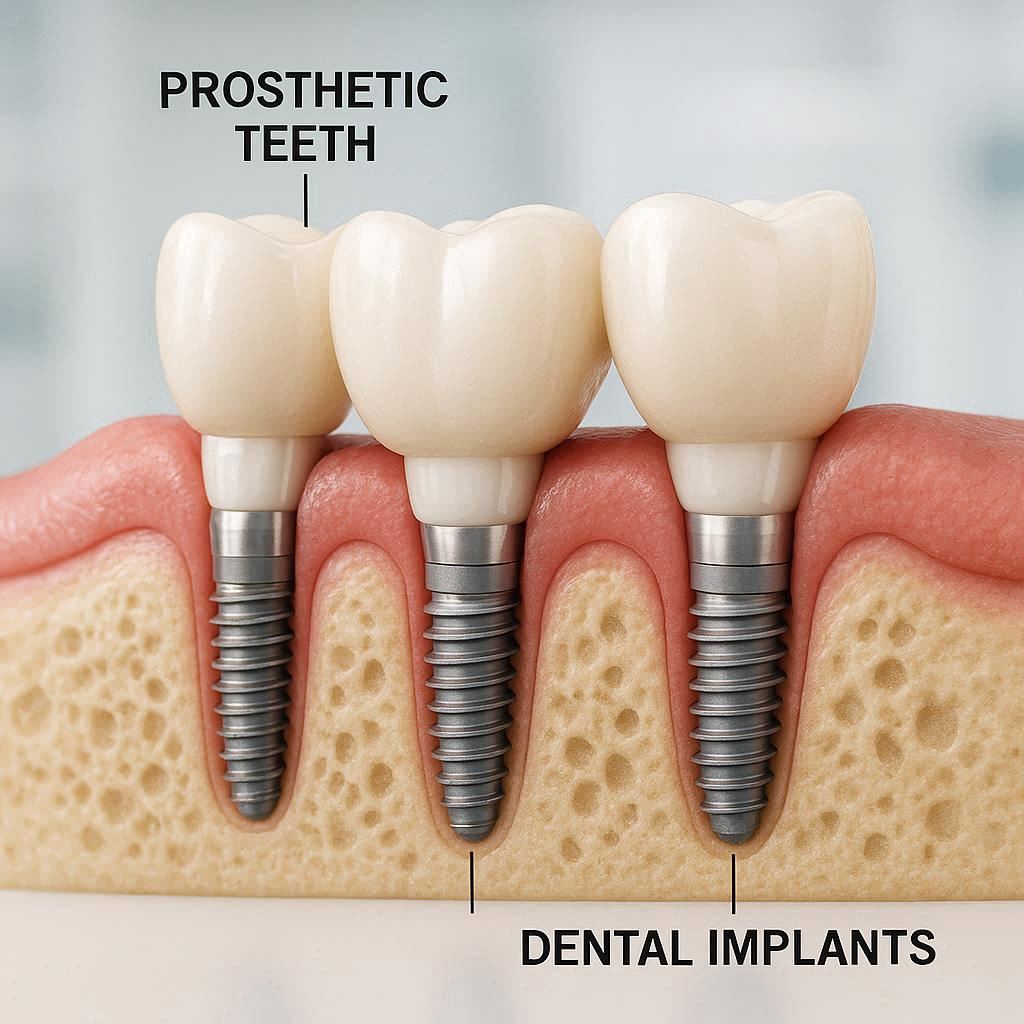
3 on 6 dental implants refers to a specific teeth replacement system where a dentist places six dental implants into your jawbone. Then, they attach a permanent bridge made of three separate sections (or three individual prosthetic bridges) across those six implants.
Think of it as a middle ground. It is not a full row of single crowns. It is not a removable denture. It is a fixed, screw-retained bridge that uses six anchors to hold three large prosthetic teeth segments.
This guide will walk you through everything you need to know. No fluff. No fake promises. Just honest, practical information to help you decide if this option fits your situation.
Understanding the Basics: What Does “3 on 6” Actually Mean?
Let us break down the name first. The numbers tell you the entire story.
- The number 3 refers to the three prosthetic bridges or sections of teeth you will see in your mouth.
- The number 6 refers to the six titanium implant posts surgically placed in your jawbone.
Each bridge section usually replaces two to three missing natural teeth. So, the three bridges together typically replace six to nine missing teeth in one arch (upper or lower jaw).
How It Looks and Feels
Unlike a full denture that covers your palate, a 3 on 6 restoration feels more natural. The bridges do not cover the roof of your mouth. They attach directly to the implants. You cannot remove them at home. Only a dentist can unscrew them for maintenance.
A Quick Comparison Table
| Feature | 3 on 6 Implants | Traditional Dentures | All-on-4 Implants |
|---|---|---|---|
| Number of implants | 6 per arch | 0 | 4 per arch |
| Removable at home? | No | Yes | No |
| Palate coverage | Minimal or none | Full coverage | Minimal or none |
| Typical cost range | $$$ | $ | $$$$ |
| Bone graft often needed? | Sometimes | No | Often |
| Longevity | 15+ years | 5-7 years | 15+ years |
How Do 3 on 6 Dental Implants Work?
Understanding the process helps you feel more prepared. The journey from missing teeth to a fixed smile usually takes several months. Let me walk you through each stage.
Step 1: The Initial Consultation
Your dentist will take 3D scans (CBCT) of your jaw. This scan shows bone density, nerve positions, and sinus locations. Not everyone has enough bone for six implants. The dentist will tell you honestly if you need bone grafting first.
Step 2: Implant Placement Surgery
Under local anesthesia or sedation, the surgeon places six titanium screws into precise positions in your jawbone. For the upper jaw, they often angle the back implants to avoid the sinuses. For the lower jaw, they avoid the inferior alveolar nerve.
The surgery usually takes two to three hours for one arch.
Step 3: Healing and Osseointegration
This is the most important phase. Your jawbone needs to grow tightly around each implant. This process is called osseointegration. It takes four to six months.
During this time, you wear a temporary denture. You eat soft foods. You avoid putting heavy pressure on the healing implants.
Step 4: Placing the 3 Bridges
Once the implants are fully integrated, your dentist uncovers them and takes digital impressions. A dental lab fabricates your three custom bridges. Each bridge screws into two implants.
Two weeks later, you return for the final placement. The dentist screws each bridge into place. They cover the screw holes with tooth-colored filling material.
Step 5: Follow-Up and Maintenance
You will return after one week, three months, and one year. Your dentist checks the screws for tightness and examines your gum health. After that, you need a check-up every six months, just like natural teeth.
Who Is a Good Candidate for 3 on 6 Implants?
Not everyone qualifies for this specific treatment. Let me give you an honest picture of who typically succeeds with 3 on 6 implants.
Ideal Candidates
- People missing most or all teeth in one jaw
- Patients with enough bone height and width to support six implants
- Non-smokers or those willing to quit before treatment
- People without uncontrolled diabetes or autoimmune diseases
- Patients who want a fixed, non-removable solution
Less Than Ideal Candidates
- Smokers (healing risks are significantly higher)
- Heavy grinders or clenchers (bruxism)
- Patients with severe bone loss requiring extensive grafting
- People with untreated gum disease
- Those who cannot afford the upfront cost
A Note on Bone Health
Here is something many websites do not tell you. You do not need perfect bone density for 3 on 6 implants. But you do need enough bone in six specific locations. If you have been missing teeth for many years, you likely have some bone loss. That is normal.
Your dentist can perform bone grafting in most cases. However, grafting adds three to nine months to your treatment time and increases the total cost.
Important Note: Do not let a dentist rush you into 3 on 6 implants without a thorough bone evaluation. A reputable provider will always show you your 3D scan and explain exactly where each implant will go.
3 on 6 vs. All-on-4 vs. All-on-6: What Is the Difference?
This is where people get confused. Let me clarify the differences once and for all.
All-on-4
Uses four implants per arch. The back two implants are angled at 30 to 45 degrees. This design avoids sinus cavities and uses available bone more efficiently. The prosthetic is one single bridge, not three sections.
Best for: Patients with moderate bone loss who want to avoid extensive grafting.
All-on-6
Uses six implants per arch, just like 3 on 6. However, the prosthetic is one single bridge, not three separate sections. All six implants share one large piece of teeth.
Best for: Patients with good bone volume who want maximum implant support.
3 on 6
Uses six implants per arch with three separate bridges. Each bridge connects two implants. The sections have small gaps between them, similar to natural teeth spacing.
Best for: Patients who want the stability of six implants but prefer segmented bridges for easier cleaning and repair.
Why Choose 3 on 6 Over the Others?
- Easier cleaning: You can floss between the three bridge sections.
- Simpler repairs: If one bridge cracks, you replace only that section, not the entire arch.
- More natural feel: The small gaps mimic natural tooth spacing.
- Better for narrow jaws: The segmented design fits narrower ridges more comfortably.
Why Choose All-on-4 Instead?
- Lower cost (fewer implants and less lab work)
- Often avoids sinus lifts and bone grafting
- Faster treatment timeline
The Pros and Cons of 3 on 6 Dental Implants
Let me give you a completely honest list. No treatment is perfect. Understanding the downsides helps you make a better decision.
The Pros
- Permanent and stable. You never worry about your teeth shifting or falling out.
- No palate coverage. You taste food fully. You speak without obstruction.
- Preserves jawbone. Implants stimulate bone, preventing the sunken-face look.
- Easier hygiene than a full bridge. You can floss between the three sections.
- Repairable. If damage occurs, you replace one small bridge, not everything.
- High success rate. Six implants distribute biting forces evenly, reducing overload.
The Cons
- Higher cost than dentures. You will pay significantly more than for traditional removable options.
- Surgery required. You need two surgeries (implant placement and uncovering).
- Long treatment time. Four to nine months from start to finish.
- Not for everyone. Severe bone loss or uncontrolled health conditions may disqualify you.
- Potential for screw loosening. Over time, screws can loosen and need tightening.
- Harder to clean than natural teeth. You still need special brushes and floss.
Realistic Expectations
Do not believe anyone who says implants are “maintenance-free.” They are not. You must clean around each implant daily. You must visit your dentist regularly. You must avoid biting hard objects like ice, pens, or bone fragments.
However, compared to dentures? The difference is night and day. Most patients say the maintenance is well worth the comfort and confidence.
The Cost of 3 on 6 Dental Implants
Let us talk money. This is usually the first question people ask, but it is also the hardest to answer. Prices vary wildly based on where you live, who performs the surgery, and what materials your dentist uses.
Average Price Ranges in the United States
| Component | Low Estimate | High Estimate |
|---|---|---|
| Surgical placement (6 implants) | $6,000 | $12,000 |
| Abutments and hardware | $1,500 | $3,000 |
| 3 prosthetic bridges (zirconia) | $6,000 | $15,000 |
| Temporary denture during healing | $500 | $1,500 |
| CBCT scans and planning | $500 | $1,500 |
| Total per arch | $14,500 | $33,000 |
Costs for Both Jaws (Upper and Lower)
If you need both arches restored, multiply the total by two. You are looking at $29,000 to $66,000 for a full mouth reconstruction with 3 on 6 implants.
What Affects the Price?
- Geographic location: New York City costs more than rural Alabama.
- Provider experience: A prosthodontist or oral surgeon charges more than a general dentist.
- Material quality: Zirconia bridges cost more than acrylic or layered porcelain.
- Bone grafting: Adding grafting adds $500 to $3,000 per site.
- Insurance coverage: Most dental insurance covers little to nothing for implants.
Does Insurance Pay Anything?
Traditional dental insurance rarely covers implants beyond a small percentage. However, some medical insurance may cover implant surgery if tooth loss resulted from an accident, tumor removal, or congenital condition.
Always ask your provider for a pre-treatment estimate before committing.
Financing Options
Many dental offices offer payment plans through companies like CareCredit, LendingClub, or Proceed Finance. Some clinics also offer in-house financing with zero or low interest.
Do not be shy about asking for discounts. Paying in cash upfront often saves you 5% to 10%.
What Materials Are Used in 3 on 6 Restorations?
The three bridges can be made from different materials. Each has strengths and weaknesses.
Zirconia
This is the gold standard today. Zirconia is a white ceramic that is stronger than metal. It resists chipping, does not stain, and looks very natural.
- Pros: Extremely strong, biocompatible, no metal showing, stain-resistant.
- Cons: Expensive, can wear opposing natural teeth if not polished correctly.
Porcelain Fused to Metal (PFM)
A metal framework covered with layers of tooth-colored porcelain.
- Pros: Strong, lower cost than zirconia, time-tested.
- Cons: Metal may show at the gum line over time, porcelain can chip.
Acrylic (Temporary or Economy)
A denture-like material reinforced with metal or fiber.
- Pros: Least expensive, easy to repair.
- Cons: Wears down faster, stains easily, feels bulkier.
What Do Most Dentists Recommend Today?
For permanent 3 on 6 restorations, most experienced dentists recommend monolithic zirconia. It offers the best combination of strength, esthetics, and longevity. Some high-end clinics use a layered zirconia for even better esthetics.
The Step-by-Step Treatment Timeline
Here is a realistic timeline for a typical 3 on 6 case. Your experience may vary, especially if you need bone grafting.
Month 1: Diagnosis and Planning
- CBCT scan and oral examination
- Treatment plan presentation
- Financial agreement and insurance verification
- Pre-surgical blood work (if medically necessary)
Month 2: Implant Placement Surgery
- Six implants placed in one arch
- Temporary denture fitted
- Prescription for antibiotics and pain medication
Months 3 to 6: Healing Phase
- Soft food diet for first 8 weeks
- Weekly saltwater rinses
- Monthly check-ups to monitor healing
- No chewing on implant side
Month 6: Uncovering and Impressions
- Minor surgery to expose implants
- Healing abutments placed for 2 weeks
- Digital impressions taken
- Lab fabricates your three bridges (10 to 15 business days)
Month 7: Final Placement
- Try-in of bridges to verify fit and esthetics
- Final torquing of screws (tightening to specific value)
- Screw holes sealed with composite filling
- Home care instructions provided
Ongoing: Maintenance Forever
- Daily cleaning with implant-specific brushes and floss
- Six-month professional cleanings
- Annual screw-tightness check (some dentists do this at every visit)
How to Clean and Maintain 3 on 6 Implants
You cannot treat these like natural teeth. But you also do not need to obsess. Here is a simple, effective daily routine.
Morning and Evening
- Soft-bristled brush: Clean all surfaces of the three bridges.
- Implant floss or superfloss: Thread the stiff end under each bridge section. Floss between the implants and the gums.
- Water flosser: Aim the tip at 45 degrees into the gum pockets around each implant. Use warm water on low pressure.
- Mouthwash: Use an alcohol-free, antibacterial rinse.
Weekly
- Interdental brushes: Small cone-shaped brushes clean the spaces between bridge sections.
- Rubber tip stimulator: Gently massage the gums around each implant.
What to Avoid Forever
- Chewing ice, hard candy, or bones
- Using your teeth as tools (opening packages, biting nails)
- Tobacco products of any kind
- Sticky candies (caramel, taffy, toffee)
Professional Maintenance Schedule
| Time After Final Placement | What the Dentist Does |
|---|---|
| 1 week | Check screw tightness, examine gums |
| 3 months | Clean around implants, take X-ray of 2 implants |
| 1 year | Full exam, torque check on all screws |
| Every 6 months thereafter | Prophylaxis, gum probing, X-rays annually |
Critical Note: Never let a hygienist use a metal scaler on your zirconia bridges. Metal scalers can scratch the surface, leading to plaque buildup and staining. Only plastic or titanium instruments should touch your restoration.
Common Problems and How to Solve Them
Even with perfect care, issues can arise. Here is what to watch for and how to handle it.
Loose Screw
You may feel a slight movement or hear a clicking sound when chewing. This is not an emergency, but you should call your dentist within a week.
Solution: The dentist removes the bridge, replaces the screw (or tightens it), and reattaches the bridge. Takes 30 minutes.
Peri-Implantitis (Gum Infection Around Implant)
Symptoms include bleeding when brushing, redness, bad taste, or pus. This is serious if ignored.
Solution: Early cases respond to deep cleaning and antibiotics. Advanced cases may require surgery or implant removal.
Fractured Bridge
Zirconia is strong but not unbreakable. Excessive force from grinding or biting hard objects can crack a bridge.
Solution: The dentist removes the broken section, sends it to the lab for repair or replacement. You wear a temporary for 1 to 2 weeks.
Gum Recession Around Implants
Over time, gums may shrink, revealing the metal abutment or implant threads.
Solution: Minor recession is cosmetic and harmless. Significant recession may need a gum graft.
Food Impaction Between Bridge Sections
Food can get stuck in the small gaps between your three bridges.
Solution: Use a water flosser immediately after meals. Carry interdental brushes with you when dining out.
How to Choose the Right Dentist for 3 on 6 Implants
Not all dentists have the training for complex implant cases. Here is how to find a qualified provider.
Credentials to Look For
- Prosthodontist: Three extra years of training in restoration and implants.
- Oral surgeon: Surgical placement expert; may work with a restorative dentist.
- Periodontist: Gum and bone specialist; excellent for soft tissue management.
Questions to Ask Before Committing
- “How many 3 on 6 cases have you completed?”
- “Can I see before-and-after photos of your own cases?”
- “What happens if an implant fails after placement?”
- “Do you provide a written warranty for the implants and bridges?”
- “Who handles emergencies after hours or on weekends?”
Red Flags to Avoid
- Dentist who promises same-day 3 on 6 implants (impossible with proper healing)
- No CBCT machine in the office
- Cannot show you patient testimonials or case photos
- Pressures you to decide before a second opinion
- Vague about total costs or hidden fees
What a Good Warranty Looks Like
A reputable clinic offers at least:
- 1-year warranty on the prosthetic bridges (against fracture)
- 5-year warranty on implant components
- Lifetime support for screw replacements (you pay only lab fees)
Some high-end clinics offer a 10-year or lifetime warranty on the entire restoration. Always get the warranty in writing before paying.
Frequently Asked Questions (FAQ)
Are 3 on 6 implants painful?
Most patients report less pain than expected. The surgery happens under local anesthesia or sedation. You feel pressure but not sharp pain. Afterward, over-the-counter pain relievers usually suffice for two to three days.
How long do 3 on 6 implants last?
The titanium implants can last 20 years to a lifetime with good care. The zirconia bridges last 15 to 20 years before needing replacement. Acrylic bridges last 5 to 8 years.
Can I eat normally with 3 on 6 implants?
Yes, after complete healing. You can eat steak, apples, corn on the cob, and most other foods. However, avoid extremely hard or sticky foods. You will have about 80% to 90% of natural chewing force.
Do 3 on 6 implants look natural?
Yes, when done well. A skilled dental lab matches the color, shape, and translucency of natural teeth. Most people cannot tell you have implants unless you tell them.
Can I get 3 on 6 implants if I smoke?
Smoking significantly increases implant failure rates. Most reputable dentists require you to quit for at least two weeks before surgery and during the healing phase. Long-term smokers have higher rates of peri-implantitis.
What happens if one implant fails?
If one implant fails to integrate (does not fuse with bone), your dentist usually removes it. The remaining five implants may still support your three bridges if the failed implant was not critical. In some cases, your dentist places a new implant in a different location.
Is 3 on 6 better than individual crowns?
For replacing three or more missing teeth in a row, yes. Individual crowns require one implant per tooth. That means six implants for six missing teeth, which costs more and requires more surgery. 3 on 6 uses six implants to replace six to nine teeth.
Can I have 3 on 6 on both upper and lower jaws?
Absolutely. Many patients get both arches done. The upper arch is often more challenging due to sinus cavities. Your dentist will evaluate each jaw separately.
How do I clean under the bridges?
Use a water flosser, implant floss with a stiff end, or superfloss. Thread the floss under each bridge section and scrub the gum area. Your dentist will show you exactly how to do this.
Will my insurance cover any part of 3 on 6 implants?
Some plans cover the extraction of remaining teeth, temporary dentures, and diagnostic X-rays. Few cover the implants or bridges themselves. Always get a pre-determination of benefits before starting.
Additional Resources
For more trusted information on dental implants and tooth replacement options, visit the American Academy of Implant Dentistry’s patient education page:
Resource Link: American Academy of Implant Dentistry – Patient Information
This resource offers dentist locators, treatment guides, and answers to common implant questions from a reputable professional organization.
Conclusion
3 on 6 dental implants offer a fixed, stable, and natural-feeling solution for people missing most or all teeth in one jaw. The system uses six implants to support three separate bridges, combining the strength of a full arch restoration with the cleaning ease of segmented teeth. While the upfront cost and treatment time are significant, most patients find the long-term comfort, confidence, and function well worth the investment.