
Cost of Dental Implants in South Dakota: A Realistic 2026 Guide for Patients
If you are missing a tooth—or several teeth—you have likely heard that dental implants are the gold standard for replacement. They look natural, feel secure, and can last a lifetime with proper care. But for many people in the Mount Rushmore State, the very first question is always the same: what will this actually cost me?
You might have seen ads online claiming “implants for $999” or heard a friend mention paying nearly $6,000 for a single tooth. The truth, as you probably suspect, lies somewhere in the middle. The final cost of dental implants in South Dakota depends on where you live (Sioux Falls versus a small rural clinic), your unique dental anatomy, and the specific components you need.
This guide does not give you one magic number. Instead, it walks you through every single piece of the bill. You will learn about the surgical fees, the abutment, the crown, and the unexpected extras like bone grafts or CT scans. We also cover financing, insurance (what little it covers), and more affordable alternatives.
Let us start with the bottom line first, then break everything down.
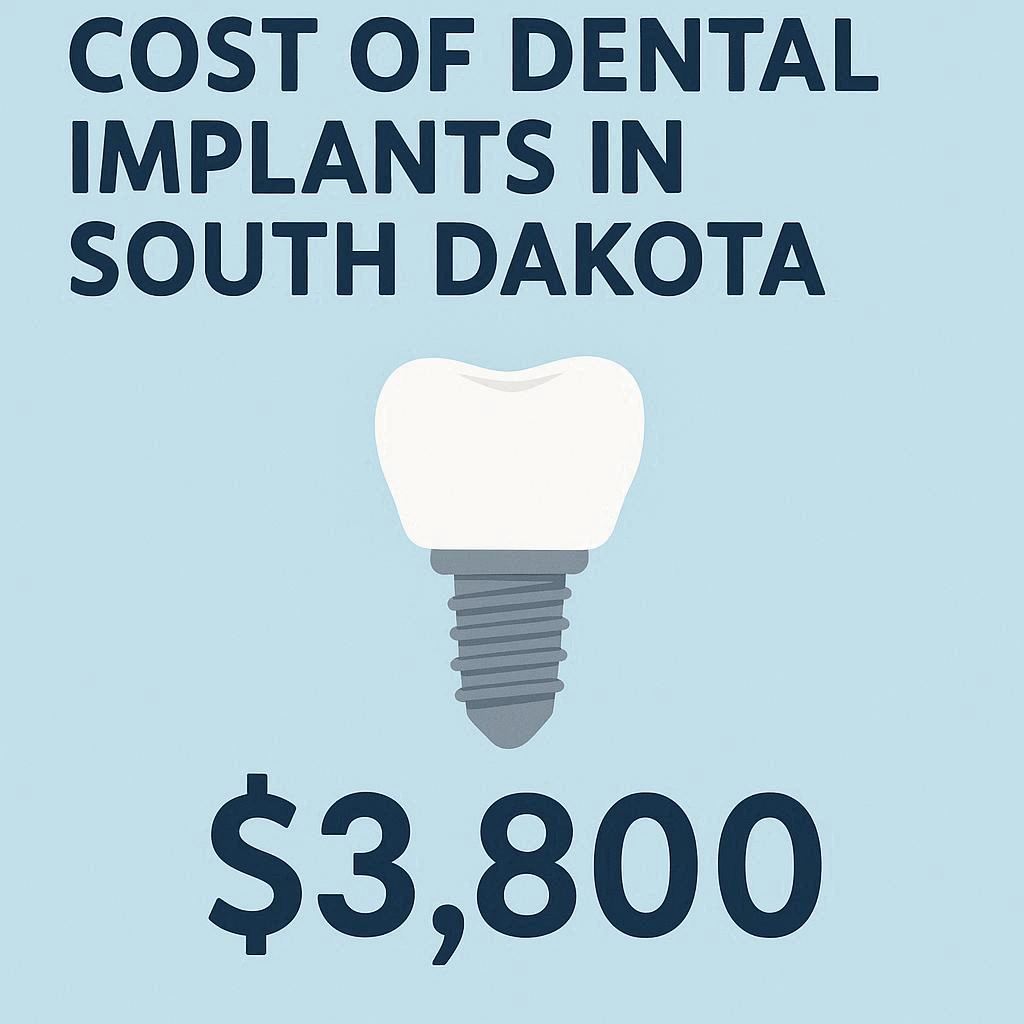
The Real Average Cost Range in South Dakota (2026)
For a single dental implant placed and restored by a general dentist in South Dakota, you should expect to pay between $3,800 and $5,500. If you need the work done by a specialist (a periodontist or oral surgeon), the price can climb to $6,000 or more per tooth.
Here is a simple breakdown of what that money covers:
- Implant fixture (the screw in the bone): $1,500 – $2,200
- Abutment (connector piece): $400 – $800
- Dental crown (the visible tooth): $1,200 – $2,200
- Surgical placement fee: Included above, but sometimes billed separately ($300 – $600)
Important note for readers: These figures are averages from 2025-2026 patient data. They do not include diagnostics like the initial exam, X-rays, or a 3D CT scan. We will cover those hidden costs next.
Why the Cost Varies Across South Dakota
South Dakota is a unique state. You have metropolitan areas like Sioux Falls and Rapid City, but you also have dozens of small towns where the nearest oral surgeon might be an hour away. That geography directly affects pricing.
- Sioux Falls and Rapid City: Higher competition among dentists, but also higher overhead (rent, staff wages, advanced equipment). Prices tend to be on the higher end of the range ($4,500 – $6,000 per implant).
- Smaller towns (Aberdeen, Brookings, Mitchell, Pierre): You might find lower surgical fees ($3,500 – $4,800 per implant), but you could pay more in travel if you need a specialist.
- Rural clinics with traveling specialists: Some rural offices bring in an oral surgeon once a month. This can reduce costs, but the waiting list is often several months long.
Another factor is the type of dentist. General dentists who complete advanced implant training often charge less than board-certified periodontists. However, complex cases (multiple missing teeth, severe bone loss, or sinus issues) should always go to a specialist, even if it costs more.
Breaking Down the Bill: From Consultation to Final Crown
To understand the total investment, you need to see the entire patient journey. Most dental offices will not give you a single “all-in” price upfront unless you specifically ask for it. Instead, they break the process into phases.
Phase 1: The Diagnostic Workup
Before anyone touches your mouth, the dentist must see what is happening beneath your gums. This phase usually includes:
| Service | Typical Cost in SD | Notes |
|---|---|---|
| Comprehensive oral exam | $75 – $150 | Often waived for new patients |
| Bitewing and periapical X-rays | $50 – $120 | |
| 3D CBCT scan (essential for implants) | $250 – $500 | Not always covered by insurance |
| Treatment planning | $0 – $200 | Some offices include this in the implant fee |
Many patients are surprised by the CT scan cost, but it is non-negotiable for safe implant placement. The scan shows bone height, width, and nerve locations. A dentist who places implants without a CT scan is taking a serious risk.
Phase 2: Preparatory Procedures (The Hidden Costs)
Here is where the budget often blows up. You might need one or more of these procedures before you are even a candidate for implants.
Bone grafting: If you have been missing a tooth for months or years, the jawbone likely shrank. A bone graft rebuilds that area. Prices vary by volume:
- Small socket graft (at the time of extraction): $300 – $800
- Larger block graft or sinus lift: $1,200 – $3,000
Tooth extraction: If the damaged tooth is still present:
- Simple extraction: $150 – $300
- Surgical extraction (impacted or broken): $300 – $650
Periodontal treatment: Active gum disease must be treated before implants. Scaling and root planing (deep cleaning): $500 – $1,200 per quadrant.
Honest advice: If a dentist quotes you a very low implant price, ask directly, “Does that include the CT scan, possible bone graft, and the final crown?” If they hesitate, you have your answer.
Phase 3: Implant Placement Surgery
This is the procedure where the titanium post is placed into your jawbone. Most dentists use local anesthesia (numbing shots) only. If you want sedation, add:
- Oral sedation (pill): $150 – $300
- Nitrous oxide (laughing gas): $100 – $200 per hour
- IV sedation: $400 – $800 per hour
The surgery itself takes 30 to 90 minutes for a single implant. The fee typically covers the implant fixture, the placement, and follow-up checks.
Phase 4: Healing and Osseointegration (No Cost, But Time)
After placement, you wait. The bone needs to fuse with the titanium surface. This takes 3 to 6 months. During this time, you might wear a temporary partial denture or a flipper ($300 – $700) if the missing tooth is in a visible area. That temporary is usually an extra cost.
Phase 5: Abutment and Crown Placement
Once the implant is stable, the dentist uncovers it, attaches the abutment, and takes impressions for the permanent crown. The crown is custom-made in a dental lab.
- Same-day crown (CEREC): $1,500 – $2,500 (faster, but not always better)
- Traditional lab crown: $1,200 – $2,200 (takes 2-3 weeks)
The lab crown generally has better aesthetics and longevity. Many South Dakota dentists prefer traditional lab-fabricated crowns for molars.
Total Cost Examples for Common Scenarios
Let us look at realistic patient stories. These are based on actual price lists from three different South Dakota clinics (names withheld for privacy).
Scenario 1: Simple single implant, no bone graft, general dentist in Rapid City
| Item | Cost |
|---|---|
| Exam + CT scan | $400 |
| Implant fixture + placement | $1,900 |
| Abutment | $550 |
| Lab crown | $1,600 |
| Total | $4,450 |
Scenario 2: Single implant with bone graft, oral surgeon in Sioux Falls
| Item | Cost |
|---|---|
| Exam + CT scan | $450 |
| Extraction of failed tooth | $250 |
| Bone graft | $750 |
| Implant surgery (surgeon fee) | $2,200 |
| Abutment + crown (restored by general dentist) | $2,100 |
| Total | $5,750 |
Scenario 3: Two adjacent implants, with sedation, rural clinic
| Item | Cost |
|---|---|
| CT scan + planning | $500 |
| Two implants + surgical guides | $4,000 ($2,000 each) |
| Two abutments | $1,000 |
| Two crowns (lab) | $3,200 |
| IV sedation (one session) | $600 |
| Total | $9,300 |
These numbers are honest and realistic. No one is paying $999 for a completed, safe implant in South Dakota in 2026.
Dental Implant Costs for Multiple Teeth: All-on-4 and Implant Bridges
If you are missing an entire arch (all teeth on top or bottom), single implants become impractical and extremely expensive. In that case, dentists recommend implant-supported dentures or the All-on-4 concept.
All-on-4 (fixed hybrid denture): Four implants support a full set of non-removable teeth.
- Lower end (economy materials, standard lab): $15,000 – $20,000 per arch
- High end (zirconia, premium lab): $25,000 – $35,000 per arch
Implant-supported overdenture (removable): Two to four implants snap into a special denture.
- Two implants + overdenture: $6,000 – $10,000 per arch
- Four implants + bar-retained denture: $10,000 – $15,000 per arch
South Dakota has several clinics offering these full-arch solutions. Prices here are generally 15-20% lower than in Minneapolis or Denver, but you should still expect to invest five figures.
Does Insurance Cover Any of This?
Traditional dental insurance was designed for cleanings, fillings, and crowns on natural teeth. Most plans explicitly exclude dental implants. However, there are some partial exceptions.
What you can sometimes get covered:
- Extraction: Usually 50-80% after deductible
- CT scan and X-rays: Possibly 50-80% if billed as diagnostic
- Crown portion: Some plans cover the final crown as they would a traditional crown (50% after deductible)
What is almost never covered: the implant fixture itself, the abutment, bone grafts, or the surgical placement fee.
A real example: A patient with Delta Dental PPO had a $4,800 implant. The plan paid $850 (for the extraction and the crown portion). The patient paid the remaining $3,950 out of pocket.
If you have a medical plan, there is a small chance of coverage if tooth loss resulted from an accident (trauma) or a medical condition (jaw tumor removal). You would need pre-authorization and detailed documentation.
How to Save Money Without Cutting Corners
You want quality work, but you also have a budget. Here are legitimate ways to reduce the cost of dental implants in South Dakota without risking your health.
- Ask about a cash discount. Many clinics offer 5-10% off if you pay in full with cash or a check. This avoids credit card processing fees.
- Use a dental school. The closest accredited dental school offering implant training is the University of Minnesota School of Dentistry (about 3-4 hours from eastern SD). Costs can be 30-40% lower. The trade-off: longer appointments and more time.
- Split the work with a general dentist. Have the oral surgeon place the implant (their specialty), then have your regular dentist make the crown (often cheaper for the restorative phase).
- Join a dental savings plan. These are not insurance. They are discount memberships. For an annual fee ($100-$200), you get 15-30% off implant services at participating South Dakota dentists.
- Use HSA or FSA funds. If you have a Health Savings Account or Flexible Spending Account, every dollar you spend on implants is pre-tax. That effectively saves you 22-35% depending on your tax bracket.
- Ask about in-house financing. Many SD clinics offer CareCredit (medical credit card) or their own payment plans. Read the interest terms carefully.
What to Avoid: Red Flags and Unrealistic Offers
You deserve honesty, so let me be direct. If you see these things, walk away:
- “All-inclusive implant for $1,500 or less.” That is impossible. The lab crown alone costs more than that. What they often mean: $1,500 for the surgical placement only, and the crown is extra. Or they use low-quality imported parts.
- No CT scan before surgery. Placing implants blindly is dangerous. It can lead to nerve damage or sinus perforation.
- Same-day “teeth in an hour” for every case. That works for specific situations, but rushing the process often leads to failure.
- No written treatment plan with fees. Any ethical dentist provides a detailed estimate before starting.
Real patient quote – Sarah from Box Elder: “I called a place in Rapid City advertising $1,899 implants. When I went in, that was just for the metal post. No crown, no abutment, no CT scan. The final total was over $5,000. I wish I had asked more questions upfront.”
Long-Term Value: Why Implants Cost More Now but Save Later
It is impossible to ignore the upfront cost. But compare implants to the alternatives:
| Option | Upfront Cost | Lifespan | Long-term costs |
|---|---|---|---|
| Dental implant | $4,000 – $6,000 | 20+ years (often lifetime) | Routine checkups only |
| Traditional bridge | $2,500 – $4,000 | 7-15 years | Needs replacement; adjacent teeth drilled down |
| Removable partial denture | $1,000 – $2,500 | 5-10 years | Clasps loosen; can damage adjacent teeth; replacement every few years |
Over 20 years, a bridge may need to be replaced twice, and each replacement requires drilling more tooth structure. A denture may need relines or remakes. An implant, once healed, acts like a natural tooth. You brush and floss normally.
In that sense, the higher initial cost of dental implants in South Dakota is actually an investment in fewer future dental bills.
Frequently Asked Questions (FAQ)
1. Are dental implants painful?
The procedure itself is not painful because of local anesthesia. After the numbing wears off, you will have some soreness and swelling, similar to a tooth extraction. Most patients manage with over-the-counter ibuprofen.
2. How long does the entire process take from start to finish?
For a simple case: 4 to 8 months. This includes surgery, 3-6 months of healing, and the final crown placement. If you need a bone graft, add 4-6 months before the implant can even be placed.
3. Can I get dental implants if I have diabetes or osteoporosis?
Yes, but your condition must be well-managed. Uncontrolled diabetes significantly increases implant failure rates. Your dentist will request medical clearance from your doctor.
4. Do South Dakota dentists offer payment plans for implants?
Many do. CareCredit is the most common. Some local banks also offer medical loans. Always ask about interest rates and whether a down payment is required.
5. What is the failure rate for dental implants?
About 5% fail in healthy non-smokers. Smoking raises the failure rate to 15-20%. Most failures happen within the first year due to poor healing or infection.
6. Is it cheaper to travel to Mexico or another country for implants?
You can find lower prices abroad ($2,000-$3,000 per implant including travel), but consider the risks: no easy follow-up care, different sterilization standards, and no legal recourse if something goes wrong. Most South Dakota dentists strongly advise against dental tourism for implants.
Additional Resource
For a free, unbiased guide to finding a qualified implant dentist in your area, visit the American Academy of Implant Dentistry (AAID) patient resource page. They offer a “Find a Dentist” tool that only includes members who meet rigorous training standards.
👉 Recommended link: aaid.com/patients/find-a-dentist (Copy and paste into your browser)
Final Conclusion
The cost of dental implants in South Dakota typically ranges from $3,800 to $6,000 for a single tooth, with full-arch solutions starting around $15,000. Hidden costs like CT scans, bone grafts, and temporary restorations can add $500 to $3,000 to your final bill. To get the best value, always ask for a written all-inclusive estimate, consider splitting care between a surgeon and your general dentist, and avoid any offer that seems too good to be true.
Disclaimer: This article provides general cost estimates based on 2025-2026 data from South Dakota dental offices and patient reports. Prices change over time and vary by clinic. Always obtain a written treatment plan and fee estimate before proceeding with any dental procedure. This content does not replace professional medical or dental advice.


