How Much Are Dental Implant Bridges?
If you are missing several teeth in a row, you have probably heard about dental implant bridges. They sound like a perfect solution. They look natural. They feel sturdy. They can last a lifetime.
But then comes the big question. The one that stops most people in their tracks.
How much are dental implant bridges?
You will find short answers online. Some websites say “$5,000.” Others say “$15,000.” It is confusing. And when it comes to your health and your wallet, confusion is the last thing you need.
This guide gives you the full, honest picture. We will break down every cost factor. We will compare options. We will share realistic price ranges. And we will help you make a confident decision without any marketing tricks.
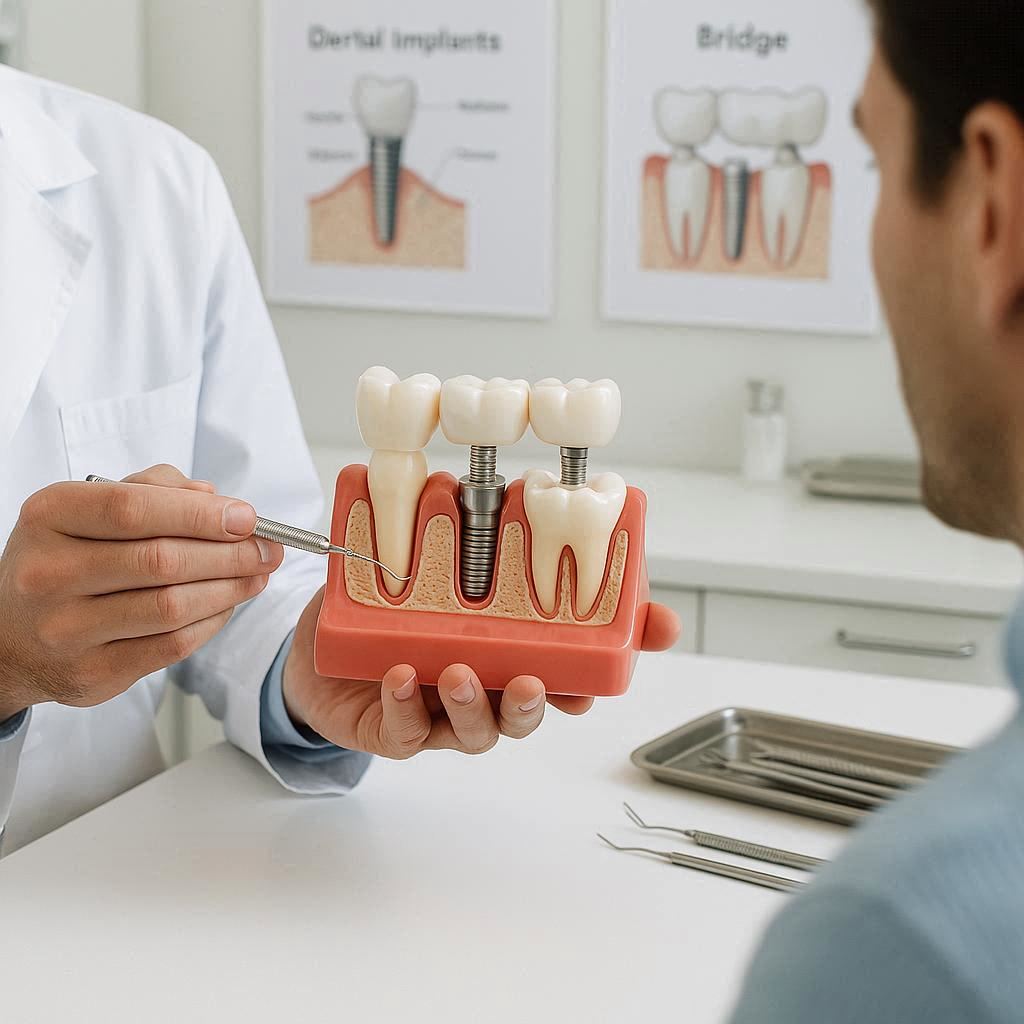
Understanding What a Dental Implant Bridge Really Is
Before we talk about money, we need to talk about the actual treatment. Many people mix up traditional bridges with implant bridges. They are not the same thing.
A traditional dental bridge uses your natural teeth as anchors. The dentist files down those healthy teeth. Then, he or she places a fake tooth (or several) in the gap. The bridge is cemented into place.
An implant bridge is different. It uses titanium posts that go into your jawbone. These posts act like artificial roots. Once they heal, the dentist connects a bridge to them. No healthy teeth get damaged.
This difference matters because it changes the cost, the healing time, and the long-term value.
Why Choose an Implant Bridge Over a Traditional One?
People choose implant bridges for three main reasons.
First, they protect your remaining teeth. With a traditional bridge, your anchor teeth take extra pressure. Over time, that pressure can lead to cracks, decay, or even tooth loss. Implant bridges stand on their own.
Second, they stop bone loss. When you lose a tooth, your jawbone starts shrinking. Implants stimulate the bone. They keep it strong and healthy.
Third, they last much longer. A traditional bridge might last 7 to 15 years. An implant bridge can last 20, 30, or even 50 years with good care.
Note: Because implant bridges last so long, the higher upfront cost often becomes cheaper per year of use compared to traditional bridges that need replacement.
Breaking Down the Real Cost of Dental Implant Bridges
Now, let us answer the main question directly.
How much are dental implant bridges in the United States? The total price typically falls between $3,000 and $30,000 per arch.
That is a wide range. Let me explain why.
The final cost depends on several key factors:
- How many implants you need
- The material of the bridge
- Your geographic location
- The dentist’s experience
- Whether you need extra procedures (bone grafts, sinus lifts)
- Your dental insurance coverage
Average Price by Number of Implants
| Number of Missing Teeth | Implants Needed | Average Total Cost (Without Insurance) |
|---|---|---|
| 3 missing teeth | 2 implants | $6,000 – $12,000 |
| 4 missing teeth | 2 – 3 implants | $8,000 – $16,000 |
| Full arch (all teeth) | 4 – 6 implants | $15,000 – $30,000 per arch |
Cost by Bridge Material
Not all implant bridges look or feel the same. The material changes the price significantly.
Acrylic (Temporary or Budget)
- Cost range: $3,000 – $6,000 per bridge
- Pros: Affordable, lightweight
- Cons: Wears down faster, less natural looking
Zirconia (Premium)
- Cost range: $8,000 – $15,000 per bridge
- Pros: Extremely strong, looks like natural teeth, gum-friendly
- Cons: More expensive, harder to adjust
Porcelain Fused to Metal (Mid-Range)
- Cost range: $6,000 – $10,000 per bridge
- Pros: Good strength, natural appearance
- Cons: Metal can show over time at the gum line
Hidden Costs You Need to Know About
Many patients focus only on the bridge itself. That is a mistake. The price you see advertised often does not include critical steps.
Here are the most common hidden fees.
1. Initial Consultations and Imaging
Most dentists charge for the first visit. X-rays cost extra. A 3D CBCT scan (which shows your bone density) can add $300 to $500.
2. Tooth Extractions
If you still have damaged teeth in the area, they must come out. Simple extractions cost $75 to $200 per tooth. Surgical extractions (for broken or impacted teeth) cost $250 to $500 per tooth.
3. Bone Grafting
This is the big one. Many patients do not have enough jawbone to support implants. Without a bone graft, the implant cannot stay stable.
A bone graft costs $500 to $3,000 per site. If you need multiple grafts, the price climbs fast.
4. Sinus Lift
For upper molars, the sinus cavity can get in the way. A sinus lift adds bone between your jaw and sinuses. This procedure costs $1,500 to $3,000.
5. Temporary Bridge
While your implants heal (3 to 6 months), you may want a temporary bridge. This keeps you smiling and eating normally. Cost: $500 to $1,500.
6. Abutments
Abutments are the connectors between the implant and the bridge. Each abutment costs $300 to $600. A bridge with two implants needs two abutments.
7. Final Bridge Placement
Some dentists include this in the bridge price. Others charge a separate fee of $500 to $1,500.
Complete Price Breakdown Example
Let me show you a realistic scenario.
Case: Missing three lower front teeth. Healthy bone. No extractions needed.
| Service | Cost |
|---|---|
| Consultation and CBCT scan | $400 |
| Two dental implants | $4,000 |
| Two abutments | $800 |
| Three-unit zirconia bridge | $8,000 |
| Temporary bridge (3 months) | $800 |
| Final placement fee | $600 |
| Total | $14,600 |
If the same patient needed a bone graft? Add another $1,500. Now the total becomes $16,100.
This is why you should never trust a “$5,000 dental implant bridge” advertisement. That price almost certainly leaves out essential steps.
How Much Are Dental Implant Bridges in Different Countries?
Some people travel abroad for dental work. This is called dental tourism. It can save money, but it also adds risks.
| Country | Average Cost for an Implant Bridge (3 teeth) | Savings vs. US |
|---|---|---|
| Mexico | $3,000 – $5,000 | 60-70% |
| Costa Rica | $4,000 – $6,000 | 50-60% |
| Colombia | $3,500 – $5,500 | 55-65% |
| Turkey | $2,500 – $4,500 | 65-75% |
| Thailand | $4,000 – $6,500 | 50-60% |
| Hungary | $4,500 – $7,000 | 40-55% |
Important warning: Low prices abroad can come with lower standards. Some clinics reuse implants. Others skip important sterilization steps. If something goes wrong after you return home, your local dentist may refuse to touch another dentist’s work. You would need to pay for corrections or even start over.
Note: If you choose dental tourism, research the clinic thoroughly. Look for international accreditation like JCI (Joint Commission International). Ask for before-and-after photos of patients with similar cases.
Dental Insurance and Payment Options
Most dental insurance plans do not cover implant bridges fully. However, they may cover parts of the treatment.
What Insurance Might Pay For
- Extractions (50-80%)
- Bone grafting (if medically necessary)
- The bridge itself (up to $1,500 per year, often capped)
- Follow-up visits
What Insurance Rarely Covers
- The implants themselves
- Cosmetic upgrades (zirconia instead of acrylic)
- Premium abutments
How to Maximize Your Benefits
- Schedule treatment across two plan years. Use this year’s benefit for extractions and next year’s for implants.
- Choose a dentist in your insurance network. They charge negotiated rates.
- Ask for a pre-treatment estimate. This shows exactly what insurance will pay before you commit.
Financing Options
If you cannot pay upfront, you have several choices.
- CareCredit: Medical credit card with 6, 12, or 18-month interest-free plans
- Alphaeon Credit: Similar to CareCredit, often with longer terms
- In-house payment plans: Some dentists offer monthly payments with zero interest
- Personal loans: LightStream, SoFi, and Upgrade offer dental loans from $5,000 to $100,000
How Much Are Dental Implant Bridges Compared to Alternatives?
To know if an implant bridge is worth it, you need to compare your options.
| Option | Upfront Cost | Lifespan | Maintenance | Pros | Cons |
|---|---|---|---|---|---|
| Implant bridge (3 teeth) | $12,000 – $18,000 | 20+ years | Normal brushing, flossing, regular checkups | Preserves bone, no damage to natural teeth | High upfront cost, surgery required |
| Traditional bridge | $2,500 – $5,000 | 7-15 years | Special floss threaders, careful cleaning | Lower upfront cost, no surgery | Damages healthy teeth, shorter lifespan |
| Partial denture | $1,000 – $2,500 | 5-10 years | Removed for cleaning, soaking overnight | Cheapest option, no surgery | Uncomfortable, can move while eating, bone loss continues |
| Single implants (three separate) | $15,000 – $21,000 | 20+ years | Same as natural teeth | Each tooth independent, easier flossing | More expensive, more surgery time |
| Do nothing | $0 upfront | N/A | None | No cost now | Bone loss, shifting teeth, difficulty chewing |
Long-Term Value Calculation
Let us do simple math over 20 years.
- Implant bridge: $14,000 once. No replacement needed. Total = $14,000.
- Traditional bridge: $4,000 every 10 years. Two replacements over 20 years. Total = $12,000 plus cost of anchor tooth repairs (often thousands more).
- Partial denture: $1,500 every 8 years. Three replacements over 20 years. Total = $4,500, but you lose bone and comfort.
The cheapest option upfront is not always the cheapest over your lifetime.
The Step-by-Step Process of Getting an Implant Bridge
Understanding the process helps you understand the cost. Here is exactly what happens, from start to finish.
Step 1: Consultation and Planning (1 visit)
The dentist examines your mouth. Takes X-rays or a CBCT scan. Discusses your medical history. Creates a treatment plan.
Cost included: Usually separate, $100-$400.
Step 2: Preparatory Procedures (1-3 visits, 1-12 months before implants)
If you need extractions, bone grafts, or sinus lifts, these happen now. Healing takes 3 to 12 months.
Cost: $500 to $5,000 depending on complexity.
Step 3: Implant Placement Surgery (1 visit, 1-2 hours)
The dentist numbs your mouth. Makes small incisions in your gum. Drills into the jawbone. Places the titanium implants. Stitches the gum closed.
Cost: Included in implant fees ($2,000-$4,000 per implant typically).
Step 4: Osseointegration (3-6 months of healing)
This is the most important phase. Your jawbone grows around the implants. It locks them in place. You wear a temporary bridge or denture during this time.
Cost: Temporary restoration: $500-$1,500.
Step 5: Abutment Placement (1 visit, 30 minutes)
The dentist re-opens the gum. Attaches small metal posts (abutments) to the implants. These will hold your final bridge.
Cost: $300-$600 per abutment.
Step 6: Impressions and Bridge Fabrication (2-3 weeks)
The dentist takes digital or physical impressions. A dental lab custom-makes your bridge. You may try a wax version first.
Cost: Included in bridge price.
Step 7: Final Bridge Placement (1 visit, 1 hour)
The dentist checks the fit. Makes small adjustments. Cements or screws the bridge onto your abutments. You walk out with a complete smile.
Cost: Sometimes separate ($500-$1,500).
Factors That Increase or Decrease Your Final Price
Factors That Lower Cost
- Dental schools: Teaching clinics offer 30-50% discounts. Supervised students perform the work. Appointments take longer, but quality is usually excellent.
- All-on-4 or All-on-6 technique: Using four or six implants for a full arch instead of eight to ten lowers the implant count.
- Same-day implants: Some dentists place implants and attach a temporary bridge in one visit. This saves time and some fees.
- In-network providers: Negotiated rates can reduce implant costs by 15-30%.
Factors That Raise Cost
- Specialists: A prosthodontist or oral surgeon charges more than a general dentist. But complex cases need specialists.
- Premium materials: German or Swiss implants (Straumann, Nobel Biocare) cost more than Korean or US brands (Hiossen, Implant Direct).
- Urban locations: New York City, Los Angeles, and San Francisco prices are 40-60% higher than rural areas.
- Emergency or expedited work: Faster timelines mean overtime for labs and extra staff.
Real Patient Examples: What People Actually Paid
Let me share anonymized real-world cases from patient reports and dental forums.
Case 1: Simple, three-tooth implant bridge
- Location: Dallas, Texas
- Missing: Teeth #4, #5, #6 (upper right)
- No bone graft needed
- Two implants, zirconia bridge
- Total paid: $11,400 after $1,200 insurance payment
Case 2: Complex, full arch implant bridge
- Location: Seattle, Washington
- Missing: All upper teeth
- Six implants, acrylic bridge (upgraded to zirconia later)
- Required sinus lift and bone graft (two sites)
- Total paid: $28,000 (no insurance coverage)
Case 3: Budget-conscious, dental school
- Location: University of Michigan Dental School
- Missing: Four lower front teeth
- Three implants, porcelain-fused-to-metal bridge
- Total paid: $6,800 (including all extractions and temporary)
Case 4: Replacement of failing traditional bridge
- Location: Phoenix, Arizona
- Original traditional bridge failed after 11 years
- Anchor teeth were damaged beyond repair
- Needed two extractions, two implants, three-unit bridge
- Total paid: $13,200
How to Get an Accurate Price Quote
Do not rely on phone estimates. Do not trust online calculators without a disclaimer.
Here is how to get a real, reliable quote.
- Schedule two or three consultations. Most dentists offer free or low-cost ($50-$100) first visits.
- Bring any existing X-rays. This saves time and money.
- Ask for a written treatment plan. It must list every procedure with individual prices.
- Request the CDT codes. These are standardized dental procedure codes. You can look them up to verify fair pricing.
- Ask about contingencies. “What if I need a bone graft during surgery?” “What if the implant fails?”
A trustworthy dentist will give you a range, not a single number. They will explain worst-case and best-case scenarios.
Note: If a dentist guarantees an exact price without examining your mouth or seeing X-rays, walk away. That is a red flag for poor quality or hidden fees.
Insurance and Tax Tips to Save Money
Using an HSA or FSA
Health Savings Accounts (HSAs) and Flexible Spending Accounts (FSAs) cover dental implants. This includes:
- Implants and abutments
- Bridges
- Bone grafts
- Extractions
- Anesthesia
- Travel to and from appointments (with a doctor’s note)
If you have an HSA, you can invest the money tax-free and withdraw it for dental work at any time.
Medical Expense Tax Deduction
If your total medical expenses exceed 7.5% of your adjusted gross income, you can deduct the overage on your federal taxes. Dental implant bridges count as medical expenses.
Example: You earn $80,000. 7.5% is $6,000. If you spend $14,000 on an implant bridge, you can deduct $8,000 from your taxable income.
Negotiating with Your Dentist
Many patients do not know that dental fees are negotiable. Here is how to approach it.
- Offer to pay cash (no credit card processing fees save the dentist 2-4%)
- Ask for a multi-procedure discount (10-15% is common)
- Schedule treatment during slow months (January and February are often slower)
- Join the dentist’s membership plan (many offer 10-20% off for a yearly fee)
Long-Term Maintenance Costs
An implant bridge will not cost you anything extra for years if you care for it properly. But neglect can lead to expensive problems.
Routine Maintenance (Annual)
- Regular checkups and cleanings: $200-$400 (often covered by insurance)
- Peri-implant evaluation: Included in checkup
Potential Future Costs
| Problem | Likelihood | Repair Cost |
|---|---|---|
| Chipped bridge material | Low (5-10% over 10 years) | $500-$1,500 for repair |
| Loose abutment screw | Low (3-5% over 10 years) | $200-$500 to tighten |
| Peri-implantitis (bone loss around implant) | Low with good hygiene (2-5%) | $2,000-$5,000 for treatment |
| Implant failure | Very low (1-2%) | Full replacement cost |
How to Avoid Extra Costs
- Brush twice daily with a soft brush
- Floss with superfloss or implant-specific floss
- Use a water flosser (Waterpik) around the bridge
- Avoid chewing ice, hard candy, or pens
- Wear a night guard if you grind your teeth
- Visit your dentist every 6-12 months
Frequently Asked Questions (FAQ)
1. How much are dental implant bridges with insurance?
With good insurance, you might pay $6,000 to $12,000 for a three-unit bridge instead of $12,000 to $18,000. But most plans cap annual benefits at $1,000 to $2,000. That rarely covers more than 10-20% of total costs.
2. How much are dental implant bridges for a full mouth?
Full mouth (both arches) with implant bridges typically costs $25,000 to $60,000. The lower end uses acrylic bridges and fewer implants. The higher end uses zirconia and premium implants.
3. How much are dental implant bridges at affordable clinics?
Community health centers and dental schools charge $5,000 to $10,000 for a three-unit implant bridge. Wait times are longer (3 to 12 months). But the quality is closely supervised.
4. How painful is the procedure?
Most patients report less discomfort than a tooth extraction. The surgery uses local anesthesia. Over-the-counter pain relievers manage post-op soreness for 2-5 days.
5. How long do implant bridges last?
With good care, 20 years to a lifetime. The bridge itself may wear after 15-20 years, but the implants can stay forever. You simply replace the bridge on top.
6. Can I get an implant bridge if I smoke?
Yes, but smoking increases failure rates by 15-30%. It slows healing and raises infection risk. Many dentists require patients to quit smoking for at least 2 weeks before and after surgery.
7. How much are dental implant bridges if I already have implants?
If you already have healed implants, you only pay for the bridge and placement. That ranges from $3,000 to $10,000 depending on material and lab fees.
8. Will Medicare or Medicaid pay?
Original Medicare does not cover dental implants. Some Medicare Advantage plans offer limited dental benefits. Medicaid coverage varies by state. A few states (like California and New York) cover implants for certain medical needs.
9. How much are dental implant bridges in the UK or Canada?
In the UK, private implant bridges cost £4,000 to £8,000 (roughly $5,000 to $10,000 USD). In Canada, expect $8,000 to $18,000 CAD ($6,000 to $13,500 USD). These prices are similar to the US but sometimes lower due to different regulations.
10. What is the cheapest way to get an implant bridge?
The cheapest safe method is a dental school. Second is traveling to Mexico or Colombia with extensive research. Third is finding a new dentist building their portfolio (ask for discounted “teaching cases”).
Additional Resource
For an independent, dentist-reviewed guide to dental implant costs by city and provider, visit the American Academy of Implant Dentistry’s patient resource page:
🔗 https://www.aaid.com/patients/index.html
This official resource helps you find accredited implant dentists in your area and explains quality standards to look for. It does not sell anything or push specific clinics.
Conclusion
Dental implant bridges are a serious financial investment. Most people pay between $6,000 and $18,000 for a bridge replacing three to four teeth. Full arch solutions range from $15,000 to $30,000 per jaw. While the upfront cost is higher than traditional bridges or dentures, implant bridges offer unmatched longevity, bone preservation, and comfort. To get the best value, seek multiple opinions, ask for written treatment plans, explore dental schools for affordable care, and remember that the cheapest option today is not always the cheapest over a lifetime.
*Disclaimer: The prices and information in this article are based on national averages and patient-reported data from 2023-2025. Your actual costs will vary based on your specific condition, location, and chosen provider. Always obtain a personalized treatment plan before making financial decisions.*