CT Scan for Dental Implants Cost: A Complete, Honest Guide for 2026
If you are missing a tooth or struggling with uncomfortable dentures, dental implants can feel like a miracle solution. They are strong, natural-looking, and built to last for decades. But before any implant surgery, there is one essential step that surprises many people: the CT scan.
You might be asking yourself, “How much is a CT scan for dental implants going to set me back?” You are not alone. That is the most common question patients ask after their first consultation.
The truth is that the ct scan for dental implants cost varies widely depending on where you live, the type of clinic you visit, and what the scan needs to show. Some people pay under $200. Others pay over $1,000.
This guide walks you through everything you need to know. No confusing medical terms. No hidden surprises. Just clear, realistic information to help you plan your budget and feel confident about your next step.
Let us start with the most important question first.
Why Do You Actually Need a CT Scan for Dental Implants?
Many patients assume that a simple dental X-ray is enough. It is not. Traditional X-rays show only two dimensions. They can tell your dentist that something is wrong, but they cannot show exactly where your nerves, sinuses, and bone are located in three dimensions.
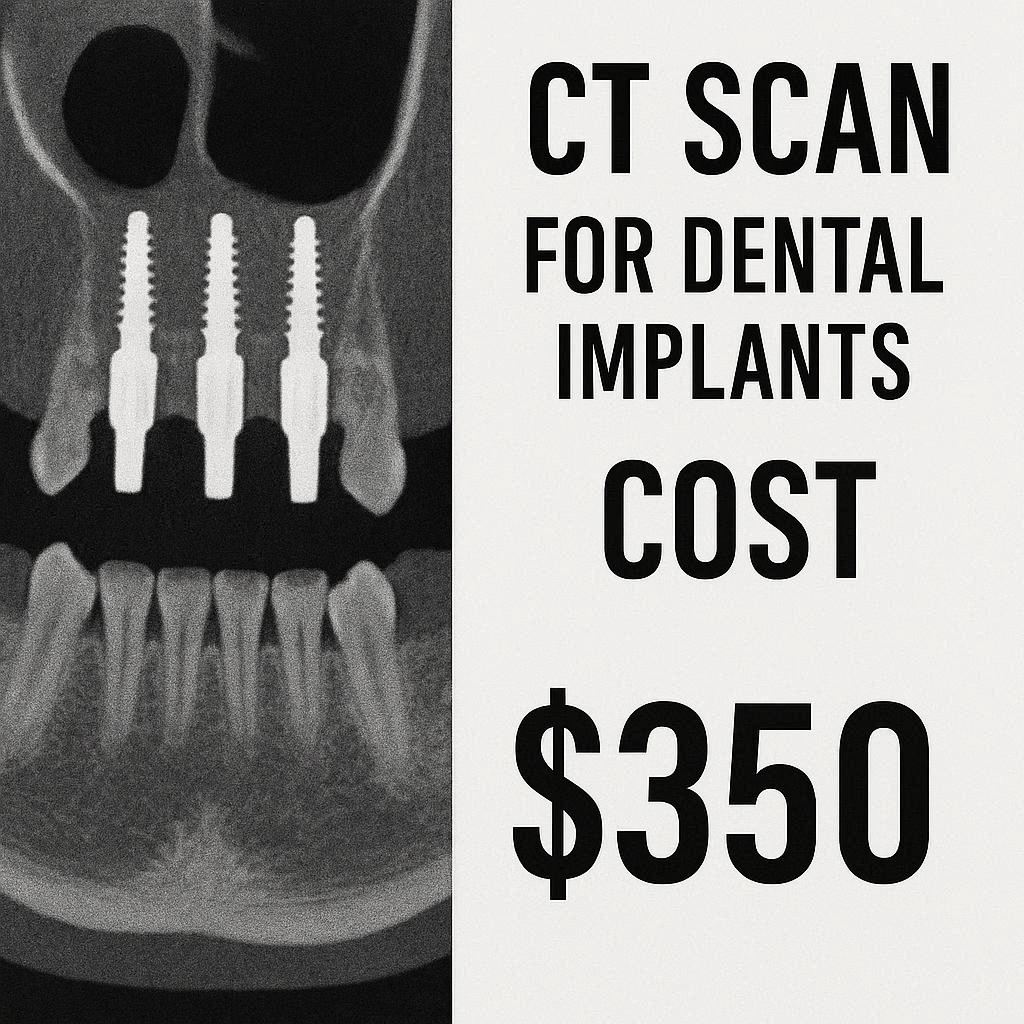
A CT scan (computed tomography) creates a complete 3D map of your mouth, jaw, and facial structure. This map allows your implant specialist to:
- Measure the exact thickness and height of your jawbone
- Locate nerves that could cause numbness if damaged
- Identify sinus cavities that might interfere with upper implants
- Detect hidden infections or cysts
- Plan the perfect angle and depth for each implant
Skipping this scan is like building a house without measuring the land. It might work, but the risk of failure is high. Most reputable implant dentists will not even start treatment without a recent CT scan.
“A CT scan is not an extra expense. It is insurance against failed implants and unnecessary pain.” — Dr. Sarah Jenkins, prosthodontist.
Average CT Scan for Dental Implants Cost: Real Numbers
Let us get straight to the numbers you came for. Keep in mind that these figures are averages based on clinics across the United States and other English-speaking countries. Prices change over time, so always confirm with your local provider.
United States
| Facility Type | Average Cost (without insurance) |
|---|---|
| Stand-alone imaging center | $150 – $350 |
| Dental school clinic | $75 – $200 |
| Private implant clinic | $250 – $650 |
| Hospital-based radiology | $400 – $1,000 |
United Kingdom (Private)
| Facility Type | Average Cost (GBP) |
|---|---|
| High street imaging center | £90 – £200 |
| Private dental practice | £150 – £350 |
| Specialist implant clinic | £200 – £500 |
Australia
| Facility Type | Average Cost (AUD) |
|---|---|
| Bulk-billing imaging (if eligible) | $0 – $150 |
| Private radiology clinic | $200 – $450 |
| Dental implant specialist office | $300 – $700 |
Canada
| Facility Type | Average Cost (CAD) |
|---|---|
| Independent imaging lab | $150 – $300 |
| Dental clinic (in-house scanner) | $250 – $500 |
| Hospital imaging department | $350 – $800 |
The wide range often confuses patients. Why would one clinic charge $200 while another charges $600 for the same type of scan? The next section explains exactly why.
Why Does the Price Vary So Much?
You might call two different dental offices and receive completely different quotes. Neither one is necessarily trying to overcharge you. Several factors influence the final price.
1. Type of CT Scanner
Older cone beam CT machines cost less to operate. Newer machines with higher resolution and lower radiation exposure are more expensive. A newer machine also produces clearer images, which can lead to more accurate implant placement.
2. In-House vs. Referral
Some implant clinics own their own CT scanner. They often charge a higher fee because you are paying for convenience and immediate results. You get scanned, and your dentist reviews the images within minutes.
Other clinics refer you to an external radiology center. Those centers usually charge less, but you have to make two separate appointments. You also wait longer for the report.
3. Geographic Location
A clinic in downtown Manhattan or central London pays much higher rent than a clinic in a small town. Those costs get passed on to you. Rural areas and smaller cities almost always offer lower prices.
4. What Is Included in the Fee
Always ask what the quoted price covers. Some clinics charge a flat fee for the scan itself. Others include:
- Radiologist interpretation report
- 3D surgical guide design (very valuable)
- Digital files sent to your implant surgeon
- Follow-up consultation to review results
A $500 scan that includes a surgical guide is often better value than a $250 scan that gives you only raw images you cannot understand.
5. Complexity of Your Case
A simple single-tooth implant in a healthy jaw requires a smaller scan field. A full-mouth reconstruction with multiple implants needs a larger scan area. Some patients also need a second scan with a bite block or a scan appliance. More complexity means higher cost.
Hidden Costs You Should Know About
Many websites tell you only the price of the scan itself. That is helpful, but it is not the full picture. Here are three additional expenses that catch patients off guard.
Interpretation Fee
Some imaging centers charge separately for a radiologist to read your scan and write a formal report. This fee typically ranges from $50 to $150. Ask upfront if interpretation is included.
Surgical Guide Fee
Your implant dentist may use your CT scan to design a 3D-printed surgical guide. This plastic guide fits over your teeth or gums and shows exactly where to place each implant. The guide dramatically improves accuracy but often costs an extra $200 to $500.
Repeat Scans
If you wait more than six to twelve months between your scan and your implant surgery, your jawbone may change. Many dentists require a fresh scan. Planning ahead saves you from paying twice.
Important note for readers: Always ask for a written estimate before scheduling your CT scan. A reputable clinic will provide a clear breakdown of all potential fees.
Does Insurance Cover CT Scans for Dental Implants?
This is where things get tricky. Dental insurance and medical insurance handle CT scans differently.
Dental Insurance
Most standard dental insurance plans do not cover CT scans for implants. They view the scan as part of a “major restorative procedure” that often has a low annual maximum (typically $1,000 to $1,500 per year). Some PPO plans may cover 30% to 50% after a waiting period.
Always call your dental insurer directly. Ask this exact question: “Does my plan include any benefits for cone beam CT imaging for implant planning?”
Medical Insurance
Your medical insurance might cover part of the cost, but only under specific circumstances. Examples include:
- You have a known pathology (cyst, tumor, infection)
- You need bone grafting after trauma or cancer surgery
- Your implant is related to a congenital condition
Routine implant planning is almost never covered by medical insurance. That said, it never hurts to submit a claim. Some patients receive partial reimbursement.
Flexible Spending Accounts (FSA) and Health Savings Accounts (HSA)
Good news here. In the United States, you can use FSA or HSA funds to pay for a dental CT scan. These accounts let you use pre-tax dollars, effectively reducing your out-of-pocket cost by 20% to 40% depending on your tax bracket.
Payment Plans
Many implant clinics offer in-house financing or work with third-party healthcare credit companies. You might pay for your CT scan as part of a larger treatment plan with monthly installments. Always ask about no-interest or low-interest options.
How to Find the Best Price Without Sacrificing Quality
You want a fair price. You also want accurate images from a well-maintained machine. Cutting corners on a CT scan can lead to failed implants, which cost thousands to fix. Here is a smart strategy to save money safely.
Step 1: Get a Referral from Your Implant Dentist
Your implant dentist knows which local imaging centers produce high-quality scans. Ask them for two or three recommendations. Some dentists even have negotiated cash rates with specific centers.
Step 2: Call Independent Imaging Centers
Freestanding radiology centers almost always charge less than dental clinics or hospitals. Search for “cone beam CT near me” or “dental 3D imaging center.” Call and ask for their “cash price for a dental implant scan.”
Step 3: Ask About “Limited Field of View”
A full head CT scan costs more and exposes you to more radiation. Most single-tooth implants only need a small scan covering three to four teeth. Ask the imaging center if a limited field of view is appropriate for your case. It is often 30% to 50% cheaper.
Step 4: Check Dental Schools
Dental schools offer some of the lowest prices. An advanced imaging student performs the scan under the supervision of a licensed radiologist. The process takes longer, but the quality is excellent, and prices are often below $150.
Step 5: Bundle the Cost
Some implant clinics offer package pricing that includes the CT scan, surgical guide, and implant placement in one flat fee. This is especially common for “implant in a day” or “teeth in a day” procedures. The upfront number looks high, but the per-service cost is usually lower.
What Happens During a Dental CT Scan?
If you have never had a CT scan before, the idea can feel intimidating. Let me walk you through exactly what happens so you know what to expect.
Before the Scan
You remove any removable dental appliances, glasses, hearing aids, and metal jewelry. You do not need to change clothes unless your shirt has metal buttons or zippers near the neck area.
During the Scan
You stand or sit in an upright position. The machine rotates around your head in a complete circle. The entire scan takes between 20 and 40 seconds. You are asked to stay very still and not swallow during the scan. Some machines ask you to bite gently on a small plastic stick to keep your jaw stable.
After the Scan
Nothing. You get up and go back to your normal activities immediately. No recovery time. No side effects. The radiation exposure from a modern dental CT scan is very low. It is similar to a few days of natural background radiation or a cross-country flight.
Your images are usually ready within one hour to three days, depending on where you had the scan.
Is It Worth the Money? A Realistic Look at Value
Let us be honest. A few hundred dollars for a scan feels like a lot when you are already facing thousands for implants. I understand that hesitation. But consider what you are buying.
A CT scan prevents these common and expensive problems:
| Problem | Cost to Fix |
|---|---|
| Implant placed into a nerve | $5,000 – $15,000 (surgical nerve repair) |
| Implant that fails due to poor bone density | $3,000 – $8,000 (removal + bone graft + new implant) |
| Sinus perforation during surgery | $2,000 – $7,000 (sinus repair surgery) |
| Implant that damages adjacent tooth roots | $2,500 – $6,000 (root canal or extraction of healthy tooth) |
A $300 scan looks very small when you compare it to a $10,000 surgical mistake. The scan is not an expense. It is a risk management tool.
“I had a patient who wanted to skip the scan to save $250. He ended up with an implant pressing on his inferior alveolar nerve. He had numbness for eighteen months. That scan would have been the best money he ever spent.” — Dr. Mark Rivera, oral surgeon.
How to Read Your CT Scan Quote (Without a Medical Degree)
When you receive an estimate for your CT scan, look for these specific line items. If something is missing, ask about it.
Checklist for Reviewing Your Estimate
- Technical fee (operating the machine)
- Professional fee (radiologist interpretation)
- Media fee (CD, USB drive, or digital download)
- Surgical guide design (if applicable)
- Follow-up consultation to review findings
- Validity period (how long the scan is usable)
Any reputable clinic will provide this breakdown in writing before you pay anything.
Frequently Asked Questions (FAQ)
1. Can I use an old CT scan from another doctor?
Yes, if the scan is less than six months old and your implant dentist can obtain the original DICOM files (the raw data, not just printed images). Older scans are usually rejected because bone density and anatomy change over time.
2. Why is my dentist charging $800 when the center down the road charges $200?
The $800 price may include a surgical guide, interpretation, and a consultation. The $200 price might be only for the raw scan. Ask both providers for a complete list of included services before deciding.
3. Does Medicare cover CT scans for dental implants?
Original Medicare does not cover routine dental implant procedures or associated imaging. Some Medicare Advantage plans offer limited dental benefits, but coverage for CT scans is rare. Always check your specific plan documents.
4. How many CT scans do I need for a full set of implants?
Most patients need one scan before surgery. Complex cases with multiple bone grafts may require a follow-up scan after healing is complete (six to twelve months later).
5. Is a CBCT scan the same as a medical CT scan?
Almost, but not exactly. CBCT (cone beam computed tomography) uses lower radiation and is specifically designed for dental and facial imaging. Medical CT scanners use higher radiation but produce different image types. For dental implants, CBCT is the standard.
6. Can I get a CT scan while pregnant?
Most dentists postpone elective implant procedures until after pregnancy. If the scan is truly urgent, modern CBCT machines use very low radiation, but you should always inform the technologist and your obstetrician first.
7. What if my bone is not thick enough for implants?
The CT scan will show exactly how much bone you have. If it is insufficient, your dentist will recommend a bone graft. That adds time and cost but makes implant placement possible. Some patients need a second CT scan after grafting to confirm healing.
8. Do all implant dentists require a CT scan?
Reputable ones do. Any dentist placing implants without a CT scan is taking a serious risk with your health. Consider finding a different provider if they suggest skipping the scan.
Additional Resource
For the most current, location-specific pricing and to compare accredited imaging centers near you, visit the American Academy of Oral and Maxillofacial Radiology’s patient resource page. They maintain a directory of certified dental CBCT facilities and offer a free patient guide to understanding your scan.
You can find this resource by searching online for “AAOMR patient CBCT information.”
A Quick Word on Artificial Intelligence and CT Scan Pricing
You may see online tools or websites claiming to give you an “instant quote” for a CT scan. Be very careful with these. Many are lead generation sites that sell your information to multiple clinics. Your phone will ring for days.
The only reliable way to know the real ct scan for dental implants cost for your specific situation is to call three local providers and ask these five questions:
- What is your cash price for a limited-field CBCT scan for implant planning?
- Does that include a radiologist’s report?
- Do you provide the DICOM files on a USB drive?
- How long is the scan valid for treatment planning?
- Do you offer any discounts for upfront payment or bundled services?
Write down the answers. Compare them. Then make your choice based on value, not just the lowest number.
Conclusion
A CT scan for dental implants typically costs between $150 and $650, depending on your location, clinic type, and what services are included. This scan prevents devastating surgical errors and is a wise investment in your long-term oral health. Always ask for a written breakdown, check if your FSA/HSA can help, and never let a dentist place implants without one.