Can You Have a CT Scan with Dental Implants?
You are scheduled for a CT scan, but you have dental implants. Suddenly, a wave of worry washes over you. Will the metal cause a problem? Is the scan even safe? These are incredibly common questions, and you are not alone in asking them.
Let me put your mind at ease right away. Yes, you can absolutely have a CT scan with dental implants.
In fact, millions of people with dental implants undergo CT scans every year without any issues. However, there are a few important details you should know. The metal in your mouth does interact with the scan, but not in the dangerous way you might think.
This guide will walk you through everything you need to know. We will cover the science, the safety protocols, and what to tell your technician before the scan begins. By the end, you will feel confident and informed.
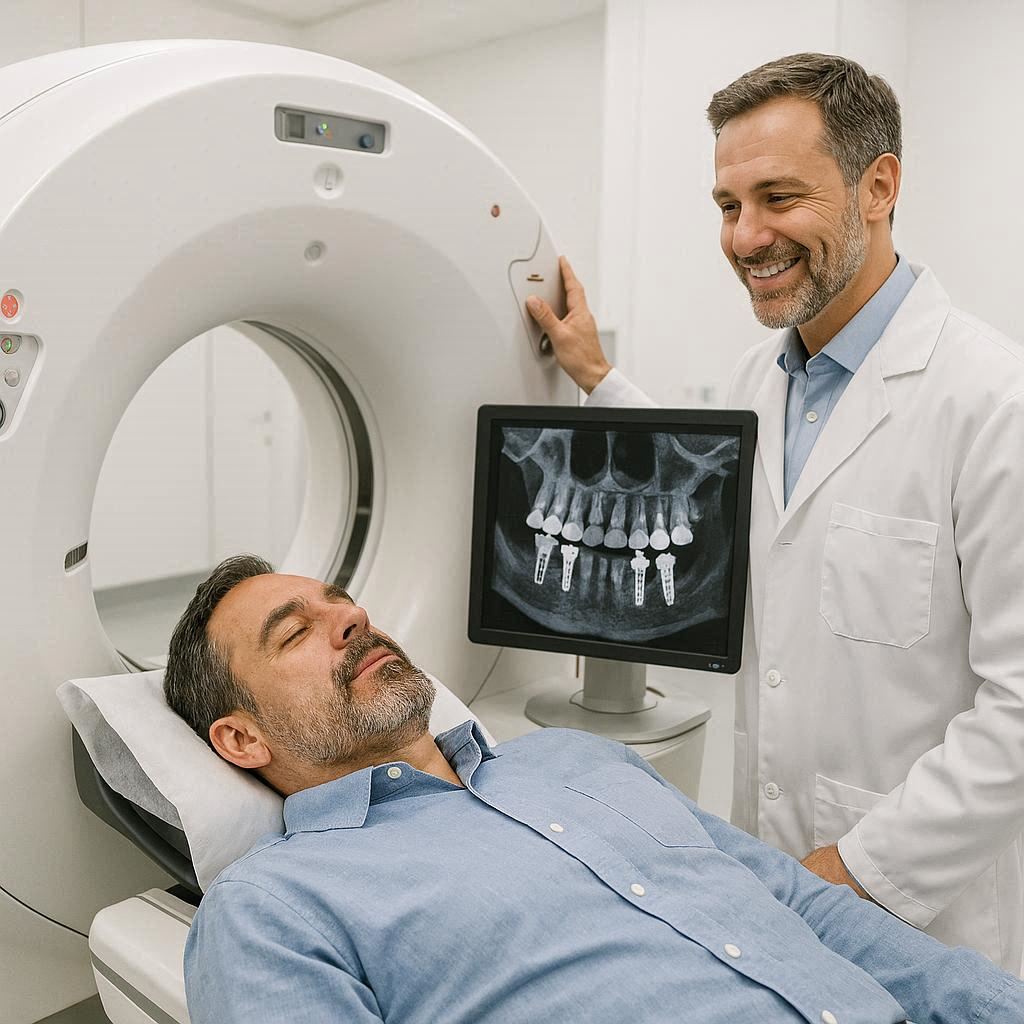
Understanding the Basics: How a CT Scan Works
To understand why dental implants are usually safe, we need to look at how a CT (Computed Tomography) scan actually works.
Unlike an X-ray, which takes a single flat picture, a CT scanner rotates around your body. It takes hundreds of images from different angles. A computer then stacks these images together to create a detailed 3D view of your insides.
Think of it like slicing a loaf of bread. The scanner sees each “slice” of your body, and the computer rebuilds the whole loaf.
The scanner uses X-rays. These are a form of electromagnetic radiation. Different materials in your body absorb X-rays at different rates.
- Soft tissue (muscles, organs) allows most X-rays to pass through. It appears gray.
- Bone absorbs more X-rays. It appears white.
- Metal absorbs almost all X-rays. It appears bright white and can create streaks.
This last point is the key. The metal in your dental implant does not “explode” or “heat up” during a CT scan. It simply blocks the X-rays. This blocking effect can create a problem called artifact.
The Real Issue: Artifacts, Not Danger
Here is the most important fact you need to remember. Dental implants are not dangerous during a CT scan. They will not move, heat up, or cause any physical harm to your jaw or body.
The only challenge is the quality of the image.
When the X-ray hits your titanium or zirconia implant, it gets stopped completely. The computer receives very little information from that specific angle. As a result, the computer might “guess” what is behind the implant. This often looks like dark streaks or bright flares radiating from your mouth.
Radiologists call this beam hardening artifact or metal artifact.
“In my 15 years of practice, I have never seen a dental implant cause physical harm to a patient during a CT scan. The only issue is that the metal can hide small details in the sinuses or the base of the skull.” — Dr. Amanda Reyes, Diagnostic Radiologist.
So, the question is not “can you have a CT scan?” The question is “will the artifact ruin the scan?”
For most body parts, the answer is no. The artifact is very localized.
When Artifacts Are a Minor Problem
If you are having a CT scan of your:
- Chest (for lungs or heart)
- Abdomen (for liver, kidneys, or stomach)
- Pelvis (for hips or bladder)
- Legs or arms
The artifact from your dental implants will be almost invisible. Your mouth is far away from these areas. The streaks will fade out completely before reaching your chest or belly. You will get a perfectly clear, diagnostic image.
When Artifacts Can Be a Problem
The only time dental implants cause a real headache is when the scan target is very close to your mouth. This includes:
- Brain CT scans (especially the lower part of the brain)
- Temporal bone CT scans (inner ear)
- Sinus CT scans
- Facial bone CT scans
- Jaw and neck CT scans
In these cases, the bright streaks from your implants can overlap with the anatomy the doctor needs to see. It is like trying to read a book while someone holds a flashlight in your eyes. You can see the book, but the bright spot hides a few words.
Titanium vs. Zirconia: Does the Material Matter?
Not all dental implants are the same. The material your dentist used can affect the scan quality.
| Implant Material | Density | Artifact Severity | Common Use |
|---|---|---|---|
| Titanium | High | Moderate to Severe | Most common implant type (strong, proven). |
| Zirconia (Ceramic) | Medium | Mild to Moderate | Metal-free alternative (gaining popularity). |
| Gold / Stainless Steel (Older) | Very High | Severe | Rarely used today. Usually in older bridges. |
What this means for you:
- Titanium: Very safe, but expect some streaks on head and neck scans. Modern scanners handle titanium well.
- Zirconia: Excellent choice for CT compatibility. It causes fewer artifacts than titanium.
- Old metal fillings (amalgam): These often cause more artifacts than modern implants because they are denser and often multiple.
If you have a choice (for example, you are planning an implant before a known future brain scan), zirconia is the more CT-friendly option. However, titanium remains the gold standard for strength. Do not switch to zirconia solely for a CT scan unless your radiologist recommends it.
What About MRI? The Common Confusion
Many people confuse CT scans with MRI (Magnetic Resonance Imaging). This is where most of the “metal danger” stories come from.
CT Scan: Uses X-rays. No magnets. Metal is safe but may cause image streaks.
MRI: Uses a powerful magnet. Metal can be dangerous.
With an MRI, the magnet can try to pull ferromagnetic metals (like old steel) out of your body. This is a real safety risk.
However, dental implants are almost always MRI-safe as well. Titanium and zirconia are non-ferromagnetic. They are not attracted to magnets. You can have an MRI with dental implants too. The only issue again is image distortion, not physical danger.
Important Note: Always tell your MRI technician about your dental implants. They will check the specific model. But for CT scans, you have nothing to fear physically.
A Step-by-Step Guide: Before Your CT Scan
You have dental implants. You need a CT scan. Here is exactly what to do.
Step 1: Inform the Technician Immediately
Do not assume it is obvious. When you arrive for your appointment, tell the CT technologist:
“I have dental implants. Please note them before the scan.”
This is not because you are in danger. It is because the technologist can adjust the scanner settings to reduce artifacts.
Step 2: Remove Removable Metal
If you have:
- Removable dentures with metal clasps
- A partial denture
- A removable retainer with metal wires
Take them out. Leave them in a safe cup. These are not fixed to your bone. They can move and create unpredictable artifacts. Your fixed, permanent dental implants will stay in place.
Step 3: Positioning Matters
The technologist can position your head to minimize the effect. For a brain scan, they might tilt your chin up or down slightly. This moves the metal streak away from the area of interest. This small adjustment takes ten seconds but makes a huge difference.
Step 4: Modern Software Solutions
Today’s CT scanners are incredibly smart. Most hospitals use Metal Artifact Reduction (MAR) software. This is a special computer program that recognizes the streaks and digitally removes them. It is like Photoshop for medical images.
Ask the technologist:
“Will you be using MAR software for my scan?”
If they say yes, you can relax. The software is very effective at clearing up the image around your implants.
Special Cases: When a Dental Implant Might Ruin the Scan
Let us be completely honest. In rare cases, the implant artifact is so severe that the scan is not useful. This is not common, but it happens.
Case Example: A patient needs a detailed CT scan of the pituitary gland (a tiny gland at the base of the brain). They have four large titanium implants in the upper jaw. The implants sit directly below the pituitary gland. The artifact streaks shoot straight up into the gland.
In this situation, the radiologist might say:
“The artifact from the implants obscures the area we need to see. A diagnostic-quality image is not possible with this method.”
What happens then?
You are not in trouble. Your doctor has other options:
- MRI: An MRI of the brain is not affected by dental implants in the same way. It will provide a clear image.
- Different angle: The radiologist might try a different scanning protocol or a lower-dose technique.
- Accept the limitation: Sometimes, the doctor only needs to see the other side of the brain. They can work around the artifact.
Do not panic if this happens. It is a technical limitation, not a medical emergency.
How Many Implants Do You Have? The Cumulative Effect
The number of implants in your mouth directly affects the scan quality.
| Number of Implants | Expected Artifact Level | Likely Scan Success |
|---|---|---|
| 1 single implant | Minimal | Excellent. Almost no visible artifact. |
| 2-4 implants (e.g., front teeth) | Mild | Very good. Easy to correct with software. |
| 4-8 implants (full arch) | Moderate | Good for body scans. Challenging for brain/sinus scans. |
| Full mouth (All-on-4, All-on-6) | Moderate to Severe | May require MRI for brain/sinus imaging. Usually fine for chest/abdomen. |
A single implant is rarely a problem. A full mouth of implants (10 or more) will definitely create visible streaks on a head CT. However, even then, the scan is often still “diagnostic,” meaning the doctor can see enough to make a decision.
What to Expect During the CT Scan (With Implants)
The process is exactly the same as for a person without implants. There is zero difference in your experience.
- You lie down on a narrow table.
- The table moves slowly into the large, donut-shaped scanner.
- You will hear a quiet whirring or buzzing sound. This is the X-ray tube rotating around you.
- You may be asked to hold your breath for a few seconds (for chest or abdominal scans).
- The scan lasts between 5 and 15 minutes total. The actual X-ray exposure is only a few seconds.
You will feel:
- Absolutely nothing from your dental implants. No heat, no vibration, no pulling, no pain.
You might notice:
- The table moving.
- The sound of the scanner.
- A request to remain very still.
That is it. You get up, you leave, and you wait for your results.
Can Dental Implants Cause a “False Positive” on a CT Scan?
This is a smart question. A false positive is when the scan shows something that looks like a disease, but it is actually just an artifact.
Yes, this can happen, but experienced radiologists know how to spot it.
Example: A bright streak from a dental implant can sometimes look like a bleed in the brain. A less experienced radiologist might call it “possible hemorrhage.” However, a good radiologist sees the streak originating from the jaw and recognizes it as artifact.
How to avoid this problem:
- Always go to an accredited imaging center.
- Make sure a board-certified radiologist reads your scan.
- Explicitly tell the ordering doctor and the radiologist about your implants. Write it on your intake form.
If you do these three things, the risk of a false positive is extremely low.
Preparing for a CT Scan of the Jaw or Teeth
What if your CT scan is for your dental implants themselves? For example, your dentist wants a CBCT (Cone Beam CT) to plan a new implant or check an old one.
This is a completely different situation. In this case, the artifact is expected. The dentist or oral surgeon wants to see the implant and the surrounding bone.
For dental CT scans (CBCT):
- The implant artifact is actually useful. It helps outline the exact position of the implant.
- The scanner uses lower radiation and specialized software designed for metal.
- These scans are almost never ruined by implant artifact because the area of interest is the implant itself.
So if your dentist orders a CT scan of your jaw, you have nothing to worry about. That scan is designed specifically for patients with metal in their mouths.
A Comparison: CT Scan vs. Other Scans with Dental Implants
This table helps you see the big picture. It compares how dental implants interact with different imaging technologies.
| Imaging Type | Safe with Implants? | Image Quality | Main Concern |
|---|---|---|---|
| CT Scan | YES | Good to Excellent (except near mouth) | Metal artifacts (streaks) |
| MRI | YES (Titanium/Zirconia) | Good to Excellent | Image distortion, no physical danger |
| Standard X-Ray | YES | Excellent | Minimal artifact |
| Ultrasound | YES | Excellent | No effect (sound waves only) |
| PET Scan | YES | Excellent (combined with CT) | Same as CT (artifacts) |
| Old-style MRI (very high field) | YES (but check specific implant model) | Good | Rare heating risk with very old implants |
As you can see, the answer is almost always “yes, you can have the scan.”
Real Patient Questions (Answered)
Let me address the most common fears I hear from patients.
Q: “Will my implants heat up and burn my jaw during a CT scan?”
A: No. Absolutely not. CT uses X-rays, not radio waves or magnets. There is zero energy transfer that would heat metal. Your implants will stay at body temperature.
Q: “Can the CT scanner pull my implants out?”
A: No. There is no magnetic force in a CT scanner. You could have a steel paperclip in your mouth, and a CT would not move it. (Please do not try that, but theoretically, it is true.)
Q: “I have an old implant from 1990. Is it different?”
A: It is likely titanium or a titanium alloy. It is safe. Older stainless steel implants are very rare. If you have one, it is still safe for CT, but it will cause more artifact. Tell your technician.
Q: “What if I have braces or permanent retainers?”
A: Braces cause more artifact than single implants because they are larger and span more teeth. However, they are also safe for CT scans. The same rules apply: safe for your body, but may blur images of your face and brain.
Q: “I am claustrophobic. Do implants make it worse?”
A: No. Your implants have no effect on claustrophobia. The CT scanner is open at both ends. You are never fully enclosed. If you are anxious, tell your doctor. They can give you mild sedatives.
The Bottom Line: What Your Doctor Wants You to Know
If you take away only five points from this entire article, remember these:
- Safety first: Dental implants are completely safe during a CT scan. There is no risk of burning, movement, or electric shock.
- Artifact is the only issue: The metal can cause streaks on the final image, especially if scanning your head or neck.
- Modern technology solves most problems: MAR software and experienced technologists can clean up almost all artifacts.
- Always disclose your implants: Tell every technician and radiologist. It takes two seconds and helps them get the best image possible.
- Alternatives exist: If a CT scan of your brain is ruined by artifact, an MRI will work beautifully.
Do not cancel your CT scan because you have dental implants. That would be a mistake. You are safe. The scan will almost certainly provide the information your doctor needs.
A Final Note for Dentists and Doctors (And Curious Patients)
If you are a healthcare provider reading this, remember that patient anxiety about metal and scans is real. Take ten seconds to reassure your patient. Say:
“Your dental implants are safe for this CT scan. The metal might create a little bit of blurring on the image, but I know how to work around that. We will get the information we need.”
That simple sentence reduces fear and builds trust.
For patients: If your doctor or radiologist seems hesitant, ask for a second opinion from a major hospital imaging department. Small clinics may have older scanners that handle metal poorly. University hospitals and large medical centers have the latest MAR software and the most experience with metal implants.
Conclusion
You can safely have a CT scan with dental implants; the metal causes no physical harm, only potential image streaks. For body scans, implants create no issues, while head and neck scans may require modern artifact-reduction software for clarity. Always inform your technician about your implants beforehand to ensure the highest quality images.
Frequently Asked Questions (FAQ)
1. Can I have a CT scan if I have a single dental implant?
Yes, absolutely. A single implant causes minimal artifact and almost never interferes with a diagnosis, even on head and neck scans.
2. Will a CT scan damage my dental implants?
No. CT scanners use X-rays, which do not interact with metal in a way that causes damage. Your implants will remain perfectly intact.
3. Do I need to remove my dental implants before a CT scan?
No. Dental implants are permanently fixed in your jawbone. They cannot and should not be removed. Only removable dentures or retainers should be taken out.
4. Are zirconia implants better than titanium for CT scans?
Yes, zirconia causes slightly less artifact than titanium. However, both are safe, and the difference is usually minor for most clinical situations.
5. What happens if the artifact is too severe?
The radiologist will note that the image quality is limited. Your doctor may then order an MRI or a different type of scan to visualize the obscured area.
6. Can I have a CT scan with a dental bridge?
Yes, if the bridge is cemented in place. If it is removable, take it out. Porcelain-fused-to-metal bridges cause similar artifact to implants.
7. Is it safe to have a CT scan with a dental implant and a pacemaker?
You need to inform your doctor about both. Dental implants do not interfere with pacemakers. However, a pacemaker itself requires special precautions during a CT scan. Your medical team will manage this.
8. How long after getting a new implant can I have a CT scan?
You can have a CT scan immediately after implant placement. There is no waiting period. However, for scans of the jaw, dentists usually wait for bone healing (3-6 months) to see the final result.
9. Will my insurance cover a repeat scan if the artifact ruins the first one?
Sometimes yes, sometimes no. If the first scan is non-diagnostic due to implant artifact, many insurance plans will cover a second scan (like an MRI). Check with your provider beforehand.
10. Can children with dental implants have CT scans?
Yes. The same principles apply. However, children are more sensitive to radiation. Doctors only order CT scans for children when absolutely necessary, regardless of implants.
Additional Resource
For the most current and official guidelines on medical imaging with dental implants, visit the American College of Radiology (ACR) Appropriateness Criteria. This resource is updated annually by expert radiologists and provides evidence-based recommendations for imaging patients with metal implants.
🔗 Link: ACR Appropriateness Criteria – Search “Dental Implants” (Copy and paste this link into your browser for direct access to clinical guidelines).