Titanium Vs Ceramic Dental Implants
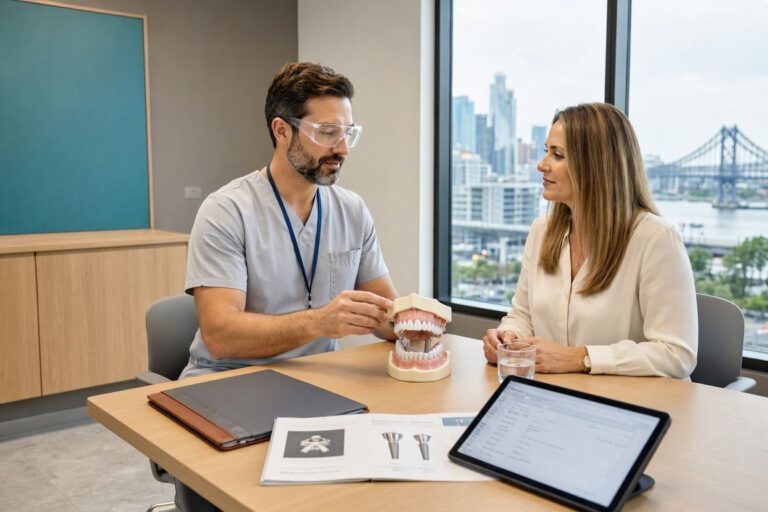
If you are reading this, you are probably facing a decision that feels surprisingly big for such a small object. You need to replace a missing tooth, and your dentist has given you two options: titanium or ceramic. At first glance, they look similar. But beneath the surface, these two materials work very differently.
You might feel a bit overwhelmed. That is completely normal. The world of dental implants is full of technical terms like “osseointegration” and “biocompatibility.” Do not worry. We are going to break everything down into simple, clear language.
This guide compares titanium and ceramic dental implants honestly. You will learn how they perform, what they cost, how they look, and which one might be better for your specific health situation. By the end, you will feel confident talking to your dentist about your preference.
What Are Dental Implants, Really?
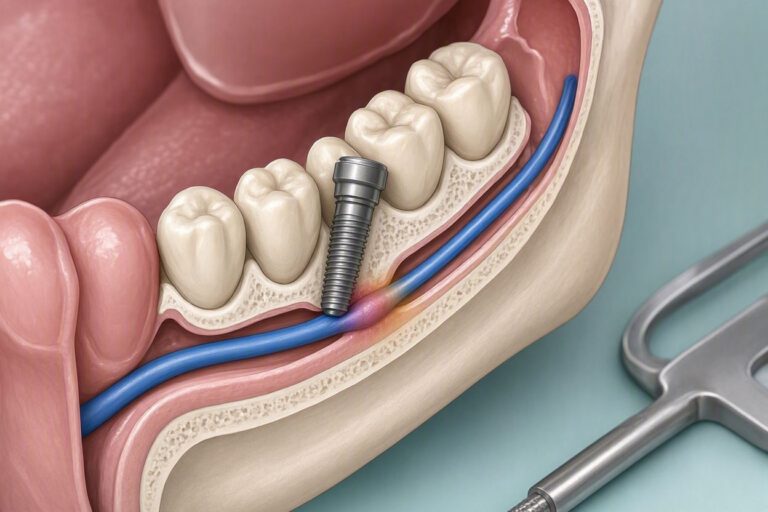
Before we compare materials, let’s quickly review what a dental implant actually is. An implant is not a fake tooth you pop in at night. It is a small, screw-like post that a surgeon places directly into your jawbone. This post acts like an artificial tooth root.
Once the implant is in place, your bone grows around it. This process takes a few months. After that, your dentist attaches a connector (called an abutment) and finally a crown. The crown is the visible part that looks like a natural tooth.
For decades, titanium was the only reliable material for this job. Then, ceramic implants entered the scene. Today, you have a real choice.
Important Note: Both titanium and ceramic implants are considered safe and effective by dental authorities worldwide. Neither is a bad option. The “best” choice depends entirely on your medical history, aesthetic goals, and budget.
The Main Differences at a Glance
To help you visualize the differences, here is a simple comparison table. Keep in mind that specific brands and individual cases can vary.
| Feature | Titanium Implants | Ceramic Implants (Zirconia) |
|---|---|---|
| Material | Metal alloy (titanium, aluminum, vanadium) | Metal-free ceramic (zirconium dioxide) |
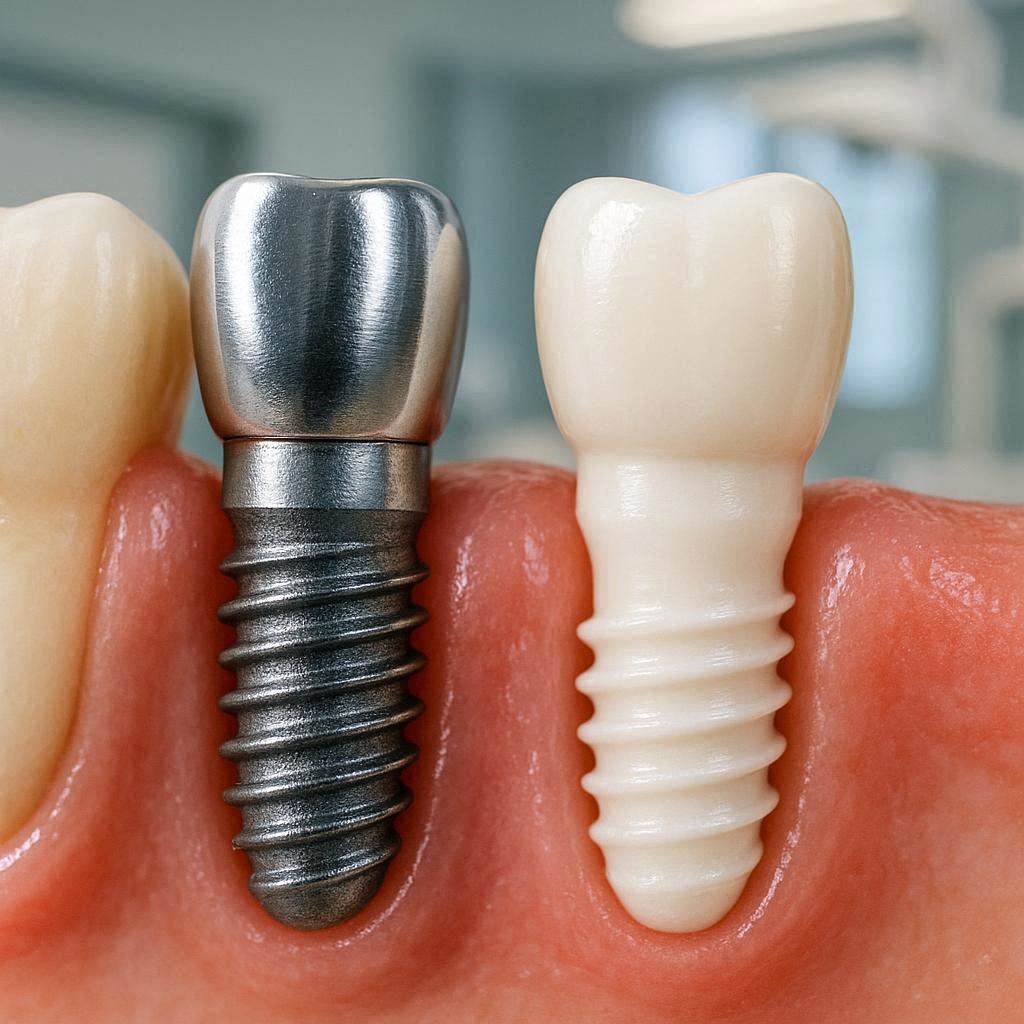
| Color | Silver / dark gray | White / tooth-colored |
| Bone Healing Time | 3 to 6 months (standard) | 3 to 6 months (similar) |
| Strength | Extremely high (flexible) | Extremely high (rigid) |
| Corrosion Risk | Extremely low | None |
| Allergy Risk | Very low (but possible) | None (hypoallergenic) |
| Gum Recession Risk | Possible gray line at gum | No gray line |
| Price Range | $1,500 – $3,000 per implant | $2,000 – $5,000 per implant |
| MRI Compatibility | Safe (but may cause image distortion) | Completely safe (no distortion) |
Now, let’s dive deeper into each material.
Titanium Dental Implants: The Gold Standard
Titanium has a long, successful history in medicine. Surgeons have used it for hip replacements, bone screws, and dental implants for over 50 years. It has a proven track record.
Why Titanium Works So Well
The secret to titanium’s success is a process called osseointegration. This is a fancy word that simply means “bone fusing to metal.” Your jawbone does not see titanium as a foreign invader. Instead, it grows right up against the implant, locking it in place.
Titanium is also very flexible for a metal. It has a similar flexibility to human bone. This means when you chew, the implant bends slightly, absorbing shock just like a natural tooth root would. This helps protect your jawbone over time.
The Pros of Titanium Implants
- Proven long-term success. Studies show a success rate of over 95% even after 20 or 30 years.
- Very strong and durable. Titanium can handle the full force of chewing without cracking.
- More affordable. Because titanium implants have been around longer, they are generally less expensive.
- Widely available. Every dental implant surgeon knows how to place a titanium implant.
- Predictable healing. The bone fusion process is well understood and rarely fails.
The Cons of Titanium Implants
- Visible gray line. If your gums are thin or recede slightly over time, the dark metal color can show through the gum tissue, creating a gray shadow at the gum line.
- Metal allergy (rare but real). About 0.6% of people have a sensitivity to titanium. Symptoms can include chronic inflammation, bone loss, or a burning sensation.
- Corrosion potential. In very rare cases, titanium can corrode inside the body, releasing metal ions. Most people never experience this.
- MRI and CT scan distortion. If you need a brain or neck MRI in the future, the titanium implant can create a “shadow” on the image, making diagnosis harder.
Ceramic Dental Implants: The Modern Alternative
Ceramic implants are newer to the mainstream market. The most common type is made from zirconia, a very hard, white ceramic material. Zirconia is the same material used to make fake diamonds, so you know it is tough.
Why Ceramic Is Gaining Popularity
Patients who want a completely metal-free mouth choose ceramic implants. The main advantage is the color. Since zirconia is white, it blends in with your natural teeth and gums. There is no risk of a gray line appearing later.
Ceramic is also very friendly to your body’s soft tissues. Studies suggest that gum cells attach to zirconia more easily than to titanium. This can lead to less inflammation and healthier gum tissue around the implant.
The Pros of Ceramic Implants
- Metal-free and hypoallergenic. Zero risk of metal allergy or reaction. Great for patients with known metal sensitivities.
- Natural appearance. The white color mimics a natural tooth root. No gray shadows, even with thin gums.
- Excellent gum health. Plaque and bacteria have a harder time sticking to polished zirconia.
- No corrosion. Ceramic is biologically inert. It will not release any particles into your body.
- MRI and CT friendly. You can have any medical scan without worrying about distortion.
The Cons of Ceramic Implants
- Shorter track record. Zirconia implants have been used for about 15-20 years. We do not have 40-year studies yet.
- Higher cost. The material is harder to manufacture, and the specialized training for dentists adds to the price.
- Less flexibility. Ceramic is very hard but also brittle. It does not bend like titanium. If you grind your teeth severely, a ceramic implant could crack under extreme pressure.
- One-piece design issues. Many ceramic implants are a single piece (implant + abutment together). This makes it harder to adjust the angle of the final crown.
- Fewer surgeons trained. Not every dentist places ceramic implants. You may need to find a specialist.
Head-to-Head Comparison: Key Factors You Care About
Let’s compare titanium and ceramic on the factors that matter most to you as a patient.
1. Appearance and Aesthetics
This is where ceramic wins clearly. Imagine you have a front tooth replaced. Your gums are thin and slightly translucent. With a titanium implant, the gray metal color can shine through, creating an ugly dark line.
With a ceramic implant, there is no metal. The white post blends perfectly. Even if your gums recede a little as you age, you will never see a dark shadow.
Winner: Ceramic
2. Healing and Bone Fusion
Both materials achieve osseointegration. However, the speed can differ slightly. Titanium is “hydrophilic,” meaning it attracts water and blood, which may speed up early healing. Ceramic is also very good, but some studies suggest it takes a few extra weeks for full bone bonding.
That said, once healed, both are extremely stable. The difference is usually measured in weeks, not months.
Winner: Tie (slight edge to titanium for speed)
3. Long-Term Safety
This is a very close race. Titanium has decades of safe use. The allergy rate is incredibly low. However, for the small percentage of people who are sensitive, ceramic is a lifesaver.
Ceramic has zero known long-term toxicity. It does not corrode. If you are concerned about heavy metals or have autoimmune issues, ceramic is the safer bet.
Winner: Ceramic (for hypoallergenic properties)
4. Strength and Durability Under Pressure
Here, titanium has an advantage. Titanium is a metal, so it bends slightly under pressure. This flexibility prevents it from cracking. Ceramic is harder than titanium, but it is also brittle. Think of it like a diamond. A diamond is the hardest material on Earth, but you can crack it with a single hammer blow.
If you have a heavy bite, grind your teeth at night (bruxism), or play contact sports, a titanium implant is more forgiving.
Winner: Titanium
5. Cost and Insurance Coverage
There is no way around it. Ceramic implants are more expensive. The manufacturing process is complex. Zirconia blocks must be milled with diamond tools. Also, fewer labs make them.
Most dental insurance plans are still designed around titanium implants. They may cover the same percentage, but since the base price is higher, you will pay more out-of-pocket for ceramic.
Winner: Titanium
Who Should Choose Titanium Implants?
Let’s make this very practical. You are a good candidate for titanium implants if:
- You are on a budget and want the most affordable, reliable option.
- You need multiple implants or a full arch restoration (like All-on-4).
- You have a history of teeth grinding (bruxism).
- You do not care about metal in your mouth and have no known allergies.
- You want a dentist with the most experience possible.
- Your gums are thick and will not show a metal shadow.
Who Should Choose Ceramic Implants?
You should lean toward ceramic implants if:
- You have a confirmed allergy to titanium or other metals.
- You want a completely metal-free body (for personal or medical reasons).
- You are replacing a front tooth where appearance is critical.
- You have thin, translucent gums that would show a dark line.
- You need an MRI scan regularly for a health condition.
- You are willing to pay more for the aesthetic and hypoallergenic benefits.
The Hybrid Approach: Can You Mix Them?
Yes, you can. Some patients choose a hybrid approach. For example, you might place titanium implants in the back of your mouth (molars) where strength matters most and no one sees them. Then, you place ceramic implants in the front for the best look.
This is not common, but it is possible. Talk to an implant specialist if this idea interests you. The main challenge is that the two materials require slightly different surgical techniques.
What the Research Really Says
Let’s look at honest numbers. A 2019 systematic review in the Journal of Clinical Medicine compared titanium and zirconia implants. The study found:
- Survival rates after 1 year: Titanium 97.2% – Zirconia 95.6%
- Bone loss after 1 year: Titanium 0.5mm – Zirconia 0.4mm
- Gum inflammation rates: Slightly lower for zirconia.
These numbers tell us both materials work very well. The difference in success rates is small. Most failures happen for the same reasons: poor bone quality, smoking, or bad oral hygiene—not the implant material itself.
Quote from Dr. Susan Maier, Prosthodontist: “I place both titanium and ceramic implants. For a young patient with no metal allergies who needs a front tooth, I recommend ceramic every time. For a back molar on a patient who grinds their teeth, I still recommend titanium. It is not about which is better overall. It is about which is better for that patient.”
Healing and Recovery: Does Material Matter?
The short answer is no. Your body’s healing response is similar for both materials. You will experience:
- First 24 hours: Minor bleeding and swelling. Stick to soft foods.
- Days 2-7: Swelling peaks, then goes down. Use ice packs.
- Weeks 2-4: The implant begins fusing with bone. No chewing on that side.
- Months 3-6: Complete fusion. Ready for the crown.
The material does not change your post-operative care. You still need to avoid smoking, stay hydrated, and keep the area clean.
However, there is one small difference. Because ceramic implants often come in a one-piece design, you cannot submerge them completely under the gum during healing. This means you have a tiny post sticking out. You need to be extra careful cleaning around it to prevent infection.
With titanium (two-piece design), the implant can be fully buried under the gum for 3-6 months, then exposed later. Some patients prefer this because the “exposed” phase is shorter.
Long-Term Maintenance for Each Type
Once your implant is healed and crowned, how do you care for it? Very similar to natural teeth, but with a few notes.
Titanium Implant Maintenance
- Brush and floss normally.
- Use a plastic or nylon-coated scraper for cleaning. Metal scrapers can scratch the titanium surface.
- Regular dental checkups. Your dentist will take X-rays every 1-2 years to check bone levels.
- Watch for any gray line at the gum. If it appears, it is cosmetic only—not a health problem.
Ceramic Implant Maintenance
- Brush and floss normally.
- Ceramic is harder, so it resists scratching. You can use standard cleaning tools.
- Avoid biting ice, hard candy, or pens. The crown is strong, but the ceramic implant post is brittle.
- Regular checkups are still essential. Because ceramic implants are newer, your dentist will monitor them closely.
The Price Breakdown: Real Numbers
Let’s talk money. These are average prices in the United States. Your location and specific dentist will change these numbers.
| Procedure Component | Titanium Implant | Ceramic Implant |
|---|---|---|
| Implant post (screw) | $300 – $600 | $500 – $1,200 |
| Surgical placement fee | $1,000 – $2,000 | $1,000 – $2,000 |
| Abutment (connector) | $300 – $500 | Included (one-piece) or $300-$500 |
| Crown (tooth part) | $800 – $2,000 | $800 – $2,000 |
| Total per implant (approx.) | $2,400 – $5,100 | $2,300 – $5,200 |
Wait, that looks similar? Yes, for a single tooth, the total cost can be close. But the average patient pays $500 to $1,000 more for ceramic because the implant post itself is more expensive, and fewer insurance plans cover the premium.
Also, if you need multiple implants, the difference adds up. A full set of four ceramic implants could cost $2,000 to $4,000 more than titanium.
Common Myths About Both Materials
Let’s clear up some misinformation you may have read online.
Myth 1: “Titanium implants cause cancer.”
Fact: There is no scientific evidence linking dental titanium implants to cancer. Titanium is considered fully biocompatible by the FDA.
Myth 2: “Ceramic implants are fragile and break easily.”
Fact: Ceramic implants are incredibly strong. They have a fracture resistance of over 800 MPa. For comparison, natural tooth enamel is about 400 MPa. They are not fragile. However, they are brittle. A direct, sharp impact (like a car accident or a hard fall) could crack them. Titanium would bend, not crack.
Myth 3: “You cannot X-ray through ceramic implants.”
Fact: Ceramic implants are radiopaque, meaning they show up on X-rays just fine. Your dentist can see bone levels around them clearly.
Myth 4: “Titanium is outdated.”
Fact: Titanium is not outdated. It is still the most placed implant material in the world. It is a mature, proven technology—not an old one.
How to Discuss This With Your Dentist
You now have solid information. But your dentist knows your specific jawbone, gum thickness, and medical history. Here is a script you can use to start the conversation.
You: “I have been reading about titanium versus ceramic implants. Can you tell me why you recommend one over the other for my case?”
Then, ask these specific questions:
- “Based on my gum thickness, would a titanium implant create a visible gray line?”
- “Have you placed ceramic implants before? How many?”
- “If I choose ceramic, what is your protocol for healing and follow-up?”
- “Do you see any risk factors in my health that make one material safer?”
- “Can you show me before-and-after photos of both types you have placed?”
A good dentist will welcome these questions. If they dismiss ceramic implants entirely without explanation, consider a second opinion. If they push ceramic aggressively without asking about your budget or grinding habits, also be cautious.
Real Patient Scenarios
Let’s walk through three realistic examples.
Scenario A: Sarah, age 34, missing front tooth (tooth #8).
Sarah has thin gums. She works as a TV news anchor. Her smile is her career. She does not grind her teeth. Her budget is flexible.
- Recommendation: Ceramic implant. The aesthetic benefit is worth the extra cost. No risk of a gray line.
Scenario B: Mike, age 55, missing lower molar (tooth #19).
Mike has a history of grinding his teeth at night. He wears a nightguard. He is on a fixed income and has good insurance that covers titanium well.
- Recommendation: Titanium implant. The molar is not visible. Titanium’s flexibility can handle his grinding forces better. Lower cost is a bonus.
Scenario C: Elena, age 42, missing two premolars.
Elena has a known nickel allergy (common in some titanium alloys). She has moderate gum thickness. She does not grind her teeth.
- Recommendation: Ceramic implant. Her metal allergy makes titanium risky. Even though the risk is low, ceramic removes the risk entirely.
The Future of Dental Implants
What comes next? Research is moving fast. Scientists are developing “hybrid” implants with a titanium core and a ceramic outer layer. Others are working on 3D-printed titanium with porous surfaces for faster bone growth.
For now, ceramic implants are improving. Newer versions are two-piece designs, solving the angle problem. Prices are slowly coming down as more companies enter the market.
Titanium is also improving. New surface treatments make bone fuse even faster.
Your choice today will remain a good choice for decades. Both materials are not going away.
Final Checklist Before You Decide
Before you call your dentist, run through this checklist.
- Do I have any known metal allergies? (Get tested if unsure)
- Is the missing tooth in a visible area (front) or hidden (back)?
- Do I grind my teeth or clench my jaw?
- What is my total budget including crown and surgical fees?
- Does my insurance cover both materials?
- Is my dentist experienced with my chosen material?
- Do I have any medical conditions (autoimmune, thyroid) that make me prefer metal-free?
Answering these questions will point you toward the right material.
Conclusion (Three-Line Summary)
Titanium implants remain the proven, affordable, and flexible gold standard for most patients, especially for back teeth and heavy chewers. Ceramic implants offer superior aesthetics and hypoallergenic safety, making them ideal for front teeth and metal-sensitive individuals. Both materials have excellent success rates, so your final decision should be guided by your specific anatomy, budget, and a trusted conversation with your dentist.
Frequently Asked Questions (FAQ)
1. Can I switch from titanium to ceramic later?
Yes, but it requires surgery to remove the old implant and place a new one. It is not a simple swap. Choose carefully the first time.
2. Do ceramic implants stain over time?
No. Zirconia does not stain from coffee, tea, or smoking. The crown above it can stain, but the implant itself stays white.
3. How long do ceramic implants last?
Long-term data is still emerging, but current studies show 95%+ success at 10 years. Experts expect them to last 20-30 years with good care.
4. Are ceramic implants safe for people with autoimmune diseases?
Many autoimmune patients prefer ceramic because it removes any potential metal trigger. Always consult your rheumatologist and dentist together.
5. Can I have an MRI with a titanium implant?
Yes, titanium is non-ferromagnetic (not magnetic). However, it can create image artifacts (distortions) around the head and neck area.
6. Which material heals faster?
Titanium may have a slight edge in early healing speed (first 4 weeks), but by 6 months, both are equivalent.
7. Do ceramic implants smell or taste like metal?
No. Ceramic is completely tasteless and odorless.
8. Why do some dentists not offer ceramic implants?
Because ceramic requires different surgical tools, training, and technique. Some general dentists prefer to stick with what they know best: titanium.
Additional Resource
For a deeper dive into the scientific studies comparing titanium and zirconia implants, visit the PubMed Central (PMC) database and search for “zirconia dental implants long-term survival.” This free resource from the U.S. National Institutes of Health provides access to peer-reviewed research papers. Direct link: https://www.ncbi.nlm.nih.gov/pmc/ (Search term: “zirconia vs titanium dental implants systematic review”).
Disclaimer: This article is for informational purposes only and does not constitute medical advice. Always consult with a licensed dental professional before making any decisions about your oral health.