Are Dental Implants Better Than Dentures?
Losing a tooth—or several teeth—can feel unsettling. You might worry about your smile, your ability to chew your favorite foods, or even how your face will look over time. If you are currently exploring your options, you have likely asked yourself this very question: are dental implants better than dentures?
The short answer is: it depends. There is no single “best” solution for everyone. What works wonderfully for your neighbor might feel completely wrong for your mouth, your budget, or your daily habits.
This guide is designed to walk you through the real, honest differences between dental implants and traditional dentures. We will look at the pros and the cons. We will talk about costs, comfort, surgery, and long-term maintenance. By the end, you will have a clear, realistic picture to discuss with your dentist.
Understanding the Basics: Two Very Different Solutions
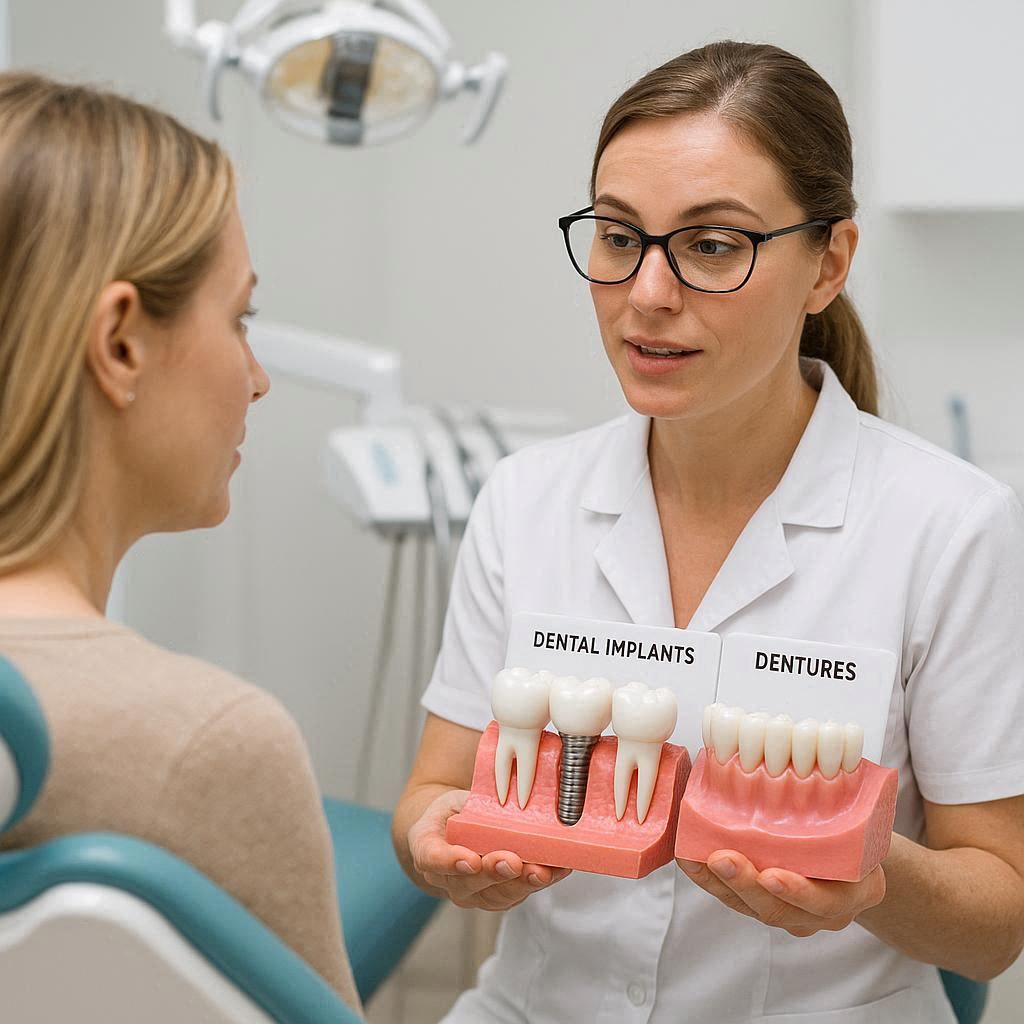
Before comparing which one is “better,” we need to understand how each option actually works. They are fundamentally different approaches to solving the same problem.
What Are Traditional Dentures?
Dentures are removable replacements for missing teeth. They come in two main types:
- Full dentures: You use these when all your natural teeth are missing in one jaw (or both).
- Partial dentures: These fill in the gaps when some natural teeth remain.
A full denture rests directly on your gums. It stays in place through suction, a thin layer of saliva, and the natural contours of your mouth. Partial dentures often use metal clasps or precision attachments that hook onto your remaining natural teeth.
Dentures are typically made from acrylic resin, sometimes with metal framework for partials. They are custom-made to match the color and shape of your natural gums and teeth.
Important note: Because dentures rest on the gums, they do not replace the tooth roots. This means the bone that once supported your natural teeth will slowly change shape over time.
What Are Dental Implants?
A dental implant is a small, screw-like post made of titanium. A surgeon places this post directly into your jawbone. Over several months, the bone grows around the implant and fuses with it. This process is called osseointegration (a fancy word for “bone and metal becoming one”).
Once the implant is secure, your dentist attaches an abutment (a small connector) and then a custom-made dental crown. The crown looks and functions like a natural tooth.
Implants can replace:
- A single missing tooth (one crown on one implant)
- Several missing teeth (a bridge supported by two implants)
- All teeth in a jaw (a fixed denture snapped onto four to six implants)
Because the implant fuses with the bone, it acts just like a natural tooth root. This is the key difference between implants and traditional dentures.
The Big Comparison: Implants vs. Dentures Head-to-Head
Let us put these two options side by side. The table below gives you a quick overview of the most important differences.
| Feature | Dental Implants | Traditional Dentures |
|---|---|---|
| Stability | Fixed permanently in the jaw. Will not move. | Removable. Can shift or slip, especially with time. |
| Bone health | Stimulates the jawbone. Prevents bone loss. | No bone stimulation. Bone loss continues over time. |
| Eating | Chew with nearly normal force (up to 90% of natural teeth). | Reduced chewing force. Hard or sticky foods can be difficult. |
| Speech | No effect on speech. Feels like natural teeth. | Can cause clicking or slurring. Requires practice to speak clearly. |
| Comfort | Feels like natural teeth. No bulky plastic on the palate. | Can feel bulky. May cause sore spots on gums. |
| Maintenance | Brush and floss like natural teeth. No special cleaners. | Must remove nightly. Requires soaking and special brushes. |
| Lifespan | 20+ years, often a lifetime with good care. | 5–8 years before needing reline or replacement. |
| Upfront cost | Higher initial investment. | Lower upfront cost. |
| Time commitment | Several months from start to finish (including healing). | A few weeks from impressions to delivery. |
| Surgery required | Yes (minor oral surgery). | No. |
This table gives you the general picture. But let us dive deeper into each factor, because the details matter.
Comfort and Daily Life: How Do They Really Feel?
This is often the first concern for most people. You want a solution that feels natural, stays in place, and does not cause daily frustration.
Living with Dentures
Dentures take time to get used to. In the beginning, they will feel foreign. Your gums and cheeks need to adapt to having a piece of acrylic in your mouth.
Here is what a typical day with dentures might look like:
You wake up and insert your dentures. You might use a denture adhesive to help them stay put. As you eat breakfast, you notice that chewing feels different. You avoid hard bread or sticky peanut butter because they can dislodge the denture.
During a conversation, you hear a slight clicking sound. You feel self-conscious. By midday, you notice a sore spot on your gum. You remove the denture to give your mouth a break.
At dinner with friends, a piece of food gets under the denture. You excuse yourself to rinse it out.
At night, you remove the dentures, brush them, and leave them soaking in a glass of water or cleaning solution. Your gums rest overnight.
This is not everyone’s experience. Many people adapt wonderfully to dentures and live active, happy lives. But it is important to be realistic. Dentures are a compromise. They restore appearance and basic function, but they do not feel like natural teeth.
“I wore dentures for twelve years. You learn to live with them, but you never forget they are there. The slipping was the hardest part for me.” — Margaret, 68
Living with Dental Implants
Implants feel remarkably like natural teeth. Once the crown is attached, you genuinely forget it is there.
A day with implants looks very different:
You wake up and brush your teeth normally. There is no soaking or adhesive. You eat breakfast without thinking about it. You bite into a crisp apple. You chew a piece of steak without hesitation.
You talk, laugh, and smile freely. Nothing clicks or shifts.
You floss between your implants just like you would between natural teeth. You brush twice a day. At night, you go to bed with your teeth still in your mouth—because they are fixed.
The only difference? Implants cannot get cavities (though the gum tissue around them still needs care).
The comfort verdict: Implants win for comfort and natural feel. But dentures can be comfortable for many people if properly fitted and maintained.
Chewing and Eating: Can You Enjoy Food Again?
Food is one of life’s great pleasures. Losing teeth often means losing the ability to eat foods you love.
Chewing with Dentures
Dentures give you back about 20% to 30% of your natural chewing force. That is a significant reduction.
Why? Because the force of your bite compresses the gum tissue under the denture. The denture acts as a cushion. Instead of a hard, direct bite (like natural teeth or implants), you are biting through plastic onto soft tissue.
Foods that are difficult with dentures include:
- Crusty bread and bagels
- Raw carrots and apples
- Steak and other tough meats
- Nuts and seeds
- Sticky candy or peanut butter
- Corn on the cob
Many denture wearers adapt by cutting food into small pieces or avoiding certain foods altogether. Some foods, like corn on the cob, become impossible.
Chewing with Implants
Implants restore about 80% to 90% of your natural chewing force. This is a dramatic difference.
Because the implant is anchored directly into bone, you bite with similar force to a natural tooth. You can eat almost anything you want.
Foods that become easy again with implants:
- Apples and pears (bite right in)
- Crusty bread
- Steak and ribs
- Nuts and crunchy vegetables
- Corn on the cob
- Chewy candies (though your dentist might warn against too much sugar)
Important note: Even with implants, some extremely hard foods (like ice cubes or hard candy) can damage the crown. But for normal eating, implants perform nearly as well as natural teeth.
The eating verdict: Implants are the clear winner for anyone who loves food and does not want restrictions.
Bone Health and Facial Structure: The Hidden Factor
This is one of the most overlooked differences between implants and dentures. And it is a big one.
What Happens to Bone with Dentures?
Your jawbone stays strong and healthy because it receives stimulation every time you chew. The roots of your natural teeth transmit chewing forces directly into the bone. This signals the body to maintain bone density.
When you lose a tooth, that stimulation stops. The bone in that area begins to resorb (shrink away). Dentures do not reverse this process because they sit on top of the gum. They do not transmit force into the bone.
Over time, bone loss leads to several problems:
- Dentures become loose. As the bone shrinks, the denture no longer fits properly. You need a reline (refitting) every few years.
- Changes in facial appearance. The loss of bone causes your lower face to collapse. Your chin moves closer to your nose. Your cheeks look hollow. Wrinkles around the mouth deepen. Many long-term denture wearers look older than they are because of this bone loss.
- Difficulty eating. Loose dentures make chewing even harder.
- Painful spots. As the bone changes shape, the denture rubs against certain areas of the gum.
What Happens to Bone with Implants?
Implants change this entire story. Because they fuse with the bone, they transmit chewing forces directly into the jaw. This mimics the natural stimulation that keeps bone healthy.
When you place an implant, the bone around it does not shrink. In fact, the bone often becomes denser around the implant over time.
This means:
- Your facial structure stays intact
- Your dentures (if you have implant-supported dentures) stay secure
- You avoid the “sunken face” look associated with long-term denture wear
The bone health verdict: Implants are vastly superior. This is not a minor difference. Bone loss is permanent and progressive. Implants are the only option that prevents it.
The Cost Question: Upfront vs. Long-Term
Let us talk about money. For most people, cost is a major deciding factor.
Upfront Costs
Traditional dentures:
- A full set of conventional dentures: $1,500 to $4,000 per arch (upper or lower)
- Economy dentures (lower quality): $500 to $1,500
- Premium dentures (better fit and materials): $4,000 to $8,000 per arch
Dental implants:
- Single implant with crown: $3,000 to $6,000
- Implant-supported bridge (multiple teeth): $5,000 to $16,000
- Full arch fixed implants (like All-on-4): $15,000 to $30,000 per arch
At first glance, dentures look much cheaper. And they are. But there is more to the story.
Long-Term Costs
Dentures are not a one-time expense. Over a lifetime, the costs add up:
- Relining: Every 2–3 years, $200–$500
- Replacement: Every 5–8 years, $1,500–$4,000
- Adhesives and cleaners: $150–$300 per year
- Adjustments and repairs: Variable, but common
- Denture-related health issues: Sore spots, infections, bone loss (which may require expensive bone grafting if you later switch to implants)
Implants have very low ongoing costs:
- No relining or replacement (the crown might need replacement after 10–20 years)
- No adhesives or special cleaners
- Normal toothbrush and floss
A 20-Year Cost Comparison
Let us do a rough calculation for a full upper denture versus a full upper implant-supported arch (four implants).
| Item | Traditional Denture | Implant-Supported Arch |
|---|---|---|
| Initial cost | $2,500 | $20,000 |
| Relines (every 3 years for 20 years) | $1,500 (6 relines) | $0 |
| Replacement denture (every 7 years) | $7,500 (3 replacements) | $0 |
| Adhesives/cleaners | $3,000 (20 years) | $0 |
| Crown replacement | $0 | $2,000 (once after 15 years) |
| Total 20-year cost | $14,500 | $22,000 |
The gap narrows significantly. And if you live longer than 20 years, implants become cheaper over time.
Important note: Many dental insurance plans cover a portion of dentures (typically 50%). Coverage for implants varies widely. Some plans cover none. Others cover a portion of the implant but not the crown. Always check your specific plan.
The cost verdict: Dentures have a lower upfront cost. Implants have a lower long-term cost for many people, especially if you expect to live more than 15–20 years.
The Treatment Process: Time and Experience
Getting Dentures
The process for traditional dentures is relatively quick and non-invasive.
- Initial impressions (visit 1): Your dentist takes molds of your mouth.
- Wax try-in (visit 2): You try a wax model to check fit and appearance.
- Delivery (visit 3): Your finished dentures are placed. Immediate adjustments are made.
- Follow-up (visit 4): A few weeks later, you return for adjustments as your gums settle.
Total time: 3 to 6 weeks
No surgery. No healing period. No needles (except for any extractions needed beforehand).
Getting Implants
Implants require more time and several procedures.
- Consultation and imaging (visit 1): X-rays or CT scan to assess bone density.
- Bone graft (if needed): If your bone is too thin, you may need a graft. This adds 4–6 months of healing.
- Implant placement (surgery): The titanium posts are inserted into the bone. This is done with local anesthesia (or sedation if you prefer). Most people describe the sensation as pressure, not pain.
- Healing period (osseointegration): 3 to 6 months while bone fuses to the implant.
- Abutment placement (minor procedure): A small connector is attached to the implant.
- Crown delivery: Your custom-made crown is cemented or screwed onto the abutment.
Total time: 4 to 9 months (longer if bone grafting is needed)
Yes, this is a long process. But here is the good news: if you are replacing all your teeth, your dentist can place a temporary denture or bridge during healing. You are never left without teeth.
The process verdict: Dentures are faster and simpler. Implants require patience and a willingness to undergo minor surgery.
Maintenance and Upkeep: Daily Life Differences
Caring for Dentures
Dentures require a nightly routine:
- Remove the denture
- Rinse away food particles
- Brush the denture with a soft brush and non-abrasive cleaner (not toothpaste)
- Brush your gums and any remaining natural teeth
- Soak the denture overnight in water or a cleaning solution
- Rinse thoroughly before reinserting in the morning
You also need to handle dentures carefully. They are fragile. Dropping them can cause cracks or breaks.
Denture adhesives are optional but many people use them for extra security. Adhesives can be messy and need to be cleaned off the denture and gums daily.
Caring for Implants
Caring for implants is nearly identical to caring for natural teeth:
- Brush twice a day with a soft toothbrush
- Floss daily (use special implant floss or a water flosser)
- Visit your dentist every 6 months for checkups
- Avoid chewing on hard objects (ice, pens, hard candy)
That is it. No soaking. No special cleaners. No adhesives.
The only extra step? Your dentist may recommend a plastic scaler or special floss to avoid scratching the implant surface. But for most people, regular oral hygiene is sufficient.
The maintenance verdict: Implants are dramatically easier to care for. Dentures require a dedicated nightly routine and ongoing supply of cleaning products.
Speech and Social Confidence
Speaking with Dentures
Dentures can affect your speech, especially at first. Common issues include:
- Clicking sounds: The denture hits the roof of your mouth when you speak
- Slurring: Certain sounds (like “s” and “f”) require precise tongue-to-palate contact
- Whistling: Air escapes around the denture
Most people adapt within a few weeks. Reading aloud helps. But some denture wearers experience permanent changes to their speech, especially if the denture does not fit well.
Speaking with Implants
Implants do not affect speech at all. Because they are fixed in place, your tongue and palate interact with them just like natural teeth.
You can sing, give presentations, and talk on the phone without thinking about your teeth.
The speech verdict: Implants win. But many denture wearers adapt successfully with practice.
Who Are Dentures Best For?
Dentures are not “worse” than implants. They are simply a different tool for a different situation. Dentures may be the right choice if:
- You have significant budget limitations and cannot afford the upfront cost of implants.
- You have insufficient bone and do not want or cannot undergo bone grafting.
- You have medical conditions that make surgery risky (uncontrolled diabetes, severe heart disease, certain autoimmune disorders, or conditions requiring blood thinners).
- You smoke heavily. Smoking dramatically increases implant failure rates.
- You have a low pain tolerance or dental anxiety and want to avoid surgery.
- You are older and the long-term bone preservation benefits of implants matter less (though many seniors successfully get implants).
- You prefer a non-invasive solution and are willing to accept the limitations of dentures.
“I chose dentures because of my age and health conditions. Surgery was too risky for me. My dentures are not perfect, but they let me smile again. That is enough for me.” — Robert, 82
Who Are Implants Best For?
Implants are an excellent choice if:
- You have healthy bone or are willing to undergo bone grafting.
- You want to eat without restrictions.
- You dislike the idea of removable teeth.
- You are a non-smoker or willing to quit before and after surgery.
- You have good overall health and can undergo minor surgery.
- You can afford the higher upfront cost or have insurance that helps.
- You are looking for a long-term solution (10+ years) and want to avoid future expenses.
- You value convenience and do not want a nightly cleaning routine.
Can You Combine Implants and Dentures? (Hybrid Solutions)
Yes. Many people do not realize there is a middle ground.
Implant-supported overdentures are a hybrid solution. You get 2 to 4 implants in your jaw, then a special denture that snaps onto them. The denture is removable (you take it out at night), but it is much more stable than a traditional denture.
Benefits of implant-supported overdentures:
- Dramatically improved stability (no slipping)
- Better chewing force than traditional dentures (though not as good as fixed implants)
- Preserves some bone (implants provide stimulation, though less than a full fixed bridge)
- Lower cost than a full fixed arch (often $8,000 to $15,000 per arch)
- Easier to clean (you can remove the denture)
Drawbacks:
- Still removable (you have to take it out at night)
- Still requires soaking and cleaning
- Less chewing force than fixed implants
For many people, this is the perfect compromise. You get the stability and bone preservation of implants with the lower cost and easier cleaning of a denture.
Common Myths and Misconceptions
Let us clear up a few misunderstandings.
Myth 1: Implants are painful.
The placement surgery is done with local anesthesia. Most people report less discomfort than a tooth extraction. Post-surgery pain is manageable with over-the-counter medication.
Myth 2: Dentures are always uncomfortable.
A well-fitted denture can be very comfortable. The problem is that gums change shape over time. Regular relining keeps dentures comfortable.
Myth 3: Implants last forever.
The implant post itself can last a lifetime. The crown on top wears out after 10–20 years and may need replacement. This is similar to a natural tooth needing a new crown.
Myth 4: You cannot get implants if you have bone loss.
Bone grafting is very effective. It adds time and cost, but it makes implants possible for most people.
Myth 5: Dentures are low maintenance.
Dentures require daily cleaning, soaking, and periodic professional adjustments. They are actually higher maintenance than implants.
Making Your Decision: A Step-by-Step Guide
If you are still unsure, follow this process:
Step 1: See a dentist for a full exam.
You need X-rays (and possibly a CT scan) to assess your bone health. No online article can replace this.
Step 2: Discuss your medical history.
Be honest about smoking, diabetes, medications, and other conditions.
Step 3: Get a complete cost breakdown.
Ask for the all-in cost of each option, including consultations, surgery, crowns, and follow-ups.
Step 4: Consider your timeline.
Do you need teeth quickly (dentures) or can you wait several months (implants)?
Step 5: Think about your long-term goals.
Are you looking for a 5-year solution or a 30-year solution?
Step 6: Ask about payment plans.
Many dental offices offer financing for implants. Some dental schools offer lower-cost implant treatment performed by supervised students.
Step 7: Get a second opinion.
Implant dentistry is expensive. A second opinion is always wise.
The Emotional Factor: Smiling Without Worry
Let us end this comparison with something that does not show up on any table: confidence.
There is a psychological difference between a removable appliance and a fixed solution. Many denture wearers live in quiet fear of their teeth slipping at the wrong moment. They cover their mouths when they laugh. They turn down dinner invitations.
That constant low-level anxiety is real. It is exhausting.
Implants remove that worry completely. Your teeth are your teeth. You stop thinking about them.
Is that peace of mind worth the extra cost and surgery? For many people, absolutely yes.
But some people adapt wonderfully to dentures and feel no anxiety at all. Personality matters. Your mileage will vary.
Final Verdict: Which One Is Better?
Here is the honest, no-nonsense answer:
From a purely clinical perspective (bone health, chewing force, comfort, convenience, longevity), implants are objectively better. They are the closest thing we have to natural teeth.
From a practical, real-world perspective, the “better” choice depends entirely on your unique situation. Dentures are better for people who cannot afford implants, cannot undergo surgery, or simply prefer a non-invasive solution.
Do not let anyone shame you for choosing dentures. They are a legitimate, time-tested solution that has helped millions of people eat and smile again.
Do not let anyone scare you away from implants either. Modern implant dentistry is safe, predictable, and life-changing for many.
The best choice is the one that fits your mouth, your health, your budget, and your lifestyle.
Conclusion (Three Lines)
Implants offer superior comfort, bone health, and chewing power but require surgery and a higher upfront cost. Dentures are faster, cheaper, and non-invasive but come with ongoing maintenance and long-term bone loss. Your best choice depends on your health, budget, and personal preferences—not on what works for anyone else.
Frequently Asked Questions (FAQ)
1. Do dental implants hurt?
Most patients report less discomfort than a tooth extraction. The procedure is done with local anesthesia. Post-surgery soreness is usually managed with ibuprofen or acetaminophen.
2. How long do dentures last?
Traditional dentures typically last 5 to 8 years before needing replacement. However, they require relining every 2 to 3 years as your gums change shape.
3. Can I sleep with my dentures in?
Dentists recommend removing dentures at night to give your gums a rest and prevent fungal infections (stomatitis). Implants stay in 24/7.
4. Are dental implants covered by insurance?
Some plans cover a portion (often 10% to 50%). Many cover none. Traditional dentures are more consistently covered. Check your specific policy.
5. What is the failure rate for dental implants?
The long-term success rate is 95% to 98%. Smoking, uncontrolled diabetes, and poor oral hygiene increase failure risk.
6. Can I get implants if I have gum disease?
You must treat active gum disease first. Once your gums are healthy, implants can be placed.
7. How do I clean implant-supported dentures?
Remove them at night. Brush the denture and the implants. Soak the denture in cleaner. Reinsert in the morning.
8. Will my face change with dentures?
Over many years, bone loss under dentures can cause a “sunken” facial appearance. Implants prevent this by preserving bone.
9. Can I switch from dentures to implants later?
Yes. Many people start with dentures and later upgrade to implants. However, bone loss from years of denture wear may require bone grafting first.
10. How many implants do I need for a full arch?
For a fixed bridge, typically 4 to 6 implants per arch (All-on-4 or All-on-6). For snap-on overdentures, 2 to 4 implants per arch.
Additional Resource
For a deeper dive into the financial side of tooth replacement, including insurance tips, payment plans, and tax-advantaged health savings accounts (HSAs), visit the American College of Prosthodontists patient resource page: