Can Dental Implants Be Removed and Replaced?
If you have a dental implant that is causing pain, looks unnatural, or simply feels “off,” you have probably asked yourself a very direct question: can dental implants be removed and replaced?
The short answer is yes. But—and this is an important “but”—the process is very different from replacing a natural tooth or fixing a denture. You cannot simply unscrew a problematic implant like a lightbulb and pop a new one in the same afternoon.
This guide walks you through everything you need to know. No exaggerated claims. No unrealistic promises. Just honest, practical information to help you make an informed decision.
Let us start with what an implant really is, because that understanding is the foundation for everything else.
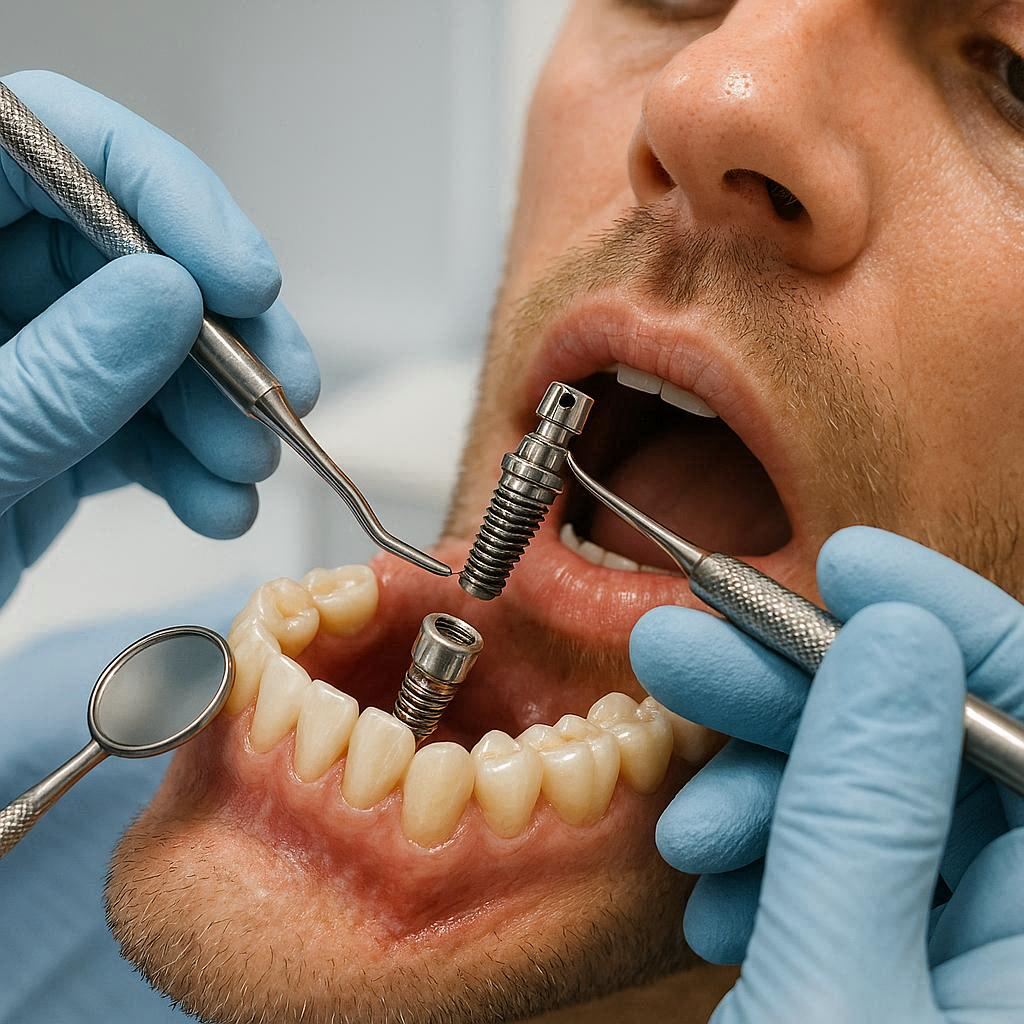
What a Dental Implant Actually Is (And Why Removal Is Different)
Many people think a dental implant is just the artificial tooth they see in the mirror. That is only one part of the story.
A complete dental implant system has three parts:
- The fixture (implant post): A small screw made of titanium or zirconia. A dentist places this directly into your jawbone. Over time, your bone grows around it. That process is called osseointegration.
- The abutment: A connector piece that sits on top of the fixture. It sticks out just above the gum line.
- The crown: The visible, tooth-colored part. It attaches to the abutment.
When people ask, “can dental implants be removed and replaced?”, they are usually thinking about the crown. And yes, crowns are easily removable and replaceable. But the post itself? That is a different story.
Once that metal post fuses with your jawbone, it becomes part of your body’s structure. Removing it requires surgery. Replacing it often requires bone grafting and months of healing.
Important note: Every case is unique. Some implants come out with minimal effort. Others require advanced surgical techniques. Never assume your situation will be the same as someone else’s.
Can Dental Implants Be Removed and Replaced Without Major Surgery?
This is the number one question people ask. Let us be direct.
If you only need to replace the crown or the abutment, surgery is usually not necessary. A dentist can unscrew the crown, take off the abutment, and attach new components in a single short visit.
But if the implant post itself must come out, then yes—surgery is required. The level of surgery depends on why the implant is failing.
| Situation | Surgery Required? | Typical Recovery |
|---|---|---|
| Loose or broken crown | No | None (same-day fix) |
| Worn or damaged abutment | No | None |
| Broken abutment screw | Possibly minor | A few days |
| Loose implant post | Yes | 1–2 weeks |
| Infected implant (peri-implantitis) | Yes | 2–4 weeks |
| Broken or fractured implant post | Yes (complex) | 4–8 weeks |
| Implant placed in wrong position | Yes | Varies |
So when you ask, “can dental implants be removed and replaced?”—the real answer depends entirely on which part is failing.
Common Reasons People Need an Implant Removed
Implants have a very high success rate. Studies show that after ten years, more than 90% of implants are still functioning perfectly. But failure does happen. Here are the most common reasons.
Peri-Implantitis (Infection Around the Implant)
This is the number one cause of late implant failure. It is essentially gum disease that affects the tissues around an implant. Bacteria build up below the gum line. The bone slowly dissolves. The implant becomes loose.
Signs of peri-implantitis include:
- Bleeding when brushing near the implant
- Red or purple gums around the area
- A bad taste or odor coming from the implant
- Visible metal threads (meaning the gum has receded)
- Mobility (the implant wiggles)
If caught early, peri-implantitis can sometimes be treated without removing the implant. But in advanced cases, removal is the only option.
Mechanical Failure (Broken Implant or Abutment)
Implants are strong, but they are not indestructible. Grinding your teeth (bruxism), biting into hard foods, or a simple manufacturing defect can cause:
- A cracked abutment screw
- A fractured implant post
- A loosening of the connection between parts
When the post itself cracks below the gum line, removal becomes complex. Special tools are often needed to unscrew or drill out the broken piece.
Poor Placement or Positioning
Sometimes an implant is placed too close to a nerve, too close to another tooth, or at the wrong angle. This can cause:
- Chronic pain or numbness
- Difficulty cleaning the area
- Interference with chewing
- An unnatural appearance
In these cases, the implant may be perfectly healthy but still needs to come out because it is causing functional or cosmetic problems.
Allergic Reaction (Rare)
True titanium allergies are extremely rare—less than 1% of the population. But they do exist. Symptoms include chronic inflammation, skin rashes, or persistent pain around the implant. For these patients, removal is the only solution.
Patient No Longer Wants the Implant
This is less common, but it happens. Some people decide they no longer want an implant due to cost, maintenance challenges, or simply changing their mind. While dentists will try to discourage removal of a healthy implant, a patient has the right to request it.
The Step-by-Step Process of Removing a Dental Implant
If you are facing implant removal, you deserve to know exactly what happens. Let us walk through the process from start to finish.
Step 1: Diagnosis and Imaging
Your dentist will not touch the implant without a clear picture of what is happening underneath. This almost always involves a CBCT scan (cone beam computed tomography). This is a special type of X-ray that shows your jawbone in three dimensions.
The CBCT scan reveals:
- How much bone remains around the implant
- The exact position of nerves and blood vessels
- Whether the implant is fractured
- The shape and angle of the implant
Step 2: Anesthesia
Removal is never done while you are awake and aware. Local anesthesia completely numbs the area. For anxious patients or complex cases, sedation dentistry (such as oral sedatives or IV sedation) may be offered.
Step 3: Accessing the Implant
The dentist makes a small incision in your gum tissue to expose the top of the implant. If the crown is still attached, it is removed first.
Step 4: Loosening and Removing the Implant
This is where the approach varies based on the situation.
For a loose implant: A special tool called a reverse torque ratchet is used to unscrew the implant. This is surprisingly gentle. Many loose implants come out in under five minutes.
For a firmly integrated implant: This is more difficult. The dentist may use:
- A trephine drill (a hollow drill that cuts around the implant)
- An ultrasonic surgical tip (vibrates the bone-implant interface)
- A bone removal bur (carefully cuts bone away from the implant threads)
For a fractured implant: This is the hardest scenario. The broken piece may need to be drilled out or removed in fragments. This requires significant skill and experience.
Step 5: Debridement and Bone Grafting
Once the implant is out, the socket (hole in the bone) is thoroughly cleaned. Any infected tissue or debris is removed. Then, in most cases, a bone graft is placed.
The bone graft serves two purposes:
- It fills the empty space left by the implant.
- It provides a foundation for a new implant in the future.
Step 6: Stitching and Healing
The gum is stitched closed over the graft. Healing begins. You will be given post-operative instructions, including pain management, diet restrictions, and oral hygiene guidelines.
A realistic timeline: From the moment you sit in the chair to the moment you leave, a simple implant removal takes about 30 to 60 minutes. A complex removal (fractured implant, significant bone loss) can take two hours or more.
Can the Same Spot Get a New Implant After Removal?
Yes, in most cases, a new implant can eventually be placed in the same location. But patience is required.
After an implant is removed, the bone needs time to heal. If a bone graft was placed, you typically wait:
- 4 to 6 months for a small bone graft to heal
- 6 to 9 months for a larger graft
- Up to 12 months if there was significant infection or bone loss
During this healing period, you are not toothless. Temporary options include:
- A removable partial denture (a “flipper”)
- A bonded bridge (if adjacent teeth are suitable)
- Doing nothing and waiting (if the area is not visible)
Once the bone has healed, your dentist will take a new CBCT scan to confirm there is enough bone density and volume for a fresh implant. If there is, the placement process begins just like the first time.
Factors That Affect Whether a New Implant Is Possible
Not everyone is a candidate for a second implant in the same spot. Here is what determines success.
Bone Quantity and Quality
This is the biggest factor. Removing an implant often removes some bone with it. If you have lost too much bone, a new implant may not have enough to hold onto.
Solutions include:
- Larger bone grafts (sometimes from your own jaw or hip)
- Shorter or narrower implants
- Zygomatic implants (anchored in the cheekbone, not the jaw)
Reason for the First Failure
If the first implant failed due to an infection you have since resolved (like gum disease), a second implant can succeed.
But if the first implant failed because you grind your teeth severely at night, a second implant will likely fail too unless you address the grinding first (usually with a night guard).
Overall Health
Conditions that slow healing—uncontrolled diabetes, autoimmune diseases, heavy smoking—reduce the success rate of any implant, whether first or second.
Cost of Removing and Replacing a Dental Implant
Let us talk about money. Prices vary widely by location, dentist, and complexity. But here are realistic estimates in the United States (without insurance).
| Procedure | Typical Cost Range |
|---|---|
| Simple implant removal (loose implant) | $500 – $1,500 |
| Complex removal (fractured or integrated implant) | $1,500 – $3,500 |
| Bone graft at time of removal | $500 – $2,000 |
| CBCT scan (required for planning) | $300 – $600 |
| New implant placement (post only) | $1,500 – $3,000 |
| New abutment and crown | $1,000 – $3,000 |
| Total for full removal and replacement | $4,000 – $12,000+ |
Many dental insurance plans cover a portion of implant removal (since it is a surgical procedure) but often do not cover the replacement implant. Always check your policy.
Some dentists offer payment plans through third-party financing companies like CareCredit.
Important: If the original implant failed due to a clear error by the dentist who placed it (poor positioning, wrong size, contamination), some dentists will offer a reduced fee or free replacement. This is not guaranteed, but it is worth asking.
Pain, Recovery, and What to Expect After Removal
No one looks forward to oral surgery. But knowing what to expect reduces fear.
Pain Level
During the procedure, you will feel nothing except pressure and vibration. The anesthesia works completely.
After the anesthesia wears off (about 3 to 5 hours later), you will feel discomfort. Most patients describe it as:
- A deep ache in the jaw
- Tenderness when touching the area
- Mild throbbing for 2 to 3 days
Over-the-counter pain relievers like ibuprofen (Advil) or acetaminophen (Tylenol) are usually enough. Stronger prescription painkillers are rarely needed for more than a day or two.
Recovery Timeline
Day 1 to 3: Swelling peaks. Stick to cold soft foods (yogurt, smoothies, pudding). No brushing near the site. No spitting or using a straw.
Day 4 to 7: Swelling goes down. You can switch to warm soft foods (mashed potatoes, soup, scrambled eggs). Gentle saltwater rinses begin.
Day 7 to 14: Stitches may dissolve or be removed. Most normal activities resume. Still avoid crunchy, hard, or sticky foods.
Week 3 to 4: The gum tissue is mostly healed. The bone underneath is still healing. You can chew on the opposite side comfortably.
Month 2 to 4: The bone graft (if placed) is maturing. You may be cleared for a new implant scan.
Signs of Complications
Call your dentist immediately if you experience:
- Severe pain not controlled by medication
- Swelling that worsens after day 3
- Fever over 101°F (38.3°C)
- Pus draining from the site
- Numbness that spreads beyond the surgical area
Risks and Downsides of Removing and Replacing Implants
Honesty requires us to discuss the risks. This is not a risk-free process.
Bone Loss
Every time you remove an implant, you lose a small amount of jawbone. If you remove an implant and then later remove the replacement, you may end up with insufficient bone for any implant at all.
Nerve Damage
The inferior alveolar nerve runs through the lower jaw. If an implant was placed too close to this nerve, removing it can sometimes irritate or damage the nerve. This can cause permanent numbness in your lower lip, chin, or gum.
Sinus Perforation
Upper jaw implants sit just below the maxillary sinus. Removing an implant that has penetrated the sinus can create a hole (perforation). Most heal on their own, but some require surgical repair.
Failed Bone Graft
Bone grafts are not guaranteed to work. In about 5% to 10% of cases, the graft does not integrate properly. It may become infected, break down, or simply not turn into solid bone.
Higher Cost Than Leaving It Alone
If an implant is not causing pain or active infection, removing it may not be necessary. Some people live with imperfect implants for decades. Removing a stable but imperfect implant can cost thousands of dollars for no real benefit.
Alternatives to Removal (When You Can Keep the Implant)
Before you schedule removal, explore these alternatives. Sometimes you can fix the problem without taking the post out.
Replace Only the Crown or Abutment
If the visible tooth looks bad or feels loose but the post is solid, a dentist can unscrew the old crown and abutment and attach new ones. This costs less than full removal and takes one appointment.
Treat Peri-Implantitis Without Removal
Early to moderate peri-implantitis can sometimes be treated with:
- Laser therapy (kills bacteria below the gum line)
- Mechanical debridement (special instruments clean the implant surface)
- Local antibiotics (gels placed into the gum pocket)
- Surgical flap procedure (lifting the gum to clean the bone)
These treatments do not guarantee success, but they can buy years of additional function.
Reshape or Adjust the Crown
If the implant feels too high, too low, or interferes with your bite, a dentist can adjust the crown’s shape or height. This is a simple, painless, low-cost fix.
Leave It Alone (Active Monitoring)
If the implant is stable and not infected but you simply do not like it, ask yourself: is removal worth the cost, pain, and bone loss? For many people, the answer is no. A “perfectly ugly” but functional implant may be better than no implant at all.
Real Patient Scenarios (Based on Clinical Reality)
Let us walk through three common situations to show how “can dental implants be removed and replaced?” plays out in real life.
Scenario 1: The Loose Crown
Patient: Maria, 45 years old. Her front tooth implant crown became wobbly after five years. No pain. No redness.
What happened: The abutment screw had loosened over time.
Solution: The dentist unscrewed the crown, replaced the abutment screw, and reattached the crown. Total time: 30 minutes. Cost: $300.
Outcome: The implant functioned perfectly for another eight years. No removal needed.
Scenario 2: The Infected Implant
Patient: James, 62 years old. Smoker. His lower molar implant started bleeding and hurting three years after placement. X-rays showed 40% bone loss around the implant.
What happened: Peri-implantitis caused by poor oral hygiene and smoking.
Solution: The dentist attempted laser treatment first. It failed. The implant was surgically removed. A bone graft was placed. James waited six months. A new implant was placed. He quit smoking.
Outcome: The second implant succeeded. Total cost: $8,500. Total time from removal to new crown: 9 months.
Scenario 3: The Fractured Implant
Patient: Linda, 38 years old. Grinds her teeth at night. Her implant broke below the gum line four years after placement.
What happened: Chronic grinding fatigue-fractured the titanium post.
Solution: A specialist used a trephine drill to core out the broken implant. The procedure took 90 minutes. Linda received a bone graft. After eight months of healing, a new, wider implant was placed. She now wears a custom night guard.
Outcome: The new implant is healthy at two years. Total cost: $11,200.
How to Choose a Dentist for Implant Removal and Replacement
Not every dentist performs implant removals. This is a specialized skill. Here is what to look for.
Credentials to Seek
- Oral surgeon: Most experienced with complex removals (fractured implants, nerve proximity)
- Periodontist: Best for peri-implantitis cases (gum and bone specialists)
- Prosthodontist: Best if the implant is healthy but needs a new crown or bite adjustment
Questions to Ask Before Booking
- “How many implant removals have you performed?” (Look for someone who has done dozens, not just a few.)
- “Do you have a CBCT machine in-office, or will I need to go elsewhere?”
- “What is your protocol for managing pain during and after?”
- “If the implant is fractured, what tools do you use to remove it?”
- “Do you place bone grafts, or will I need a separate specialist?”
Red Flags to Avoid
- A dentist who promises a new implant can be placed on the same day as removal (rarely appropriate)
- Someone who dismisses the need for a CBCT scan
- A practice that cannot show you before-and-after cases
- Pressure to decide immediately without a second opinion
Preventing the Need for Removal in the First Place
The best removal is the one you never need. Here is how to maximize the life of your existing implants.
Daily Home Care
Implants do not get cavities, but they are vulnerable to gum disease. Clean them like this:
- Soft-bristled brush: Twice daily, paying special attention to the gum-implant border
- Water flosser: Excellent for flushing out bacteria below the crown
- Interdental brushes: Small brushes that clean between implants and natural teeth
- Non-abrasive toothpaste: Avoid baking soda or whitening pastes that scratch the implant surface
Professional Maintenance
See your dentist or hygienist every 6 to 12 months for:
- Implant-specific cleaning (plastic scalers, not metal)
- Periapical X-rays to check bone levels
- Checking for screw loosening or wear
Lifestyle Factors
- Stop smoking: Smokers have a 3x higher implant failure rate.
- Manage grinding: A custom night guard saves implants from fracture.
- Control diabetes: Stable blood sugar = better healing.
- Avoid hard foods: No ice chewing, no hard candies, no bone-in ribs bitten directly.
A Comparative Table: Removal and Replacement vs. Alternatives
| Option | Time | Cost (USD) | Success Rate | Bone Loss |
|---|---|---|---|---|
| Remove and replace implant | 6–12 months | $4,000–12,000 | 85–95% | Moderate to high |
| Remove implant, no replacement | 1 month healing | $500–3,500 | N/A | High |
| Keep implant, replace crown only | 1 day | $1,000–3,000 | 95%+ | None |
| Keep implant, treat infection | 1–6 months | $1,000–5,000 | 50–70% | Low to moderate |
| Remove implant, place bridge | 2–4 weeks | $2,500–5,000 | 80–90% | Moderate |
| Remove implant, wear partial denture | 2 weeks | $800–2,000 | N/A | Low (bone still resorbs) |
Frequently Asked Questions (FAQ)
1. Can dental implants be removed and replaced in one day?
No, not the post itself. The crown can be replaced in one day. But if the implant post is removed, the bone needs months to heal before a new post can be placed.
2. Is implant removal painful?
The procedure is not painful because of anesthesia. Afterward, most people compare it to a tooth extraction—achy but manageable with over-the-counter pain relievers.
3. How long does a replaced implant last?
A second implant placed in the same spot has a similar long-term success rate as a first implant (over 90% at 10 years), assuming the reason for the first failure has been addressed.
4. Can a failed implant cause health problems?
Yes. An infected implant can lead to bone loss, chronic pain, and in rare cases, systemic infection. That is why removal is sometimes medically necessary.
5. Will my insurance cover implant removal?
Most dental insurance plans cover medically necessary removal. Many do not cover the replacement implant. Call your provider before scheduling.
6. What happens if I do nothing and leave a failing implant?
It depends. Some failing implants stay stable for years. Others gradually lose bone, become loose, and eventually fall out or need emergency removal. Infection can spread to nearby teeth.
7. Can I get a refund if my implant fails?
Almost never from the implant manufacturer (warranties are limited). Some dentists offer a “replacement warranty” of 1–5 years. Ask about this before your first implant placement.
8. Are zirconia implants easier to remove than titanium?
Not necessarily. Zirconia is harder and more brittle. Fractured zirconia implants are very difficult to remove because they shatter into sharp fragments.
9. Can I drive myself home after implant removal?
If you receive only local anesthesia, yes. If you receive sedation (oral or IV), you will need someone to drive you.
10. How soon can I eat normally after removal?
Soft foods for the first week. Normal chewing (on the opposite side) by week two to three. Crunchy foods after four weeks.
Additional Resource
For peer-reviewed, evidence-based information on dental implant complications and management, visit the American Academy of Periodontology’s patient education page:
🔗 www.perio.org/patient-resources/dental-implants
This resource provides free, non-commercial guides on peri-implantitis, implant maintenance, and when to seek specialist care.
Conclusion
So, can dental implants be removed and replaced? Yes, but it is a surgical procedure that requires healing time, bone grafting in most cases, and a significant financial investment. Crowns and abutments are easy to swap; implant posts are not. If you are experiencing implant problems, get a CBCT scan, consult an oral surgeon or periodontist, and explore non-removal alternatives first. With proper planning, a replaced implant can serve you well for decades.