ADA Code for Zirconia Bridge Pontic
If you have ever stared at a dental claim form wondering which code truly fits a zirconia bridge pontic, you are not alone. The world of CDT (Current Dental Terminology) codes can feel like a maze.
You know the restoration looks beautiful. The patient needs a missing tooth replaced. The pontic is made from high-strength zirconia. But which three-digit code gets the claim paid correctly the first time?
Let us clear up the confusion together.
In this guide, I will walk you through every relevant ADA code for zirconia bridge pontics. We will look at real-world scenarios, compare similar codes, and highlight common billing mistakes. By the end, you will feel confident choosing the right code for every clinical situation.
What Exactly Is a Zirconia Bridge Pontic?
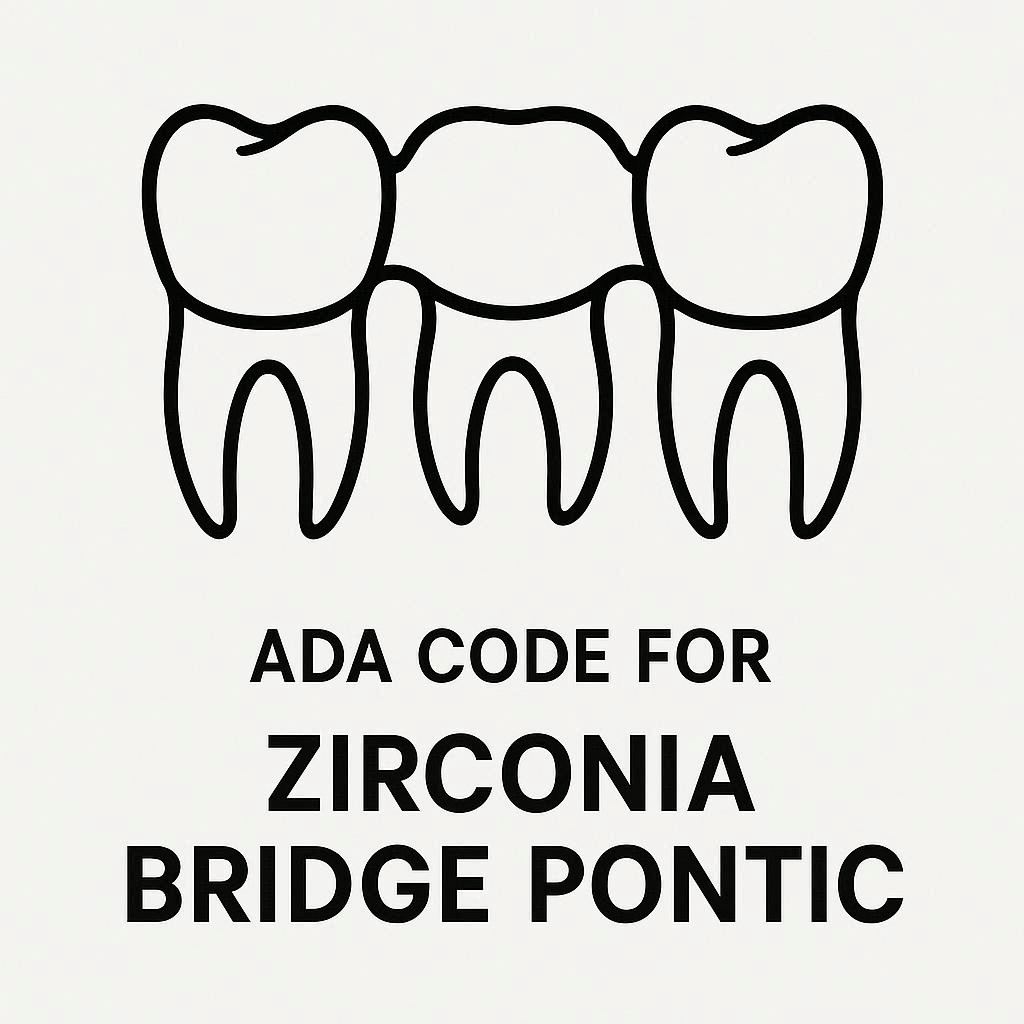
Before we jump into codes, let us quickly define our terms. A pontic is the artificial tooth in a bridge that replaces a missing natural tooth. It spans the gap where a tooth once lived.
Zirconia is a ceramic material known for its incredible strength, biocompatibility, and lifelike appearance. Unlike older materials, zirconia resists chipping and does not irritate gum tissue.
A zirconia bridge pontic can be:
- Part of a monolithic zirconia bridge (single material)
- Combined with porcelain layering
- Part of a full-contour zirconia restoration
Why does this matter? Because the ADA code you choose depends partly on how the lab fabricates the pontic and how the dentist cements it.
Understanding the Basics of ADA Codes for Fixed Prosthodontics
The American Dental Association (ADA) publishes the CDT code set. These codes describe dental procedures for insurance billing.
For pontics, you are working within the fixed prosthodontics section (D6200–D6999). This section covers crowns, bridges, inlays, onlays, and related restorations.
Here is a golden rule: You bill the pontic separately from the abutment crowns. Each unit of a bridge has its own code.
For example, a three-unit bridge (two abutment crowns + one pontic) requires three procedure codes on the claim form.
Common Codes You Will Use for Pontics
Let me show you the codes that most often apply to a zirconia bridge pontic.
| ADA Code | Description | Typical Material Association |
|---|---|---|
| D6240 | Pontic – porcelain fused to high noble metal | Metal-ceramic |
| D6241 | Pontic – porcelain fused to predominantly base metal | Metal-ceramic (base) |
| D6245 | Pontic – porcelain/ceramic | All-ceramic or zirconia |
| D6720 | Pontic – indirect resin based composite | Composite |
| D6750 | Pontic – crown – porcelain fused to high noble metal | Not typically zirconia |
| D6210 | Pontic – cast metal (high noble) | Metal only |
For a pure zirconia pontic, the most accurate code is D6245 – Pontic – porcelain/ceramic. This code covers all ceramic pontics, including zirconia, lithium disilicate, and feldspathic porcelain.
Some offices mistakenly use D6240 because they think of traditional PFM bridges. That would be incorrect. Zirconia is not metal-ceramic.
Important Note: Insurance companies do not always list D6245 in their fee schedules. If they do not, you may need to appeal or use the closest equivalent code. However, using an inaccurate code can be considered fraud. Always code what you actually did.
The Primary Code: D6245 – Pontic – Porcelain/Ceramic
Let us break down D6245 in detail. This is your go-to code for a zirconia bridge pontic.
What the code covers:
- A pontic fabricated entirely from ceramic material
- Laboratory processing (CAD/CAM or pressed ceramic)
- Shade selection
- Adjustments and insertion
- Cementation (though cement is often billed separately)
What the code does NOT cover:
- Abutment crowns (bill those separately)
- Core buildup (D2950)
- Post and core (D2952 or D2954)
- Sedation or anesthesia
- Temporary bridge (D6970 or D6976)
When to Use D6245 for a Zirconia Pontic
Use D6245 when:
- The pontic is milled from a solid block of zirconia.
- The pontic has no metal substructure.
- The pontic is part of a full-contour zirconia bridge.
- The pontic receives porcelain layering (still an all-ceramic restoration).
Do not use D6245 if your pontic has a metal framework with ceramic fused to it. That would be D6240 or D6241.
Real Example: Three-Unit Zirconia Bridge
A patient misses tooth #19 (first molar). You prepare teeth #18 and #20 for full crowns. The lab mills a three-unit monolithic zirconia bridge.
Your ADA codes on the claim form:
- D2750 – Crown – porcelain/ceramic (for tooth #18 abutment)
- D2750 – Crown – porcelain/ceramic (for tooth #20 abutment)
- D6245 – Pontic – porcelain/ceramic (for missing tooth #19)
Notice the symmetry. Abutments use crown codes. The missing tooth uses a pontic code.
Alternative Codes You Might See or Use
Sometimes D6245 is not the best fit. Let us look at other codes and when they apply.
D6240 and D6241 – Porcelain Fused to Metal Pontics
These codes exist for PFM pontics. If your zirconia pontic has a metal substructure, you are not dealing with a true zirconia pontic. You are dealing with a hybrid restoration.
In honest practice, a pure zirconia pontic never uses these codes. But some older insurance plans do not recognize D6245. In those rare cases, you might submit D6240 with a narrative explaining the ceramic nature. However, I advise against this unless you have written payer approval.
D6210 – Cast Metal Pontic (High Noble)
This code is for all-metal pontics. Zirconia is not metal. Never use D6210 for zirconia.
D6720 – Indirect Resin Based Composite Pontic
Resin-based composite pontics exist for certain situations, but zirconia is a ceramic, not a composite. Do not confuse the two.
D6930 – Recement or Rebond Bridge
This is a repair code. If a zirconia pontic becomes loose but the bridge is otherwise intact, you might use D6930. This is not an initial placement code.
Zirconia Bridge Abutment Crown Codes (For Reference)
You cannot bill a bridge correctly without knowing the abutment codes. These work alongside your pontic code.
| ADA Code | Description | Use with Zirconia |
|---|---|---|
| D2740 | Crown – porcelain/ceramic substrate | Yes (full contour) |
| D2750 | Crown – porcelain/ceramic | Yes (layered) |
| D2783 | Crown – ¾ porcelain/ceramic | Rare |
| D2799 | Provisional crown | Temporary only |
For most zirconia bridges, D2740 or D2750 work well. Check with your lab and payer.
Step-by-Step: How to Bill a Zirconia Bridge Pontic Correctly
Let me walk you through a clean billing process. Follow these steps to reduce denials.
Step 1 – Verify the patient’s benefits
Call the insurance carrier. Ask specifically if they cover D6245 (porcelain/ceramic pontic). Some plans downgrade to D6240 (PFM). If they downgrade, you may need to accept the lower fee or have the patient pay the difference.
Step 2 – Document medical necessity
Take radiographs showing the missing tooth. Note why a bridge is needed over an implant or partial denture. Write a clear narrative.
Step 3 – Prepare the claim form
List each unit of the bridge on a separate line. Use the appropriate crown code for each abutment. Use D6245 for each pontic.
Step 4 – Attach a narrative
Many denials happen because the insurer does not understand what zirconia is. Write a simple sentence:
*“The pontic (tooth #19) is fabricated from high-strength monolithic zirconia, an all-ceramic material with no metal substructure. We request allowance under D6245.”*
Step 5 – Submit pretreatment estimate
For any bridge with three or more units, submit a pretreatment estimate. This saves everyone from surprises.
Common Billing Mistakes to Avoid
I have seen these errors repeatedly. Avoid them, and you will save hours of rework.
Mistake #1: Using D6240 for Zirconia
Some billers use D6240 because “it is what the insurance pays.” That is dangerous. If an auditor reviews your claims, using a PFM code for an all-ceramic restoration is misrepresentation.
Mistake #2: Billing the Pontic as a Crown
You cannot bill a pontic as D2740 or D2750. Crown codes are for natural teeth that receive a crown. Pontic codes are for missing teeth. Mixing them confuses the payer and may trigger a denial.
Mistake #3: Forgetting to Bill Each Unit Separately
A three-unit bridge needs three line items. Some new billers try to bill one code for the whole bridge. That does not work.
Mistake #4: No Narrative for Zirconia
Insurance adjusters are not mind readers. If you submit D6245 with no explanation, they may assume it is an older ceramic material and reduce the fee. A short narrative helps.
Insurance Coverage Realities for Zirconia Pontics
Let us be realistic. Not every insurance plan covers D6245 generously.
Here is what you can expect:
PPO plans: Many cover D6245 at 50% of their allowed amount. Some reimburse the same as D6240. A few offer higher fees for all-ceramic.
DMO or HMO plans: These often cover only the lowest-cost option. You may need to submit a waiver or have the patient pay out of pocket for the upgrade to zirconia.
Medicaid: Rarely covers D6245. Most state Medicaid programs cover D6240 (PFM) or D6210 (cast metal) for posterior bridges. Anterior esthetic exceptions exist but require prior authorization.
Indemnity plans: These usually pay based on a fee schedule. Check your fee guide. Some older guides do not list D6245 at all.
Reader Note: When a plan does not recognize D6245, you have three options:
- Bill D6240 with a narrative and accept the lower fee.
- Bill D6245 and have the patient pay the difference.
- Use a different restorative material covered by the plan.
Comparison Table: Pontic Codes for Common Materials
| Material | Correct ADA Code | Common Incorrect Code |
|---|---|---|
| Monolithic zirconia | D6245 | D6240 |
| Layered zirconia | D6245 | D6240 |
| PFM (high noble) | D6240 | D6245 |
| PFM (base metal) | D6241 | D6245 |
| Lithium disilicate (e.max) | D6245 | D6740 (crown code) |
| Full gold | D6210 | D6245 |
| Indirect composite | D6720 | D6245 |
Frequently Asked Questions (FAQ)
Q1: Can I use D6245 for a zirconia bridge that has porcelain layering?
Yes. Porcelain layering over a zirconia framework is still an all-ceramic restoration. D6245 remains the correct code.
Q2: What if my lab invoice says “zirconia” but the insurance denies D6245?
Appeal the denial. Attach a copy of the lab invoice and a brief letter explaining that zirconia is a ceramic. Ask the insurer to reprocess the claim under D6245.
Q3: Do I bill the cement separately for a zirconia bridge pontic?
Usually not. Most commercial plans consider cementation part of the crown or pontic code. However, check your specific payer agreement. Some require D2920 (recement or rebond) for subsequent cementations, but not for initial placement.
Q4: Is there a specific ADA code for a “zirconia bridge” as a whole?
No. You must bill each unit separately using crown and pontic codes. There is no single code for “bridge.”
Q5: What about a Maryland bridge with a zirconia pontic?
A Maryland bridge (resin-bonded bridge) uses different codes. For a zirconia pontic with resin-bonded wings, you would use D6545 (pontic – resin bonded – porcelain/ceramic). That code exists for this exact situation.
Q6: Does D6245 cover the temporary pontic?
No. Temporary pontics are billed under D6970 (fixed partial denture pontic – temporary) or D6976 (each additional temporary pontic). The permanent zirconia pontic is D6245.
Q7: Can a hygienist or assistant submit the claim for a zirconia bridge pontic?
Yes, but the dentist must sign the claim form. Most offices have trained billing staff handle this. The treating dentist is ultimately responsible for accuracy.
Additional Resources for Dental Coders and Dentists
You do not have to memorize every code. Keep these resources handy.
1. CDT Code Book (current year)
Published annually by the ADA. This is the official source. Do not rely on online summaries alone.
2. ADA Coding Companion for Prosthodontics
A focused guide with clinical scenarios and code examples.
3. Your local dental society
Many offer coding workshops and hotlines. You can call and ask, “What code do I use for a zirconia pontic?” and get a reliable answer.
4. Insurance payer provider manuals
Download the manual from each major insurer you work with. Look for their specific rules on D6245.
5. Recommended Link:
For an up-to-date list of CDT codes and official ADA coding guidance, visit the American Dental Association’s CDT page at https://www.ada.org/en/publications/cdt (external link – open in a new tab). This is the most authoritative source for code definitions and changes.
Putting It All Together: A Quick Reference List
Before you submit your next claim for a zirconia bridge pontic, run through this checklist.
- Confirm the pontic material is zirconia (not PFM, not composite).
- Use D6245 for each zirconia pontic.
- Use D2740 or D2750 for each zirconia abutment crown.
- Bill each unit of the bridge on a separate claim line.
- Attach a short narrative explaining “all-ceramic zirconia pontic.”
- Submit a pretreatment estimate for bridges of three or more units.
- Document medical necessity in the patient’s chart.
- Verify insurance coverage for D6245 before treatment.
A Word on Ethical Coding
I want to leave you with something important. Dental coding is not a game. Every code you submit is a legal attestation that you performed that exact procedure.
Using an incorrect code to get higher reimbursement is fraud. Even if done accidentally, it can trigger audits, fines, and loss of insurance participation.
When in doubt, call the payer. Ask for written clarification. And always code what you actually did.
A zirconia pontic is a beautiful, strong restoration. It deserves the correct code: D6245 for all-ceramic pontics. Do not let old habits or fee schedules push you into incorrect coding.
Conclusion
Choosing the right ADA code for a zirconia bridge pontic comes down to three simple facts. First, zirconia is a ceramic, so the correct primary code is D6245. Second, you must bill each pontic and each abutment crown separately. Third, always attach a clear narrative and verify insurance coverage beforehand.
When you follow these guidelines, you reduce claim denials, get paid faster, and stay compliant with coding regulations.