Full Mouth Series X Rays Dental Code
Let’s be honest: dental insurance codes can feel like a secret language. You sit in the dentist’s chair, the technician takes a dozen X-rays, and later you see a string of letters and numbers on your bill. One of the most common—and confusing—codes is the one for a Full Mouth Series (often called FMX).
If you have ever looked at your dental statement and wondered, “What exactly is D0210, and why does it cost that much?” you are in the right place.
This guide explains everything you need to know about the dental code for full mouth X-rays. We will cover what the code means, how much you might pay, how often insurance covers it, and why your dentist recommends it. No confusing jargon. Just clear, honest information to help you make smart decisions about your oral health.
What Is a Full Mouth Series (FMX)?
Before we talk about codes and costs, let us understand what a Full Mouth Series actually is.
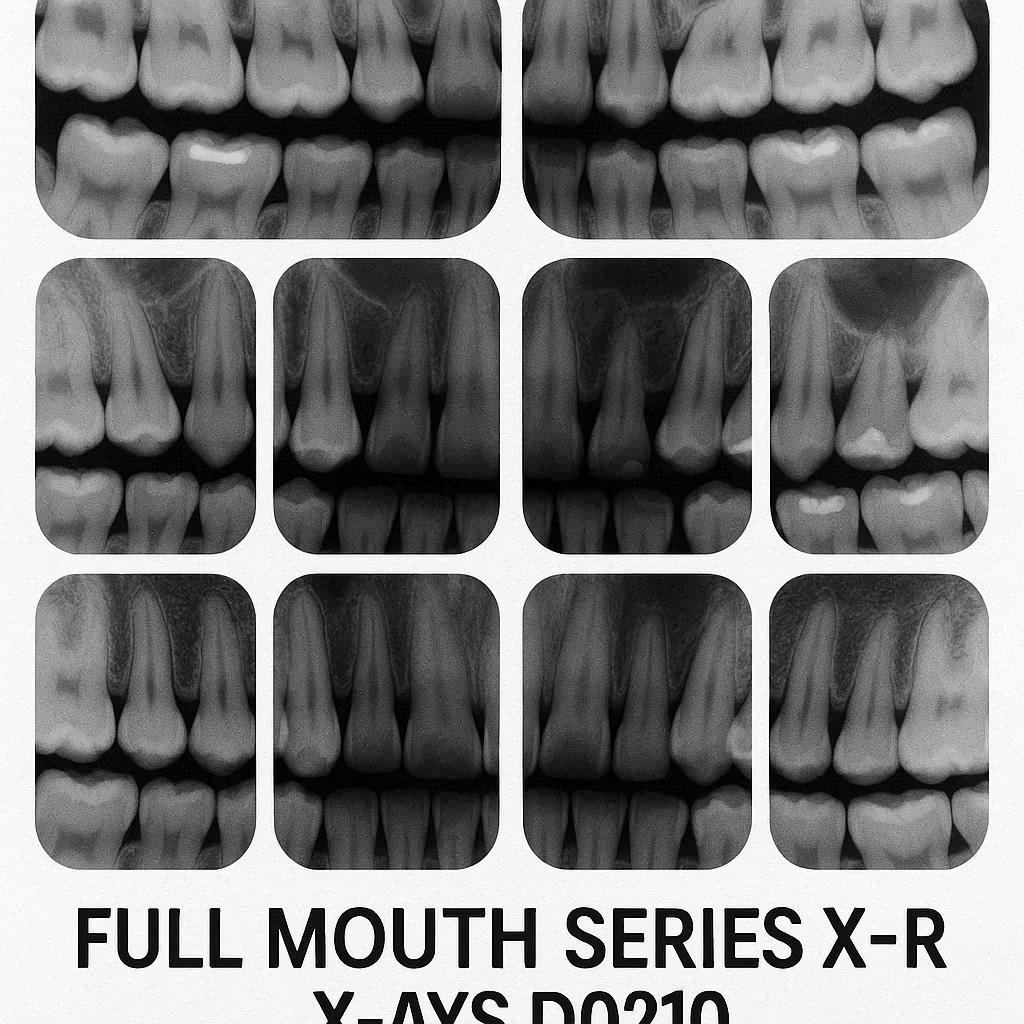
A Full Mouth Series is a set of 14 to 22 individual X-ray images that show every tooth in your mouth—from the crown (the part you see) to the root (the part below the gum line). These images also show the surrounding bone and supporting structures.
What Does an FMX Show?
- All tooth surfaces: Front, back, and between teeth.
- Tooth roots: To detect abscesses, cysts, or infections.
- Bone levels: To check for gum disease (periodontitis).
- Hidden decay: Cavities that are not visible during a visual exam.
- Impacted teeth: Such as wisdom teeth that haven’t erupted.
- Existing restorations: Fillings, crowns, bridges, and implants.
FMX vs. Other X-rays
| Type of X-ray | Number of Images | What It Shows | Common Code |
|---|---|---|---|
| Bitewing X-rays | 2 to 4 | Crowns of back teeth (cavities between teeth) | D0270, D0272, D0274 |
| Periapical X-ray | 1 to 3 | Full tooth from crown to root | D0220, D0230 |
| Panoramic X-ray | 1 | Entire mouth in one wide image | D0330 |
| Full Mouth Series (FMX) | 14 to 22 | Every tooth, crown to root, plus bone | D0210 |
As you can see, an FMX is much more detailed than a simple panoramic or a few bitewings. That is why it has its own specific billing code.
The Exact Dental Code: D0210
The official Current Dental Terminology (CDT) code for a Full Mouth Series is D0210.
Here is the exact definition from the American Dental Association (ADA):
“Intraoral – complete series of radiographic images.”
In plain English: A set of intraoral (inside the mouth) X-rays that includes both periapical and bitewing images. The series must cover all existing teeth and show the entire crown and root of each tooth.
What D0210 Includes
When a dentist bills D0210, you should receive:
- A complete set of periapical images (usually 14 to 16) covering all teeth from root to crown.
- A set of bitewing images (usually 4) to show the interproximal areas (between teeth).
What D0210 Does NOT Include
- A single panoramic X-ray (that is D0330).
- A limited set of bitewings (that is D0270 or D0272).
- A few periapical images of just one area (that is D0220 or D0230).
Important note for readers: Some offices use digital sensors that allow them to take fewer images while still capturing all necessary angles. That is fine. As long as the diagnostic quality equals a full series, the code D0210 remains correct.
Why Do Dentists Recommend a Full Mouth Series?
You might wonder, “Do I really need all those X-rays?” It is a fair question. Dentists do not recommend FMX lightly. There are specific clinical reasons.
1. Establishing a Baseline for New Patients
When you visit a new dentist, they have no history of your mouth. An FMX gives them a complete map. It shows:
- Past dental work (fillings, crowns, root canals).
- Areas that need immediate attention.
- Healthy areas to monitor over time.
Without a baseline, your dentist is working blindly. That increases the risk of missing problems.
2. Detecting Hidden Problems
Tooth decay often starts in places you cannot see or feel. An FMX finds:
- Cavities between teeth (interproximal decay).
- Decay under existing fillings or crowns.
- Infections at the root tip (periapical abscess).
3. Evaluating Gum Disease
Periodontal disease destroys the bone that holds your teeth. An FMX shows bone levels around every tooth. This helps your dentist:
- Diagnose mild, moderate, or advanced gum disease.
- Plan treatment like deep cleanings (scaling and root planing).
- Monitor bone loss over time.
4. Planning Major Treatment
Before starting complex procedures, your dentist needs a complete view. An FMX is essential for:
- Dental implants (to assess bone volume).
- Orthodontics (braces or clear aligners).
- Extractions (especially wisdom teeth).
- Full-mouth reconstruction.
Realistic advice: Most dentists recommend a full mouth series every 3 to 5 years for healthy adult patients. If you have active gum disease, frequent cavities, or a history of dental problems, your dentist may recommend more frequent X-rays.
How Often Does Insurance Cover D0210?
Insurance coverage varies widely. However, most dental insurance plans follow a general pattern.
Typical Coverage Limits
| Patient Type | Typical Frequency | Insurance Coverage |
|---|---|---|
| New patient (adult) | Once per dentist | Usually 80% to 100% |
| Established patient (adult) | Every 3 to 5 years | 60% to 80% |
| Child (full primary dentition) | Every 3 to 5 years | 70% to 100% |
| Patient with active gum disease | Every 1 to 2 years | Varies (medical necessity may apply) |
How to Check Your Coverage
Do not assume anything. Follow these steps:
- Call your insurance provider. Ask: “Does my plan cover code D0210? How often? What is my co-pay or coinsurance?”
- Check your plan summary. Look for “diagnostic services” or “oral radiographs.”
- Ask your dentist’s office. Most front desk teams can verify your benefits before taking X-rays.
What If Insurance Denies the Claim?
Sometimes insurance denies D0210 because:
- You had an FMX less than 3 years ago at another office.
- The plan only covers bitewings and a panoramic (not a full series).
- The dentist did not submit documentation proving medical necessity.
If that happens, do not panic. You can:
- Appeal the decision with your insurance company.
- Ask your dentist to submit a narrative explaining why the X-rays were necessary.
- Negotiate a discounted rate with your dental office.
How Much Does a Full Mouth Series Cost?
Prices vary by location, dental office type, and whether you have insurance.
Average Out-of-Pocket Costs (USA, 2025)
| Setting | Without Insurance | With Insurance (after co-pay) |
|---|---|---|
| Private practice (suburban) | $150 – $300 | $20 – $60 |
| Private practice (urban) | $200 – $400 | $25 – $80 |
| Dental school clinic | $50 – $120 | N/A (insurance rarely accepted) |
| Community health center | $60 – $150 | Sliding scale based on income |
| Corporate/chain dental office | $100 – $250 | $10 – $50 |
Factors That Influence Price
- Geographic location: Cities cost more than rural areas.
- Digital vs. film X-rays: Digital is faster and often cheaper.
- Office overhead: High-end cosmetic practices charge more.
- Number of images: Some offices take 14 images; others take 22. Both can bill D0210.
Note: Never pay the full “retail” price without asking. Many offices offer a 10% to 20% discount if you pay in cash or same-day.
FMX for Children: What Parents Need to Know
Children also need full mouth X-rays, but only in specific situations.
When a Child Needs D0210
- First visit to a new dentist (if the child has many teeth).
- Before orthodontic treatment (braces or expanders).
- After dental trauma (a fall or sports injury).
- If the child has a high cavity risk (frequent cavities, poor oral hygiene).
Special Code for Children
The code for a full mouth series on a child is usually the same: D0210. However, some plans use a different code for a child with mixed dentition (some baby teeth, some adult teeth).
Always confirm with your dental office before the appointment.
How Many X-rays for a Child?
A pediatric full mouth series typically uses:
- 6 to 8 periapical images
- 4 bitewing images
The total radiation exposure is very low—equivalent to a few hours of natural background radiation.
Digital FMX vs. Traditional Film X-rays
Most dental offices have switched to digital X-rays. Here is why that matters for you.
| Feature | Digital FMX | Traditional Film FMX |
|---|---|---|
| Radiation exposure | Up to 80% less | Higher |
| Image available | Immediately (seconds) | Minutes (developing time) |
| Image quality | Adjustable (brightness, contrast) | Fixed |
| Sharing with specialists | Easy (email, cloud) | Difficult (mail films) |
| Cost to patient | Often slightly lower | Often slightly higher |
| Code used | D0210 | D0210 |
Key takeaway: The code is the same. You should not pay extra just because an office uses digital technology. Digital benefits the office (speed, storage) and you (lower radiation).
Common Billing Mistakes to Watch For
Even honest dental offices make mistakes. Here are a few billing errors that happen with D0210.
1. Unbundling the Code
Some offices bill separate codes for the periapical series (D0220 repeated many times) plus bitewings (D0270 or D0272) instead of using D0210. This is called unbundling. It often increases your out-of-pocket cost.
What to do: If you see multiple line items for X-rays on one date of service, ask: “Why wasn’t this billed as D0210?”
2. Billing D0210 When Only Bitewings Were Taken
Sometimes an office takes only 4 bitewings but bills D0210. That is incorrect and fraudulent.
What to do: Count how many X-rays were taken. A true FMX requires at least 14 images (often more).
3. Billing D0210 Twice on the Same Day
You cannot have two full mouth series on one day. If you see duplicate charges, call your dental office immediately.
4. Charging for Retakes Due to Office Error
If the dental assistant takes poor-quality images and needs to retake them, you should not be billed again. The original D0210 fee covers all necessary retakes on the same day.
Medical Necessity: When Your Dentist Must Justify D0210
Insurance companies love the phrase “medical necessity.” If your dentist recommends an FMX more often than the plan’s standard frequency (e.g., every 2 years instead of 5), the office may need to send documentation.
Valid Reasons for More Frequent FMX
- Active periodontal disease with bone loss visible on previous X-rays.
- History of root canal treatment in multiple teeth.
- Multiple large fillings that need monitoring for decay underneath.
- Dry mouth (xerostomia) due to medications or radiation therapy.
- Orthodontic treatment that requires baseline and progress X-rays.
- Immunosuppressed patients (organ transplant, chemotherapy, HIV).
If your dentist recommends more frequent X-rays, ask them to explain the medical reason. A good dentist will happily provide that explanation—both to you and to your insurance company.
Radiation Safety: Should You Be Worried?
Many patients worry about X-ray radiation. That is understandable. But the facts are reassuring.
Radiation Comparison Chart
| Source | Estimated Radiation Exposure |
|---|---|
| Full Mouth Series (digital) | 0.01 mSv |
| Full Mouth Series (film) | 0.04 mSv |
| Panoramic X-ray | 0.007 mSv |
| Daily background radiation (1 year) | 3.1 mSv |
| Roundtrip flight NYC to LA | 0.04 mSv |
| Chest X-ray | 0.1 mSv |
| Mammogram | 0.4 mSv |
| CT scan (head) | 2.0 mSv |
A digital full mouth series exposes you to roughly the same radiation as a single cross-country flight. The risk is extremely low, especially compared to the benefit of finding hidden dental disease.
Safety Measures
- Lead apron + thyroid collar: Always request these, especially for children and pregnant women.
- Pregnancy: Tell your dentist if you are or might be pregnant. Routine FMX can wait until after delivery. Emergency FMX may still be necessary (with double shielding).
- Frequency: Follow your dentist’s recommended schedule. Unnecessary X-rays are never good. Necessary X-rays are safe.
Quote from the American Dental Association: “Dental X‑rays are among the lowest radiation dose examinations performed in medicine. The risk of undiagnosed oral disease far outweighs the minimal risk from properly prescribed dental X‑rays.”
Alternatives to a Full Mouth Series
Sometimes a full mouth series is not the right choice. Depending on your situation, your dentist might recommend alternatives.
Option 1: Panoramic + Bitewings
- Code combination: D0330 (panoramic) + D0270 or D0272 (bitewings)
- What you get: One wide view of all teeth and jaws, plus 2 to 4 close-up images of back teeth.
- Pros: Lower radiation than FMX, faster, good for general screening.
- Cons: Less detail on individual tooth roots. Cannot see small cavities between front teeth as well.
Option 2: Bitewings Only
- Code: D0270 (2 images), D0272 (4 images), or D0274 (8 images)
- What you get: Crowns of back teeth only.
- Pros: Very low radiation, inexpensive, good for routine cavity checks.
- Cons: No root images, no bone level assessment for front teeth.
Option 3: Selected Periapicals
- Code: D0220 (single periapical, first image) and D0230 (each additional periapical)
- What you get: Full tooth images (crown to root) of specific problem areas.
- Pros: Targeted, low radiation if only a few teeth.
- Cons: Does not provide a complete mouth map.
When to Choose an FMX Over Alternatives
- You are a new patient and have no recent X-rays.
- You have symptoms in multiple areas of your mouth (pain, swelling, gum bleeding).
- You are planning major treatment (implants, full crown work, braces).
- You have a history of root decay or recurrent decay under fillings.
What to Expect During an FMX Appointment
If you have never had a full mouth series before, here is a step-by-step walkthrough. It will help you feel more comfortable and prepared.
Before the X-rays
- You will remove any removable appliances like dentures, partials, or retainers.
- You will put on a lead apron with a thyroid collar. This protects your body from scatter radiation.
- The dental assistant will position the sensor (or film) inside your mouth.
During the X-rays
- You will bite down gently on a plastic holder that keeps the sensor in place.
- The assistant will step behind a shield or leave the room briefly.
- You will hear a beep or buzz when each X-ray is taken. This lasts about 0.1 to 0.5 seconds.
- You will reposition the sensor 14 to 22 times.
Total time
- Taking the images: 10 to 20 minutes
- Processing and reviewing: 5 to 10 minutes (digital is faster)
- Discussion with dentist: Included in your exam time
Discomfort level
- Mild: The sensor edges can press against your gums or the roof of your mouth.
- Gag reflex: Some people gag, especially with back teeth. Tell the assistant if you feel nauseous. They can try different sensor sizes or positions.
- Pain: Zero. X-rays themselves are painless.
Tip: Breathe slowly through your nose during back tooth X-rays. Many patients find that focusing on a spot on the ceiling helps reduce the gag reflex.
How to Read Your Dental Bill for D0210
Understanding your explanation of benefits (EOB) or dental bill is a superpower. Here is a sample bill breakdown.
Sample Bill Line Item
| Procedure Code | Description | Fee | Insurance Paid | Patient Responsibility |
|---|---|---|---|---|
| D0210 | Full Mouth Series | $225 | $180 | $45 |
What the Columns Mean
- Fee: The office’s full price for the service.
- Insurance Paid: What your plan covers (often 80% of the negotiated rate).
- Patient Responsibility: What you owe. This could be a co-pay, coinsurance, or deductible.
Red Flags on Your Bill
- Missing code description: “D0210” without a plain English description is fine, but some offices hide extra charges.
- Separate “processing fee” or “digital fee”: These are not standard. Politely ask to have them removed.
- Two FMX codes on the same day: As mentioned earlier, this is an error.
Frequently Asked Questions (FAQ)
1. How often can I have a full mouth series?
For most healthy adults, every 3 to 5 years. Your dentist may recommend more often if you have active gum disease, high cavity risk, or complex treatment needs.
2. Does Medicaid cover D0210?
Yes, in most states. Medicaid typically covers a full mouth series for new patients and then every 3 to 5 years. Coverage varies by state. Check your specific Medicaid plan.
3. Is D0210 the same as a panoramic X-ray?
No. A panoramic (D0330) is one single image of the entire mouth. D0210 is a set of 14 to 22 individual images. The panoramic is faster and has less detail per tooth.
4. Can I refuse a full mouth series?
Yes. You have the right to refuse any medical or dental procedure. However, your dentist also has the right to dismiss you as a patient if they cannot provide standard care without necessary diagnostic images.
5. Will my insurance cover D0210 if I had X-rays at another office last year?
Typically no. Most plans have a frequency limit (e.g., once every 36 months). However, if you lost those X-rays or they were poor quality, your dentist can submit a request for an exception.
6. How do I transfer my FMX to a new dentist?
Sign a release of records form at your previous dental office. They can email, mail, or hand you a copy of the X-rays (usually on a CD or via a secure link). There may be a small administrative fee (typically $10 to $30).
7. Are full mouth X-rays safe during pregnancy?
Routine FMX should wait until after delivery. However, if you have a dental emergency (severe pain, swelling, trauma), an FMX with double shielding (lead apron + thyroid collar) is considered safe. Always tell your dentist if you are pregnant or trying to conceive.
8. Why does my dentist want an FMX when I just had bitewings?
Bitewings only show the crowns of back teeth. An FMX shows roots, bone levels, and front teeth. If you have gum disease, root pain, or need orthodontics, bitewings alone are insufficient.
9. Can I get a full mouth series without insurance?
Absolutely. Ask for the self-pay or cash discount. Many offices offer 15% to 30% off if you pay in full at the time of service.
10. What is the difference between D0210 and D0220?
D0210 is a complete series (many images). D0220 is a single periapical X-ray of one specific tooth. Think of D0210 as a map of the whole city and D0220 as a close-up of one house.
Additional Resources
For more reliable information on dental X-rays, billing codes, and your rights as a patient, visit the American Dental Association’s patient education page:
👉 MouthHealthy.org – Dental X-Rays
This resource provides ADA-approved explanations, videos, and downloadable guides. It is free, ad-light, and written for real people—not dental professionals.
Final Checklist Before Your Next FMX Appointment
Use this checklist to save money, avoid billing errors, and stay informed.
- Ask your dentist: “Why do I need an FMX now?”
- Check your insurance: “Does my plan cover D0210? What is my frequency limit?”
- Request previous X-rays from your last dentist (if within 3 years).
- Confirm the total out-of-pocket cost before X-rays are taken.
- Ask if the office uses digital X-rays (lower radiation).
- Request a lead apron and thyroid collar (always).
- Tell the assistant if you have a strong gag reflex.
- After the appointment, review your bill for unbundling or duplicate charges.
- Keep a copy of your FMX for your personal records (digital or printed).
Conclusion: Your Smile, Your Information, Your Choice
Understanding the full mouth series X-rays dental code D0210 puts you in control. You now know what the code means, how much it should cost, how often insurance pays, and how to spot billing mistakes. You also understand why dentists recommend FMX—not to upsell you, but to find hidden problems before they turn into expensive emergencies.
Remember these three key points:
- D0210 is the correct code for a complete set of intraoral X-rays showing every tooth from crown to root.
- Most insurance plans cover FMX every 3 to 5 years, with typical patient costs between $20 and $80 after insurance.
- You have the right to ask questions, verify coverage, and request previous X-rays before agreeing to new ones.
A healthy smile starts with good information. Now you have both.