How Much Do New Teeth Implants Cost: A Complete Guide for 2026
If you are missing one or more teeth, you have probably heard that dental implants are the gold standard for replacement. They look natural, feel secure, and can last a lifetime with proper care. But there is one question that stops most people from moving forward: how much do new teeth implants cost?
The honest answer is not a single number. It depends on where you live, how many teeth you need to replace, the materials used, and whether you need extra procedures like bone grafts or sinus lifts.
In this guide, we will walk through every cost layer, from the initial consultation to the final crown. You will find real price ranges, financing options, insurance truths, and practical tips to avoid overpaying. No exaggerated claims. No hidden agenda. Just clear, reliable information to help you plan your budget.
What Exactly Are Dental Implants?
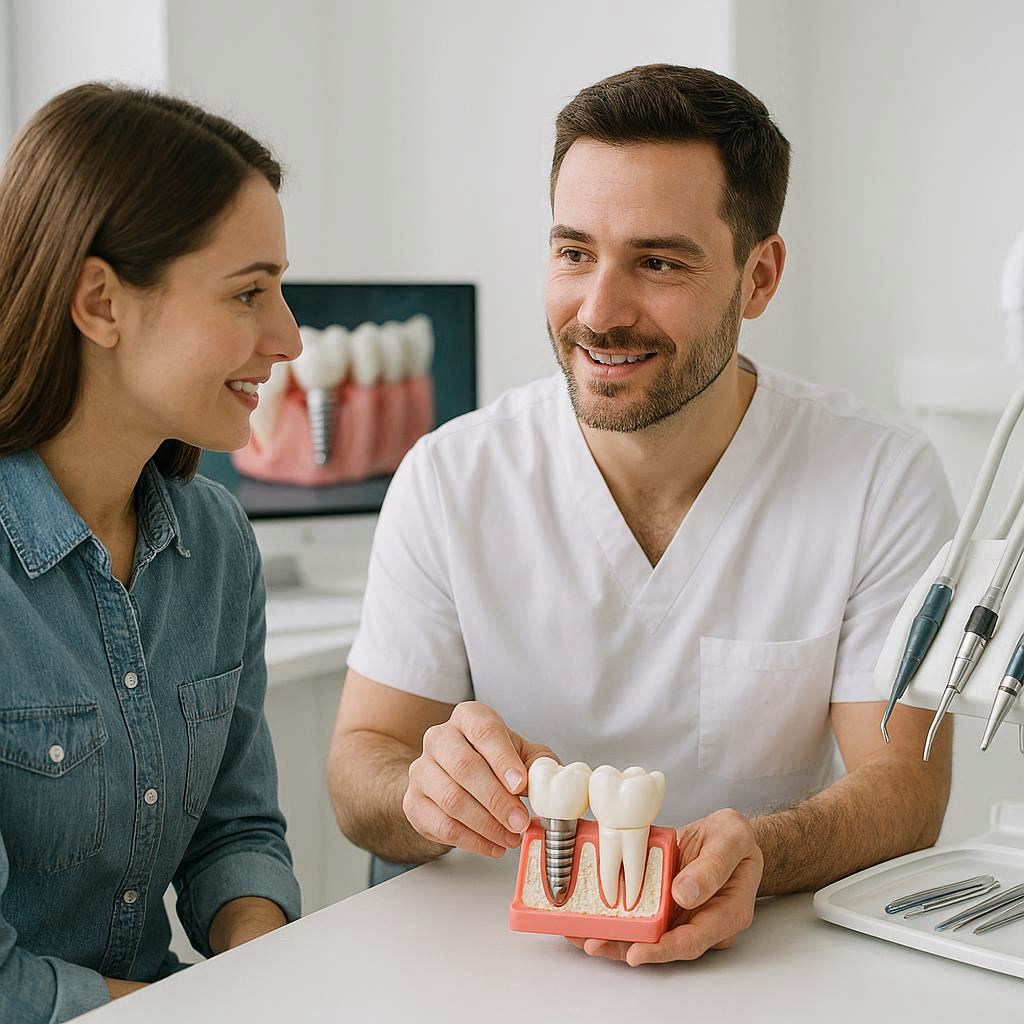
Before talking about prices, it helps to understand what you are actually paying for. A complete dental implant is not a single screw. It is three main parts working together.
- The implant post – A small titanium or zirconia screw that your dentist surgically places into your jawbone. This acts like an artificial tooth root.
- The abutment – A connector piece attached to the post. It sits just above the gum line.
- The dental crown – The visible, tooth-like part that snaps or screws onto the abutment.
Some people also need temporary teeth while the implant heals. Others require bone grafting if their jaw is too thin or soft to support the post.
When you ask how much do new teeth implants cost, you are really asking for the sum of all these parts plus the surgical procedures and follow-up visits.
Average Cost of a Single Tooth Implant
Let us start with the most common scenario: replacing one missing tooth.
Across the United States and most Western countries, the total price for a single implant (post, abutment, and crown) ranges from $3,000 to $6,000. That is the complete, turnkey price.
Here is a more detailed breakdown:
| Component | Low range | Average range | High range |
|---|---|---|---|
| Consultation and X-rays (CBCT scan) | $150 | $250 | $500 |
| Implant post placement surgery | $1,500 | $2,000 | $3,000 |
| Abutment | $300 | $500 | $800 |
| Custom crown (porcelain or zirconia) | $1,000 | $1,500 | $2,500 |
| Follow-up visits and adjustments | $100 | $200 | $400 |
| Total | $3,050 | $4,450 | $7,200 |
Important note: Many dental offices offer “all-inclusive” packages for single implants. These usually range from $3,500 to $5,000 and cover everything except possible bone grafts or extractions.
If you see an advertised price of $1,500 for an implant, read the fine print. That often covers only the surgical post. The crown and abutment are extra.
How Many Teeth Are You Replacing?
The total price changes dramatically based on the number of missing teeth. But it is not a simple multiplication.
One missing tooth
As above: $3,000 to $6,000.
Two or three missing teeth
You have two options:
- Separate implants for each tooth – More expensive but each tooth works independently.
- Implant-supported bridge – Two implants holding a three-unit bridge. This lowers the cost.
Example for three missing teeth in a row:
- Three single implants: $9,000 to $18,000.
- Two implants with a three-unit bridge: $6,000 to $12,000.
Full arch (all teeth on upper or lower jaw)
This is where implant costs can actually become more affordable per tooth.
- Removable implant denture (snap-on): $7,000 to $15,000 per arch.
- Fixed hybrid denture (non-removable, often called All-on-4 or All-on-6): $15,000 to $30,000 per arch.
- Individual implants for every tooth: $45,000 to $80,000 per arch (rarely recommended).
Many patients ask: how much do new teeth implants cost for a full mouth? For both upper and lower jaws with fixed hybrid prosthetics, expect $30,000 to $60,000 total.
Extra Procedures That Increase the Final Bill
Not everyone needs these. But if your dentist recommends them, your final cost will be higher.
Bone grafting
When you lose a tooth, the surrounding jawbone shrinks over time. If there is not enough bone height or width, the implant cannot stay stable.
- Simple socket graft (right after extraction): $300 – $800
- Ramus or chin bone graft (from your own body): $2,000 – $4,000
- Sinus lift (for upper back teeth): $1,500 – $3,000
Tooth extraction
If the damaged tooth is still in place, it must come out before the implant.
- Simple extraction: $75 – $200
- Surgical extraction (impacted or broken): $200 – $600
Temporary tooth during healing
While your implant integrates with the bone (3 to 6 months), you may want a temporary removable partial or a temporary crown.
- Flipper (acrylic partial): $300 – $800
- Temporary crown: $200 – $500
CT scan (3D imaging)
Traditional X-rays are often included. A CBCT scan gives a detailed 3D view of your bone and nerves.
- Cost: $250 – $500 (sometimes separate from the consultation)
Sedation or anesthesia
Local anesthesia is usually included. But if you need IV sedation or general anesthesia for anxiety or complex cases:
- Oral sedation (pill): $100 – $300
- Nitrous oxide (laughing gas): $100 – $250 per hour
- IV sedation: $400 – $1,000
Geographic Price Differences
Where you live plays a huge role in how much do new teeth implants cost. Major cities and high-cost states charge more.
| Region | Single implant (total) | Full arch fixed |
|---|---|---|
| New York, Los Angeles, San Francisco | $5,000 – $8,000 | $25,000 – $45,000 |
| Chicago, Dallas, Atlanta | $3,800 – $6,000 | $18,000 – $30,000 |
| Rural Midwest or South | $3,000 – $4,500 | $15,000 – $25,000 |
| Western Europe (UK, Germany, France) | £2,500 – £5,000 / €3,000 – €6,000 | £18,000 – £35,000 |
| Mexico (dental tourism) | $800 – $2,500 | $6,000 – $12,000 |
| Costa Rica or Colombia | $1,000 – $2,500 | $7,000 – $15,000 |
Realistic warning: Dental tourism can save money, but factor in travel costs, hotel stays, and the risk of limited follow-up care if complications arise back home.
Material Choices and Their Price Impact
Not all implants and crowns cost the same. The materials affect both the price and how long they last.
Implant post materials
- Titanium (most common): $1,500 – $3,000 per post. Proven track record of 95%+ success over 20+ years.
- Zirconia (metal-free): $2,000 – $4,000 per post. Preferred by patients with metal allergies or gum recession concerns.
Crown materials
| Crown type | Cost range | Durability | Aesthetics |
|---|---|---|---|
| Porcelain fused to metal | $800 – $1,500 | Good | Acceptable (metal line visible) |
| Full zirconia | $1,200 – $2,000 | Excellent | Very good (opaque) |
| Lithium disilicate (E-max) | $1,500 – $2,500 | Very good | Outstanding (translucent like natural teeth) |
Most dentists recommend E-max for front teeth and zirconia for molars (back teeth).
Dental Insurance: What It Actually Covers
Let us be realistic. Most dental insurance plans are not designed to help with major restorative work like implants.
Typical coverage:
- Annual maximum: $1,000 – $2,000 (this has not changed in 40 years).
- Implant post: Often partially covered as a “major service” (50% after deductible).
- Crown: Usually covered at 50% as a major service.
- Bone graft or extraction: May be covered as a basic service (70–80%).
- Cosmetic portions: Not covered.
What this means in dollars:
If your single implant costs $4,500 and you have a $1,500 annual max with 50% coverage on the crown and post, your insurance might pay $1,000 to $1,500. You pay the remaining $3,000 to $3,500.
Pro tip: Some plans have a “missing tooth clause.” They will not cover an implant to replace a tooth that was missing before the policy started. Always read your plan documents.
Payment Plans and Financing Options
Because few people have $5,000 sitting in a dental savings account, most implant dentists offer payment solutions.
In-house membership plans
Many dental offices offer annual membership plans for patients without insurance.
- Typical cost: $300 – $500 per year.
- What you get: 10–20% off implants, free exams, and no waiting periods.
Third-party medical financing
- CareCredit: Very common. Offers 6, 12, or 18 months interest-free if paid in full. Longer terms have interest (14–18% APR).
- LendingClub, Alphaeon, Proceed Finance: Specialized healthcare loans. Approval based on credit score.
Personal loans
Banks and online lenders (SoFi, Upstart, LightStream) offer unsecured loans.
- Interest rates: 6% to 25% depending on credit.
- Terms: 12 to 84 months.
Health Savings Account (HSA) or Flexible Spending Account (FSA)
If you have an HSA or FSA through work, you can use pre-tax dollars for implants. This saves you 20–40% on the effective cost depending on your tax bracket.
Warning: Never pay the full amount upfront before surgery. A reasonable deposit (20–30%) is normal. The rest should be due upon completion of each phase.
Low-Cost and Affordable Options
If your budget is tight, you still have realistic paths to implants. They just require more time or compromise.
Dental schools
Teaching clinics offer supervised implant placement by advanced students (residents).
- Cost savings: 30% to 50% less than private practices.
- Single implant at a dental school: $1,800 to $3,000 total.
- Trade-offs: Longer appointments (2–4 hours each). More visits. You cannot rush the schedule.
Nonprofit and sliding scale clinics
Some community health centers offer reduced-cost dental care based on your income.
- Examples: Mission of Mercy, Remote Area Medical (RAM), local Federally Qualified Health Centers (FQHCs).
- Waitlists: Often months long. But the savings can be 40–60%.
Corporate dental chains
Chains like Aspen Dental, Affordable Dentures & Implants, and ClearChoice advertise package prices.
- Pros: Published pricing, financing options, many locations.
- Cons: High pressure sales tactics. Variable quality. Always get a second opinion.
Travel to lower-cost U.S. regions
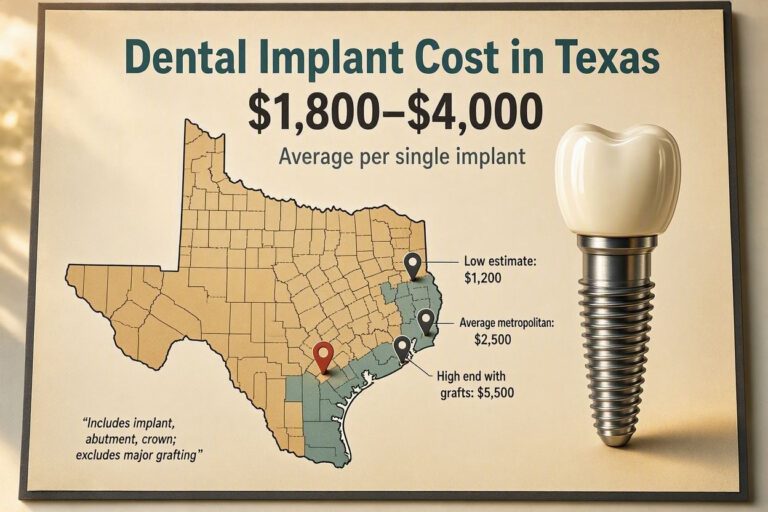
You do not have to leave the country. Traveling from New York to a reputable clinic in Texas or Alabama can save $1,000–$2,000 per implant, even after travel costs.
Hidden Costs Most Websites Do Not Mention
Here is the reality that glossy brochures leave out.
Failed implant replacement
Implants fail in about 2–5% of cases, mostly due to smoking, uncontrolled diabetes, or poor bone quality.
- Cost to remove a failed implant: $300 – $800.
- Replace with new implant: Full price again (though some dentists offer a partial discount if failure was not your fault).
Peri-implantitis treatment
This is an infection around the implant, similar to gum disease but harder to treat.
- Mild case (deep cleaning): $500 – $1,000.
- Severe case (surgical debridement or laser): $1,500 – $4,000.
Crown replacement
Crowns last 10–15 years on average. Replacing a worn or broken crown.
- Cost: $1,000 – $2,500.
Night guard (if you grind your teeth)
Grinding can destroy implant crowns.
- Custom night guard: $500 – $1,000. Non-negotiable for grinders.
Honest advice: Ask your dentist for a written treatment plan with all phase fees, including “what if” scenarios. Any good clinic will provide this without pressure.
How to Get an Accurate Price Quote
You cannot get a reliable online price. But you can prepare so the quote you receive is accurate.
Step-by-step:
- Schedule two consultations – Never settle for one opinion.
- Bring your recent X-rays (if you have them) to save $150–$300.
- Ask for a line-item estimate – Post, abutment, crown, graft, CT scan, sedation, temporary teeth.
- Request a “valid until” date – Prices change. Get it in writing.
- Ask about included warranty – Some dentists guarantee the implant for 5–10 years against failure.
Three questions to ask every dentist:
- “If the implant fails during healing, do I pay for a replacement?”
- “Are follow-up adjustments for the crown included for the first year?”
- “What is your fee if I need an extra visit for the final crown fit?”
Comparison Table: Implants vs. Alternatives
To decide if implants are worth the cost, compare them to other tooth replacement options.
| Feature | Dental implant | Fixed bridge | Removable partial denture | No treatment |
|---|---|---|---|---|
| Initial cost | $3,000 – $6,000 (single) | $2,000 – $5,000 (3-unit) | $500 – $2,000 | $0 |
| Long-term cost | Low (no adjacent teeth damage) | Medium (abutment teeth eventually fail) | High (replaced every 5–8 years) | Very high (bone loss, shifting, more missing teeth) |
| Lifespan | 20+ years (often lifetime) | 7–15 years | 5–8 years | N/A |
| Bone preservation | Yes | No | No | No |
| Affects adjacent teeth | No | Yes (shaved down) | Yes (clasps and wear) | Yes (shifting) |
| Eating comfort | Like natural teeth | Good | Fair | Poor |
The honest bottom line: Implants cost more upfront but almost always cost less over 20+ years compared to replacing bridges or dentures multiple times.
Real Patient Examples (Hypothetical but Realistic)
These examples reflect typical cases from dental offices across the U.S.
Case 1 – Sarah, 34, single missing molar
- Location: Suburban Ohio
- Procedure: Single implant + E-max crown
- Bone graft? No (extracted 6 months ago)
- Total cost: $4,200
- Insurance paid: $1,200
- Sarah paid: $3,000 via 12-month interest-free CareCredit
Case 2 – Michael, 58, full upper arch
- Location: Phoenix, Arizona
- Procedure: All-on-4 hybrid fixed denture (zirconia)
- Bone graft? Yes, sinus lift ($2,500)
- Total cost: $28,000
- Insurance paid: $1,500 (annual max)
- Michael paid: $26,500 using home equity line of credit
Case 3 – Linda, 45, two missing front teeth
- Location: Rural Mississippi
- Procedure: Two separate implants with lithium disilicate crowns
- Bone graft? Yes, socket grafts ($600 each)
- Total cost: $8,900
- Insurance paid: $0 (missing tooth clause)
- Linda paid: $8,900 via dental school (saved 45% from private quote)
How Much Do New Teeth Implants Cost in 2026 vs. 2020?
Prices have increased, but not as dramatically as other medical procedures.
| Year | Single implant average (U.S.) | Full arch fixed average |
|---|---|---|
| 2020 | $3,800 | $22,000 |
| 2023 | $4,200 | $24,000 |
| 2026 | $4,500 – $4,800 | $26,000 – $28,000 |
Why the increase?
- Higher material costs (zirconia, titanium supply chains).
- Increased lab fees for custom crowns.
- Higher staff wages in dental offices.
- More CBCT scanning (3D imaging) becoming standard.
The good news: competition is growing. More general dentists now place implants, which keeps prices from exploding.
FAQ: Frequently Asked Questions
1. Are dental implants painful?
Most patients report less discomfort than a tooth extraction. You receive local anesthesia during surgery. Post-operative soreness lasts 2–5 days and responds well to over-the-counter pain relievers like ibuprofen.
2. How long does the whole process take?
From extraction to final crown: 4 to 9 months on average. Healing (osseointegration) takes 3–6 months. If you need bone grafting, add 4–9 months before implant placement.
3. Can I get implants if I smoke?
Yes, but your failure risk doubles or triples. Many dentists require you to quit smoking for at least 2 weeks before surgery and during the healing period. Heavy smokers have failure rates up to 15–20%.
4. Do implants ever look fake?
High-quality custom crowns from good labs look extremely natural. The biggest giveaway is gum color or shape. An experienced dentist matches the crown to your adjacent teeth and the gum contour to your natural tissue.
5. What is the cheapest way to get implants in the U.S.?
A dental school in a low-cost state. Example: University of Mississippi or Texas A&M dental schools often complete single implants for $1,800–$2,500.
6. Does Medicare cover dental implants?
Original Medicare (Parts A and B) does not cover routine dental care or implants. Some Medicare Advantage plans (Part C) offer limited dental benefits, usually up to $1,500 per year.
7. Can I finance implants with bad credit?
Yes, but with higher interest rates (18–28% APR). Some in-house dental financing programs approve patients with scores as low as 550. Your down payment may be 30–50% instead of 10–20%.
8. How many implants do I need for a full mouth?
- Removable denture that snaps on: 2–4 implants per arch.
- Fixed hybrid (All-on-4): 4 implants per arch.
- Fixed hybrid with extra support (All-on-6): 6 implants per arch.
9. Can implants be done in one day?
Yes, same-day implants (immediate loading) exist for some patients with good bone density. But the final crown is often temporary. A permanent crown comes 4–6 months later. Not everyone is a candidate.
10. Do I need to take time off work?
Plan for 1–2 days off for implant surgery (more for full arch). For each crown placement appointment, you can usually return to work the same day.
Additional Resource
For a free, dentist-reviewed cost calculator and to find accredited implant providers near you, visit:
American Academy of Implant Dentistry – Patient Resources
This official resource offers:
- A search tool for AAID-credentialed implant dentists.
- Educational videos on the implant process.
- Downloadable treatment planning checklist.
Conclusion
So, how much do new teeth implants cost? A single tooth implant in the United States ranges from $3,000 to $6,000, while a full arch fixed solution runs $15,000 to $30,000 per jaw. Bone grafts, sedation, and crown materials can add thousands more. Dental insurance covers only a small fraction. However, dental schools, financing plans, and in-house membership programs make implants more accessible than ever. The upfront price is real, but the long-term value—preserving bone, protecting adjacent teeth, and restoring full chewing function—is unmatched by any other tooth replacement option.