How Much Are Dental Implants in Kentucky? A Realistic 2026 Price Guide
If you are missing one or more teeth, you have probably heard that dental implants are the gold standard for replacement. They look natural, feel secure, and last for decades. But like most people, you likely have one big question on your mind: how much are dental implants in Kentucky?
The short answer is that a single implant in the Bluegrass State typically costs between $3,000 and $6,000. However, that number can change depending on where you live, how many teeth you need to replace, and what your insurance covers.
Let’s be honest—this is a major financial decision. You deserve a clear, honest breakdown without confusing dental jargon or hidden fees. In this guide, we will walk through real prices in cities like Louisville, Lexington, and Bowling Green. We will also explore affordable alternatives, financing options, and tips to save money without sacrificing quality.
By the end, you will know exactly what to expect when you call a Kentucky dental office for a quote.
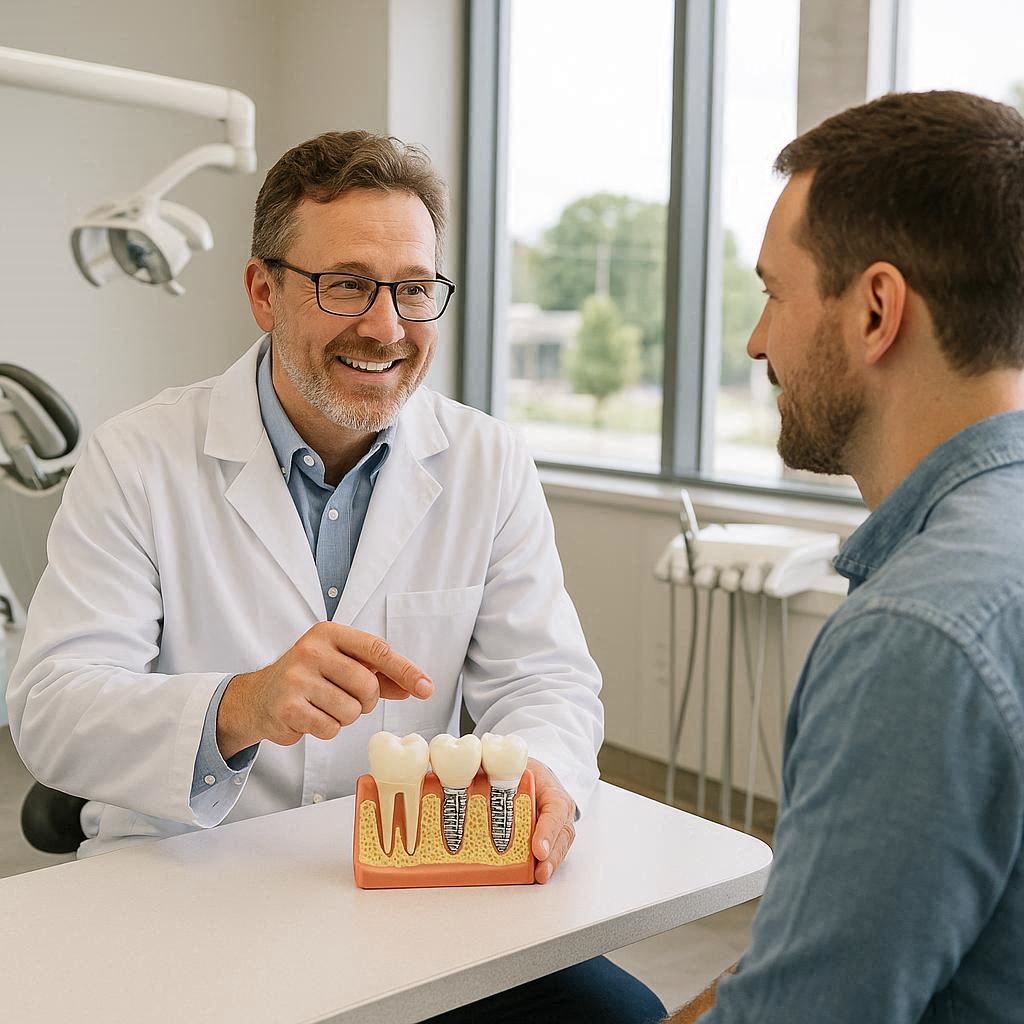
Understanding the True Cost of Dental Implants in Kentucky
Before we look at specific numbers, it helps to understand what you are actually paying for. A dental implant is not a single item. It is a multi-step process involving several different components and specialists.
Many patients make the mistake of asking for the price of just the “screw” (the implant post). That is like asking for the price of a car engine without the wheels, seats, or steering wheel. You need the whole package.
Breaking Down the Three Main Parts of an Implant
| Component | What It Is | Typical Cost Range (KY) |
|---|---|---|
| Implant Post | The titanium screw placed into your jawbone. | $1,200 – $2,000 |
| Abutment | The connector piece that attaches the crown to the post. | $300 – $600 |
| Dental Crown | The visible, tooth-colored cap. | $1,200 – $2,500 |
| Surgical Guide & Placement | The procedure and technology used to place the post. | $500 – $1,200 |
Important note: The table above shows typical fees for standard cases. If you need bone grafting, sinus lifts, or extractions, you will add several hundred to several thousand dollars more.
Why Do Prices Vary So Much Across Kentucky?
You might find a dentist in rural western Kentucky charging $2,800 for an implant, while a specialist in downtown Lexington asks $6,500 for the exact same tooth. This is not a trick. Several factors explain the difference:
- Overhead costs: Rent, staff salaries, and equipment are higher in big cities.
- Specialist vs. general dentist: Periodontists and oral surgeons usually charge 20–40% more than general dentists.
- Material quality: Premium titanium alloys and zirconia crowns cost more.
- Technology: Practices with 3D CT scanners and same-day CAD/CAM crowns charge higher fees.
- Experience level: A clinician with 15 years of implant experience commands higher prices.
Average Cost for Single, Multiple, and Full-Mouth Implants in KY
Let’s move from general ranges to specific scenarios. These estimates reflect real numbers from dental clinics across Kentucky in 2025–2026.
| Procedure | Low-End Estimate (Rural/General Dentist) | High-End Estimate (Urban/Specialist) |
|---|---|---|
| Single tooth implant | $2,800 | $6,200 |
| Two adjacent implants | $5,500 | $11,000 |
| Three implants (bridge support) | $8,000 | $16,000 |
| Implant-supported overdenture (lower) | $7,000 | $15,000 |
| Full arch fixed bridge (All-on-4) | $15,000 | $28,000 per arch |
| Full mouth restoration (both arches) | $28,000 | $55,000 |
A quote from a dentist in Frankfort: “Patients often call and ask for ‘the price of an implant.’ When I explain that the total includes surgery, the abutment, and the crown, many are surprised. But once they understand that this is a lifelong solution—not a quick fix—most say it is worth every dollar.”
Additional Procedures That Increase the Final Bill
Sometimes the jawbone is not healthy enough to support an implant. Teeth may have been missing for years, or gum disease may have eroded the bone. In these cases, you will need extra procedures before the implant can be placed.
Bone Grafting: When and How Much?
Your jawbone needs a certain height and width to hold an implant securely. If you have been missing a tooth for over a year, you will likely need a bone graft.
- Small socket graft (at the time of extraction): $300 – $800
- Larger block graft (significant bone loss): $1,200 – $3,000
- Sinus lift (upper back molars): $1,500 – $3,500
Tooth Extraction Fees
If the damaged tooth is still in your mouth, it must come out first.
- Simple extraction: $150 – $350
- Surgical extraction (impacted or broken below gumline): $300 – $650
CT Scan and Consultation Costs
Before any surgery, your dentist needs a 3D image of your mouth.
- Initial exam and X-rays: $75 – $200 (sometimes free if you proceed with treatment)
- Cone beam CT scan: $250 – $500
Note for readers: Always ask if the consultation fee applies toward your final treatment. Many Kentucky dentists will deduct the exam cost from your total bill if you move forward with implants.
How to Find Affordable Dental Implants in Kentucky
You do not need to be wealthy to afford implants. Thousands of Kentuckians are getting them every year by using smart strategies. Here is how you can lower your out-of-pocket costs.
Dental Schools: The Best Kept Secret
Kentucky is home to excellent dental schools where advanced students perform implant procedures under expert supervision. The trade-off? Longer appointment times. The reward? Prices up to 50% lower.
- University of Kentucky College of Dentistry (Lexington): Offers reduced fees for implants placed by residents. A single implant here may cost $1,800–$2,500 total.
- University of Louisville School of Dentistry: Known for its implant program. Patients report saving thousands compared to private practices.
“I drove two hours from Paducah to Louisville for my implant. The total cost was $2,200 including the crown. My local dentist quoted me $5,100. The appointments took longer, but the care was fantastic.” — Recent patient.
Dental Discount Plans vs. Traditional Insurance
Traditional dental insurance rarely covers implants fully. Most plans have a $1,000–$2,000 annual maximum, and they may classify implants as “cosmetic.” However, discount plans can help.
| Plan Type | How It Works | Best For |
|---|---|---|
| Traditional PPO insurance | Pays a percentage (often 50%) of implant crown, but not always the post or surgery. | Patients with employer-sponsored plans. |
| Dental discount plan | You pay a yearly fee ($100–$150) and get 20–30% off all implant services. | Uninsured patients needing multiple implants. |
| Medicaid (KY) | Generally does not cover implants for adults. Covers extractions and dentures only. | Low-income patients (not for implants). |
| Medicare | Does not cover dental implants. | Seniors (not applicable). |
Travel Within Kentucky: Urban vs. Rural Pricing
You do not need to leave the state to find savings. Consider driving one or two hours to a smaller town.
- High-cost cities: Louisville, Lexington, Northern Kentucky (Covington, Florence)
- Moderate-cost cities: Bowling Green, Owensboro, Richmond
- Lower-cost rural areas: Murray, Morehead, London, Pikeville
A survey of 45 Kentucky dental offices found that the same implant procedure costs an average of 38% less in a rural clinic compared to an urban specialist.
Financing Options: Paying for Implants Over Time
Very few people pay $5,000 for an implant with cash. That is normal. Most patients use some form of financing or payment plan.
In-House Payment Plans
Some Kentucky dental offices offer no-interest or low-interest payment plans directly through their billing department. Typically, you will need to put 25–50% down and pay the rest over 6–12 months.
Ask these questions when calling a dentist:
- “Do you offer in-house financing without a credit check?”
- “What is your down payment requirement?”
- “Is there any interest or late fee?”
Third-Party Medical Financing
Two major companies specialize in healthcare loans, including dental implants.
- CareCredit: The most widely accepted. Offers 6, 12, 18, and 24-month promotional financing. Interest-free if paid in full by the deadline.
- LendingClub (formerly Springstone): Longer terms (up to 84 months) but with interest rates from 5–15%.
Warning: Always read the fine print. If you miss a payment on a CareCredit promotion, you may be charged deferred interest on the entire original balance.
Health Savings Accounts (HSA) and Flexible Spending Accounts (FSA)
If you have an HSA or FSA through your employer, you can use those pre-tax dollars for implants. This effectively gives you a 20–30% discount because you are not paying income tax on that money.
Step-by-Step: What to Expect During the Implant Process
Understanding the timeline helps you budget not only money but also time. Most implant cases take 4 to 9 months from start to finish.
Step 1: Initial Consultation (1 hour)
The dentist examines your mouth, takes X-rays or a CT scan, and discusses your medical history. You receive a written treatment plan with all costs.
Step 2: Preparatory Work (1–3 visits)
If you need extractions, bone grafts, or treatment for gum disease, this happens now. You may need to heal for 3–6 months after a bone graft.
Step 3: Implant Placement Surgery (1–2 hours)
The dentist numbs the area, makes a small incision in your gum, and drills a precise hole for the implant post. You will feel pressure but not pain. The post is screwed into place, and the gum is stitched over it.
Step 4: Osseointegration (3–6 months of healing)
This is the most critical phase. Your jawbone grows around the titanium post, locking it in place like a natural tooth root. You wear a temporary partial denture or simply live with the gap.
Step 5: Abutment Placement (30 minutes)
A second small surgery exposes the implant and attaches the abutment. Your gums heal around it for 2–4 weeks.
Step 6: Crown Fabrication (2–3 weeks)
The dentist takes impressions of your mouth. A dental lab creates your custom crown. Some offices have in-house milling machines that produce the crown in one day.
Step 7: Final Crown Attachment (30 minutes)
Your dentist screws or cements the permanent crown onto the abutment. You walk out with a complete, beautiful smile.
Questions to Ask Before Committing to a Kentucky Implant Dentist
Not all implant dentists are equally skilled. Protect your investment by asking these five questions during your consultation.
- “How many implant procedures have you completed?” Look for a dentist who has placed at least 100 implants.
- “What is your success rate?” A confident dentist will say 95–98% for healthy patients.
- “Do you use a 3D CT scan for planning?” If they say no, consider another provider.
- “What brand of implants do you use?” Major brands (Straumann, Nobel Biocare, Zimmer Biomet) have long track records.
- “What is included in your quoted price?” Get it in writing. Ask about temporary teeth, follow-up visits, and the warranty.
Insurance and Implants: A Realistic Look
Let us be direct: most dental insurance plans are not designed for implants. They were created decades ago to cover fillings, cleanings, and simple extractions. However, you can still use insurance strategically.
What Insurance Might Cover
- Diagnostic costs (exam, X-rays, CT scan): Often 80–100%
- Extractions: Usually 50–80% if medically necessary
- Crown portion: Some plans cover 50% of the implant crown
- Anesthesia and sedation: May be partially covered
What Insurance Rarely Covers
- The implant post itself
- Bone grafting or sinus lifts
- Abutment
- Cosmetic or elective cases
Pro tip: If your dentist says you need a bone graft because of bone loss from periodontal disease, your medical insurance (not dental) might cover the graft. Ask your dentist for a medical billing code.
Low-Cost and Sliding Scale Clinics in Kentucky
If you have a very low income or no insurance at all, these community health centers offer dental care on a sliding fee scale based on what you earn. Not all offer implants, but many will perform extractions, bone grafts, and refer you for reduced-cost implants.
- Family Health Centers (Louisville): 502-774-4404
- White House Clinics (multiple locations in eastern KY): 606-464-6000
- Primary Care Centers of Eastern Kentucky (PCC): Several locations
- Kentucky River District Health Department (Hazard area): 606-439-3361
Call ahead and ask specifically: “Do you offer dental implant services or referrals to reduced-cost implant providers?”
Comparing Implants to Other Tooth Replacement Options
Sometimes, after seeing the price of implants, patients wonder if dentures or bridges might be “good enough.” Here is an honest comparison.
| Feature | Dental Implant | Fixed Bridge | Removable Partial Denture |
|---|---|---|---|
| Initial cost (KY) | $3,000 – $6,000 per tooth | $2,000 – $4,000 per unit | $700 – $1,800 |
| Lifespan | 20+ years (often lifetime) | 7–15 years | 5–10 years |
| Bone preservation | Yes (stimulates bone) | No | No |
| Affects adjacent teeth? | No | Yes (shaves down healthy teeth) | Yes (clasps can damage) |
| Feeling/look | Like natural teeth | Good | Less stable |
| Long-term cost | Lowest | Medium | Highest (due to replacements) |
A bridge may cost less today, but you will likely replace it twice in 20 years. An implant, properly cared for, will never need replacement. When you do the math over two or three decades, implants are often the cheaper choice.
Real Patient Stories from Kentucky (Names Changed for Privacy)
Case 1: Sarah, age 54, Lexington
Missing tooth #19 (lower left molar). Had healthy bone. Total cost at a general dentist: $4,200. Used CareCredit with 12 months no interest. Paid $350 per month. “I was terrified of the surgery, but it was easier than a root canal. Now I forget it is even there.”
Case 2: James, age 67, Bowling Green
Missing all lower teeth. Wore a denture that floated and hurt. Received an implant-supported overdenture with 4 implants. Total cost: $13,800. Used savings plus a small LendingClub loan. “I can eat an apple again. That is priceless.”
Case 3: Maria, age 42, Pikeville
Needed two front teeth replaced. Required bone grafting due to old trauma. Total with graft and two crowns: $11,500. Traveled to UK dental school in Lexington. Final cost: $6,200. “The students were incredibly careful. I saved a car’s worth of money.”
How to Avoid Cheap Implant Scams
You may see advertisements for “$999 dental implants” or “same-day implants for $1,500.” Be very careful. While Kentucky has ethical dentists, low-quality implant providers exist everywhere.
Red flags to watch for:
- The price does not include the crown or abutment.
- The dentist uses off-brand, non-certified implants from China.
- There is no CT scan or surgical guide.
- The dentist offers no follow-up or warranty.
- They pressure you to pay in full upfront.
A failed implant costs much more to remove and replace than a properly done one. Do not chase the lowest price. Chase the best value—which means a qualified dentist using quality parts.
Maintaining Your Implants: Long-Term Costs
Once your implant is complete, ongoing costs are minimal. You will treat it like a natural tooth.
- Regular cleanings and exams: $150–$300 per year (often covered by insurance)
- New crown if damaged: Rare, but $1,200–$2,500 if needed after 15+ years
- Tightening or screw replacement: $100–$300 (very uncommon)
With good oral hygiene and twice-yearly dental visits, your implant should outlive you.
Final Thoughts on Dental Implants in Kentucky
So, how much are dental implants in Kentucky? For a single tooth, you will likely pay between $3,000 and $6,000 when all is said and done. For multiple teeth or full arches, expect $7,000 to $28,000 per arch. These numbers are not small, but neither is the value of a permanent, comfortable, confident smile.
The good news is that you have options. Dental schools offer top-tier care at half the price. Financing spreads the cost over months or years. And for many patients, the long-term savings compared to bridges or dentures make implants the smart financial move.
Your next step is simple: pick up the phone. Call two or three dentists on your area—perhaps one specialist and one general dentist. Ask for a written estimate that includes everything. Compare the prices, but also compare the trust you feel with each provider.
Your smile is worth the investment.
Conclusion
Dental implants in Kentucky range from $3,000 to $6,000 per tooth, with full-mouth restorations reaching $28,000 to $55,000. Real savings come from dental schools, rural providers, and strategic financing. While the upfront cost is significant, implants offer unmatched durability and quality of life compared to bridges or dentures.
Frequently Asked Questions (FAQ)
1. Does Kentucky Medicaid cover dental implants?
No. Kentucky Medicaid (Medicaid) does not cover dental implants for adults. It covers extractions, fillings, and dentures in limited situations. Children under 21 may have more coverage, but implants remain rare.
2. How long do dental implants last?
With proper care, 20 years to a lifetime. The crown may need replacement after 15–20 years, but the titanium post should last forever.
3. Are dental implants painful?
Most patients report less pain than a tooth extraction. The procedure is done under local anesthesia. Over-the-counter pain relievers usually manage post-surgery discomfort for 2–3 days.
4. Can I get all my teeth done in one day in Kentucky?
Yes, some clinics offer “Teeth in a Day” or All-on-4 procedures. However, these require careful patient selection and cost $15,000–$28,000 per arch. Most patients still need a healing period before final crowns.
5. What is the cheapest way to get dental implants in Kentucky?
Go to the University of Kentucky or University of Louisville dental schools. You will pay roughly half the private practice price. The trade-off is longer appointment times.
6. Do any dentists in Kentucky offer free dental implants?
No legitimate dentist offers free implants except for rare charitable events (e.g., Dental Lifeline Network or Mission of Mercy events). Be extremely skeptical of any “free implant” advertisement.
7. Can I use my HSA for dental implants?
Yes. Health Savings Accounts (HSA) and Flexible Spending Accounts (FSA) can pay for implants, bone grafts, extractions, and even travel to appointments.
8. How much is a full mouth of dental implants in Kentucky?
For fixed, permanent teeth on both upper and lower arches, expect $28,000 to $55,000. Removable implant-supported dentures are less expensive: $14,000–$28,000 total.
Additional Resource
For an up-to-date list of Kentucky dental implant providers who offer payment plans, sliding scale fees, or pro bono care, visit the Kentucky Dental Association’s “Find a Dentist” tool: