What Are Screwless Dental Implants
If you have started researching tooth replacement options, you have probably come across traditional dental implants. They are often described as small titanium screws that act like artificial tooth roots. But there is another option growing in popularity: screwless dental implants.
The name can be confusing at first. Does “screwless” mean no screw at all? Or does it refer to something else?
Let us clear that up right away.
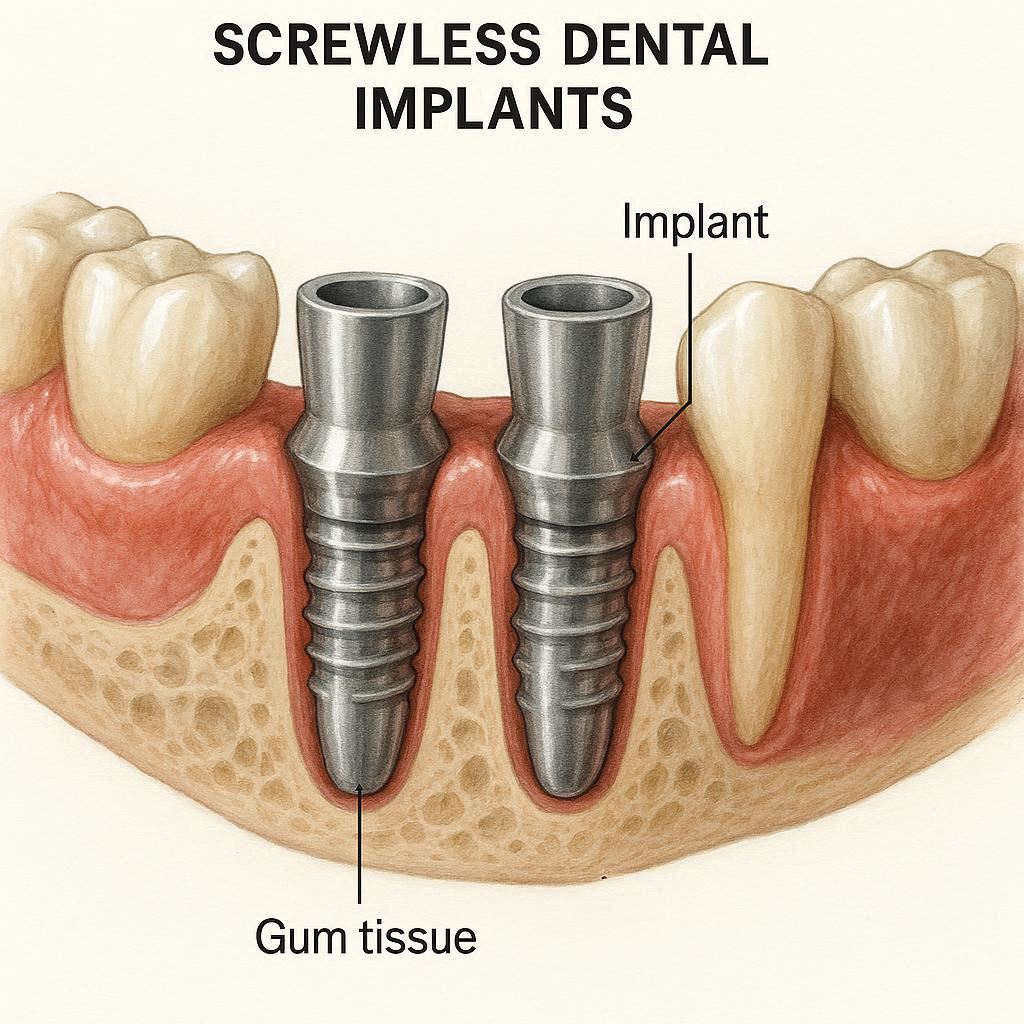
Screwless dental implants are not entirely screw-free in the bone. The part that goes into your jawbone still has a screw-like shape. What makes them “screwless” is the connection between the implant body and the visible crown (the false tooth). Instead of using a small screw to attach the crown to the implant, these systems use a different mechanism. They might use a ball-and-socket connection, a magnetic system, a sliding taper, or a cement-free friction fit.
In other words, the “screwless” part refers to the abutment-crown connection. This is the part you see when you smile.
Many people find this idea appealing. No tiny screws to loosen. No visible metal. No small parts to swallow if something goes wrong. But are screwless implants right for everyone? Let us explore that question in detail.
A Quick Look at Traditional Implants First
To understand screwless implants, it helps to know how traditional ones work.
A regular dental implant has three parts:
- The implant body – a screw placed into the jawbone.
- The abutment – a connector piece that attaches to the implant body.
- The crown – the artificial tooth that you see.
In a traditional system, the abutment is screwed into the implant body. Then, the crown is either cemented onto the abutment or screwed into it. That means there is a small screw holding the crown in place.
This design works very well. Millions of people have successful traditional implants. However, the small screw can sometimes loosen over time. Chewing forces, grinding teeth, or normal wear can cause it to back out. If that happens, the crown feels loose, and a dentist needs to tighten it.
Screwless designs aim to remove that small screw entirely. Instead, they use other engineering solutions to keep the crown secure.
How Screwless Dental Implants Actually Work
Let us walk through the mechanism step by step.
The implant body itself still looks like a screw. It is surgically placed into your jawbone. Over several months, the bone grows around it. This process is called osseointegration, and it happens with both traditional and screwless systems.
Once healing is complete, the dentist attaches the abutment and crown. But here is where the difference appears.
Instead of a screw, screwless implants use one of these five systems:
1. Ball Attachment (Stud Attachment)
The implant has a small ball-shaped top. The crown has a matching socket with an internal rubber or plastic ring. When you press the crown onto the ball, it snaps into place. Friction and the rubber ring hold it firmly.
Think of it like a button on clothing. It stays put until you pull it off with some force.
2. Magnet Retention
A small magnet is placed inside the implant or abutment. The crown contains a magnetic keeper. The magnetic force holds the crown in place. This system works well for people with reduced hand strength, such as older adults with dentures supported by implants.
3. Locator Attachment
This is a common system for overdentures (removable dentures supported by implants). A metal female part sits inside the denture, and a male part stays on the implant. They click together without a screw.
4. Tapered Friction Fit (Cold Welding)
This is an advanced method. The abutment and the implant have matching tapered cones. When the dentist pushes them together with force, they lock through friction. No screw, no cement. This creates an incredibly tight seal. Some brands call this “cold welding” because the surfaces bond at a molecular level.
5. Cemented Crown Without Abutment Screw
This is simpler. The crown is cemented directly onto the implant body. There is no separate abutment screw. This is less common today because cement can be hard to remove completely, but some systems still use it.
Why Choose Screwless Dental Implants? Benefits Explained
People choose screwless implants for several practical reasons. Let us look at the most important ones.
No Loose Screws
This is the number one benefit. Traditional implant crowns have a tiny screw that can loosen over time. It is not a disaster when that happens. Your dentist simply retightens it. But it can be annoying, especially if it happens often. Screwless designs remove that risk.
No Visible Metal
Traditional screw-retained crowns have a small hole on the chewing surface. That hole is filled with a material that matches your tooth, but it can become visible over time as the filling wears down or stains. Screwless crowns have no screw hole. They look more natural.
Easier to Clean
Some screwless designs allow the patient to remove the crown at home. This is especially true for ball or locator attachments. You can take the crown off, clean underneath it, and put it back. This is excellent for hygiene. Traditional screw-retained crowns usually require a dentist to remove them.
Gentler on Opposite Teeth
Because screwless implants can have a small amount of give (especially ball attachments), they may put less stress on the teeth you bite against. This can be helpful if you have natural teeth on the other jaw.
Lower Risk of Screw Fracture
Screws are small. They can break. It is rare, but it happens. If a screw breaks inside the implant, retrieving it is difficult and sometimes impossible. That could mean losing the entire implant. Screwless designs avoid this risk entirely.
Quieter in the Mouth
Metal screws can sometimes create a very faint clicking sound when they settle. Some patients notice this. Screwless connections, especially friction-fit ones, are completely silent.
Are There Any Downsides? Honest Reality Check
Yes. No dental solution is perfect for everyone. Screwless implants have some limitations you should know about.
Not All Dentists Offer Them
Screwless systems require special training and specific implant brands. Many general dentists only work with traditional screw-retained systems. You may need to find a prosthodontist or an implant specialist who uses screwless technology.
Can Cost More
The components for screwless implants — magnets, locators, special abutments — are often more expensive than standard screws. Your overall treatment cost might be 10% to 20% higher compared to traditional implants.
May Wear Out Over Time
Ball attachments have a rubber or plastic ring inside the crown. That ring wears down with use. After five to seven years, you may need a new ring or a new crown insert. Magnets can also lose their strength over many years. In contrast, a screwed connection has no wearing parts.
Not Ideal for Single Molars
For a single molar in the back of your mouth, where chewing forces are extremely high, a screw-retained crown is often more stable. Some screwless designs can handle molars, but your dentist will need to assess your bite carefully.
Requires Precision Fit
Screwless connections rely on very tight tolerances. If the crown does not fit perfectly, it will feel loose or rock slightly. Traditional screws can compensate for minor misfits by tightening down. Screwless systems cannot.
Replacement Parts Might Be Hard to Find
If the company that made your screwless implant stops producing its components, finding a replacement crown or ring could be difficult. This is less of a risk with major brands but a real concern with smaller manufacturers.
Who Is a Good Candidate for Screwless Implants?
Not everyone needs or wants screwless implants. The best candidates usually share these characteristics.
You Have Multiple Missing Teeth
Screwless attachments shine when supporting a bridge or a denture. For example, if you are missing all your lower teeth, two to four screwless implants can hold a denture very securely. You can snap the denture in and out for cleaning.
You Want Removable Teeth
Some people like the idea of removing their own implant-supported teeth at night. It feels familiar if you have worn traditional dentures before. Screwless systems make this easy.
You Have Good Bone Density
While screwless implants work in most bone types, they do best in good-quality bone. Very soft bone might not hold the implant body as securely, which can affect how well the screwless connection performs.
You Do Not Clench or Grind Your Teeth
Bruxism (teeth grinding) puts extreme sideways forces on implants. Those forces can unlock some screwless attachments over time. If you grind your teeth and cannot wear a nightguard, a traditional screwed crown may be safer.
You Prefer Easy Hygiene
If you have had trouble keeping traditional crowns clean in the past, a removable screwless crown might be a game-changer. You can take it out, brush it like a natural tooth, and clean the implant underneath.
Comparing Screwless vs. Traditional Screw-Retained Implants
Let us put the differences side by side. This table will help you see the trade-offs clearly.
| Feature | Screwless Implant | Traditional Screw-Retained Implant |
|---|---|---|
| Crown attachment | Ball, magnet, locator, or friction fit | Small metal screw |
| Loose screw risk | None | Low but possible |
| Visible metal | No screw hole visible | Small filling over screw hole may show |
| Crown removal | Often patient-removable | Dentist only |
| Hygiene access | Excellent (can remove crown) | Good, but crown stays on |
| Parts that wear | Rubber rings or magnets may wear | None |
| Repair cost | Moderate (new ring or magnet) | Low (tighten existing screw) |
| Best for | Multiple teeth, overdentures | Single teeth, bridges |
| Availability | Limited to certain specialists | Widely available |
| Long-term data | 15–20 years for some systems | 40+ years |
Note: The table above reflects general patterns. Some screwless systems can handle single teeth, and some traditional systems allow patient removal. Always ask your dentist about the specific system they recommend.
The Step-by-Step Procedure for Screwless Implants
If you decide to pursue screwless implants, what can you expect? Let me walk you through the timeline.
Initial Consultation (1 visit)
Your dentist examines your mouth, takes X-rays or a CT scan, and reviews your medical history. They check your bone density and gum health. If you are a candidate, they explain which screwless system they recommend and why.
Treatment Planning (1–2 weeks)
The dentist creates a surgical guide. This is a 3D-printed device that shows exactly where to place each implant. Precision is even more important with screwless systems because the fit must be perfect.
Implant Placement Surgery (1 visit)
The dentist numbs your mouth. They make small incisions in your gum and place the implant bodies into your jawbone. You will feel pressure but no pain. The surgery usually takes 1–2 hours, depending on how many implants you get.
Healing Period (3–6 months)
Your bone grows around the implants. This is the osseointegration phase. You may wear a temporary denture or partial during this time. Avoid chewing on the healing implants.
Uncovering the Implants (1 short visit)
If your implants were buried under gum tissue, the dentist makes a small opening to expose the top of each implant. Then they attach a healing cap. This shapes the gum tissue properly.
Abutment and Crown Placement (1–2 visits)
Once the gums heal, the dentist places the screwless abutment onto the implant body. Then they attach the crown. For ball or locator attachments, they will show you how to snap the crown on and off. For friction-fit systems, they will use a special instrument to press the crown into place with force. You will hear a click or feel a firm seat.
Follow-Up (1 week later)
You return for a check. The dentist tests the crown to make sure it has not loosened. They also check your bite and gum health.
Annual Checkups (Once per year)
At each cleaning appointment, your dentist will inspect the screwless connection. If you have removable crowns, they may ask you to bring them in so they can check the internal rings or magnets.
Types of Screwless Implants: Popular Brands and Systems
Several well-known companies manufacture screwless or screw-retained alternative systems. Here are the ones you are most likely to encounter.
Locator by Zest Dental Solutions
This is the most popular screwless system for overdentures. It uses a nylon female insert inside the denture that snaps onto a metal male abutment on the implant. The nylon insert comes in different retention strengths (light, medium, heavy). Patients can replace the nylon insert themselves if their dentist shows them how.
Best for: Full lower dentures, partial dentures.
Equator by Rhein83
Similar to Locator but with a lower profile (shorter height). This is useful when there is limited vertical space between the gum and the opposite teeth. It also uses replaceable nylon rings.
Best for: Cases with limited mouth opening or short teeth.
Ankylos by Dentsply Sirona
This is a friction-fit system. The abutment has a tapered cone that locks into a matching cone inside the implant. No screw, no cement. The company calls it “taper seal” technology. It is a true screwless implant in the sense that even the abutment is not screwed. The crown is cemented onto the abutment.
Best for: Single teeth and bridges where a permanent, non-removable solution is desired.
Bicon Dental Implants
Bicon uses a locking taper connection. The implant body is short and wide, not shaped like a traditional screw. The abutment slides into the implant and locks with friction. No screw anywhere in the system. This is one of the few implants that is truly screwless from top to bottom.
Best for: Cases with limited bone height (sinus area, lower jaw near the nerve).
Magnets (Various Brands)
Magnet-retained systems are less common today but still used for elderly patients or those with arthritis. The magnet is housed inside the denture. The implant has a magnetic keeper. The denture simply snaps onto the implants.
Best for: Older adults who struggle with small clips or buttons.
Cost Breakdown: What Should You Expect to Pay?
Pricing varies widely depending on where you live, the dentist’s experience, and the brand used. However, here is a realistic range for the United States (private pay, no insurance).
| Procedure | Traditional Implant (per tooth) | Screwless Implant (per tooth or attachment) |
|---|---|---|
| Implant placement surgery | $1,500 – $3,000 | $1,600 – $3,200 |
| Abutment (connector) | $300 – $600 | $400 – $900 |
| Crown | $1,000 – $2,000 | $1,200 – $2,500 |
| Total per single tooth | $2,800 – $5,600 | $3,200 – $6,600 |
For an implant-supported denture (lower jaw with 2–4 implants):
| Treatment | Traditional (screw-retained bar) | Screwless (Locator or ball) |
|---|---|---|
| 2 implants + denture | $6,000 – $10,000 | $7,000 – $11,000 |
| 4 implants + denture | $10,000 – $15,000 | $11,000 – $16,000 |
Insurance coverage: Most dental insurance plans do not cover implants well. They may cover $1,000–$1,500 per year, which is a small fraction of the total. Medical insurance sometimes covers implants if tooth loss resulted from an accident or medical condition (like cancer surgery). Check with your provider.
Financing options: Many implant dentists offer payment plans through third-party companies like CareCredit, LendingClub, or Alphaeon. Some also offer in-house membership plans.
Important note: Prices have risen due to inflation and supply chain costs. Always get a written treatment plan with a total price before starting. Ask what is included (surgery, components, crown, follow-ups, any replacements within the first year).
Care and Maintenance of Screwless Implants
Keeping your screwless implants healthy is straightforward, but it is not identical to caring for natural teeth or traditional implants.
Daily Cleaning (Removable Crowns)
If your crowns snap on and off:
- Remove them once a day.
- Brush the crown with a soft toothbrush and mild soap or non-abrasive toothpaste.
- Brush the implant abutment (the part in your mouth) gently.
- Rinse both with water.
- Snap the crown back on.
Daily Cleaning (Non-Removable Friction-Fit Crowns)
If your crowns are fixed in place:
- Brush them exactly like natural teeth.
- Floss around the implant. Use superfloss or implant-specific floss with a stiff end to thread under the crown.
- Consider a water flosser on a low setting to flush out food particles.
Replacing Worn Parts
- Rubber rings (Locator/Ball): Replace every 6–12 months for heavy users, or every 2–3 years for light users. Rings cost $5–$15 each. Some dentists stock them; others will order them for you.
- Nylon inserts: Replace when the crown feels loose or spins easily. Nylon inserts often last 1–3 years.
- Magnets: Magnets lose about 1% of their strength per year. After 10–15 years, you may notice the denture holding less firmly. The dentist can replace the magnet in the denture.
Professional Maintenance
At your annual checkup, the dentist will:
- Check the stability of each crown.
- Inspect o-rings or nylon inserts for wear.
- Clean the abutments with special plastic scalers (metal scalers can scratch the surface).
- Take an X-ray to check bone levels around the implants.
Signs of Trouble
Contact your dentist if you notice:
- The crown rocks or spins when you bite.
- Food gets stuck under the crown constantly.
- Bleeding or redness around the implant.
- The implant feels painful when you tap it.
- A bad taste coming from the implant area.
Longevity: How Long Do Screwless Implants Last?
Let us separate the implant body from the replaceable parts.
The implant body itself (the part in the bone) lasts just as long as a traditional implant — usually 20+ years, often a lifetime, if you maintain good oral hygiene and bone health.
The crown (the visible tooth) lasts 10–15 years on average, then may need replacement due to wear, staining, or chipping. This is the same for traditional and screwless implants.
The screwless attachment components (rubber rings, nylon inserts, magnets) have a shorter lifespan. Plan to replace them every 1 to 7 years, depending on the system and how much you use it.
Here is a realistic timeline:
| Component | Expected Lifespan |
|---|---|
| Implant body | 20+ years (often lifetime) |
| Crown (porcelain) | 10–15 years |
| Crown (zirconia) | 15–20 years |
| Rubber O-rings | 6 months – 2 years |
| Nylon inserts (Locator) | 1–3 years |
| Magnets | 10–15 years |
| Friction-fit taper (Ankylos/Bicon) | No wearing parts, lifetime |
Note: The friction-fit taper connection (cold weld) is the only screwless system with no consumable parts. If you never want to replace rings or magnets, this may be your best choice.
Common Myths About Screwless Dental Implants
Let me clear up a few misunderstandings.
Myth 1: “Screwless implants are completely screw-free”
Not exactly. Most screwless implants still have a screw-like body that goes into the bone. Only a few brands (like Bicon) use a non-screw shape. The “screwless” name refers to the crown attachment, not the whole implant.
Myth 2: “They are weaker than traditional implants”
False. The bone-to-implant connection is identical. The difference is above the gum. A friction-fit screwless connection can be even stronger than a tiny screw because there is no small part to break.
Myth 3: “You can never remove them”
Some screwless implants are designed to be removable by the patient. Others are permanent. Your dentist will tell you which type you are getting. Do not assume either way.
Myth 4: “They are new and unproven”
Locator attachments have been used since the 1990s. Ankylos taper seal implants have over 25 years of published research. Bicon has been around since 1985. These are not experimental technologies.
Myth 5: “Any dentist can place them”
This is false. Because screwless systems require precise fit and specific handling instruments, not every general dentist offers them. You may need to see a prosthodontist or an implant surgeon. Always ask about the dentist’s training and experience with your chosen system.
Questions to Ask Your Dentist Before Choosing Screwless Implants
Before you commit to treatment, ask these questions. Write down the answers.
- Which screwless system do you recommend, and why? (Look for brand names like Locator, Ankylos, Bicon, or Equator.)
- How many of these systems have you placed in the last year? (Experience matters. Look for at least 20–30 cases.)
- Will my crowns be patient-removable or fixed? (Know what to expect.)
- What happens if the crown loosens? (Can I fix it at home, or do I need to come in?)
- Where do I buy replacement O-rings or nylon inserts? (Some dentists sell them directly; others require an office visit.)
- What is the warranty on the implant and the crown? (Many brands offer a lifetime warranty on the implant body but not on the crown or attachments.)
- If the implant fails, do you offer a free replacement? (Ethical dentists often replace a failed implant at no charge for the implant body itself.)
- Can you show me before-and-after photos of your screwless cases? (Visual proof is valuable.)
- What is the total cost including all future replacement parts for five years? (Get a complete picture, not just the upfront price.)
- Do you have a backup plan if the screwless connection fails? (Can they convert it to a screw-retained crown later?)
Realistic Scenarios: When Screwless Implants Shine
Let me paint three pictures. See if any match your situation.
Scenario A: The Lower Denture Wearer
Maria is 62 years old. She has worn a lower denture for 10 years. It floats and clicks when she talks. She cannot chew apples or nuts. She wants stability but also wants to remove her teeth at night because she is used to that routine.
Solution: Two screwless Locator implants in the front of her lower jaw. Her denture is modified to snap onto them. She can still remove it at night, but during the day it feels solid. She pays $7,500 total. Every 18 months, she replaces two nylon inserts for $20. She is thrilled.
Scenario B: The Single Missing Molar
James is 35 years old. He lost his lower left first molar. He wants a permanent replacement. He does not want to think about it. He grinds his teeth at night but wears a nightguard.
Solution: A traditional screw-retained implant would work well, but James asks about screwless. His dentist recommends an Ankylos friction-fit implant. The crown is cemented permanently. No screws. No removable parts. James pays $5,200. Ten years later, the crown is still solid.
Scenario C: The Upper Partial Denture
Linda is 55 years old. She is missing three upper teeth on the right side. She hates her removable partial denture because food gets underneath it. She wants fixed teeth but is worried about cleaning around screws.
Solution: Two Bicon short implants placed in the back. They support a three-unit bridge. The connection is a locking taper (no screws, no cement). Linda flosses under the bridge daily. She pays $12,000. She says it was worth every dollar.
What the Research Says (In Plain English)
You do not need to read scientific journals. Let me summarize what studies have found about screwless implants.
- Survival rates: For single crowns, screwless implants have 95–98% survival after 10 years. This is essentially identical to traditional implants (96–98%). No meaningful difference.
- Crown loosening: Traditional screw-retained crowns have a 5–15% chance of screw loosening over 5 years. Screwless designs (except friction-fit) have a similar rate of component wear, but patients can often replace the worn part themselves.
- Patient satisfaction: Studies show that patients with removable screwless overdentures report higher satisfaction than those with traditional dentures. The convenience of home removal is a major factor.
- Bone loss: No difference between screwless and traditional implants. Both preserve bone equally well when properly maintained.
The bottom line from research: Screwless implants are not better or worse overall. They are simply different. The right choice depends on your preferences, budget, and clinical situation.
Potential Complications and How to Avoid Them
No surgery is risk-free. Let me be honest about what can go wrong and how to prevent it.
Complication 1: Crown Pops Off Too Easily
Cause: Worn O-ring or nylon insert, or the crown was not manufactured to the correct tolerance.
Prevention: Replace O-rings annually. Use only high-quality components from the original manufacturer. Avoid generic knock-offs.
Fix: Replace the insert. This costs $10–$30 and takes five minutes.
Complication 2: Crown Will Not Come Off (Removable Type)
Cause: Debris or hardened food stuck around the attachment.
Prevention: Remove and clean the crown daily.
Fix: Your dentist can use a special removal tool to pop it off. Do not force it yourself with pliers.
Complication 3: Peri-Implantitis (Gum Infection Around Implant)
Cause: Poor oral hygiene, smoking, or untreated gum disease.
Prevention: Brush twice daily, floss, and see your dentist every 6–12 months. Do not smoke.
Fix: Early stages can be treated with deep cleaning. Late stages may require surgery or implant removal. This is serious.
Complication 4: Fractured Crown
Cause: Biting ice, hard candy, or using teeth as tools.
Prevention: Do not chew non-food items. Wear a nightguard if you grind.
Fix: The dentist makes a new crown. This is rarely covered by warranty.
Complication 5: Magnet Falls Out of Denture
Cause: The adhesive holding the magnet fails over time.
Prevention: None, really. It happens with age.
Fix: Your dentist re-glues the magnet with dental cement. Simple repair.
Screwless Implants vs. Other Tooth Replacement Options
Sometimes, implants are not the only answer. Let us see how screwless implants compare to alternatives.
| Option | Pros | Cons | Best For |
|---|---|---|---|
| Screwless implant | No loose screws, natural look, removable option | Higher cost, limited availability | People who want easy hygiene or removable teeth |
| Traditional implant | Proven, widely available, strong | Tiny screw can loosen | Most people, especially single teeth |
| Fixed bridge | No surgery, faster | Shaves down healthy teeth, harder to clean | People who cannot have surgery |
| Removable partial denture | Cheapest, no surgery | Uncomfortable, affects taste, accelerates bone loss | Temporary or low-budget cases |
| Do nothing | Free | Bone loss, shifting teeth, difficulty chewing | Not recommended |
Frequently Asked Questions (FAQ)
1. Are screwless dental implants painful to place?
No more than traditional implants. The surgery is done with local anesthesia. You feel pressure but not sharp pain. Most people describe post-surgery discomfort as mild to moderate, similar to a tooth extraction.
2. Can I eat normally with screwless implants?
Yes, after healing is complete (3–6 months). For removable screwless crowns, avoid very sticky foods like caramel or taffy, which can pull the crown off. For fixed screwless crowns, eat normally.
3. How do I know if my screwless crown is loose?
You will feel it rocking or spinning when you bite down. You might also hear a clicking sound. If this happens, remove the crown (if removable) and inspect the O-ring or insert.
4. Can I sleep with removable screwless implants in place?
You can, but most dentists recommend removing them at night. This gives your gums a rest and allows saliva to clean the abutments naturally. It also prevents accidental swallowing if the crown loosens while you sleep.
5. Do screwless implants look fake?
Not if they are made well. A good dental lab can match the color, shape, and translucency of your natural teeth. The lack of a screw hole on the chewing surface actually helps them look more natural than some screw-retained crowns.
6. What happens if I swallow a removable crown?
Stay calm. Most crowns are too large to block your airway. They typically pass through your digestive system in 24–48 hours. However, see a doctor if you have chest pain, trouble breathing, or severe abdominal pain. Call your dentist to order a replacement crown.
7. Can I get screwless implants if I have gum disease?
Not until the gum disease is treated. Active gum disease increases the risk of implant failure. Your dentist will treat the gum disease first, then re-evaluate you for implants.
8. Are screwless implants covered by insurance?
Typically, dental insurance covers the same percentage for screwless implants as for traditional ones (often 0–50%). The crown and surgery are coded the same way. The difference is in the abutment code, which may have slightly higher patient responsibility.
9. How long does the screwless connection last without replacing parts?
For friction-fit systems (Ankylos, Bicon): The connection lasts indefinitely. For systems with O-rings or nylon inserts: Expect 1–3 years before needing replacement. For magnets: 10–15 years.
10. Can a screwless implant be converted to a screw-retained one later?
Sometimes, yes. If you start with a screwless system and later decide you want a permanent screw-retained crown, the dentist may be able to replace the abutment and crown. However, the implant body itself stays the same. This is a question for your specific implant brand.
Additional Resources
For more reliable, patient-friendly information about dental implants, including screwless options, visit the American Academy of Implant Dentistry (AAID) patient education page:
👉 https://www.aaid.com/patients/index.html
This resource includes:
- A “Find an Implant Dentist” search tool.
- Videos explaining implant surgery in simple terms.
- FAQs about costs, risks, and recovery.
- Patient testimonials.
Important Note for Readers
Disclaimer: This article is for informational purposes only. It does not constitute medical or dental advice. Every person’s mouth is unique. The information here does not replace a face-to-face consultation with a licensed dentist or implant specialist. Do not make treatment decisions based solely on online reading. Always seek professional advice for your specific health situation.
Conclusion
Screwless dental implants are a real, proven alternative to traditional screw-retained implants. They eliminate the small screw that can loosen over time. They offer removable options for easier cleaning. They can look more natural because there is no screw hole in the crown. However, they cost slightly more, are less widely available, and have replaceable parts (like rubber rings) that wear out. The implant body itself lasts decades. Choose screwless if you value easy hygiene, removable teeth, or avoiding tiny screws. Choose traditional if you want the most widely available, time-tested option. Both work well. The best choice depends on your mouth, your budget, and your personal preferences.