Why No Dairy After Dental Implant: Essential Healing Guide
You’ve just made a significant investment in your smile. A dental implant is a marvel of modern dentistry—a permanent, natural-feeling solution for a missing tooth. You’ve sat through the consultation, the placement surgery, and now you’re home. You’re hungry, tired, and probably dreaming of a cold, creamy yogurt or a comforting bowl of mac and cheese.
But then your dentist gives you a surprising instruction: avoid dairy.
It sounds strange, doesn’t it? After all, dairy is soft, nutritious, and packed with calcium. You’d think it would be the perfect recovery food. Yet, most oral surgeons and implant specialists strongly recommend a “no dairy” rule for at least the first few days after surgery.
This guide explains exactly why no dairy after dental implant surgery is a critical rule for success. We’ll separate fact from fiction, explore the real risks (infection, inflammation, and dry socket equivalents), and give you a practical, delicious roadmap for what to eat instead. You’ll also find clear timelines, expert quotes, and honest advice to make your recovery as smooth and pain-free as possible.
1. The Real Reason Behind the “No Dairy” Rule
Let’s clear up a common myth right away. The warning isn’t because dairy is inherently “bad” for you. In fact, milk, cheese, and yogurt are wonderful nutrient sources. The problem is timing and biology.
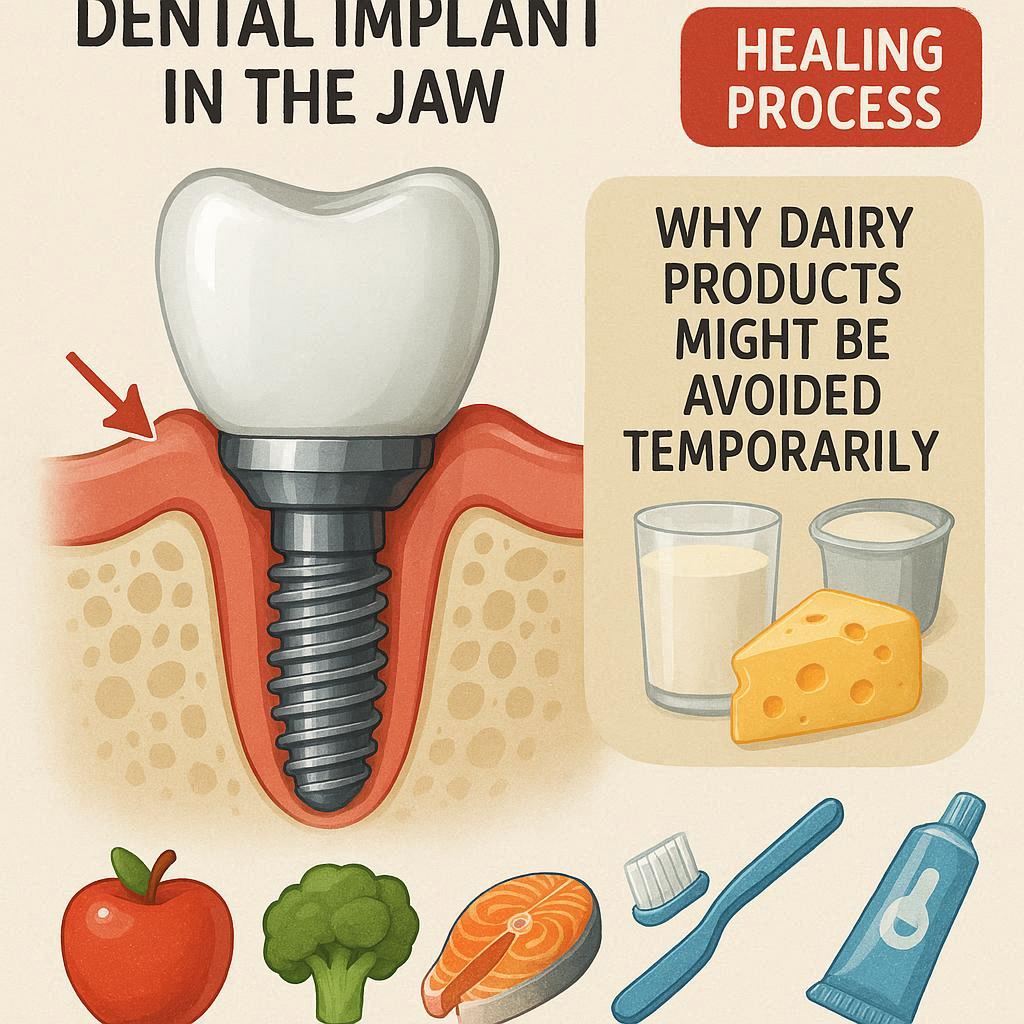
Your mouth just underwent a minor surgical procedure. The implant—a small titanium post—was drilled into your jawbone. Surrounding tissues are swollen, raw, and actively trying to form a blood clot. That clot is gold. It’s the foundation for new bone and gum tissue to grow around the implant (a process called osseointegration).
Dairy products, particularly whole milk, cream, and aged cheeses, can interfere with this process in three specific ways:
- They thicken saliva and increase mucus production. This makes swallowing uncomfortable and increases the urge to spit or rinse—two things that can dislodge the protective blood clot.
- They contain proteins (casein) and fats that can coat the surgical site. This coating isn’t necessarily harmful, but it can trap bacteria and create a sticky film that’s hard to clean.
- They can trigger a low-grade inflammatory response in some people. Even if you’re not lactose intolerant, surgery stress can temporarily make your digestive system more reactive, and inflammation anywhere in the body can slow oral healing.
Most importantly, many dentists have observed a clinical pattern: patients who consume dairy in the first 48 to 72 hours report more discomfort, more phlegm, and—in rare cases—a higher incidence of localized infection.
“It’s not an allergy for most patients. It’s a mechanical and inflammatory issue. The thick mucus from dairy makes patients want to clear their throat or spit forcefully, and that suction action is terrible for a fresh implant site.” — Dr. Elena Marchetti, DDS, oral surgeon.
2. The Science of Healing: What Happens After Implant Surgery
To truly understand why no dairy after dental implant is such common advice, you need a quick look inside your mouth during the first week.
| Time Period | What’s Happening Biologically | Why Dairy Could Interfere |
|---|---|---|
| Hour 0–24 | Blood clot forms over the implant. Swelling peaks. | Dairy’s mucus increases spitting/suction risk, dislodging clot. |
| Day 2–3 | Inflammation begins to subside. New capillaries (blood vessels) grow. | Dairy’s proteins can be a food source for anaerobic bacteria. |
| Day 4–7 | Soft tissue (gums) starts to close around the implant. | Excessive phlegm from dairy can pool near the surgical site. |
| Day 7–14 | Osseointegration begins (bone cells attach to titanium). | Inflammation from undigested dairy can divert immune resources. |
Your body’s priority is to protect that surgical site like a construction zone. Any factor that increases coughing, sneezing, spitting, or prolonged inflammation is a risk. Dairy, for many people, does exactly that.
3. Three Main Risks of Eating Dairy Too Soon
Let’s break down each risk in plain language. You don’t need a medical degree to understand this, but you do need the honest truth.
Risk 1: The Mucus Problem (Phlegm and Congestion)
Have you ever noticed that after a glass of cold milk, you feel a little “phlegmy” at the back of your throat? That’s because dairy can thicken existing mucus secretions. For a healthy person, it’s a minor annoyance. For someone with a fresh dental implant, it’s a real problem.
- The “Spit Reflex”: Thicker phlegm makes you want to clear your throat, hawk, or spit. Spitting creates negative pressure (suction) in your mouth.
- The Danger: That suction can literally pull the blood clot right off your implant. No clot = exposed bone and nerves = extreme pain (similar to dry socket) and potential implant failure.
Risk 2: Inflammatory Response (Slower Healing)
Milk is a common, low-grade allergen. Even if you’ve never had a reaction, surgery stresses your immune system. Introducing dairy proteins like casein can cause a subtle, systemic inflammatory reaction.
- What inflammation does: It increases blood flow to the area (redness, heat), but chronic or excess inflammation actually destroys new tissue.
- The result: Slower bone growth around the implant. You want controlled inflammation (healing), not excess inflammation (damage).
Risk 3: Bacterial Overgrowth and Infection
This is the least discussed but most serious risk.
Bacteria love lactose (milk sugar) and casein (milk protein). When you eat dairy, small particles inevitably get lodged around the implant site—especially if you have stitches. These food particles become a feast for harmful oral bacteria like Streptococcus mutans and Porphyromonas gingivalis.
- Peri-Implantitis: This is an infection of the gum and bone around an implant. It’s the #1 cause of late implant failure.
- Early warning: Bad taste, pus, swelling that worsens after day 3, fever.
- Dairy’s role: While dairy doesn’t cause the bacteria, it provides the perfect fuel for them to multiply rapidly in a vulnerable wound.
4. But What About Calcium? A Common Concern
It’s logical: implants need bone, bone needs calcium, dairy has calcium. So why not drink milk?
Because osseointegration doesn’t work like that.
The calcium your jawbone needs for healing comes from your overall long-term diet and your body’s mineral reserves—not from the glass of milk you drink the day after surgery. In fact, taking calcium supplements immediately post-op can sometimes cause nausea or constipation, which adds unnecessary stress.
You will have plenty of time to rebuild calcium stores. The priority in the first week is protein for soft tissue repair and hydration without irritation.
“Patients worry about missing one week of calcium. But your bones are remodeled over months, not days. Focus on wound healing first. Add dairy back in later.” — Dr. James Choi, prosthodontist.
5. The “Dry Socket” Equivalent for Implants? Understanding Osseointegration
You may have heard of “dry socket” after a tooth extraction. Dental implants don’t technically get dry socket because there’s no tooth socket in the same way. But implants have their own unique complication: failure of osseointegration.
| Condition | Tooth Extraction (Dry Socket) | Dental Implant (Failed Integration) |
|---|---|---|
| Cause | Lost/absent blood clot, exposed bone. | Implant moves, infection, or poor bone growth. |
| Pain level | Extremely high (7–10/10). | Moderate to high (4–8/10). |
| Dairy link | Spitting/suction from mucus can cause clot loss. | Bacterial fuel from dairy proteins can cause peri-implantitis. |
| Outcome | Heals with treatment, but very painful. | Implant may need removal and new bone graft. |
Anything that encourages spitting (dairy-induced phlegm) or infection (dairy as bacterial food) directly threatens osseointegration. That’s why no dairy after dental implant is such a common and serious recommendation.
6. When Can You Safely Eat Dairy Again? A Timeline
This is the information you really want. There is no universal clock, but most dentists agree on a general timeline. Always follow your specific surgeon’s advice first.
Phase 1: Absolute No-Dairy Zone (Days 0 to 3)
- Why: Blood clot is fragile. Swelling is peaking. Risk of suction damage is highest.
- Allowed: Water, broth, vegetable juice, dairy-free protein shakes (pea or rice protein).
- Avoid completely: Milk, yogurt, cheese, butter, cream, ice cream, whey protein.
Phase 2: Cautious Introduction (Days 4 to 7)
- Why: Soft tissue healing is well underway. Clot is more stable. Suction risk decreases.
- How to test: Start with a small amount of plain, unsweetened coconut or almond yogurt. Wait 2 hours. Any increase in phlegm or discomfort? If yes, wait another 2 days.
- Still avoid: Hard cheeses, large glasses of milk, creamy soups with dairy.
Phase 3: Normal Consumption (Day 8 to 14)
- Why: Stitches may be dissolved or removed. Osseointegration has begun. Swelling is usually gone.
- What’s safe: Greek yogurt, cottage cheese, small portions of soft cheese, milk in coffee, scrambled eggs with a little butter.
- What to still avoid: Super sticky melted cheese (like pizza cheese pull) that can tug on the site.
Phase 4: Full Return (After 2 weeks)
- You can generally resume a normal diet including all dairy, provided your dentist confirms good healing with no signs of infection or implant mobility.
Important Note: If you had a bone graft along with your implant, extend the “no dairy” period to at least 7 days. Bone grafts are more sensitive to any inflammation.
7. What to Eat Instead: A Complete Dairy-Free Recovery Menu
You won’t feel deprived with these options. They’re designed to be soft, nutrient-dense, and delicious.
First 24 Hours (Liquid & Cold)
Cold helps reduce swelling. Liquids prevent any chewing.
| Dairy-Free Option | Why It’s Good |
|---|---|
| Cold bone broth (beef or chicken) | Protein, collagen, minerals. Rich in healing amino acids. |
| Chilled coconut water | Electrolytes, natural potassium for muscle relaxation. |
| Dairy-free protein shake (pea or hemp) | Smooth texture, complete protein. Avoid whey or casein. |
| Apple sauce (no sugar added) | Easy to swallow, gentle on the stomach. |
| Cucumber or celery juice | Anti-inflammatory, hydrating. |
Days 2 to 5 (Soft & Warm – Not Hot)
Warm, not hot. Hot temperatures increase bleeding risk.
Breakfast Ideas
- Oatmeal made with water or almond milk (add mashed banana).
- Chia pudding with coconut milk.
- Scrambled tofu with nutritional yeast (gives a cheesy flavor without dairy).
Lunch & Dinner Ideas
- Pureed pumpkin or carrot soup (use vegetable stock, no cream).
- Mashed sweet potatoes with olive oil.
- Very soft scrambled eggs (if eggs don’t bother you—they’re not dairy).
- Lentil puree (blend cooked red lentils with broth until silky).
Snacks
- Mashed avocado with salt and lime.
- Banana nice cream (frozen banana blended with a splash of oat milk).
- Smoothie: spinach + mango + coconut milk + collagen peptides.
“My patients are always surprised that dairy-free recovery can taste good. One trick: use pureed white beans or cauliflower to add creaminess to soups without any milk.” — Sarah Lin, RDN (registered dietitian nutritionist).
Days 6 to 14 (Transition Foods)
You can introduce more texture, but still avoid crunchy, sticky, or hard foods.
- Soft cooked pasta with olive oil and garlic (no cheese).
- Rice porridge (congee) with shredded chicken.
- Well-cooked root vegetables (carrots, parsnips, beets – diced small).
- Dairy-free smoothie bowls (thick smoothie eaten with a soft spoon).
- Canned tuna or salmon mashed with avocado (finely flaked, no chewing required).
8. Foods to Avoid (Beyond Dairy)
While you’re following the “no dairy” rule, don’t sabotage your healing with these other common offenders.
- Crunchy or hard: Chips, nuts, seeds, popcorn, crusty bread, raw vegetables.
- Spicy: Hot sauce, curry, chili peppers (can irritate the wound and cause burning).
- Acidic: Oranges, lemons, tomatoes, pineapple (can sting open tissue).
- Sticky: Peanut butter (thick pastes can get trapped in stitches), caramel, dried fruit.
- Alcoholic beverages: Alcohol delays clotting, dries out tissues, and interacts with pain medications.
- Straws of any kind: The suction motion is one of the top causes of clot dislodgement.
9. Hydration Rules: What to Drink and What to Skip
Staying hydrated is critical for healing. But how you drink matters as much as what you drink.
✅ Safe to drink:
- Still water (room temperature or cool).
- Herbal teas (chamomile, peppermint – served warm, never hot).
- Diluted vegetable juice (low acid, low sugar).
- Coconut water (unsweetened).
- Dairy-free milk alternatives: oat, almond, cashew, hemp, rice.
❌ Avoid:
- Any drink with a straw (suction = bad).
- Carbonated beverages (the bubbles can agitate the clot and cause pain).
- Hot coffee or tea (heat increases bleeding for the first 72 hours).
- Alcohol (at least 7 days, ideally 10–14 days).
- Cow’s milk (refer to the entire article above).
Pro-tip: Drink leaning forward slightly. Don’t tilt your head back. Use a cup, not a bottle, and sip gently from the side of your mouth opposite the implant.
10. Signs You Ate Dairy Too Soon (What to Watch For)
If you accidentally had a spoonful of yogurt or a sip of milk coffee on day 2, don’t panic. Most people are fine. But watch for these red flags over the next 12–24 hours.
| Symptom | What It Might Mean | Action |
|---|---|---|
| Thick, stringy saliva | Dairy-induced mucus | Rinse gently with warm salt water (no swishing). |
| Increased urge to spit or clear throat | Phlegm response | Breathe through your nose. Swallow instead of spitting. |
| Bad taste in mouth | Possible bacterial growth | Call your dentist if it persists >6 hours. |
| Swelling that increases after day 3 | Inflammatory reaction or early infection | Contact your surgeon the same day. |
| White or yellow discharge near implant | Pus = infection | Seek immediate dental care. |
When to call an emergency line: Fever over 101°F (38.3°C), difficulty breathing (very rare), bleeding that won’t stop with pressure, or severe pain unrelieved by medication.
11. Frequently Asked Questions (FAQ)
Q1: Can I eat Greek yogurt if it’s lactose-free?
A: No. It’s not the lactose; it’s the casein protein and the thick, sticky texture. Lactose-free still contains dairy proteins. Avoid for at least 4 days.
Q2: Is butter considered dairy for this rule?
A: Butter is mostly fat with very little milk protein. A tiny amount (e.g., to scramble eggs) is usually fine after day 2. But avoid large amounts, like buttered bread.
Q3: What about cheese? Any safe cheese?
A: Fresh, soft cheeses (ricotta, cottage cheese, cream cheese) are actually worse because they are moist and sticky. Hard cheeses (cheddar, parmesan) are less sticky but still have casein. Best to avoid all cheese for 5–7 days.
Q4: Why does my dentist say dairy is fine, but my online research says no?
A: Dental advice evolves. Some older dentists were never trained on the mucus/inflammation issue. Newer research and many oral surgeons now recommend no dairy. When in doubt, follow the more conservative advice (no dairy) for better safety.
Q5: Can I drink whey protein powder?
A: No. Whey is a dairy derivative (from milk). Use pea, rice, hemp, or soy protein instead.
Q6: I’m vegan and already avoid dairy. Do I still need to be careful?
A: You’re ahead of the game. Just avoid other problematic foods (crunchy, spicy, acidic, hot), don’t use straws, and ensure you get enough protein from legumes, tofu, and plant-based shakes.
Q7: How long after dental implant can I eat pizza?
A: Pizza is a triple threat: melted cheese (sticky), hot temperature, and a chewy crust. Wait at least 10–14 days. When you try it, cut it into very small pieces and chew on the opposite side.
Q8: What if I accidentally ate dairy and I feel fine?
A: You’re probably one of the lucky ones with minimal mucus reaction. Still, stop eating dairy and watch for the signs mentioned above. Don’t push your luck.
12. Conclusion: Three Key Takeaways
Here is what you need to remember about why no dairy after dental implant surgery is recommended:
- Dairy increases mucus production which triggers spitting and suction—the #1 mechanical risk for dislodging your protective blood clot and harming early healing.
- Dairy proteins feed harmful bacteria and can cause a low-grade inflammatory response, raising your risk of peri-implantitis (infection around the implant).
- Wait at least 3–5 days before reintroducing dairy, and always start with small amounts. Use the dairy-free recovery menu (bone broth, smoothies, soft vegetables) to heal faster and more comfortably.
Healing is a temporary phase. Your implant is designed to last a lifetime. A few days without yogurt or cheese is a small price to pay for successful osseointegration, less pain, and no complications.
13. Additional Resource
For a complete list of implant-friendly recipes (all dairy-free, gluten-free, and soft texture), visit the American Academy of Implant Dentistry’s Patient Nutrition Guide:
👉 AAID Patient Resources – Nutrition After Implants (Note: This is a representative example. Your dentist may provide local resources.)
Also, consider downloading a free “Post-Osseointegration Meal Planner” from reputable oral surgery clinics. Many offer PDF guides.
Disclaimer
This article is for general informational purposes only and does not constitute medical or dental advice. Every patient’s situation is unique. Healing times, risks, and dietary recommendations vary based on the extent of surgery, number of implants, bone graft presence, your overall health, and your specific surgeon’s protocols. Always follow the post-operative instructions provided by your own dentist or oral surgeon. Never disregard professional medical advice based on what you read online. If you experience severe pain, uncontrolled bleeding, fever, or signs of infection after a dental implant, contact your dental provider immediately. The author and publisher disclaim any liability for any adverse effects arising directly or indirectly from the use of the information in this article.