
Can Dental Implants Cause Cancer? A Honest, Evidence-Based Guide
When a dentist first suggests a dental implant, most people worry about the procedure itself. Will it hurt? How long will it take? Is it expensive?
But after the initial consultation, a different question often creeps in. A deeper one.
Can dental implants cause cancer?
It is a fair question. You are putting a foreign material—usually titanium—into your jawbone. It will stay there for decades. It only makes sense to ask if that metal could trigger something serious, like oral cancer or tumors in your head and neck.
The short answer is reassuring. Based on the best scientific evidence we have today, dental implants do not cause cancer.
But you did not come here for just a short answer. You want the details. You want the studies. You want to know why some people still worry, and whether those worries have any real foundation.
This guide gives you exactly that. No fluff. No scare tactics. Just honest, clear information to help you make a smart decision for your health.
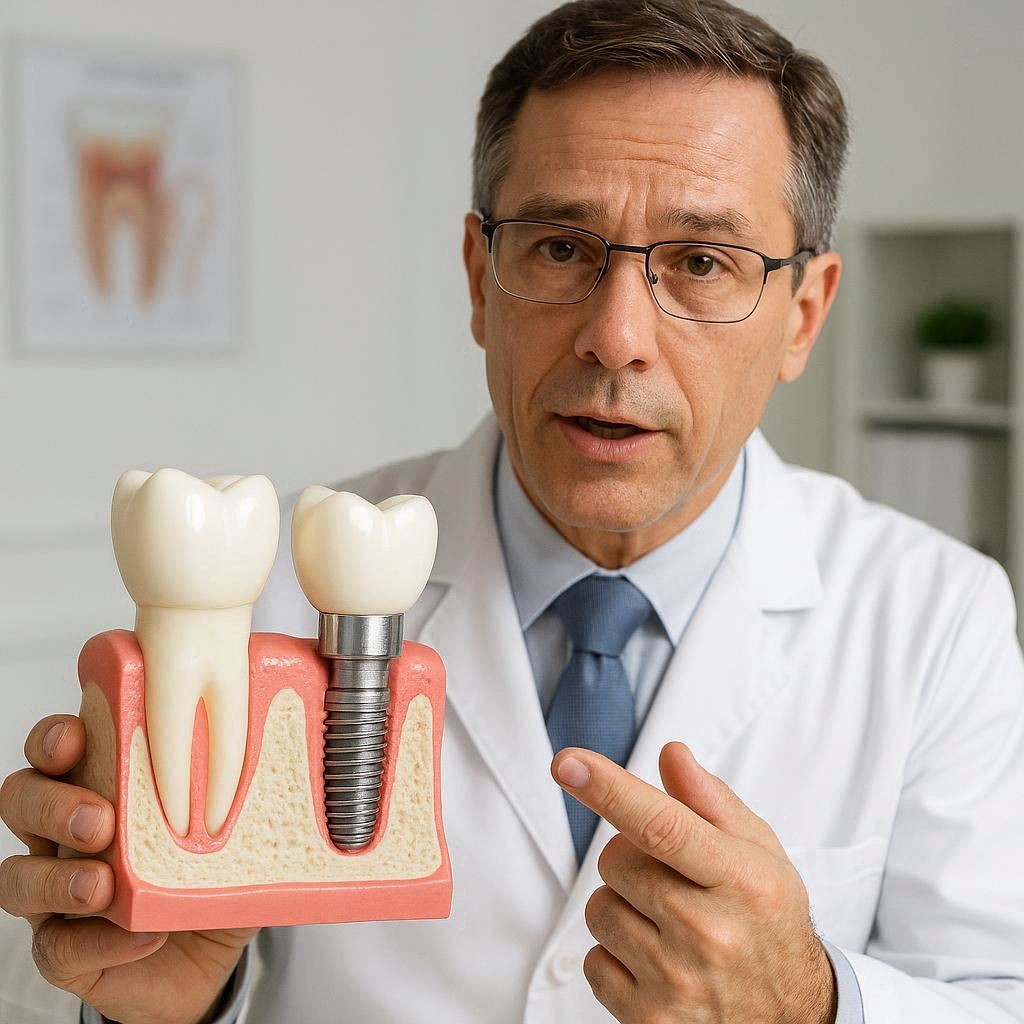
First, What Exactly Is a Dental Implant?
Before we talk about cancer risks, let us quickly cover what a dental implant actually is. This matters because different materials and designs could, in theory, have different safety profiles.
A standard dental implant has three parts:
- The implant post: This is a small screw, usually made of titanium or zirconia. The surgeon places it directly into your jawbone, where it acts like an artificial tooth root.
- The abutment: This connector piece sits on top of the implant post and sticks out just above your gum line.
- The crown: This is the visible part that looks like a natural tooth. Your dentist will attach it to the abutment.
The magic of a dental implant is a process called osseointegration. That is just a fancy word for your jawbone growing tightly around the titanium screw. Over a few months, the bone and metal fuse together. That gives you a rock-solid foundation for chewing and smiling.
Titanium is the gold standard material for most implants. It is biocompatible, which means your body generally accepts it without rejecting it. In recent years, ceramic implants made from zirconia have also become popular, especially for people who prefer metal-free options.
Important note: The cancer conversation usually revolves around titanium implants because they are far more common. However, we will also touch on zirconia implants later in this article.
The Big Question: Can Dental Implants Cause Cancer? – The Short Answer
Let us give you the bottom line right away.
No, there is no reliable scientific evidence showing that dental implants cause cancer in humans.
Major health organizations, dental associations, and research reviews have looked into this question carefully. Again and again, they reach the same conclusion. Dental implants are safe.
However, there is a reason this question keeps coming up. A few small studies on animals, some laboratory experiments, and a handful of individual case reports have raised questions. We will look at those honestly. But the key word here is “questions,” not “proof.”
When you look at the big picture—hundreds of thousands of implants placed each year, millions of people walking around with them for decades—the number of cancer cases linked to implants is effectively zero.
That does not mean we should stop asking questions. Good science always leaves the door open. But it does mean you can move forward with confidence if your dentist recommends an implant.
Why Do People Worry? The Origins of the Concern
Rumors and fears rarely come from nowhere. So where did the idea that dental implants might cause cancer actually start?
Several sources have fueled this concern over the years.
1. Animal Studies from the 1990s
In the 1990s, a few researchers looked at what happened when they put metal implants into rats and hamsters. Some of these studies suggested that certain metals (not necessarily titanium) could cause tumors in the animals.
But there is a critical detail here. Animal studies, especially in rodents, do not always translate to humans. Rats are much smaller. Their tissues react differently. And the doses of metal exposure in those studies were often much higher than what a human would experience from a single dental implant.
Modern researchers generally agree that these old animal studies are not a good reason to fear dental implants in people.
2. Metal Sensitivity and Inflammation
Some people worry that the body might react to titanium particles over time. As an implant ages, microscopic wear and tear can release tiny metal particles into the surrounding tissue. This is called “tribocorrosion.”
In theory, chronic inflammation from any source—including metal particles—could increase cancer risk over many years. We know that long-term inflammation plays a role in some cancers.
But here is what the evidence actually shows. Most people tolerate titanium incredibly well. The amount of metal particles released by a modern, well-placed implant is very small. And the body has natural ways of clearing those particles.
Dozens of studies have looked for a link between titanium implants and cancer in humans. So far, none have found one.
3. Online Forums and Personal Stories
The internet amplifies rare stories. Someone, somewhere, might develop oral cancer a few years after getting an implant. They post about it online. Suddenly, others wonder if the two are connected.
But correlation is not causation. Oral cancer has many known risk factors. Smoking, heavy alcohol use, HPV infection, and poor oral hygiene are the big ones. In most cases where someone with an implant develops cancer, doctors can point to one of those real risk factors instead of the implant.
Personal stories are powerful, but they are not scientific evidence.
4. The “Foreign Body” Theory
For more than a century, scientists have known that putting a foreign object into living tissue can sometimes cause cancer. This is called “foreign body carcinogenesis.” It was first discovered in rodents with smooth plastic implants.
But here is what most people do not know. This effect is extremely rare in humans. And it is almost always seen with large, rough-surfaced implants that cause chronic physical irritation. Think of things like certain metal hip replacements from decades ago.
A small, smooth, biocompatible dental implant is a very different story. It integrates with your bone instead of floating around and rubbing against tissues. That makes foreign body reactions highly unlikely.
What Does the Research Actually Say? A Look at Key Studies
Let us move from theory to data. You want numbers, not just opinions. Here is a summary of the most important research on dental implants and cancer risk.
The Big Observational Studies
Several large studies have tracked thousands of dental implant patients over many years.
- A 2015 Finnish study followed nearly 9,000 people who received dental implants between 1994 and 2010. The researchers compared their cancer rates to the general population. The result? No overall increase in cancer risk among implant patients.
- A 2018 Swedish study used national health registries to look at over 200,000 implant patients. They found no link between dental implants and oral cancer specifically.
- A 2021 systematic review (a study that analyzes all the best available research) concluded that there is no evidence to support a causal relationship between titanium dental implants and cancer.
What About Titanium Particles in the Body?
Some studies have measured titanium levels in people with and without implants. Here is what they found. People with dental implants do have slightly higher titanium levels in their blood and tissues compared to people without implants. That makes sense.
But here is the reassuring part. Those levels are still far below any known toxic threshold. And having titanium present is not the same as titanium causing cancer.
Think of it this way. Many people have aluminum in their bodies from cookware or deodorant. That does not mean aluminum causes cancer in everyone who uses a frying pan.
The Zirconia Alternative
Zirconia implants are newer. There are fewer long-term studies on them. But what we know so far suggests they are also safe. Zirconia is highly biocompatible and does not release metal particles because it is a ceramic.
For people who are anxious about metal, zirconia offers a compelling alternative. However, zirconia implants can be more brittle than titanium, and not every dentist places them.
Types of Cancer: Are Any Specific Cancers Linked to Implants?
When people ask, “Can dental implants cause cancer?” they often have a specific type in mind. Usually, it is oral cancer (including cancers of the mouth, tongue, cheeks, gums, or jaw).
Let us be direct about that.
There is no evidence that dental implants cause oral cancer.
Oral cancer has well-established causes. The biggest risk factors are:
- Tobacco use (smoking, chewing, vaping).
- Heavy alcohol consumption.
- Human papillomavirus (HPV), especially HPV type 16.
- Poor oral hygiene and chronic gum disease.
- A family history of cancer.
If you have a dental implant and later develop oral cancer, your dentist will look for these factors first. They will not assume the implant is to blame.
What about other cancers, like brain cancer, leukemia, or bone cancer? Again, no research supports a link to dental implants.
Potential Risks You Should Know About (They Are Not Cancer)
We want to be honest with you. Dental implants are remarkably safe, but they are not risk-free. However, the real risks have nothing to do with cancer.
Here are the actual complications that can happen with dental implants.
| Complication | How Common? | Is It Serious? |
|---|---|---|
| Infection at the implant site | 5-10% of cases | Usually mild; treatable with antibiotics |
| Implant failure (does not fuse with bone) | 1-5% of cases | Frustrating, but not dangerous |
| Nerve damage (numbness in lip or chin) | Less than 1% | Can be permanent in rare cases |
| Sinus problems (upper jaw implants) | 1-2% of cases | Usually temporary |
| Damage to nearby teeth | Rare | Usually repairable |
| Allergic reaction to titanium | Extremely rare | Requires removal and replacement with zirconia |
None of these are cancer. They are surgical risks, similar to what you would face with any minor bone surgery.
Note for readers: If your dentist has warned you about these risks, they are doing their job. A good dentist will never promise zero complications. But they can tell you honestly that cancer is not a realistic concern.
What If You Already Have a Dental Implant and Are Worried?
Let us say you already have an implant. Maybe you got it years ago. Now you are reading online forums and feeling nervous.
Take a deep breath. Here is what you should do.
Step 1: Do not remove the implant without talking to a dentist.
Removing a healthy, well-integrated implant is surgery. It carries its own risks, including bone loss and damage to nearby teeth. Do not let fear drive you to an unnecessary procedure.
Step 2: Look for real symptoms, not vague fears.
Panic can mimic physical symptoms. Anxiety can cause jaw pain, headaches, and a metallic taste in your mouth that is not really there.
Instead, ask yourself: Do you have any specific signs of oral cancer? These include:
- A sore in your mouth that does not heal after two weeks.
- A lump or thickening in your cheek, gums, or tongue.
- White or red patches inside your mouth.
- Numbness in your mouth or lips.
- Persistent sore throat or feeling that something is caught in your throat.
- Difficulty chewing, swallowing, or moving your tongue.
If you have any of these symptoms, see a dentist or doctor right away. Do not assume it is your implant. But do not ignore it either.
Step 3: Get a second opinion if you are still worried.
Sometimes, you just need to hear the same information from another professional. That is perfectly fine. Find an oral surgeon or a prosthodontist (a dentist who specializes in implants and restorations). Ask them directly: “Based on my specific health history, am I at any increased cancer risk from this implant?”
A good specialist will give you a straight answer.
Debunking Common Myths: A Quick Reference Table
The internet is full of half-truths. Let us clear up the most common myths about dental implants and cancer.
| Myth | Truth |
|---|---|
| “Titanium is a heavy metal, and heavy metals cause cancer.” | Titanium is not classified as a carcinogen by any major health agency. Unlike lead or cadmium, titanium is highly biocompatible. |
| “My friend got cancer a year after her implant. It must be connected.” | Cancer takes years or decades to develop. A one-year gap is almost certainly a coincidence, not a cause. |
| “Dentists hide the cancer risk because they make money from implants.” | This is simply not true. Dental associations publish safety data openly. Implant manufacturers must prove safety to regulators like the FDA. |
| “I read a study that said implants cause tumors in rats.” | That study used metal types or exposure levels that do not match real human dental implants. Rodent studies often do not apply to people. |
| “Zirconia implants are 100% safe, but titanium is dangerous.” | Both materials are very safe. Zirconia has less long-term data because it is newer. Neither causes cancer. |
Who Should Be Extra Cautious? (Honest Advice)
For the vast majority of people, dental implants are a safe and effective choice. However, there are a few groups who should think carefully and talk to their doctor first.
People with a History of Head and Neck Cancer
If you have already been treated for cancer in your mouth, throat, or jaw, the rules change. Radiation therapy to the jawbone can reduce blood flow and healing capacity. That increases the risk of implant failure.
But does it increase the risk of cancer recurrence? Not directly. However, your oncology team should be involved in the decision. They may want to wait a certain number of years after remission before placing an implant.
People with Unexplained Metal Allergies
True titanium allergy is extremely rare. But it exists. Symptoms can include chronic swelling, redness, or itching around the implant site. In very rare cases, some people report systemic symptoms like fatigue or brain fog.
There is no evidence that these allergic reactions cause cancer. But they can make an implant fail. If you know you react to metals like nickel or cobalt, ask for allergy testing before getting a titanium implant. A zirconia implant might be a better fit for you.
People with Compromised Immune Systems
If you are on immunosuppressive drugs after an organ transplant, or if you have a condition like HIV that affects your immune system, you are at higher risk for infections. Infections can lead to inflammation. Chronic inflammation is a cancer risk factor in theory, but again, no direct link has been shown for implants.
Your main concern should be implant failure and infection, not cancer. Work closely with your medical team.
What Does the FDA Say?
The U.S. Food and Drug Administration (FDA) regulates dental implants as medical devices. For an implant to be approved for sale, the manufacturer must provide evidence of safety and effectiveness.
Currently, the FDA classifies dental implants as Class II devices. That means they pose a moderate risk and require special controls to ensure safety. But they are not considered high-risk (Class III) devices like heart valves or brain implants.
Importantly, the FDA has not issued any warnings linking dental implants to cancer. If new evidence ever emerged, the FDA would be required to act. They would issue safety communications, request label changes, or even pull products from the market.
None of that has happened. And it is not likely to happen based on current science.
A Balanced Look at the “Other Side”
We want to be fair. There are a small number of researchers and clinicians who remain cautious about metal implants. They are not conspiracy theorists. They are scientists who believe we should keep studying long-term effects.
Dr. Robert G. Hale, a researcher who has written about metal implants and inflammation, argues that we simply do not have 50-year human studies on dental implants. He says it is possible, though unproven, that very low-level chronic inflammation from metal particles could contribute to disease over a lifetime.
That is a reasonable scientific position. It is not a reason for panic. It is a reason for continued research.
So here is the balanced view:
- Fact: No study has proven a link between dental implants and cancer.
- Fact: Millions of people have had implants for 20+ years with no cancer signal.
- Possibility: Very long-term effects (40-50 years) have not been fully studied.
- Conclusion: The current evidence strongly supports safety. But science is never finished.
How to Choose a Dentist Who Prioritizes Safety
If you decide to move forward with an implant, choosing the right provider reduces your risk of complications (though not cancer, since that is not a real risk).
Look for these qualities:
- Board certification in oral surgery or periodontics. These specialists have the most training.
- Use of FDA-approved implant systems. Reputable brands include Straumann, Nobel Biocare, Zimmer, and Dentsply.
- Pre-surgical imaging. A good surgeon uses 3D CT scans to plan the implant placement. This avoids nerves and sinuses.
- Clear discussion of risks. If a dentist says “no risks,” walk away. Honest professionals name the real risks (infection, failure, nerve injury).
- Follow-up protocol. Who will you see if something goes wrong? How long is the warranty?
Real Questions from Real Patients
We have gathered common questions from patient forums and actual dental consultations. Here are honest answers.
“I have breast implants. Should I worry about dental implants too?”
Breast implants have their own safety profile. Some types of breast implants have been linked to a rare lymphoma called BIA-ALCL. That is specific to textured breast implants.
Dental implants are completely different. Material, location, and surface texture are not comparable. Do not assume a risk with one applies to the other.
“Can I ask my dentist to use zirconia instead of titanium?”
Absolutely. Many dentists now offer zirconia implants. They are metal-free. But be aware that zirconia is more brittle. It can crack under extreme pressure. Titanium has a longer track record of success.
“Should I have my old amalgam fillings removed before getting an implant?”
Amalgam fillings contain mercury. Some people worry about mercury toxicity. But there is no known interaction between amalgam and titanium implants. Removing amalgam fillings can actually release more mercury vapor than leaving them in place. Do not remove them just for an implant.
“What if I feel fine now, but I want to prevent cancer?”
Prevention is smart. But focusing on dental implants is not the highest yield strategy. For oral cancer prevention, these steps matter more:
- Stop smoking or using tobacco.
- Limit alcohol.
- Get the HPV vaccine (if eligible).
- Brush and floss daily.
- See your dentist twice a year for oral cancer screenings.
Do those things, and your oral cancer risk will drop dramatically—regardless of whether you have implants.
Additional Resource
For the most current and reliable information on dental implant safety, visit the American Academy of Implant Dentistry (AAID) :
This professional organization publishes patient-friendly guides, research updates, and a surgeon locator tool. Always cross-reference any online claim with trusted professional sources like this.
Frequently Asked Questions (FAQ)
1. Can dental implants cause cancer in the long term?
No. Long-term studies following patients for 20+ years have found no increased cancer risk.
2. Are titanium dental implants carcinogenic?
Titanium is not classified as a carcinogen by the IARC, NTP, or any major health authority.
3. Should I remove my dental implants to prevent cancer?
No. There is no medical reason to remove healthy implants. Removal surgery carries its own risks.
4. Are zirconia implants safer than titanium?
Both are safe. Zirconia has no metal, but it has less long-term safety data because it is newer.
5. Can dental implants cause lymphoma or leukemia?
There are no studies linking dental implants to blood cancers like lymphoma or leukemia.
6. Could my implant cause mouth sores that turn into cancer?
Mouth sores that do not heal should always be checked. But implants themselves do not cause cancerous sores.
7. Is there any class action lawsuit about dental implants and cancer?
As of this writing, there is no major class action lawsuit linking standard dental implants to cancer. Some lawsuits exist for failed implants, but not for cancer.
8. How often should I get my implants checked?
Twice a year, just like your natural teeth. Your dentist will examine the implant and screen for oral cancer at the same time.
9. Can I get an MRI with dental implants?
Yes. Titanium is non-magnetic. Most implants are MRI-safe. Always tell the MRI technician you have implants.
10. Where can I report a problem with my implant?
In the U.S., you can report to the FDA’s MedWatch program: https://www.fda.gov/medwatch
Conclusion
Let us wrap this up clearly.
First, the best available science says no—dental implants do not cause cancer. Major studies on hundreds of thousands of patients have found no link.
Second, real risks with implants exist, but they are surgical risks like infection or failure, not cancer. A good dentist will manage those risks carefully.
Third, if you already have implants, you do not need to remove them out of fear. Continue regular dental checkups and cancer screenings, and you are doing everything right.
Make your decision based on facts, not fear. Dental implants have restored smiles and chewing function for millions of people. For the vast majority, they are a safe, life-changing option.
Disclaimer: This article is for informational purposes only and does not constitute medical advice. Always consult with a qualified dentist or physician before making any healthcare decisions. Individual cases vary, and only a licensed professional who knows your full medical history can provide personalized recommendations.


