How Do Dental Implants Work
If you are missing one tooth—or several—you have probably already asked yourself this question. You might have heard the word “implant” at a friend’s dinner party or seen an ad online. But how do dental implants actually work under the surface?
Let me be honest with you right away. A dental implant is not magic. It is also not a quick fix. But for millions of people, it has been a life-changing solution.
In this guide, we will walk through everything step by step. No complicated medical terms. No fluff. Just clear, useful information that helps you understand exactly what happens before, during, and after the procedure.
By the time you finish reading, you will know more than most people who already have implants. You will understand the science, the timeline, the costs, and the daily reality of living with them.
What Is a Dental Implant, Really?
Let us clear up a common confusion first.
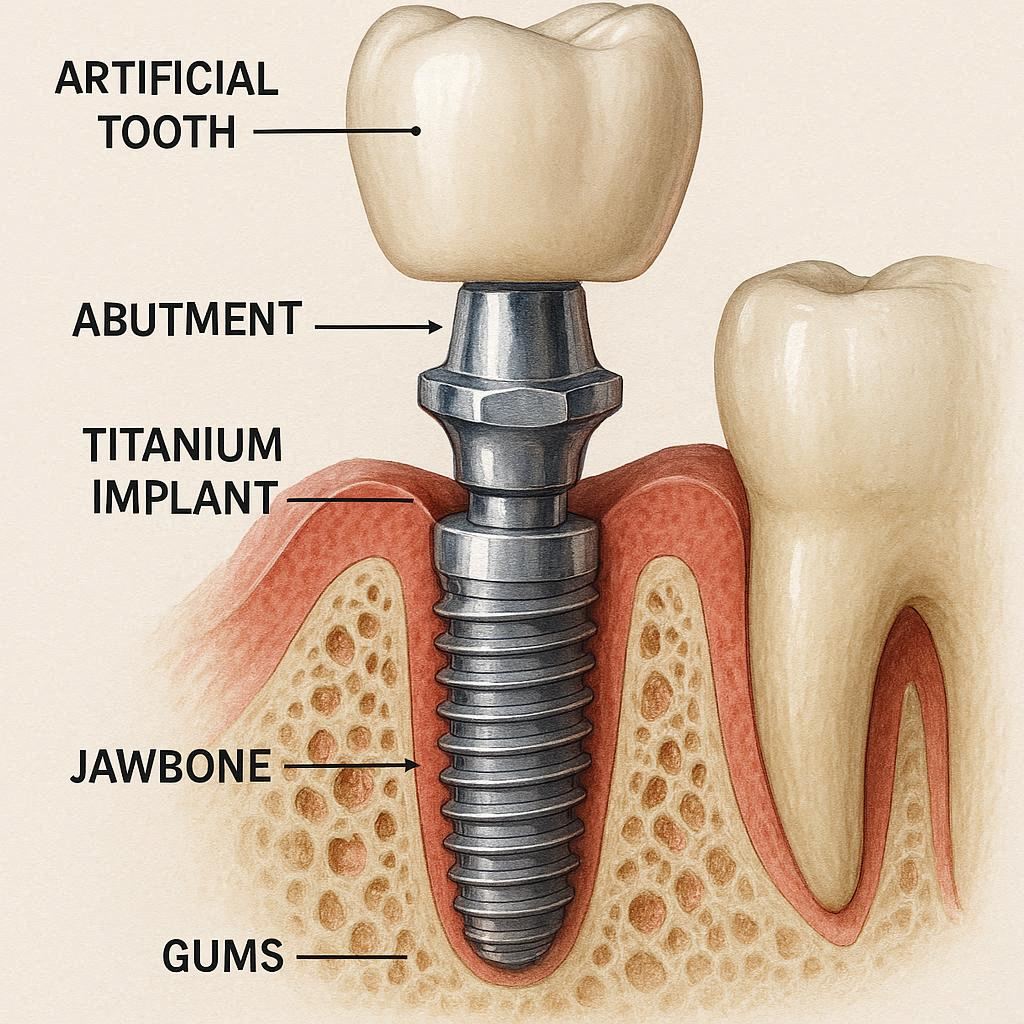
When people say “I got an implant,” they usually mean the entire structure: the screw inside the bone, the connector piece, and the visible tooth on top. But technically, the implant is only the part that goes into your jawbone.
Think of it like this.
- The implant = the artificial root (usually titanium).
- The abutment = the connector.
- The crown = the fake tooth you see.
So, “how do dental implants work” really means: how do these three pieces work together to feel and function like a real tooth?
The short answer is: the implant fuses with your bone. Then the crown attaches to it. Your jaw holds the implant tight, just like it held your natural root.
But that simple answer hides a lot of clever engineering. Let us unpack it.
The Basic Idea: Replacing Root and Crown
A natural tooth has two main parts.
- The crown (the part above the gum).
- The root (the part buried in the bone).
When you lose a tooth, you lose both pieces. A bridge only replaces the crown. A denture rests on top of the gum. But an implant replaces both.
This is the key difference.
The implant acts like a new root. It goes deep into your jawbone. Over time, your bone grows around it and locks it in place. That is why implants feel solid. That is why you can bite an apple without worrying about them shifting.
Important note: Implants do not “grow” into the bone like a plant grows roots. Instead, living bone cells attach themselves to the implant’s surface. It is a biological bond, not a mechanical one.
Once that bond is strong enough, your dentist attaches a custom-made crown on top. The result? A tooth that looks, feels, and functions almost exactly like the original.
The Science of Osseointegration (Made Simple)
You will hear this word a lot: osseointegration.
It sounds scary. But it is actually a beautiful process.
“Osseo” means bone. “Integration” means joining together. So osseointegration is simply your bone joining with the implant.
Here is what happens on a microscopic level.
The implant is made of titanium. Titanium is special because bone cells love it. When your dentist places the implant into your jaw, your body does not reject it. Instead, your bone cells start crawling onto the tiny pores of the implant’s surface.
Over several months, those cells multiply and attach firmly. The implant becomes literally part of your bone structure.
This discovery was made by accident in the 1950s by a Swedish researcher named Per-Ingvar Brånemark. He put titanium chambers into rabbit bones to study blood flow. Later, he could not remove them. The bone had grown into the titanium. That accident changed dentistry forever.
Today, osseointegration is the gold standard for tooth replacement.
| Without osseointegration | With osseointegration |
|---|---|
| Implant stays loose | Implant is locked in bone |
| Constant movement | No movement |
| Risk of infection high | Low risk of infection |
| Feels unnatural | Feels natural |
Step-by-Step: How the Process Works
Let me walk you through the entire journey. From your first consultation to biting into a pizza.
Step 1 – Initial Consultation
Your dentist examines your mouth. They take X-rays or a 3D scan. They check your bone density. They ask about your medical history.
Step 2 – Treatment Planning
The dentist creates a custom plan. Where will the implant go? Do you need bone grafting first? What type of crown?
Step 3 – Bone Grafting (If Needed)
If your jawbone is too thin or soft, the dentist adds bone material. Then you wait a few months for it to heal.
Step 4 – Implant Placement Surgery
This is the actual procedure. The dentist makes a small cut in your gum. They drill a precise hole into the bone. Then they screw the titanium implant into that hole.
Step 5 – Osseointegration Period
You wait. Usually 3 to 6 months. During this time, your bone fuses with the implant.
Step 6 – Abutment Placement
Once the implant is stable, the dentist attaches a small metal connector (the abutment) on top. This pokes through the gum.
Step 7 – Crown Fabrication
Your dentist takes impressions. A dental lab makes your custom crown. This takes 2 to 4 weeks.
Step 8 – Crown Placement
The dentist screws or cements the crown onto the abutment. Done.
Reader note: Some dentists use “same-day implants” where they place the implant and a temporary crown in one visit. But full osseointegration still takes months. Be careful with clinics promising “teeth in a day.” It is possible, but not always best for long-term success.
Types of Dental Implants
Not all implants are the same. Here are the most common types.
Endosteal Implants (Most Common)
These go directly into the jawbone. They look like small screws. Almost all modern implants are endosteal.
Subperiosteal Implants
These rest on top of the bone but under the gum. They are rarely used today. Only for people who cannot have bone grafting and do not have enough bone height.
Zygomatic Implants
Very long implants that anchor into the cheekbone (zygomatic bone). Used for severe upper jaw bone loss.
Mini Implants
Smaller diameter implants. Often used for lower dentures. Less expensive but also less strong.
Here is a quick comparison.
| Type | Best for | Healing time | Strength |
|---|---|---|---|
| Endosteal | Most patients | 3–6 months | Very high |
| Subperiosteal | Low bone height | 2–4 months | Moderate |
| Zygomatic | Severe bone loss | 4–6 months | High |
| Mini | Stabilizing dentures | 1–2 months | Low to moderate |
Who Is a Good Candidate?
Here is an honest answer. Almost anyone can get implants if they are willing to prepare.
But some people are better candidates than others.
Ideal candidate:
- Has good general health
- Has enough jawbone density
- Does not smoke heavily
- Has healthy gums (no active gum disease)
- Is committed to good oral hygiene
Not ideal, but still possible:
- Smokers (higher failure rate)
- Diabetics (need excellent blood sugar control)
- People with osteoporosis (bone healing may be slower)
- Grinders (may need a night guard)
What about age?
There is no upper age limit. People in their 80s and 90s get implants successfully. The lower limit is usually around 18 for women and 20 for men, when the jaw stops growing.
Important note: If your dentist tells you “you are not a candidate,” always get a second opinion. Technology has improved enormously. Many people who were rejected 10 years ago can now get implants with bone grafting or zygomatic implants.
The Surgery Day: What Actually Happens
I want to demystify the surgery because fear stops many people from even trying.
Let me tell you what a typical single-tooth implant surgery looks like.
Before you arrive:
You take any prescribed medications (sometimes an antibiotic or anti-anxiety pill).
When you arrive:
You sit in the dental chair. The dentist applies numbing gel. Then they inject local anesthetic. You will feel pressure but not sharp pain.
The procedure (30–60 minutes):
- A small incision in the gum to expose the bone.
- A special drill creates a hole exactly the size of the implant.
- The implant is screwed into place.
- A healing cap or cover screw is placed on top.
- The gum is stitched closed over or around the implant.
After surgery:
You rest for 10–15 minutes. A friend drives you home. You feel numb for a few hours.
Pain level on day 1:
Most people say 2 to 4 out of 10. Less painful than a tooth extraction for most patients.
Quote from a real patient (anonymized): “I was terrified. I kept imagining a big drilling sound. But honestly? My last filling was worse. The recovery was more annoying than painful.”
Healing and Recovery: What to Expect
Healing happens in two phases: soft tissue healing and bone healing.
First 2 weeks (Gum healing)
- Some swelling and bruising
- Mild discomfort (ibuprofen usually helps)
- Soft food diet
- No smoking (critical!)
- Gentle salt water rinses
Weeks 3–12 (Early bone healing)
- Gums look normal
- No pain day to day
- Still no heavy chewing on that side
- Bone cells are actively attaching to the implant
Months 4–6 (Osseointegration complete)
- The implant is now locked into the bone
- Your dentist tests the stability
- Ready for the abutment and crown
What slows healing?
- Smoking (slows healing by up to 50%)
- Poor diabetes control
- Radiation therapy to the jaw (history)
- Bisphosphonate medications (rare but serious risk)
Reader note: If you take osteoporosis medication (especially intravenous bisphosphonates), tell your dentist before anything else. In rare cases, implants can fail catastrophically. Your dentist may need to coordinate with your doctor.
Attaching the Abutment and Crown
Once osseointegration is complete, you are ready for the second small surgery.
Abutment placement (15–30 minutes)
The dentist:
- Numb the area
- Makes a tiny opening in the gum
- Removes the healing cap
- Screws the abutment onto the implant
- Stitches or heals the gum around the abutment
Then you wait another 2–4 weeks for the gum to heal into a nice, natural collar around the abutment.
Crown fabrication (2–4 weeks)
The dentist takes impressions. A dental lab creates your crown. They match the color to your adjacent teeth.
Crown placement (30 minutes)
The dentist:
- Checks the fit
- Tries the crown in your mouth
- Adjusts as needed
- Screws or cements it permanently
Congratulations. You now have a new tooth.
Do Dental Implants Feel Natural?
This is the question everyone really wants to ask.
Here is the honest truth.
Most of the time:
You will forget which tooth is the implant. You will bite, chew, smile, and floss normally. There is no clicking. No slipping. No bad taste.
Some of the time:
You might feel a slightly different sensation when biting very hard foods (like nuts or crusty bread). The implant has no ligament. A natural tooth has tiny shock absorbers. The implant is rigid. So the feedback is different, but most people adapt within weeks.
Rarely:
If the crown is slightly too high, you may feel discomfort. That is easy to fix. Your dentist simply adjusts the crown.
Patient quote: “I honestly cannot tell the difference anymore. I had to look in my file to remember which tooth it was.”
Success Rates and Long-Term Outlook
Let me give you realistic numbers.
- Single implant, healthy patient: 95–98% success at 10 years
- Multiple implants, healthy patient: 90–95% at 10 years
- Smokers: success rate drops 10–20%
- After 20 years: most studies show 85–90% still functioning well
What does “success” mean? It means the implant is still in your mouth, stable, with no infection or pain.
What causes implants to fail?
- Peri-implantitis (infection around the implant)
- Failed osseointegration (never bonded)
- Overloading before healing (chewing too hard too soon)
- Poor oral hygiene
- Uncontrolled grinding (bruxism)
Can a failed implant be replaced?
Yes. Most of the time, a second implant can be placed after the bone heals. Success rates for second attempts are slightly lower but still good (80–90%).
Costs, Insurance, and Payment Options
Let us talk money. This is where many people stop reading. But do not give up yet.
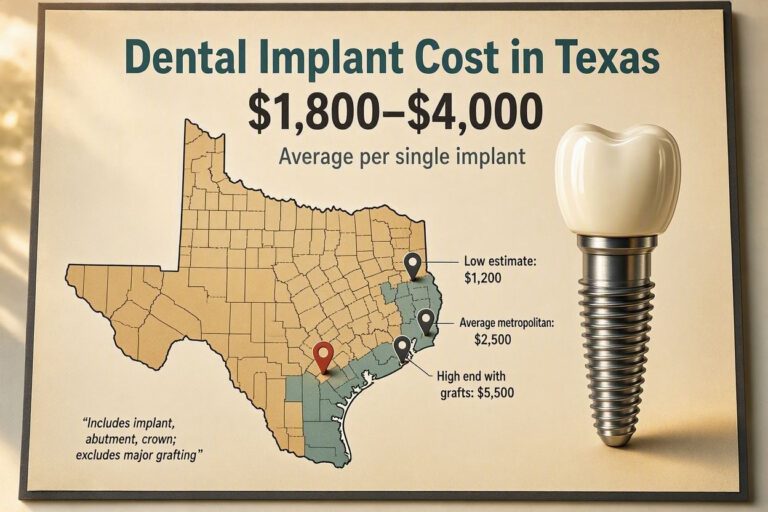
Typical costs in the United States (without insurance)
| Component | Low end | High end |
|---|---|---|
| Implant fixture (screw) | $1,000 | $1,500 |
| Abutment | $300 | $500 |
| Crown | $1,000 | $2,000 |
| Surgery fee | $500 | $1,000 |
| Total per tooth | $2,800 | $5,000 |
Bone grafting adds: 500–2,000
Full arch (All-on-4): 15,000–30,000 per arch
Does insurance help?
Most dental insurance does not cover implants fully. But many plans cover part of the crown. Some cover the extraction or bone grafting.
Tips to save money:
- Dental schools (50% less expensive, but longer appointments)
- Dental tourism (Mexico, Costa Rica, Turkey – do your research)
- In-house membership plans (many private dentists offer them)
- CareCredit or other medical financing
Important note: Be very careful with “super cheap” implants ($1,000 total). The implant itself might be fine, but if the dentist cuts corners on planning or the crown quality, you will pay more later in repairs or replacements.
Common Problems and How to Avoid Them
Let us be real. Implants are wonderful, but they are not perfect.
Problem 1 – Peri-Implantitis
This is gum disease around the implant. It is the #1 cause of late failure.
Prevention: Floss daily. Use a soft pick. See your hygienist every 6 months. Do not skip.
Problem 2 – Screw Loosening
The abutment screw can loosen over time. You might feel a tiny movement.
Solution: Your dentist tightens it. Takes 5 minutes.
Problem 3 – Crown Chipping
Porcelain crowns can chip if you grind your teeth or bite something very hard.
Solution: Night guard for grinders. Avoid ice, hard candy, and pens.
Problem 4 – Implant Fracture
Very rare with modern implants (less than 1%). More common with mini implants.
Solution: Replace the implant (complex surgery).
Problem 5 – Nerve Injury
Temporary numbness in the lower lip or chin. Permanent injury is very rare (less than 1%) when done by an experienced dentist.
Prevention: Choose an implant specialist. Ask them how many they have placed. Ask about their complication rate.
Caring for Your Implants
Good news here. Caring for implants is easier than caring for natural teeth in some ways, harder in one way.
Daily care:
- Brush twice a day (soft brush)
- Floss daily (special implant floss or superfloss)
- Use a water flosser on low setting
- Avoid metal scrapers (use plastic or titanium instruments)
Professional care:
- Cleanings every 6 months
- Yearly X-rays to check the bone level
- Check screw tightness once a year
What to avoid:
- Smoking (massively increases failure)
- Using your teeth as tools
- Skipping cleanings
Reader note: You cannot get cavities on an implant crown because it is not real tooth material. But you can get peri-implantitis, which is worse than a cavity. Do not ignore bleeding around the implant. That is your warning sign.
Alternatives to Dental Implants
Implants are not the only option. And they are not always the best option for every person or every budget.
Option 1 – Do Nothing
Leaving a missing tooth empty is not neutral. Adjacent teeth will shift into the gap. The opposing tooth may over-erupt. Bone will shrink over time.
Option 2 – Removable Partial Denture
A plastic or metal fake tooth clipped to neighboring teeth.
Pros: Cheap (500–1,500). No surgery.
Cons: Moves. Covers your palate. Can break. Feels less stable.
Option 3 – Fixed Bridge
The teeth on either side are shaved down. A three-piece crown replaces the missing tooth.
Pros: Fixed. Feels more natural than a partial. Quicker than implants (3 weeks).
Cons: Requires damaging healthy teeth. Harder to clean. Lasts 10–15 years typically.
Option 4 – Resin-Bonded Bridge (Maryland Bridge)
A fake tooth with wings glued to the back of adjacent teeth.
Pros: Minimal tooth damage. Less expensive than implant.
Cons: Wings can detach. Not for back teeth (too much force).
| Option | Cost | Longevity | Does it save bone? | Damages other teeth? |
|---|---|---|---|---|
| Implant | $$$$ | 20+ years | Yes | No |
| Bridge | $$$ | 10–15 years | No | Yes |
| Partial denture | $ | 5–10 years | No | No |
| Do nothing | $0 | N/A | No | Yes |
Frequently Asked Questions (FAQ)
1. How long does the entire implant process take from start to finish?
Typically 4 to 9 months. If you need bone grafting, add 4–6 months. Same-day implants exist but the final crown still needs healing time.
2. Does getting a dental implant hurt?
The surgery itself is not painful (numbing works well). The days after are mildly uncomfortable. Most people say 2–4 out of 10. Less than a tooth extraction for most.
3. Can my body reject a dental implant?
No. Rejection is an immune response. Implants are made of titanium, which is biocompatible. Failure happens from infection or failed bone bonding, not from rejection.
4. Can I get an implant years after losing a tooth?
Yes. But you may need bone grafting because the bone shrinks over time without a root.
5. Are dental implants safe for seniors?
Yes. Age is not a problem. Health is the main factor. Many people in their 80s get implants successfully.
6. Can I have an MRI with dental implants?
Yes. Titanium is non-magnetic. MRI is safe. Some very old implants (pre-1980s) might be different, but modern ones are fine.
7. What is the failure rate for smokers?
Studies show 10–20% higher failure rate compared to non-smokers. Healing takes longer. But many smokers still succeed if they stop smoking 2 weeks before and 2 months after surgery.
8. Do implants whistle or click?
No. That is dentures. Implants are fixed.
9. Can I get implants if I have gum disease?
Yes, but you must treat the gum disease first. Active infection will ruin the bone and cause failure.
10. How often do I need to replace the crown?
A good porcelain crown lasts 10–15 years. Sometimes longer. The implant itself can last a lifetime if cared for properly.
Additional Resource
For independent, non-commercial information on dental implant research and patient safety, visit the National Institute of Dental and Craniofacial Research (NIDCR) – part of the U.S. National Institutes of Health.
🔗 Link: www.nidcr.nih.gov (Search “dental implants”)
This is a government resource. No ads. No clinic recommendations. Just science-based information.
Final Conclusion
Dental implants work by replacing both the root and the crown of a missing tooth. A titanium screw fuses with your jawbone through a process called osseointegration. After healing, a custom crown is attached, creating a stable, natural-feeling replacement.
The procedure is safe, predictable, and long-lasting when performed on a healthy candidate. Success rates exceed 95% at ten years for non-smokers with good oral hygiene.
However, implants require patience (months of healing), investment (3,000–3,000–5,000 per tooth on average), and commitment to daily cleaning. They are not for everyone, but for most people missing one or more teeth, they remain the closest thing to growing a new tooth.