Bicon Dental Implants
If you have ever been told that your jawbone is too thin or too weak for traditional dental implants, you might feel stuck. You might think dentures are your only option. But there is another path.
Bicon Dental Implants have been helping people with limited bone density for over thirty years. They work differently than most implants you hear about.
This guide walks you through everything you need to know. We will look at how they work, who they help most, and what makes them unique. No fluff. No false promises. Just useful, honest information to help you make a smart choice for your oral health.
What Are Bicon Dental Implants? A Fresh Look at Implant Design
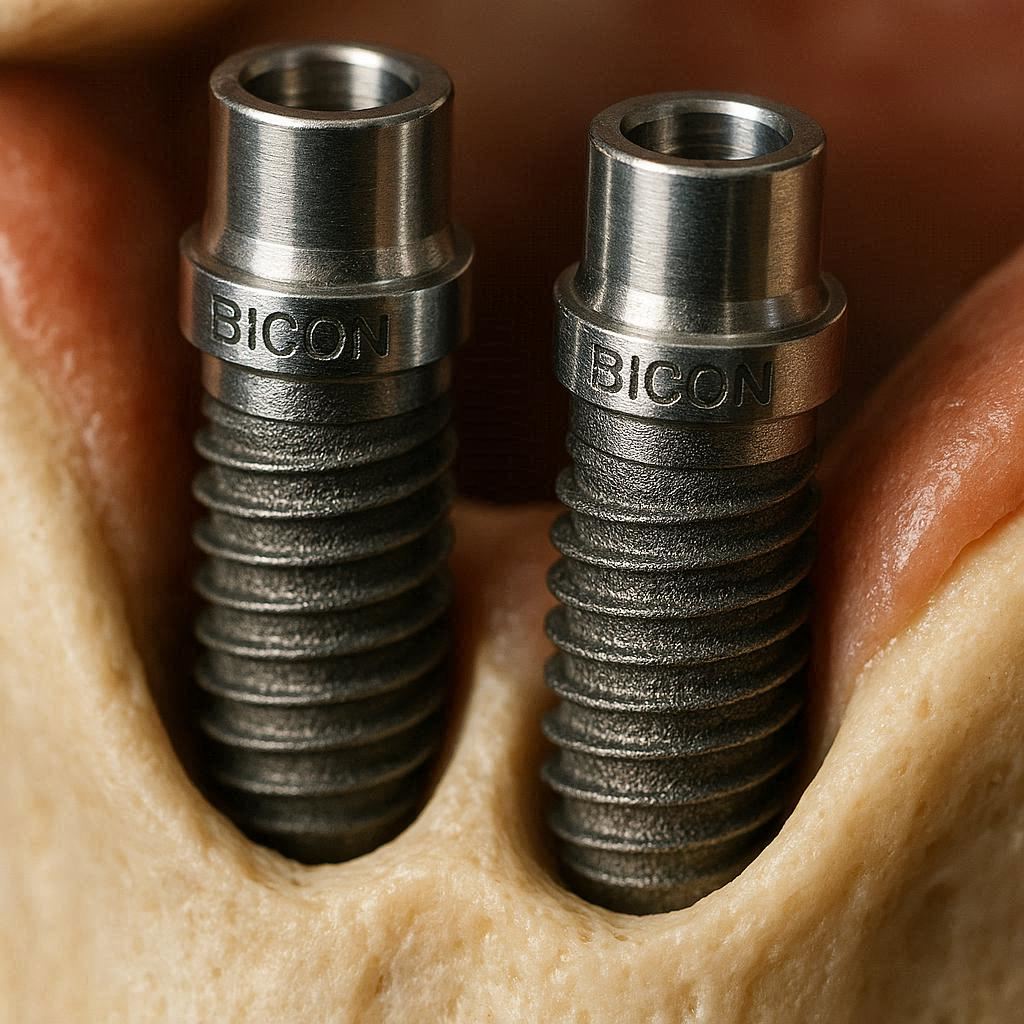
Bicon Dental Implants are a specific type of root-form implant. But here is the thing—they do not look like the typical screw-shaped implants you see in most dental ads. They are short, wide, and tapered.
The company Bicon LLC started designing these implants in the mid-1980s. Their goal was simple. Create an implant that works well even when a person has minimal bone height. Traditional implants often need eight to ten millimeters of bone. Bicon implants can succeed with much less.
This is not a new or experimental technology. Thousands of dentists have placed millions of Bicon implants over decades. It is a mature system with a strong track record.
How Are Bicon Implants Different from Traditional Screw Implants?
Let us break down the main differences in a simple way.
| Feature | Traditional Screw Implants | Bicon Dental Implants |
|---|---|---|
| Shape | Long, threaded screw | Short, tapered, finned design |
| Typical Length | 10 mm to 16 mm | 5 mm to 8 mm |
| Bone Requirement | 10 mm minimum height | 5 mm to 6 mm often sufficient |
| Connection Type | Internal hex or external hex | Locking taper (no screw) |
| Abutment Attachment | Small screw passes through | Tapered post locks in place |
| Common Bone Grafting | Often required | Often avoided |
As you can see, the short design changes the game. It means less surgery. Less waiting. And often lower cost.
The Locking Taper Connection: Why No Screws?
Most implants use a tiny screw to hold the abutment—the part that connects to your crown—to the implant body. That little screw can loosen over time. It can break. It can trap bacteria.
Bicon does something entirely different. They use a locking taper connection. Imagine placing a cold metal post into a slightly smaller cold metal hole. The fit is so tight that it locks together through friction. There is no screw to loosen or fail.
Dentists call this a “cold weld.” It is incredibly stable.
“The locking taper connection eliminates the most common weak point in conventional implant systems—the prosthetic screw.”
— Dr. Thomas D. Dyer, Bicon-trained prosthodontist
This design has big advantages:
- No screw loosening over time.
- Bacteria have no path to seep into the implant.
- Simpler placement for the dentist.
- Easier repair if something ever needs adjustment.
For you, the patient, this means less risk of future problems.
Who Are Bicon Dental Implants For?
Not every person needs Bicon implants. But for certain situations, they are a fantastic option.
Ideal Candidates
You might be a good fit if:
- You have been told you lack enough bone height.
- You want to avoid a bone graft surgery.
- You have a narrow jawbone in the molar area.
- You need implant-supported dentures but have limited bone.
- You have existing implants that failed due to bone loss.
- You want a less invasive procedure with faster healing.
Situations Where Bicon Shines
Let me give you real examples.
The low sinus case. Your upper back molars sit right below your sinus cavity. If that sinus droops down, traditional implants cannot fit without a sinus lift. Bicon short implants often slide right in below the sinus. No lift needed.
The thin lower jaw. In the back of your lower jaw runs a nerve called the inferior alveolar nerve. Traditional implants must stay above it. Short Bicon implants can fit in the smaller space.
Immediate replacement. Sometimes a tooth breaks off at the gumline. There is not much root left. A Bicon implant can often go directly into that same spot without extra bone work.
Who Should Look Elsewhere?
Honesty matters.
Bicon implants may not be the best choice if:
- You have very soft bone that cannot hold the locking taper.
- You need a single implant to support a very large, heavy bridge.
- Your dentist has no experience with the Bicon system.
- You prefer a widely-used system with more spare parts in local labs.
Talk to your dentist. Ask about their personal success rate with Bicon.
The Surgical Process: What to Expect
I will walk you through the steps. Every case is different, but here is a typical timeline.
Step 1: The Consultation and 3D Imaging
Your dentist takes a CBCT scan. This is a three-dimensional X-ray. It shows exactly how much bone you have, where the nerves run, and how close the sinuses are.
Do not skip this step. Good planning makes the surgery smooth.
Step 2: Treatment Planning
Your dentist measures your bone height and width. They select the right Bicon implant size for your specific spot. Bicon offers many lengths from 5.0 mm to 8.0 mm and widths from 3.0 mm to 8.0 mm.
Step 3: The Surgery Day
Most Bicon placements are done under local anesthesia. You are awake but numb. Some patients prefer light sedation if they are nervous.
The dentist makes a small hole in your gum. They drill a precise socket into the bone. This socket is smooth—not threaded like a screw hole.
They insert the Bicon implant using a special instrument. No turning or torquing. Just gentle tapping into place.
Then they place a healing abutment or a cover screw. Your gum is stitched closed over it.
Total time for a single implant: Often 20 to 40 minutes.
Step 4: Healing and Integration
Here is where Bicon is different again. Traditional implants need three to six months to fuse with bone. Bicon implants often integrate faster because their short, finned design creates more surface contact with less drilling trauma.
Many patients wait only two to four months before getting their permanent crown.
Step 5: Restoring the Implant
After healing, your dentist uncovers the implant. They take an impression. A dental lab makes your custom crown. At the final visit, your dentist seats the crown onto the implant using the locking taper connection. No cement. No screw. Just a firm tap.
You walk out with a fixed tooth that day.
Pain, Recovery, and Realistic Healing
Let me be honest. Any surgery involves some discomfort.
But most patients say Bicon implant placement hurts less than a tooth extraction. You may feel pressure during the procedure but not sharp pain.
What to expect after surgery:
- Days 1 to 3: Mild swelling. Some bruising. Take over-the-counter pain relievers like ibuprofen.
- Days 4 to 7: Swelling goes down. You can eat soft foods.
- Week 2: Stitches dissolve or get removed. Numbness wears off.
- Month 1: Bone healing is active. Avoid chewing directly on the implant site.
Tips for faster healing:
- Do not smoke. Smoking dramatically raises implant failure risk.
- Keep your mouth clean with warm salt water rinses.
- Avoid crunchy or sticky foods on that side.
- Follow your dentist’s antibiotic instructions exactly.
Important Note: If you ever feel severe pain, pus, or the implant feels mobile, call your dentist immediately. These signs are rare but serious.
Success Rates: What Does the Research Say?
Let us look at real numbers. Not marketing claims.
Long-term studies on Bicon implants show:
- Over 97% success rate after 10 years for properly selected patients.
- Success in reduced bone height: One study tracked 1,000+ short Bicon implants (5 mm to 6 mm). The 5-year success rate was 96.4%.
- Upper jaw vs. lower jaw: Lower jaw success is slightly higher because the bone is denser. But upper jaw still sees 95%+ success in most studies.
To put this in perspective, traditional screw implants average 95% to 98% success over 10 years. Bicon performs comparably—but in patients who might not qualify for traditional implants at all.
The difference is not about being “better.” It is about being an option where none existed before.
Cost Comparison: Bicon vs. Traditional Implants
Pricing varies widely by location. But here is a realistic guide in US dollars for a single tooth replacement.
| Cost Component | Traditional Implant | Bicon Implant |
|---|---|---|
| Implant body | 500−800 | 550−750 |
| Abutment | 300−500 | Included (locking taper) |
| Crown | 1,200−2,000 | 1,200−2,000 |
| Bone graft (if needed) | 500−1,500 | Often $0 |
| Sinus lift (if needed) | 1,500−3,000 | Often $0 |
| Total average without complications | 3,500−3,500−5,500 | 2,500−2,500−3,500 |
Notice the big savings often come from avoiding bone grafting and sinus lifts.
Check with your dental insurance. Many plans cover part of the crown and abutment. Some cover a portion of the implant surgery. Ask before you start.
Advantages and Disadvantages: A Balanced View
No treatment is perfect. Let me give you the real pros and cons.
Advantages of Bicon Dental Implants
- Saves bone. No need to remove healthy bone during drilling.
- Less invasive surgery. Smaller incisions. Faster healing.
- Avoids grafting. Huge win for many patients.
- No screw complications. No loose abutments to tighten.
- Easier cleaning. The connection seal stops bacteria from getting inside.
- Simplifies complex cases. Can go where longer implants cannot.
Disadvantages or Limitations
- Fewer trained dentists. Not every implant specialist knows the Bicon system.
- Limited restoration options. Some prefabricated abutments and parts are Bicon-specific.
- Requires specific instruments. A dentist cannot just “try” Bicon without the full kit.
- Less research volume. Fewer published studies than major brands like Straumann or Nobel Biocare.
- Not ideal for full-arch bridges with very long spans.
If your dentist offers Bicon and has placed dozens or hundreds, the disadvantages shrink dramatically.
How to Find a Qualified Bicon Dentist
Do not just pick any implant dentist. Ask specific questions.
Good questions to ask:
- “How many Bicon implants have you placed in the last year?”
- “Can you show me before-and-after photos of Bicon cases like mine?”
- “Do you own the full Bicon surgical kit and restorative kit?”
- “What is your personal success rate with Bicon in the upper jaw?”
- “Will you provide a written treatment plan with all costs?”
Red flags to avoid:
- A dentist who says “Bicon is the only good implant.” (There are many good systems.)
- An office that charges separately for the abutment (it should be included).
- No CBCT machine on-site or nearby referral.
- High pressure to sign up today with a “limited time discount.”
Resources to find a Bicon provider:
- Bicon’s official website has a dentist locator.
- Ask local prosthodontists—they often know who uses Bicon.
- Call Bicon directly at their Boston headquarters. They are helpful and will tell you trained dentists in your area.
Caring for Your Bicon Implant Long-Term
Good news. Bicon implants do not need special products or crazy routines.
Your daily home care:
- Brush twice a day with a soft toothbrush.
- Floss normally. Thread floss under the crown just like a natural tooth.
- Consider a water flosser on low pressure.
- Avoid chewing ice or hard candy on that side.
Professional maintenance:
- See your dentist every six months.
- Ask them to check the implant’s stability.
- Routine X-rays every one to two years to check the bone level.
What shortens implant life?
- Untreated gum disease. This attacks the bone around any implant.
- Smoking more than 10 cigarettes per day.
- Grinding your teeth (bruxism) without a nightguard.
- Poor oral hygiene leading to peri-implantitis (inflammation around the implant).
Take care of your implant, and it can last thirty years or more. Many of the earliest Bicon implants placed in the 1980s are still functioning today.
Bicon for Multiple Teeth and Denture Support
Bicon is not just for single missing teeth.
Implant-Supported Dentures
If you wear a lower denture that floats and clicks, two to four Bicon implants can lock it in place. You snap the denture onto the implants. It stays steady when you eat and talk. You still remove the denture at night for cleaning.
Fixed Bridges
If you are missing three teeth in a row, you may only need two Bicon implants. They support a three-unit bridge. Fewer implants mean lower cost and less surgery.
Full-Mouth Reconstruction
Some patients get six to eight Bicon implants per jaw to support a full fixed bridge. This is complex but possible. Recovering all your teeth in one arch is life-changing for people with failing teeth.
In these multiple-implant cases, the short design really helps. You can place implants where bone exists without needing bone from elsewhere.
Common Myths and Misconceptions
Let me clear up a few things I hear often.
Myth 1: “Short implants always fail.”
False. Short implants work as well as long implants when bone is dense. The key is matching the implant to the bone quality.
Myth 2: “Bicon is experimental.”
False. Bicon received FDA clearance in the 1990s. Over 3 million placed. That is not experimental.
Myth 3: “You cannot put a crown on a short implant.”
False. Many studies show short implants supporting single crowns for 10+ years. The crown shape distributes forces down into the bone, not sideways.
Myth 4: “Bicon is cheaper because it is low quality.”
False. Bicon costs less in many cases because you avoid extra surgical steps (grafts, lifts), not because the implant is inferior. The locking taper design is actually more expensive to manufacture than a simple screw.
A Step-by-Step Decision Checklist
Use this before booking your implant surgery.
- I have had a CBCT scan in the last six months.
- My dentist has placed at least 50 Bicon implants.
- I understand the total cost, including the crown and any unexpected fees.
- I have asked about the warranty or guarantee on the implant.
- I know how long I must wait for the final crown.
- I have a plan for pain management and time off work.
- I have discussed alternative implant systems and why Bicon is recommended for me.
- I have read at least two patient reviews of my specific dentist.
If you check all eight boxes, you are ready to move forward confidently.
Comparison Table: Bicon vs. Other Short Implant Systems
| Feature | Bicon | Straumann BLX Short | Zimmer TSV Short |
|---|---|---|---|
| Typical length range | 5 – 8 mm | 6 – 8 mm | 6 – 8 mm |
| Connection type | Locking taper | Cross-fit screw | Internal hex screw |
| Requires specific cement? | No | No | No |
| Abutment screw | None | Yes | Yes |
| 10-year published data | Yes | Limited | Moderate |
| Avg. cost (implant body) | 550−750 | 600−900 | 550−800 |
Bicon stands out for its screw-free connection. If that matters to you, it is worth seeking out.
Frequently Asked Questions (FAQ)
1. Are Bicon implants as strong as regular implants?
Yes. In independent testing, the locking taper connection withstands similar or greater forces than screw-retained connections. The implant body itself is made of medical-grade titanium alloy.
2. Can I get a Bicon implant if I already have bone loss?
Often yes. That is exactly the situation where short implants help. Your dentist will measure your remaining bone height on the CBCT scan.
3. How long does the Bicon implant procedure take from start to finish?
Typically three to five months from surgery to final crown. Rare cases may take six months if bone healing is slower.
4. Will my insurance cover Bicon implants?
Most dental insurance plans cover implants the same way regardless of brand. They pay a fixed percentage for “implant placement” and “crown.” Check your specific policy.
5. Can Bicon implants be removed if something goes wrong?
Yes. A dentist can remove them with special extractors. The removal is easier than screw implants because there are no threads to cut out.
6. Does Bicon make zirconia (metal-free) implants?
No. Bicon implants are titanium. If you have a known titanium allergy (rare), discuss other options with your dentist.
7. Can I have an MRI scan with Bicon implants?
Yes. Titanium is non-magnetic. Bicon implants are safe for MRI up to 3 Tesla. Always tell the MRI technician you have dental implants.
8. Do Bicon implants cause bad breath or a metallic taste?
No. A properly healed implant and crown should not cause either. If you experience this, see your dentist—it may signal trapped food or infection.
9. Are Bicon implants available in the UK, Australia, or other countries?
Yes. Bicon has trained dentists in over 40 countries. Check their international distributor list.
10. What is the warranty on a Bicon implant?
Bicon offers a lifetime warranty against manufacturing defects for the implant body. The crown and your dentist’s work have separate warranties. Ask for details in writing.
Additional Resource
For a deeper look into clinical studies, training videos, and to locate a certified Bicon dentist near you, visit the official Bicon educational portal:
🔗 www.bicon.com/patient-resources
This page includes:
- An interactive 3D model showing how the locking taper works
- Patient case studies with before-and-after images
- A free PDF download: “Questions to Ask Your Implant Dentist”
Conclusion
Bicon Dental Implants offer a smart, bone-saving alternative for people who have been told they lack enough bone for traditional implants. Their short, screw-free design avoids common complications like loosening abutments and frequently removes the need for bone grafting. With over three decades of clinical use and millions of successful placements, Bicon stands as a reliable option—not a miracle cure, but a realistic, effective second path to a fixed, natural-feeling smile.
Disclaimer: This article is for informational purposes only and does not constitute medical advice. Dental implant surgery carries risks, including infection, nerve damage, and failure. Always consult with a licensed dentist or oral surgeon to determine the best treatment for your specific health situation. Results vary by individual. The author and publisher are not responsible for any outcomes resulting from the use of this information.