Dental Implants in Pembroke Pines FL: The Complete Guide to a Lasting Smile
Losing a tooth can feel frustrating. Maybe you feel self-conscious when you laugh. Perhaps chewing has become a challenge. The good news is that modern dentistry offers a permanent solution that looks and feels completely natural.
If you live in Broward County, you have access to some of the best dental care in the state. This guide will walk you through everything you need to know about replacing missing teeth in your local area. We will focus on honest, realistic information. No hype. No false promises. Just a clear path toward a healthier smile.
Why So Many People Are Choosing Tooth Replacement
Have you ever wondered why dental implants have become so popular over the last decade? The answer is simple. They work.
Traditional bridges and dentures have been around for a long time. They serve a purpose. But they come with limitations. Dentures can slip. Bridges require shaving down healthy teeth. Implants solve both problems by replacing the root as well as the crown.
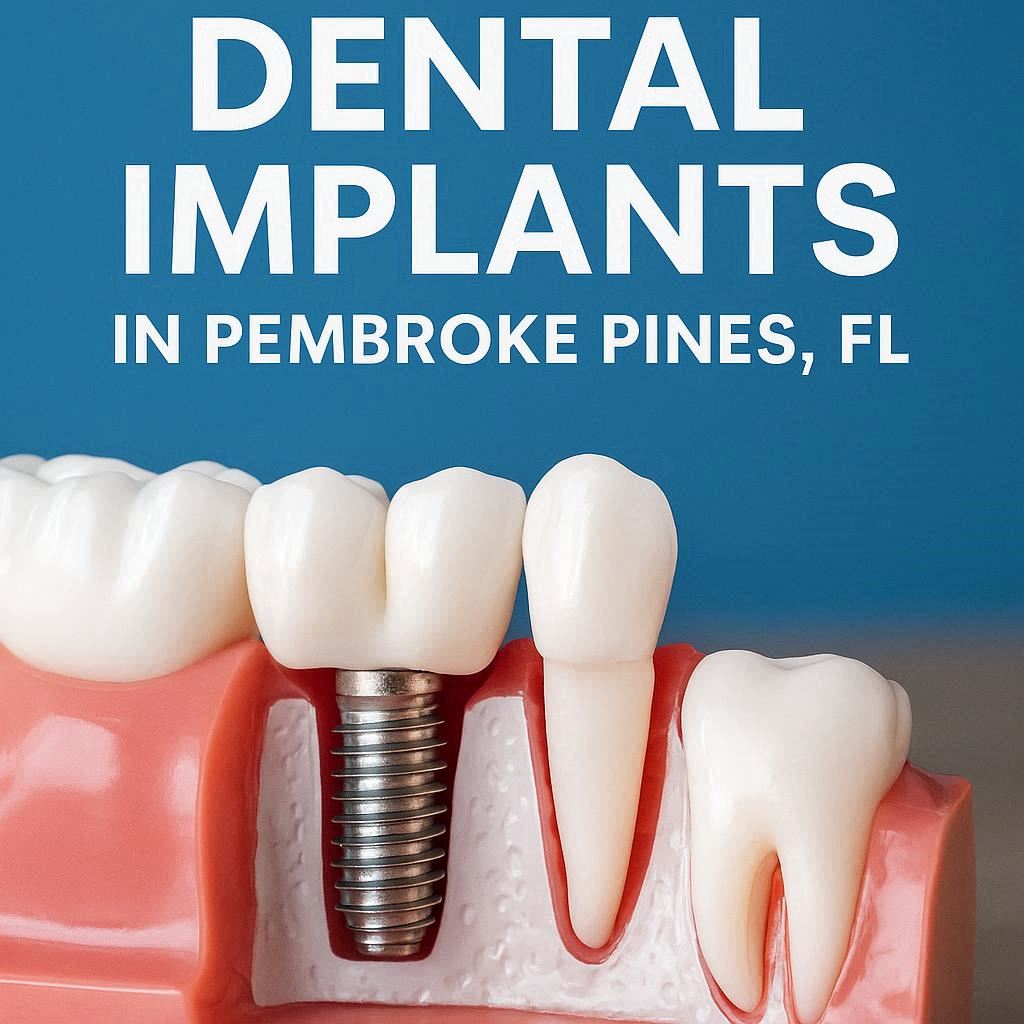
Think of an implant as an artificial root. A skilled surgeon places a small titanium post into your jawbone. Over time, that post fuses with the bone. This creates a rock-solid foundation for a new tooth.
This is why so many residents are now searching for Dental Implants in Pembroke Pines FL. They want something that stays put. They want something that preserves their facial structure. Most importantly, they want to eat, speak, and smile without worry.
The Anatomy of a Modern Implant
Before we dive into local options, let us break down the three main parts of an implant system.
| Component | What It Is | Function |
|---|---|---|
| The Fixture (Post) | A small screw made of medical-grade titanium | Surgically placed into the jawbone to act as the new root |
| The Abutment | A connector piece (often titanium or zirconia) | Attaches to the post and holds the final crown |
| The Prosthesis | The visible part of the tooth (crown, bridge, or denture) | Restores chewing function and aesthetics |
Each part must work perfectly with the others. That is why you want a dentist who uses high-quality materials from trusted brands like Straumann, Nobel Biocare, or Zimmer.
Are You a Candidate? Realistic Expectations
Not everyone is an ideal candidate right away. Let us be honest about this.
To receive implants, you need adequate jawbone density. Think of the bone as the soil for a plant. If the soil is too soft or thin, the plant will not stand up straight. The same applies to implants.
Good Candidates Typically Have:
- Healthy gums (no active periodontal disease)
- Enough bone volume to support the post
- Good overall health (certain conditions like uncontrolled diabetes may slow healing)
- A commitment to oral hygiene
- Non-smoking status (or willingness to quit during healing)
What If You Lack Bone?
Do not lose hope. Many people who think they cannot get implants are actually still candidates. They just need a little preparation.
Bone grafting is a common procedure. Your oral surgeon takes bone material from another area of your mouth or uses a synthetic substitute. They place it into the weak area. After a few months of healing, the bone becomes strong enough to hold an implant.
Sinus lifts are another option for the upper back teeth. This procedure gently raises the sinus floor to make room for new bone.
These additional steps add time and cost. But they open the door for almost everyone to enjoy the benefits of implants.
The Complete Procedure Timeline (Step by Step)
Understanding the timeline helps reduce anxiety. You will know what to expect at each visit. Here is a realistic breakdown from start to finish.
Step 1: Initial Consultation and Imaging
Your first visit is all about information gathering. The dentist will examine your mouth. They will take x-rays. Most modern offices in Pembroke Pines use a CBCT scanner (3D imaging). This machine gives a complete picture of your nerves, sinuses, and bone density.
Important note: Always request a copy of your CBCT scan. It belongs to you. Having it makes it easier to get second opinions.
Step 2: Treatment Planning
Using the 3D images, your dentist plans the exact position of each implant. Computer-guided surgery is now the standard of care. It is safer and more precise.
Step 3: Tooth Extraction (If Needed)
If you still have a damaged tooth in the spot, the dentist will remove it. Sometimes they place the implant immediately after extraction. Other times they let the socket heal for a few months. Your dentist will explain which approach suits your situation.
Step 4: Implant Placement Surgery
This is a minor surgical procedure. Most people receive local anesthesia (numbing shots) only. Some choose sedation dentistry if they feel nervous.
The surgeon makes a small incision in your gum. They drill a precise hole into the bone. Then they insert the titanium post. Finally, they place a healing cap or a temporary crown on top.
The entire surgery for a single implant usually takes 30 to 60 minutes.
Step 5: Osseointegration (The Waiting Period)
This is the most critical phase. Osseointegration is the process where your bone grows tightly around the implant surface. It takes time. Usually 3 to 6 months.
During this period, you can wear a temporary partial denture or a flipper. But you must avoid putting heavy chewing pressure on the implant site.
Step 6: Abutment Placement
Once the implant is fully integrated, you return for a small procedure. The dentist uncovers the implant (if it was buried) and attaches the abutment. This shapes the gum tissue to look natural around the final crown.
Step 7: Final Restoration
Your dentist takes impressions of the abutment. A dental lab fabricates your permanent crown, bridge, or denture. This usually takes 2 to 3 weeks.
When the restoration is ready, you return for the final fitting. The dentist checks the bite and cements or screws the new tooth in place.
Total time from start to finish: 4 to 9 months. Add extra time if you need bone grafting.
Types of Implant Restorations Available in Pembroke Pines
Not all implants are the same. The type of restoration depends on how many teeth you are missing.
Single Tooth Implant
Best for one missing tooth. One post supports one crown. This is the most common procedure.
Implant-Supported Bridge
Best for two or three missing teeth in a row. Two implants support a bridge of three or four crowns. You avoid placing an implant for every single missing tooth.
Implant-Supported Denture
Best for people missing all teeth on the upper or lower arch. Four to six implants snap into a special denture. The denture does not move or rock. This is often called “All-on-4” or “Teeth-in-a-Day.”
| Restoration Type | Number of Implants | Best For | Removable? |
|---|---|---|---|
| Single Crown | 1 | One missing tooth | No (fixed) |
| Implant Bridge | 2 (for 3-4 teeth) | Several missing teeth in a row | No (fixed) |
| Overdenture | 2 to 4 | Full arch with bone loss | Yes (snap-on) |
| Fixed Full Arch | 4 to 6 | Full arch, no bone loss | No (fixed) |
What Does It Cost? A Transparent Breakdown
Let us talk about money. Dental implants are an investment. They cost more upfront than a bridge or denture. But they last much longer.
In Pembroke Pines, FL, prices vary based on the dentist’s experience, the lab used, and the complexity of your case. Here are realistic estimates.
- Single implant (crown included): 3,500to6,000
- Implant-supported bridge (3 units): 8,000to15,000
- Implant-supported denture (per arch): 15,000to30,000
- Bone grafting (if needed): 500to3,000 per site
Does Insurance Cover Implants?
Traditional dental insurance often excludes implants. However, some plans now offer partial coverage. Review your policy carefully. Look for the words “implant” or “prosthetic replacement.”
If your insurance does not cover implants, check your medical plan. Sometimes medical insurance covers the surgical portion if the tooth loss resulted from an accident or injury.
Financing Options in Pembroke Pines
Most dental offices work with third-party financing companies. Popular options include:
- CareCredit (healthcare credit card)
- LendingClub (patient solutions)
- Proceed Finance (specializes in dental implants)
Many local dentists also offer in-house payment plans. Do not be afraid to ask. A good office wants to help you afford treatment.
Comparing Implants to Traditional Alternatives
You have choices. Let us compare implants objectively against other options.
Implants vs. Traditional Dental Bridge
| Factor | Implant | Traditional Bridge |
|---|---|---|
| Impact on healthy teeth | None | Requires grinding down adjacent teeth |
| Lifespan | 20+ years (often lifetime) | 7 to 15 years |
| Bone preservation | Yes (stimulates bone) | No (bone shrinks over time) |
| Cost (initial) | Higher | Lower |
| Cost (long-term) | Lower (rarely needs replacement) | Higher (replacement likely) |
Implants vs. Conventional Dentures
| Factor | Implant Denture | Conventional Denture |
|---|---|---|
| Stability | Does not move or click | Can slip and rock |
| Chewing power | 80-90% of natural teeth | 20-30% of natural teeth |
| Speech | Clear and natural | Can cause clicking or whistling |
| Facial support | Excellent (prevents bone loss) | Poor (face collapses over time) |
Choosing the Right Provider in Pembroke Pines FL
You want someone skilled. But skill alone is not enough. You also want a dentist who communicates clearly and respects your budget.
Here are five questions to ask during your consultation.
- “How many implants do you place each month?” Look for a provider who places at least 20 to 30 implants monthly.
- “Do you use guided surgery?” Yes is the only acceptable answer. Computer guidance reduces nerve injury risks.
- “What happens if my implant fails?” A confident dentist will offer a warranty or replacement guarantee.
- “Who handles the restoration?” Some dentists place the implant but send you elsewhere for the crown. Ask if they do both.
- “Can you show me before-and-after photos of similar cases?” Visual proof matters.
Types of Providers
- General Dentist with Implant Training: Suitable for simple single-tooth cases.
- Periodontist (Gum Specialist): Excellent for cases with gum disease or soft tissue concerns.
- Oral Surgeon: Best for complex bone grafting or full-arch cases.
- Prosthodontist: Focuses on the final restoration (crowns and dentures). Often works with a surgeon.
Many top offices in Pembroke Pines use a team approach. The surgeon places the implant. The restorative dentist makes the crown. This collaboration often produces the best results.
Recovery and Aftercare: What to Expect
The first 24 hours after surgery are the most uncomfortable. You will likely experience swelling, minor bleeding, and some soreness. This is normal.
First Week Instructions
- Apply ice packs to your face (20 minutes on, 20 minutes off)
- Eat soft foods only (yogurt, soup, smoothies, mashed potatoes)
- Avoid spitting or using a straw (this can dislodge the blood clot)
- Take prescribed pain medication as directed
- Do not smoke or vape (this dramatically increases failure rates)
Long-Term Maintenance
Implants cannot get cavities. But they can get a condition called peri-implantitis. This is inflammation and infection around the implant. It is similar to gum disease.
To prevent peri-implantitis:
- Brush twice daily with a soft toothbrush
- Floss daily (use super floss or implant-specific floss)
- Use a water flosser (highly recommended)
- Visit your dentist every 6 months for professional cleanings
- Avoid chewing ice, hard candy, or pencils
With proper care, your implant has a success rate of 95% or higher over 10 years.
Common Fears and Misconceptions (Addressed Honestly)
Let us clear up some myths.
Myth 1: “The surgery is extremely painful.”
Reality: Most patients report less discomfort than a tooth extraction. The procedure itself is painless due to anesthesia. Post-surgery soreness usually lasts 2 to 3 days.
Myth 2: “My body might reject the titanium.”
Reality: True rejection is almost impossible. Titanium is biocompatible. Your body does not attack it. When implants fail, it is usually due to infection or lack of bone integration, not rejection.
Myth 3: “I am too old for implants.”
Reality: Age is not a barrier. As long as you are healthy enough for minor oral surgery, you can receive implants. Many people in their 80s and 90s enjoy implant-supported dentures.
Myth 4: “The whole process takes years.”
Reality: Routine cases take 4 to 9 months. Complex cases with grafting take 12 to 18 months. But you are never without teeth. Temporary restorations keep you smiling throughout.
Real Patient Journey: A Pembroke Pines Story
Maria is a 62-year-old retiree living near Chapel Trail. She lost her lower back teeth over several years due to grinding. She wore a partial denture but hated how it moved when she ate.
Maria visited a periodontist in Pembroke Pines. Her CBCT scan showed moderate bone loss. She needed bone grafting on two sites. The grafting added $1,200 to her bill and 4 months to her timeline.
After the graft healed, the surgeon placed three implants. Maria waited 5 months for osseointegration. Finally, she received an implant-supported bridge.
Today, Maria eats steak and apples without worry. She says the temporary inconvenience was worth the permanent result.
This is a realistic story. Not every case is smooth. But most reach a happy ending.
How to Prepare for Your First Consultation
Walking into a dental office for the first time can feel intimidating. Preparation reduces anxiety.
Bring the following:
- Your insurance card (dental and medical)
- A list of current medications (including dosages)
- Any recent x-rays or scans from other dentists
- A written list of questions
- A friend or family member if you want support
Be ready to discuss:
- Your medical history (diabetes, heart disease, osteoporosis)
- Smoking or alcohol habits (be honest; it affects healing)
- Your budget and financing needs
- Your smile goals (function, aesthetics, or both)
A good dentist will listen more than they talk. If you feel rushed, consider a second opinion.
The Future of Dental Implants: What Is Coming?
Dental technology never stops improving. Here are three trends already arriving in South Florida.
1. Same-day implants with 3D printing. Some offices now offer chairside milling. They design and create your permanent crown while you wait. This compresses the timeline significantly.
2. Zirconia implants. Metal-free implants exist for people with metal sensitivities. They are white and blend with the tooth. However, they are less studied than titanium. Most experts still recommend titanium for the best long-term data.
3. Growth factors (PRF). Platelet-rich fibrin uses your own blood to accelerate healing. Your dentist draws a small blood sample, spins it in a centrifuge, and places the concentrated growth factors into the surgical site. This can reduce healing time by weeks.
A Note on Dental Tourism
You may have heard about getting implants in Costa Rica, Mexico, or Colombia. The prices are lower. Sometimes significantly lower.
However, there are serious risks to consider.
- Follow-up care: If your implant fails or gets infected, who will treat you back home? Most local dentists will not touch another dentist’s failed work without a steep fee.
- Quality variation: Some international clinics are excellent. Others use cheap, unbranded implants that are not approved in the US.
- Travel costs: Adding flights, hotels, and lost work time often eats up the savings.
If you have limited budget, look for a dental school or a reduced-fee clinic in Florida first. Nova Southeastern University in Davie (near Pembroke Pines) offers implant care at reduced rates. Dental students are supervised by experienced faculty.
Maintaining Your Investment Over Time
Your implant is a medical device. Like a knee replacement or a pacemaker, it needs monitoring.
Yearly Maintenance Checklist
- Clinical exam: The dentist checks for bleeding, swelling, or mobility.
- Peri-implant probing: They measure the gum pocket around the implant. Normal is 3mm or less.
- Radiographs: X-rays every 12 to 24 months to check bone levels.
- Professional cleaning: Special plastic scalers (not metal) protect the implant surface.
Many offices offer an implant maintenance program. For a flat annual fee, you receive two cleanings, exams, and X-rays. This is a smart investment.
Cost-Saving Strategies Without Cutting Corners
You want quality. You also need affordability. Here is how to balance both.
Strategy 1: Stage your treatment. Get one implant this year and another next year. Spread the financial burden over time.
Strategy 2: Use a dental savings plan. These are not insurance. They are discount cards. You pay an annual fee (around 100to150) and receive 20% to 40% off implant services. Look for plans that include “major restorative” coverage.
Strategy 3: Ask about in-house membership plans. Many Pembroke Pines dentists now offer monthly subscription plans for uninsured patients. For a monthly fee (often 30to50), you get free exams, discounted cleanings, and 15% off procedures like implants.
Strategy 4: Pay with pre-tax dollars. If your employer offers a Flexible Spending Account (FSA) or Health Savings Account (HSA), use it. You save 20% to 30% on every dollar because the money comes out before taxes.
Red Flags to Avoid
Unfortunately, not every dental office operates ethically. Watch for these warning signs.
- “You need implants in every missing tooth.” False. As we discussed, bridges and partials on implants can replace multiple teeth.
- “We can do everything today for half the price.” Extreme discounts usually mean extreme shortcuts. Quality implant dentistry has real costs.
- “No need for a CBCT scan.” Never allow implant surgery without 3D imaging. You are risking nerve damage.
- “Sign this contract immediately.” A trustworthy dentist encourages second opinions.
If something feels wrong, trust your gut. Walk away. There are dozens of qualified implant dentists in Pembroke Pines and surrounding areas like Cooper City, Weston, and Davie.
The Emotional Side of Tooth Loss (We Need to Talk About It)
We have focused on clinical facts. But tooth loss affects your emotions too.
Maybe you cover your mouth when you laugh. Maybe you avoid photos. Maybe you have stopped going to social dinners because chewing is embarrassing.
You are not alone. Thousands of adults in Broward County feel the same way.
The good news is that implants restore more than teeth. They restore confidence. Patients often describe feeling “like themselves again.” They stop worrying about their smile. They start living fully.
Is that worth an investment of time and money? Most people who complete the journey say yes without hesitation.
Checklist: Is Now the Right Time for You?
Answer these five questions honestly.
- Do I have one or more missing teeth that bother me daily?
- Am I in good general health (or is my chronic condition well-managed)?
- Do I have the budget (or a financing plan) for a 4,000to6,000 investment?
- Am I willing to commit to 4 to 9 months of treatment?
- Can I commit to daily flossing and regular dental visits afterward?
If you answered yes to four or five questions, you are ready to schedule consultations.
If you answered no to several questions, that is fine. You might benefit from a less expensive interim solution like a flipper or a bridge. Revisit implants later when your situation changes.
Frequently Asked Questions (FAQ)
Q: How long do dental implants last?
A: With proper care, many implants last 20 years to a lifetime. The crown on top may need replacement after 10 to 15 years due to normal wear.
Q: Is the procedure safe for seniors?
A: Yes. Age alone does not stop you. Your overall health matters more than your birthdate. Many seniors in Pembroke Pines receive implants successfully.
Q: Can I get implants if I smoke?
A: Smoking significantly increases failure rates. It reduces blood flow to the gums and bone. If you quit for 2 weeks before surgery and 2 months after, your success rate approaches that of a non-smoker.
Q: Will my insurance pay anything?
A: Most traditional dental plans exclude implants. However, some PPO plans cover 10% to 30% of the crown portion. Always call your insurer to ask about “implant-supported prosthetics.”
Q: Do implants hurt more than extractions?
A: No. Most patients report similar or less discomfort. The surgical techniques are precise and minimally invasive.
Q: What happens if an implant fails?
A: Your dentist will remove it (a simple procedure). After the bone heals, they can place a new implant. Many offices offer a warranty or replacement guarantee for free.
Q: Can I have an MRI if I have implants?
A: Yes. Titanium is non-ferromagnetic. It is safe for MRI and airport scanners. Always tell the technician, but no special precautions are needed.
Q: How do I clean under an implant bridge?
A: Use super floss (stiff ends to thread under the bridge) and a water flosser. Your hygienist will show you the specific technique.
Additional Resource
For a deeper dive into implant safety, long-term studies, and patient testimonials, visit the American Academy of Implant Dentistry patient information page.
👉 Link to AAID Patient Resources (Opens in new window)
This is a trusted, non-commercial source of evidence-based information.
Conclusion
Dental implants offer a permanent, natural-feeling solution for missing teeth. The process requires time, financial investment, and a commitment to oral hygiene. However, the reward is a smile that functions like natural teeth and lasts for decades.
If you live in Pembroke Pines FL, you have access to highly skilled providers, modern technology like CBCT scanning, and flexible financing options. Start with two or three consultations. Ask the hard questions. Then move forward with confidence.
Your new smile is not a dream. It is a realistic, achievable goal.
Disclaimer: This article is for informational purposes only and does not constitute medical advice. Always consult with a licensed dental professional in Pembroke Pines, FL, for a formal diagnosis and treatment plan tailored to your specific health needs.