Dental Implants in Denton
If you are reading this, you have probably been thinking about fixing your smile. Maybe you have one missing tooth, several gaps, or you struggle with uncomfortable dentures. Whatever your situation, you want a solution that feels natural and lasts for decades.
That solution is often the dental implant.
Living in Denton gives you access to excellent dental care. But knowing where to start can feel overwhelming. What is the process? How much does it cost? Does it hurt?
This guide answers all those questions. We will walk through everything step by step, with honest advice and zero confusing medical jargon. By the end, you will know exactly what to expect from dental implants in Denton.
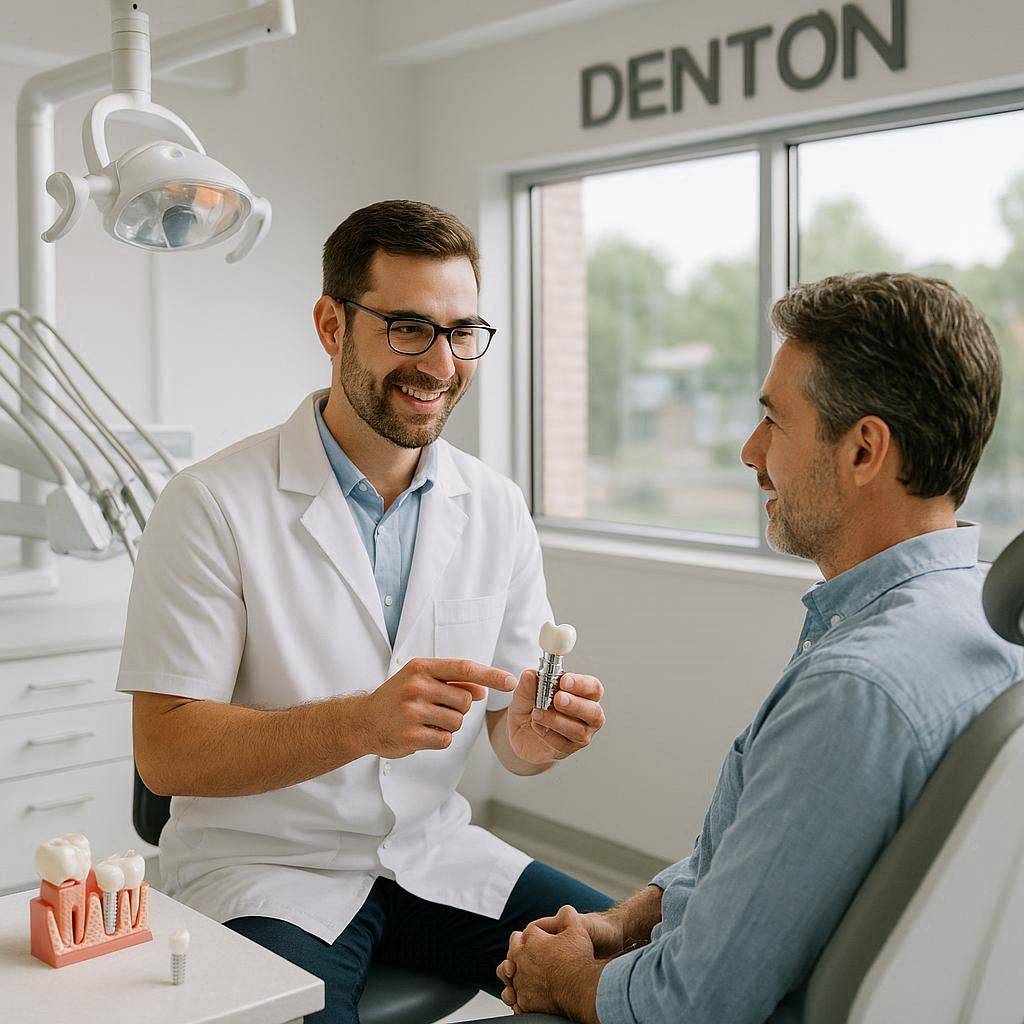
What Exactly Is a Dental Implant? (A Simple Explanation)
Let us break this down. A dental implant is not the crown you see on top. It is the artificial root that goes into your jawbone.
Think of it like this:
- The implant = a small titanium screw placed in the bone.
- The abutment = a connector piece on top of the screw.
- The crown = the visible, tooth-colored replacement.
Together, these three parts act just like a real tooth. The implant fuses with your bone through a process called osseointegration. That sounds technical, but it simply means your bone grows tightly around the titanium. This gives you unmatched stability.
Important note: Unlike bridges or dentures, implants do not slip, click, or damage neighboring teeth. They stand completely on their own.
Why Are Dental Implants So Popular in Denton?
Denton has grown quickly over the last ten years. With more families and professionals moving here, the demand for quality, long-term dental solutions has risen. People no longer want temporary fixes. They want permanent results.
Here is why so many Denton residents choose implants:
- Natural feel and appearance. No one will ever know you have an implant unless you tell them.
- Preserves jawbone health. When you lose a tooth, the bone starts shrinking. Implants stop that process.
- No food restrictions. Eat steak, apples, nuts, or anything else without worry.
- Easy cleaning. Brush and floss normally. No special soaks or adhesives.
- Long-term value. A bridge might last 7 to 10 years. A well-maintained implant can last a lifetime.
Dr. Sarah Mitchell, a Denton implant specialist, puts it simply: “Patients tell me they forget they even have an implant. That is the ultimate compliment.”
Who Is a Good Candidate for Dental Implants in Denton?
The short answer: most healthy adults.
But let us get more specific. You are a good candidate if:
- You have one or more missing teeth.
- Your jawbone is fully grown (usually over age 18).
- You have healthy gums (no active gum disease).
- You do not smoke heavily (smoking slows healing).
- You are committed to good oral hygiene.
Even if you have bone loss, do not lose hope. Many Denton dental offices offer bone grafting procedures. A graft rebuilds the bone so you can still get implants.
Conditions That Need Extra Attention
Some health conditions require careful planning. These include:
- Uncontrolled diabetes
- Autoimmune diseases
- Radiation therapy to the jaw area
- Heavy alcohol use
None of these automatically disqualify you. They just mean your dentist will create a customized treatment plan.
Comparing Tooth Replacement Options (A Clear Table)
Let us look at how implants stack up against other solutions. This table uses realistic, Denton-specific information.
| Feature | Dental Implant | Fixed Bridge | Removable Denture |
|---|---|---|---|
| Longevity | 20+ years (often lifetime) | 7–12 years | 5–8 years |
| Bone preservation | Yes | No | No |
| Affects nearby teeth? | No | Yes (shaving down healthy teeth) | No |
| Comfort | Like natural teeth | Good | Can slip or rub |
| Cleaning | Normal brushing/flossing | Requires special floss | Needs nightly removal |
| Average cost in Denton | 3,500–5,500 per tooth | 2,000–4,000 per unit | 800–2,500 per arch |
| Insurance coverage | Partial | Often covered | Frequently covered |
As you see, implants have a higher upfront cost. But over twenty years, they often become the cheaper option because you do not keep replacing them.
The Step-by-Step Process for Dental Implants in Denton
Every patient’s journey is slightly different. However, most follow this general timeline.
Step 1: Initial Consultation (Day 1)
You meet with a Denton implant dentist. They will:
- Examine your teeth and gums.
- Take 3D scans (CBCT) of your jawbone.
- Discuss your medical history.
- Give you a written treatment plan with costs.
Question to ask: “How many implants have you placed in the last year?” A good answer is 50 or more.
Step 2: Preparatory Work (If Needed)
Some patients need bone grafting, sinus lifts, or gum disease treatment. This adds 3 to 9 months of healing. Do not skip this step. A strong foundation is everything.
Step 3: Implant Placement (Surgery Day)
This is a minor surgical procedure. Your dentist numbs the area completely. Many also offer sedation (pill, nitrous oxide, or IV). You will feel pressure but not pain.
The procedure takes 30 to 60 minutes for one implant. For multiple implants, plan on 1.5 to 2.5 hours.
Realistic expectation: You will have some swelling and mild soreness for 2 to 4 days. Over-the-counter pain relievers usually work fine.
Step 4: Osseointegration (Healing Phase)
This is the waiting period. Your bone fuses with the implant. It takes 3 to 6 months. During this time, you wear a temporary partial denture or bridge so you can smile and eat normally.
Step 5: Abutment Placement (15-Minute Visit)
Once healing is complete, the dentist attaches a small metal or zirconia connector (the abutment) to the implant. This sticks out just above the gum line. You will wait another 2 weeks for the gums to shape around it.
Step 6: Final Crown Placement (Final Visit)
Your custom-made crown is screwed or cemented onto the abutment. The dentist checks your bite and makes small adjustments. That is it. You walk out with a new tooth.
Total time: 4 to 9 months from start to finish.
How Much Do Dental Implants Cost in Denton? (Realistic Numbers)
Let us talk honestly about money. This is the number one question people ask.
A single dental implant in Denton typically costs 3,800to3,800to5,200 when you include:
- The implant fixture (the screw)
- The abutment
- The crown
- The surgical placement
Here is a realistic breakdown from three Denton dental offices (anonymous averages):
| Service | Low range | High range |
|---|---|---|
| Consultation and 3D scan | $150 | $350 |
| Implant placement (surgical fee) | $1,500 | $2,500 |
| Abutment | $300 | $600 |
| Porcelain crown | $1,200 | $2,000 |
| Total one implant | $3,150 | $5,450 |
Additional costs to plan for:
- Bone graft: 400–1,200 per site
- Sinus lift: 1,500–3,000
- Extraction of failed tooth: 150–400
- Sedation (IV): 300–600
Many Denton offices offer payment plans through CareCredit, LendingClub, or in-house financing. Some even provide a 5% to 10% discount if you pay in cash or check.
Does insurance help?
Most dental insurance does not fully cover implants. However, many plans cover parts like:
- The crown (50% after deductible)
- The extraction
- The bone graft
Call your insurance company and ask: “What is my coverage for implant-supported crowns?” Be persistent. The first representative might not know.
Single Tooth vs. Multiple Teeth vs. All-on-4
Different problems require different solutions.
Single Tooth Implant
Best for one missing tooth. One implant + one crown.
Multiple Implants (Implant Bridge)
If you have three missing teeth in a row, you do not need three implants. Two implants can support a three-unit bridge. This saves money and surgery time.
All-on-4 (Full Arch)
For patients missing all teeth on the upper or lower jaw. Four implants support a fixed denture. You never remove it. It feels much more natural than traditional dentures.
All-on-4 cost in Denton: 15,000to25,000 per arch.
Implant-Supported Overdenture
Two to four implants help snap a removable denture in place. It stays firm but you can still take it out for cleaning. A great middle-ground option.
Cost: 7,000to15,000 per arch.
Finding the Best Dentist for Dental Implants in Denton
Not all dentists are the same. Some have taken hundreds of hours of implant training. Others place only a few per year.
Here is how to find a true expert:
Credentials to look for:
- Diplomate, American Board of Oral Implantology (ABOI) – The highest certification.
- Fellow or Master, International Congress of Oral Implantologists (ICOI) – Excellent advanced training.
- Oral surgeon or periodontist – Specialists in surgery and gum health.
Questions to ask during your consultation:
- “How many implants do you place per month?”
- “What brand of implants do you use?” (Nobel Biocare, Straumann, Zimmer, and Hiossen are all reputable.)
- “Do you have before-and-after photos of Denton patients?”
- “What is your success rate for non-smokers?” (Should be 97% or higher.)
- “Who handles the emergency if the implant fails?”
Warning signs to avoid:
- An office that quotes you without an exam or X-ray.
- A dentist who says “they are all the same” regarding implant brands.
- No published reviews or patient photos.
Local tip: The Denton County Dental Society keeps a referral list of experienced implant providers. Ask your general dentist for a referral.
The Healing Timeline: What to Expect Week by Week
Many patients worry about pain and downtime. Here is a realistic day-by-day look.
Day of surgery
You go home with gauze over the site. Bite down gently for 30 minutes. Numbness wears off after 3 to 5 hours.
Day 1 to 3
Some swelling and bruising. Use ice packs (20 minutes on, 20 off). Eat soft foods like yogurt, soup, scrambled eggs. Do not spit or use a straw.
Day 4 to 7
Swelling goes down. You can return to office work or light activity. Avoid heavy lifting or gym workouts.
Week 2 to 6
The area feels almost normal. You forget anything happened. But the bone is still healing underneath. Continue eating on the opposite side.
Month 3 to 6
Bone fusion is nearly complete. Your dentist takes an X-ray to confirm. You are ready for the abutment and crown.
Total recovery to full function: about 4 months.
Advantages and Disadvantages (Balanced and Honest)
Let us be fair. Implants are wonderful, but they are not perfect for everyone.
Advantages ✅
- Long-lasting. Often a lifetime solution.
- No damage to adjacent teeth. Bridges require grinding healthy teeth down.
- Preserves facial structure. Prevents the “sunken” look from bone loss.
- High success rate. Over 97% for lower jaw, 95% for upper jaw.
- Easy maintenance. Brush, floss, see your dentist.
Disadvantages ❌
- Higher upfront cost. $4,000+ per tooth is a real investment.
- Surgery required. Some people feel anxious about minor procedures.
- Long timeline. 4 to 9 months from start to finish.
- Not for heavy smokers. Smoking dramatically raises failure risk.
- Possible need for bone graft. Adds time and expense.
A word from a Denton patient: “I put off implants for three years because of the cost. Looking back, I wasted money on two bridges that failed. Just do it right the first time.” — Mark, Denton resident.
Caring for Your Dental Implants: A Simple Routine
Good news: caring for implants is almost identical to caring for natural teeth.
Daily home care:
- Brush twice a day with a soft toothbrush.
- Floss once daily using implant-specific floss or superfloss.
- Use a water flosser (Waterpik) on low pressure to clean around the abutment.
Professional maintenance:
- See your hygienist every 6 months.
- Your hygienist will use plastic scalers (metal ones can scratch the crown).
- X-rays every 12 to 24 months to check bone levels.
What to avoid:
- Chewing ice or hard candy (can crack the crown).
- Using your teeth as tools (opening packages).
- Skipping cleanings (plaque can cause peri-implantitis – a gum infection around the implant).
Peri-implantitis is the number one cause of implant failure after the first year. It is preventable with good hygiene.
Myths and Misconceptions About Dental Implants
Let us clear up some common misinformation.
Myth 1: “Implants are painful.”
Truth: The surgery itself is painless due to anesthesia. Afterward, most patients say it is easier than a tooth extraction. Over-the-counter pain relievers handle the soreness.
Myth 2: “My body will reject the implant.”
Truth: Titanium is biocompatible. The body does not “reject” it like an organ transplant. Failure happens from infection, smoking, or poor bone quality – not rejection.
Myth 3: “I am too old for implants.”
Truth: Age is not a factor. Healthy 80 and 90-year-olds get implants successfully. The only real age limit is young children whose jaws are still growing.
Myth 4: “Dental implants look fake.”
Truth: Modern crowns are made from layered zirconia or porcelain that mimics natural enamel. Your dentist matches color, shape, and translucency to your other teeth.
Myth 5: “Insurance never covers anything.”
Truth: More plans now offer implant benefits. Some cover 50% of the crown. Others include a yearly implant allowance. Always check.
What If an Implant Fails?
Let us be honest. Even with a skilled dentist, failures happen. The overall success rate is high, but a small percentage of implants do not integrate.
Early failure (first 3-6 months):
- Cause: Infection, poor bone quality, smoking, overheating during surgery.
- Solution: Remove the implant, let the area heal for 2 months, then try again (often free or discounted).
Late failure (after 1+ years):
- Cause: Peri-implantitis (gum disease), grinding/clenching, trauma.
- Solution: Depends on bone loss. Sometimes salvageable with deep cleaning and antibiotics. Severe cases require removal.
Do you get a refund?
Most dentists offer a warranty, but read the fine print. Typical warranties cover:
- Implant fixture failure within 1 year: free replacement.
- Crown fracture within 3 years: free replacement.
- Labor and bone grafting: often not covered.
Ask upfront: “If my implant fails, what exactly do I pay again?” A transparent dentist will answer clearly.
Frequently Asked Questions (FAQ)
1. How long do dental implants last?
With proper care, 20 years to a lifetime. The crown may need replacement after 10–15 years, but the implant itself lasts.
2. Can I get dental implants if I have gum disease?
Not immediately. You must treat the gum disease first. Once your gums are healthy, you can proceed.
3. Does Medicare or Medicaid cover implants?
Original Medicare does not. Some Medicare Advantage plans (Part C) offer limited implant benefits. Medicaid rarely covers implants except for children in certain states.
4. Are same-day implants possible in Denton?
Yes, some offices offer immediate load implants. But not everyone is a candidate. Your bone must be very dense. Ask your dentist if you qualify.
5. How do I clean under a fixed bridge on implants?
Use superfloss, interdental brushes, or a water flosser. Your hygienist will show you the proper technique.
6. Will my dental implants affect my sinuses?
Upper implants near the sinuses can sometimes protrude into the sinus cavity. A CBCT scan prevents this. If needed, a sinus lift creates more space.
7. Can I have an MRI with dental implants?
Yes. Titanium is non-magnetic and MRI-safe. Older stainless steel implants (rare today) may cause artifacts.
8. What is the recovery time for bone grafting?
Three to nine months before implant placement. The graft needs time to turn into living bone.
9. Do dental implants feel different from real teeth?
Most patients say they feel exactly the same. You cannot feel the screw. You feel pressure through your natural nerve endings.
10. How do I choose between a Denton dentist and a Dallas specialist?
Denton offers excellent care at slightly lower prices than Dallas. However, complex cases (severe bone loss, full mouth reconstruction) may benefit from a specialist.
Conclusion (Three-Line Summary)
Dental implants in Denton provide a permanent, natural-looking solution for missing teeth that preserves your jawbone and restores full chewing ability. The process takes four to nine months and costs 3,800to5,200 per tooth, but financing options and long-term value make it a smart investment. Choose an experienced local dentist, commit to good oral hygiene, and you can expect your implant to last a lifetime.
Additional Resource
For a list of verified implant dentists in Denton, free cost guides, and patient reviews, visit the Texas Academy of Implant Dentistry referral page:
🔗 www.taid.org/find-a-dentist-denton
Disclaimer
This article is for informational purposes only and does not constitute medical or dental advice. Always consult a qualified dental professional for a complete examination and personalized treatment recommendations. Results and costs vary by individual case and provider. The author and publisher are not liable for any actions taken based on this content.