Dental Implants in Bethesda MD
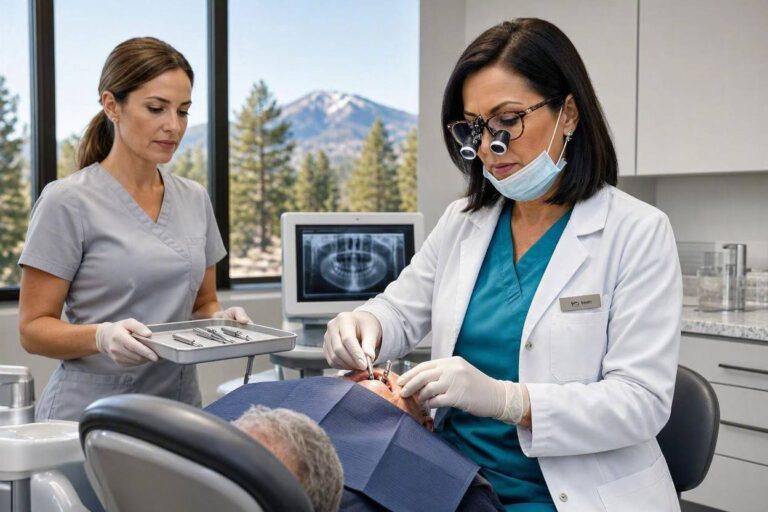
If you are missing one tooth, several teeth, or all of them, you have probably heard about dental implants. And you might be searching for dental implants in Bethesda MD because you want a solution that feels natural, lasts a long time, and lets you eat, smile, and talk without worry.
You are not alone. Every year, thousands of people in the Bethesda area choose implants over dentures or bridges.
But let us be clear from the start: dental implants are surgery. They are not right for everyone. They require time, money, and commitment. That is why this guide exists—to give you the real story, not just the highlight reel.
We will walk through everything step by step. No rushed decisions. No hidden surprises. Just useful, honest information from a writer who has researched this topic deeply for readers just like you.
By the end, you will know exactly what questions to ask, what to expect, and whether implants are the right choice for your life and your budget.
Important note for readers: This article is for educational purposes. It does not replace a clinical exam or professional medical advice. Always consult a licensed dentist or oral surgeon in Bethesda for a personal evaluation.
What Exactly Are Dental Implants? (And Why Bethesda Residents Love Them)
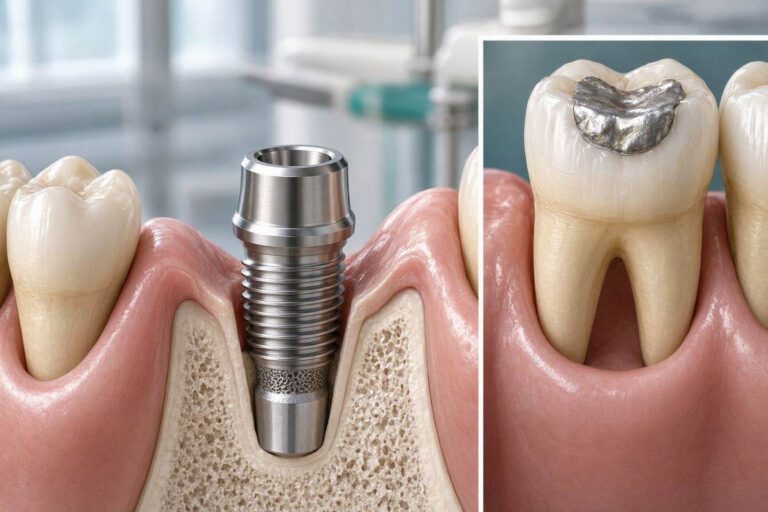
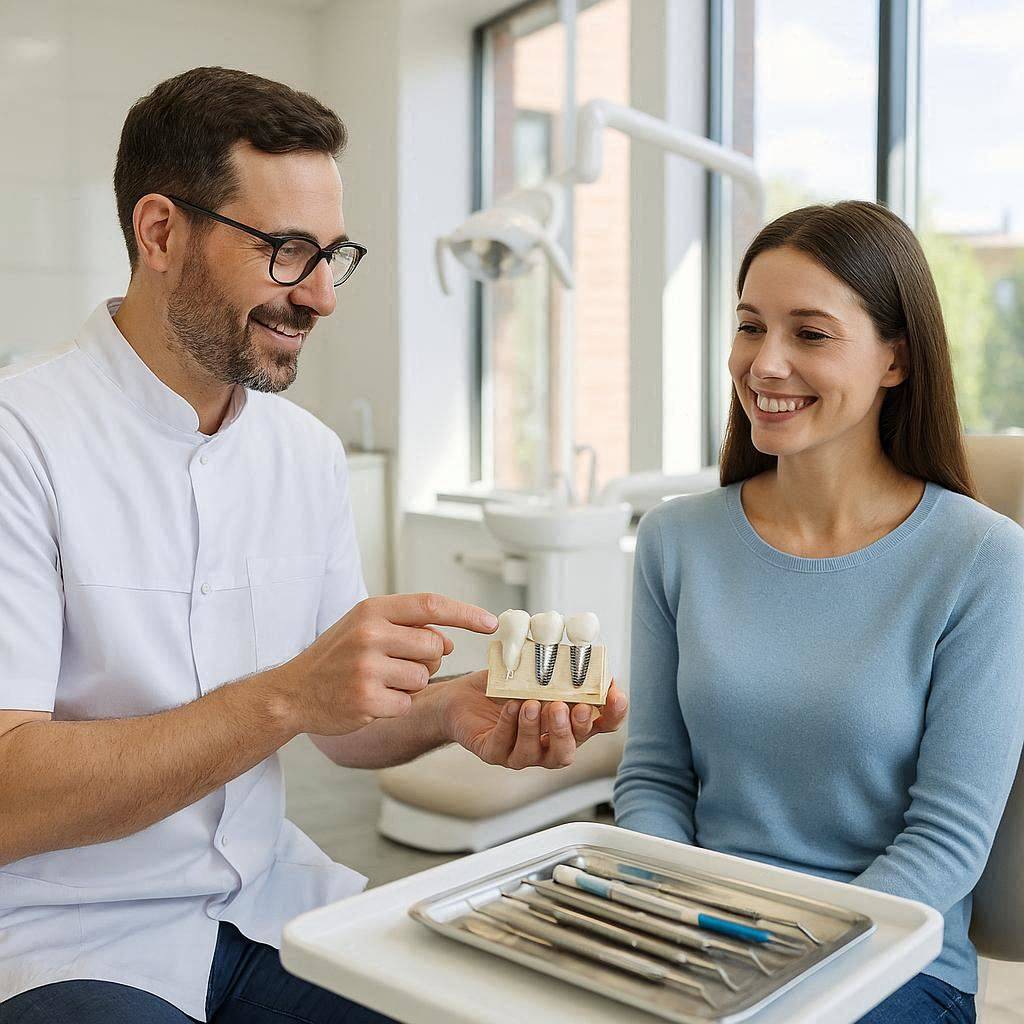
Let us start with the basics. A dental implant is not just a fake tooth. It is a three-part system designed to replace the entire tooth—from root to crown.
The three parts of a dental implant
| Component | What it is | What it does |
|---|---|---|
| Implant post | A small screw made of titanium or zirconia | Surgically placed into your jawbone. Acts as the new root. |
| Abutment | A small connector piece | Attaches to the post and sticks out just above the gum line |
| Crown | The visible “tooth” part | Custom-made to match your natural teeth in shape, size, and color |
Why implants are different from bridges or dentures
Traditional bridges rely on adjacent teeth for support. Dentures sit on top of your gums. Implants, on the other hand, fuse directly with your bone through a process called osseointegration.
That fusion creates two huge advantages:
- Stability. Your implant will not slip or click when you eat or speak.
- Bone preservation. When you lose a natural tooth, the jawbone in that area begins to shrink. Implants stimulate that bone, keeping it healthy and strong.
Many Bethesda residents choose implants for exactly these reasons. They want a permanent fix. They do not want to worry about adhesives, slipping dentures, or damaging healthy teeth.
A quick reality check
Implants are excellent. But they are not magic.
You need healthy gums. You need enough bone. You need to be willing to maintain good oral hygiene for life. And you need to be patient—the entire process usually takes several months.
If that sounds reasonable, keep reading.
Who Is a Good Candidate for Dental Implants in Bethesda MD?
Not everyone walks into a Bethesda dental office and walks out with an implant the same day. In fact, most people need some preparation first.
The ideal candidate checklist
Let me be straightforward. The best candidates share these traits:
- Good general health. Uncontrolled diabetes, active cancer treatment, or autoimmune disorders can affect healing.
- Healthy gums. No active gum disease (periodontitis). That needs treatment first.
- Enough jawbone density. If your bone has shrunk too much, you may need a bone graft.
- Nonsmoker or willing to quit. Smoking dramatically increases implant failure rates.
- Committed to oral hygiene. Implants do not decay, but the gums around them can get infected (peri-implantitis).
- Patient and realistic. The process takes months. You may feel some discomfort after surgery.
What about age?
Age alone is not a problem. Healthy adults from their early 20s to their 90s receive implants successfully. The real question is bone health and healing ability, not your birthday.
Common reasons Bethesda residents lose teeth
| Reason | Percentage of cases (approx.) |
|---|---|
| Tooth decay | 40% |
| Gum disease | 35% |
| Injury or trauma | 15% |
| Genetic absence (never grew a tooth) | 10% |
Each of these situations can be treated with implants, but the underlying cause must be managed first. For example, if gum disease caused your tooth loss, you need to control that infection before placing an implant.
Important note for readers: Do not assume you are not a candidate. Many people who think they have “too much bone loss” or “bad gums” can still get implants after proper preparation. A consultation is the only way to know.
The Step-by-Step Process of Getting Dental Implants in Bethesda MD
Let me walk you through what actually happens. This is not a one-day miracle. But for most patients, it is manageable, predictable, and worth the wait.
Step 1: Initial consultation and digital imaging
You will meet with a dentist or oral surgeon. They will:
- Review your medical history
- Examine your mouth and gums
- Take a CBCT scan (3D X-ray) to see your bone in detail
- Discuss your goals and budget
This visit usually takes 30 to 60 minutes. Expect to pay 100to300 for the exam and scan, though some offices apply that fee toward your treatment.
Step 2: Treatment planning
Your dental team will create a custom plan. They will decide:
- How many implants you need
- Whether you need bone grafting or sinus lift
- Which type of implant (single, multiple, All-on-4, etc.)
- The timeline and cost
Step 3: Preparatory procedures (if needed)
Not everyone needs these, but many do.
| Procedure | What it is | Healing time |
|---|---|---|
| Bone graft | Adds bone material to a weak or thin jaw | 4–9 months |
| Sinus lift | Raises the sinus floor to make room for implants in the upper jaw | 4–9 months |
| Tooth extraction | Removes a damaged tooth that cannot be saved | 4–8 weeks before implant placement |
Yes, these add time. But skipping them almost guarantees failure. A good Bethesda dentist will never cut corners here.
Step 4: Implant placement surgery
This is the main event. Here is what to expect:
- Anesthesia: Local anesthetic numbs the area. You are awake but feel no pain. Sedation options (nitrous oxide, oral sedatives, or IV sedation) are available for nervous patients.
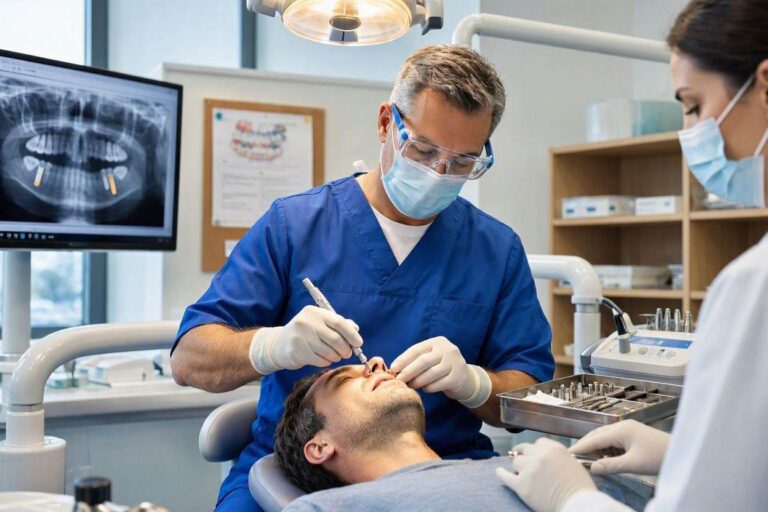
- Procedure: The dentist makes a small cut in your gum, drills a precise hole in the bone, and screws in the implant post.
- Duration: 15 to 30 minutes for a single implant. Two to three hours for multiple implants.
- After surgery: You will have stitches (often dissolvable) and a temporary tooth if needed.
Most people describe the experience as “pressure but no pain.” The injection is the worst part.
Step 5: Osseointegration – the waiting game
Now the real work begins. Your bone needs to grow around the implant and lock it in place. This takes:
- Lower jaw: 3 to 4 months
- Upper jaw: 4 to 6 months (bone is softer here)
During this time, you eat soft foods, avoid chewing directly on the implant, and keep the area very clean. You will have a temporary tooth or a flipper (removable partial denture) if esthetics are a concern.
Step 6: Abutment placement
Once the implant is fully fused, your dentist reopens the gum (small incision) and attaches the abutment. This is a short visit—usually 30 minutes. Healing around the abutment takes another two weeks.
Step 7: Crown fabrication and placement
Your dentist takes impressions or a digital scan of your mouth. A dental lab creates your permanent crown. This takes two to four weeks.
When the crown arrives, your dentist checks the fit, bite, and color. Then they cement or screw it onto the abutment.
Congratulations. You now have a new tooth that looks, feels, and functions like a natural one.
Total timeline summary
| Step | Approximate duration |
|---|---|
| Consultation & planning | 1–2 weeks |
| Bone graft (if needed) | 4–9 months healing |
| Implant surgery | 1 day |
| Osseointegration | 3–6 months |
| Abutment & crown | 3–6 weeks |
| Total (no graft) | 4–8 months |
| Total (with graft) | 10–14 months |
Yes, that is a long time. But remember: once healed, a properly cared-for implant can last 30 years, 40 years, or even a lifetime.
Types of Dental Implants: Which One Is Right for You?
Not all implants are the same. The right type depends on how many teeth you are missing and your bone condition.
Single tooth implant
Exactly what it sounds like. One implant post, one crown.
Best for: People missing just one tooth.
Pros: Does not touch adjacent teeth. Easy to clean.
Cons: Higher upfront cost than a bridge (but often cheaper long-term).
Multiple implants for several missing teeth
If you have three or four missing teeth in a row, you do not need one implant per tooth. Two or three implants can support a bridge (a set of connected crowns).
Best for: Patients with gaps but still have some natural teeth.
Pros: Fewer implants means lower cost and less surgery.
Cons: Harder to floss between the crowns. Requires a dental hygienist’s help.
Implant-supported overdenture
This is for people missing all teeth in one arch (upper or lower). Instead of a traditional denture that sits on gums, this denture snaps onto two to four implants.
Best for: Patients who want dentures but hate the rocking and slipping.
Pros: Much more stable than regular dentures. Removable for cleaning.
Cons: Still covers the roof of your mouth (upper). Can be bulkier than fixed options.
All-on-4 or All-on-6
This is the premium option for full-arch replacement. Four or six implants support a fixed, non-removable bridge of 12 to 14 teeth.
Best for: Healthy patients who want the closest thing to natural teeth.
Pros: Fixed in place. You never take it out. Feels and looks incredible.
Cons: Expensive. Harder to clean underneath. Requires excellent home care.
| Type | Number of implants | Fixed or removable | Cost range (Bethesda) |
|---|---|---|---|
| Single implant | 1 | Fixed | 4,000–6,500 |
| Implant bridge (3–4 teeth) | 2–3 | Fixed | 7,000–15,000 |
| Overdenture (full arch) | 2–4 | Removable | 10,000–20,000 |
| All-on-4 (full arch) | 4–6 | Fixed | 25,000–40,000 per arch |
Important note for readers: These are per arch numbers. Full mouth (upper and lower) All-on-4 can cost 50,000to80,000 or more in Bethesda. Do not be shocked. This is normal for a high-cost metropolitan area.
Cost of Dental Implants in Bethesda MD: Real Numbers, No Tricks
Let us talk money. Bethesda is not a low-cost area. Montgomery County has some of the highest dental fees in Maryland. But you also have access to some of the best specialists.
Breaking down the costs
A single implant is rarely just one price. Here is the real breakdown:
| Service | Typical cost |
|---|---|
| Consultation & CBCT scan | 150–350 |
| Extraction (if tooth is present) | 200–600 |
| Bone graft (if needed) | 500–2,500 |
| Implant post placement | 1,500–3,000 |
| Abutment | 300–600 |
| Custom crown | 1,500–2,500 |
| Total single implant | 4,150–4,150–9,550 |
Most Bethesda patients pay between 4,500and4,500and6,500 for a straightforward single implant with no bone graft.
Why is Bethesda more expensive?
Three reasons:
- Overhead. Rent, salaries, and equipment costs are higher here.
- Specialist fees. Many implants are placed by periodontists or oral surgeons, not general dentists.
- Lab fees. High-quality crowns made in US labs cost more than overseas crowns.
Does insurance cover implants?
Some plans cover a portion. Here is the truth:
- Rarely 100%. Most plans cap implant coverage at 1,000–2,000 per year.
- Often a waiting period. Many plans make you wait 6–12 months after enrollment.
- Crowns are usually covered better. Some plans cover 50% of the crown but not the implant post.
Call your insurance before your consultation. Ask: “Do you cover implant posts? What percentage? Is there a waiting period? What is my annual maximum?”
Financing options in Bethesda
You do not have to pay everything upfront. Most dental offices offer:
- CareCredit: Medical credit card with 6, 12, or 18 months interest-free (if paid in full).
- LendingClub or Alphaeon: Fixed-rate dental loans.
- In-house payment plans: Some Bethesda dentists offer monthly payments with no interest.
- Health Savings Account (HSA) or Flexible Spending Account (FSA): Use pre-tax dollars.
A realistic word: Cheap implants usually mean cheap materials, rushed work, or inexperienced providers. This is major surgery. Do not shop by price alone. A failed implant costs more to remove and redo than a successful one costs upfront.
Recovery, Pain, and Healing: What You Will Actually Feel
Let me be honest with you. Many online guides make recovery sound like a walk in the park. It is not terrible, but it is not nothing either.
The first 24 to 72 hours
Immediately after surgery:
- Numbness for 2–4 hours. You cannot feel your lip, cheek, or tongue. Do not eat hot food or drink hot liquids.
- Bleeding. Mild oozing is normal. Bite on gauze for 30–60 minutes.
- Swelling. Peaks at 48 hours. Use ice packs (20 minutes on, 20 off).
- Pain. Most people rate it 3–5 out of 10. Over-the-counter ibuprofen (Advil) usually works. Some need prescription painkillers for 1–2 days.
- Diet. Cold soft foods only: smoothies, yogurt, applesauce, pudding, cold soup.
Days 4 to 14
Swelling goes down. Bruising may appear on your neck or chin (normal). You can switch to warm soft foods: mashed potatoes, scrambled eggs, oatmeal, well-cooked pasta.
Do not use a straw. Do not spit forcefully. Do not smoke or vape. These actions can dislodge the blood clot and cause a dry socket (very painful).
Weeks 3 to 12
You will forget you had surgery. The implant feels like part of your jaw. You can eat normally but avoid extremely hard or sticky foods directly on the implant site (no taffy, no whole nuts, no ice cubes).
Signs of trouble (call your dentist immediately)
- Bleeding that soaks through a gauze pad every hour
- Severe pain not relieved by medication
- Fever over 101°F (38.3°C)
- Pus or foul taste (possible infection)
- The implant feels loose (rare but serious)
What most patients say after a week
“The first two days were uncomfortable, but ibuprofen handled it. By day five, I forgot it was there except when I brushed. I am glad I did it.”
— Bethesda patient, age 52, single molar implant
Risks and Complications: Being Realistic
You deserve the truth. Dental implants have a success rate of 95–98% over 10 years. That is excellent. But failure happens.
Early failures (within first 3–6 months)
These usually mean the bone did not fuse with the implant.
- Infection at the surgical site
- Overheating bone during drilling (technique issue)
- Patient smokes (smokers have 2–3x higher failure rate)
- Uncontrolled diabetes (poor healing)
Late failures (after crown is placed)
- Peri-implantitis: Gum disease around the implant. Causes bone loss and loosening.
- Bruxism (teeth grinding): Crushing force can break the crown or the implant screw.
- Poor oral hygiene: Plaque builds up below the gum line.
Can an implant be replaced if it fails?
Yes. But it costs almost as much as the original. And you may need a bone graft to repair the damage. This is why prevention—good hygiene, no smoking, regular checkups—matters so much.
Important note for readers: A good Bethesda dentist will never guarantee your implant for life. But they should offer a warranty on the crown (usually 1–5 years) and on the implant post itself (often 10 years to lifetime from manufacturers like Nobel Biocare or Straumann).
How to Choose the Right Dentist for Dental Implants in Bethesda MD
Not every dentist places implants the same way. Here is how to find a true expert.
Three types of implant providers in Bethesda
| Provider type | Who they are | Best for |
|---|---|---|
| General dentist with implant training | Family dentist who took weekend courses | Single, easy implants on healthy patients |
| Periodontist | Gum and bone specialist. 3 extra years of training | Most implants. Experts in bone grafts and gum health. |
| Oral surgeon | Surgical specialist. 4–6 years of hospital-based training | Complex cases: full arch, sinus lifts, nerve repositioning, sedation |
Questions to ask before booking
Write these down. Bring them to your consultation.
- How many implants have you placed in the last year?
(Look for 50+ per year for a general dentist, 100+ for a specialist.) - What is your success rate?
(Anything below 95% is a red flag.) - Do you use a CBCT scanner in-house?
(Yes = better planning. No = old-school, less precise.) - What brand of implants do you use?
(Straumann, Nobel Biocare, Zimmer Biomet are top-tier.) - Do you have before-and-after photos of similar cases?
- Who handles the crown? Do you have an in-house lab or outside lab?
(In-house = faster. Outside lab = usually higher quality.)
Red flags to walk away from
- Prices that seem “too good to be true” (e.g., $1,999 for a full implant)
- No CBCT scanner
- No written treatment plan
- Rushing you to sign and pay the same day
- No discussion of risks or alternative treatments
Top Bethesda neighborhoods with implant specialists
You will find excellent providers in:
- Downtown Bethesda (Wisconsin Ave, Old Georgetown Rd)
- Friendship Heights
- Chevy Chase (just over the border)
- Near Suburban Hospital
Many specialists also serve patients from Rockville, Potomac, and Silver Spring.
Alternatives to Dental Implants (And When They Make Sense)
Implants are not always the best answer. Sometimes something simpler, cheaper, or faster works better for your situation.
Fixed dental bridge
A bridge grinds down the two teeth next to the gap and places a three-unit crown.
- Pros: No surgery. Faster (2–3 weeks). Lower upfront cost (2,500–4,500).
- Cons: Damages healthy teeth. Lasts 10–15 years, not lifetime. Can trap decay under the crowns.
Good for: People with healthy adjacent teeth who want a quick, less invasive fix.
Removable partial denture
A metal or plastic framework with one or more false teeth that clips onto natural teeth.
- Pros: Cheapest option (500–2,000). No drilling.
- Cons: Feels bulky. Can loosen over time. Accelerates bone loss. Many people never wear them.
Good for: Tight budgets or temporary solution while saving for implants.
Traditional dentures
Full set of false teeth for an entire arch.
- Pros: Lower cost (1,500–5,000 per arch). No surgery.
- Cons: Slipping, clicking, sore spots. Loss of taste. Bone shrinks over time. Need relining every few years.
Good for: Patients who cannot have surgery or cannot afford implants.
Do nothing
Yes, this is an option. If the missing tooth is in the back and does not affect chewing or your smile, you might leave the space.
Warning: Adjacent teeth will tilt. The opposing tooth will erupt (grow longer). Bone will shrink. This can cause bigger problems in 5–10 years.
| Solution | Cost (Bethesda) | Longevity | Surgery? | Feels natural? |
|---|---|---|---|---|
| Implant | 4,500–80,000 | 30+ years | Yes | Excellent |
| Bridge | 2,500–4,500 | 10–15 years | No (grinds teeth) | Good |
| Partial denture | 500–2,000 | 5–10 years | No | Fair |
| Do nothing | $0 | N/A | No | N/A – bone loss occurs |
Important note for readers: If you are healthy and can afford implants, they are almost always the best long-term investment. But if you cannot, do not feel ashamed. Bridges and dentures have helped millions of people. The best treatment is the one you can actually afford and maintain.
Caring for Your Dental Implants: Long-Term Success Guide
Once your implant is finished, you are not done. You must maintain it like a high-performance machine.
Daily cleaning routine
- Brush twice a day with a soft or extra-soft toothbrush. Nylon-coated “interdental” brushes work well around implants.
- Floss daily using implant-specific floss or superfloss (has a stiff end to thread under the bridge).
- Water flosser (Waterpik): Excellent for flushing food from under implant bridges. Use on low setting.
- Avoid: Metal scrapers, hard-bristle brushes, toothpicks that can scratch titanium.
Regular professional maintenance
See your hygienist every 3 to 6 months—not every 12 months. Implants need special plastic or graphite scalers (metal ones scratch the surface and trap bacteria).
Your dentist should check:
- Crown tightness (screws can loosen over years)
- Gum pocket depths around the implant (should be 3–4mm, not 5+)
- X-rays every 12–24 months to monitor bone levels
Lifestyle changes for implant longevity
| Do this | Avoid this |
|---|---|
| Stop smoking or vaping | Chewing ice, pens, or fingernails |
| Wear a nightguard if you grind | Opening bottles or packages with teeth |
| See your dentist regularly | Skipping cleanings for years |
A well-maintained implant can outlast you. A neglected implant can fail in 5–10 years. The choice is yours.
Frequently Asked Questions (FAQ)
1. Are dental implants painful?
The surgery is not painful because of local anesthesia. Afterward, most people rate discomfort 3–5/10 for 1–3 days. Over-the-counter pain relievers usually work.
2. How long do dental implants last?
With good care, 30 years to a lifetime. The crown may need replacement after 15–20 years, but the post usually stays.
3. Can I get dental implants if I have bone loss?
Yes, but you will likely need a bone graft first. Many Bethesda patients get grafts successfully.
4. Does insurance cover dental implants in Bethesda MD?
Partially, sometimes. Most PPO plans cover 30–50% of the crown and abutment. Few cover the implant post fully. Check your plan.
5. How much do full mouth dental implants cost in Bethesda?
Full mouth All-on-4 ranges from 50,000to80,000+. Implant-supported overdentures are 20,000–40,000 per arch.
6. Can I get a dental implant the same day as extraction?
Sometimes. This is called “immediate implant placement.” But it requires perfect conditions (no infection, enough bone). Most patients wait 4–8 weeks.
7. Are dental implants safe for seniors?
Yes, if they are healthy enough for minor surgery. Age is not a barrier. Many 80- and 90-year-olds receive implants successfully.
8. What is the failure rate for dental implants?
About 2–5% over 10 years. Smoking, uncontrolled diabetes, and poor oral hygiene raise the risk significantly.
9. How do I clean under an implant bridge?
Use a water flosser, superfloss (with a stiff end), or interdental brushes. Your hygienist will show you.
10. Can I have an MRI if I have dental implants?
Yes. Titanium implants are not magnetic. You can safely have MRIs, CT scans, and X-rays.
Additional Resource
For a current, vetted list of patient-reviewed implant specialists in Bethesda, Chevy Chase, and surrounding Montgomery County, visit:
🔗 Maryland State Dental Association – Find an Implant Dentist
(Search by zip code 20814 or 20815 for Bethesda providers with advanced implant training.)
Disclaimer
This article is for general informational purposes only and does not constitute medical or dental advice. Individual results, costs, and treatment plans vary. Always seek the advice of a licensed dentist or oral surgeon in Bethesda, MD, with any questions regarding your specific dental condition or treatment options. Do not disregard professional medical advice or delay seeking it based on anything you have read here.
Conclusion
Dental implants in Bethesda MD offer a permanent, natural-feeling solution for missing teeth, but they require time, money, and commitment. Success depends on choosing an experienced provider, maintaining excellent oral hygiene, and being realistic about healing and costs. For healthy patients, implants remain the gold standard—but bridges and dentures are still valid alternatives worth discussing with your dentist.
Ready to take the next step? Book consultations with two or three Bethesda implant specialists. Compare their treatment plans. Ask the questions from this guide. And choose the provider who makes you feel informed, not rushed.