Dental Implant Refunds After Failure
You made a significant investment in your smile. You trusted your dentist, followed the aftercare instructions, and hoped for the best. But now, something feels wrong. The implant is loose. There is pain. Or maybe your dentist just told you the hard news: the implant has failed.
First, take a deep breath. You are not alone, and you have options.
Many people believe that dental implants last a lifetime. In most cases, they do. But failures happen. When they do, the financial loss can feel overwhelming. You paid for a permanent solution, but you now face a broken tooth, bone loss, or even an infection.
This guide walks you through everything you need to know about dental implant failure refunds. We will look at why implants fail, who is responsible, how to ask for a refund, and when to take legal action. Our goal is to give you clear, realistic, and honest information. No false promises. No complicated legal words. Just practical help.
Let us start with the most important question.

Why Do Dental Implants Fail? (The Real Reasons)
Before you ask for a refund, you need to understand why your implant failed. The reason matters. It determines who is at fault and who should pay you back.
Dental implants fail for two main groups of reasons: surgical errors and biological issues. Sometimes, it is a mix of both.
Surgical Mistakes During Placement
Your dentist or oral surgeon has a big responsibility. Placing an implant requires precision. Even small errors can lead to failure.
Common surgical mistakes include:
- Incorrect positioning. If the implant goes in at the wrong angle, it cannot support a crown properly. This creates uneven pressure and leads to loosening.
- Damage to nearby nerves. This causes chronic pain or numbness, making the implant non-functional.
- Overheating the bone. Drilling creates heat. Too much heat kills bone cells, and the implant never fuses with the bone.
- Poor quality of the temporary crown. A poorly fitted temporary can micro-move the implant during healing.
Medical and Biological Issues
Sometimes, the surgeon does everything right, but your body rejects the implant. These cases are harder for refunds, but not impossible.
Biological causes include:
- Peri-implantitis. This is an infection around the implant. It destroys the bone and soft tissue. It can happen months or even years after placement.
- Insufficient bone density. If your jawbone is too soft, the implant cannot integrate. A good surgeon should check this before surgery.
- Uncontrolled diabetes or smoking. These factors reduce healing. A responsible dentist will warn you about them beforehand.
- Allergic reactions. Rare, but some people react to the titanium in the implant.
Manufacturer Defects
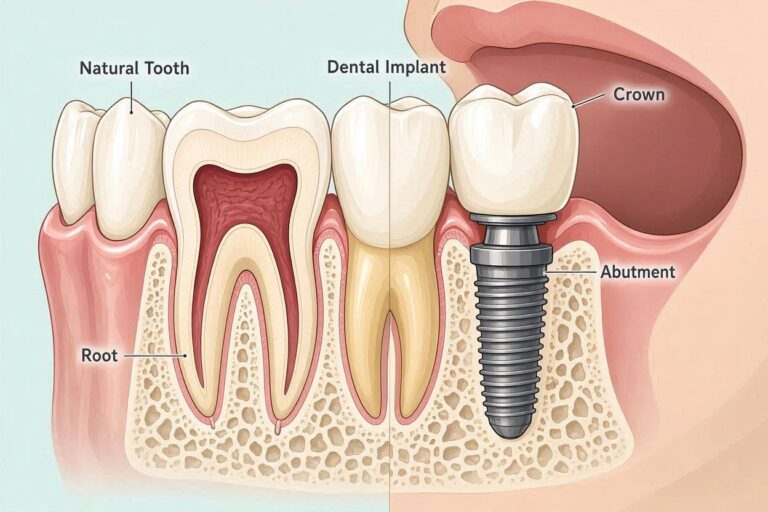
Yes, implants themselves can be faulty. The titanium screw might have a micro-crack. The surface coating might be poor. The abutment (the connector piece) might not fit perfectly.
These defects are uncommon, but they do happen. In these cases, the implant manufacturer, not your dentist, may owe you a refund.
Important note: If you grind your teeth at night (bruxism) or do not maintain good oral hygiene, you increase the risk of failure. These factors are usually your responsibility. Honest dentists will explain this before treatment.
Who Owes You a Refund? (The Short Answer)
There are three possible parties who might give you money back:
- Your dentist or oral surgeon – If they made a surgical error or failed to inform you of risks.
- The implant manufacturer – If the implant part was defective.
- Your dental insurance or warranty plan – If you purchased an additional protection plan.
Most refunds come from the dentist or the manufacturer. Sometimes, you get a partial refund from both.
Let us explore each one in detail.
Dental Implant Failure Refunds from Your Dentist
Your first conversation should be with the dentist who placed the implant. How you handle this conversation matters a lot.
When Your Dentist Should Offer a Refund
Your dentist is responsible for:
- Doing a proper pre-surgery evaluation (bone density, health history, X-rays)
- Using sterile, high-quality materials
- Placing the implant correctly
- Giving you clear aftercare instructions
- Recognizing early signs of failure and acting quickly
If the implant fails because the dentist made an obvious mistake, you deserve a refund. For example:
- The implant was placed too close to a nerve, causing permanent numbness.
- Your dentist did not treat an existing infection before surgery.
- You received no written aftercare instructions.
- The implant became loose within the first three months without any trauma or infection.
When a Refund Is Less Likely
Dentists are not miracle workers. Some failures happen despite perfect care. You are less likely to get a refund if:
- You smoked heavily during the healing period.
- You have uncontrolled diabetes or a condition that slows healing.
- You stopped brushing or flossing around the implant.
- The implant failed after five or more years of normal use.
In these cases, the dentist may still offer a discount on a new implant. But a full refund is rare.
How to Ask for a Refund (Step by Step)
Most people feel nervous asking a doctor for money back. That is normal. But remember: you paid for a service, and you did not receive the promised result. You have every right to ask.
Step 1: Gather your evidence.
Collect all your records. This includes:
- Receipts and payment history
- X-rays before and after the surgery
- Photos of the failed implant area
- Notes on your symptoms (when the pain started, what it felt like)
- Copies of any consent forms you signed
Step 2: Request a meeting in writing.
Send a calm, professional email or letter. Do not show up unannounced and angry. Write something like:
“Dear Dr. [Name], my implant placed on [date] has failed. I would like to meet with you to understand why this happened and discuss a financial adjustment. Please let me know when you are available.”
Step 3: Bring a support person.
Take a trusted friend or family member to the meeting. They can take notes and help you stay calm.
Step 4: Ask questions, then make your request.
Listen to the dentist’s explanation first. Then say:
“I understand. Given that the implant did not last as promised, I would like a full refund of my out-of-pocket costs.”
If they refuse a full refund, ask for a partial refund or a free replacement implant.
Step 5: Get the agreement in writing.
If the dentist agrees to any refund or discount, ask for a signed letter detailing the amount and timeline. Verbal agreements are hard to enforce later.
What If Your Dentist Refuses?
Do not panic. Many dentists will refuse at first. They hope you will go away. This is when you escalate.
You have several options:
- Contact your state dental board – File a formal complaint. The board will investigate if the dentist violated standards of care.
- Send a formal demand letter – Write a letter stating that you will sue in small claims court if they do not respond by a specific date.
- Leave honest reviews – Share your experience on Google, Yelp, and Healthgrades. Stick to facts to avoid defamation claims.
- Consult a lawyer – For implants costing over $5,000, a lawyer’s letter often changes the conversation.
Most dental implant refund cases settle before going to court. Dentists do not like lawsuits. It costs them time, money, and reputation.
Manufacturer Refunds for Defective Implants
Large implant companies like Straumann, Nobel Biocare, Zimmer, and Dentsply have warranty policies. These policies usually cover the implant part only, not the dentist’s surgical fee.
How Manufacturer Warranties Work
A typical implant warranty lasts between one and five years. Some premium warranties last ten years or a lifetime.
The warranty usually promises to replace the failed implant part for free. It does not cover:
- The cost of removing the old implant
- Bone grafting if the bone was damaged
- A new crown or abutment
- The dentist’s time for the replacement surgery
This is a common point of confusion. Patients think “lifetime warranty” means everything is free. That is not true. You will still pay hundreds or thousands for the dentist’s work.
How to File a Manufacturer Refund Claim
You cannot file this claim yourself. Your dentist must do it. The manufacturer only works with dental professionals.
Ask your dentist to send the following to the manufacturer:
- The failed implant part (cleaned and packaged)
- Pre- and post-operative X-rays
- A clinical report explaining the failure
- Proof of purchase from the dental supplier
If the manufacturer accepts the claim, they will send a replacement implant part to your dentist. At that point, your dentist may charge you only for the surgical placement, not for the new part.
Note: Some dentists include manufacturer warranties in their treatment plan. Ask your dentist before surgery: “What happens if the implant fails within two years?” Their answer tells you a lot about their ethics.
Dental Implant Warranty Plans: Are They Worth It?
You may have seen ads for third-party dental implant warranties. These are separate insurance plans that promise to cover replacement costs.
Most of these plans are not worth the money. Here is why:
- They have many exclusions (smoking, gum disease, grinding).
- They require strict maintenance visits every three to six months.
- The refund amount decreases over time.
- The claims process is slow and frustrating.
Example table: Typical third-party warranty vs. manufacturer warranty
| Feature | Third-party plan | Manufacturer warranty |
|---|---|---|
| Cost to you | 300–800 upfront | Free |
| Covers surgical fee? | Partial, often 50% | No |
| Covers new crown? | Rarely | No |
| Requires ongoing visits? | Yes, every 6 months | No |
| Claim difficulty | High | Medium |
| Worth buying? | Only if you have high risk factors | Yes, it is included |
Our advice: Skip the third-party warranty. Instead, choose a dentist who offers their own in-office guarantee. Some clinics promise one free replacement if an implant fails within five years, even if the failure is not their fault. That is a much better deal.
The Legal Path: Small Claims Court for Implant Refunds
If your dentist refuses any refund and you believe they made a clear error, small claims court is a realistic option. You do not need a lawyer. The process is designed for ordinary people.
When to Sue
Consider small claims court if:
- Your implant failed within 12 months of placement.
- You have clear evidence of negligence (wrong angle, wrong position, untreated infection).
- The dentist refuses to meet or respond to your letters.
- The amount you want is less than your state’s small claims limit (usually 5,000to10,000).
What You Can Claim
You can ask for:
- The full cost of the failed implant and crown
- The cost of removal at another dentist
- Your court filing fees
- Limited travel expenses to see specialists
You usually cannot claim pain and suffering or lost wages in small claims court.
The Process Simplified
- Send a final demand letter. Give the dentist 14 days to respond.
- File forms at your local courthouse. The fee is usually 30to100.
- Serve the dentist with notice. A sheriff or process server delivers the papers.
- Prepare your evidence. Organize photos, X-rays, receipts, and emails.
- Show up on your court date. Tell your story clearly to the judge.
- Collect if you win. The court does not collect for you. You may need to garnish wages or place a lien.
Most dentists will settle before the court date. They do not want a public record of losing a case to a patient.
Warning: If you signed an arbitration agreement before treatment, you may not be able to sue in small claims court. Read your consent forms carefully. Arbitration is private and often favors the dentist.
How Much Money Can You Realistically Get Back?
Let us be honest. Full refunds are rare unless the dentist made a serious error. Here is what most patients actually receive.
Typical refund scenarios:
| Situation | Likely refund | Notes |
|---|---|---|
| Surgical error (wrong position, nerve damage) | 75–100% of all fees | Includes removal and replacement at another clinic |
| Implant fails within 3 months, no clear cause | 50–75% of surgical fee | Dentist may offer free replacement instead |
| Peri-implantitis after 1 year | 0–30% of surgical fee | Often considered patient hygiene issue |
| Manufacturer defect | Cost of new part only | Patient pays for new surgery |
| Failure after 5+ years | 0% | Normal wear and tear |
Real example: A patient in Texas paid 6,200forasingleimplant.Itbecamelooseaftereightmonths.Thedentistadmittedtheimplantwasangledpoorly.Thepatientreceiveda5,000 refund and used it to see a specialist for the replacement.
Another example: A patient in Florida had an implant fail after two years due to peri-implantitis. The dentist said it was the patient’s poor flossing. The patient received no refund but was offered a new implant at 40% off.
How to Prevent Refund Headaches (Before You Get an Implant)
The best time to think about refunds is before your surgery. A few simple steps can save you thousands of dollars and months of stress.
1. Choose your dentist carefully
Do not go to the cheapest clinic or a dental chain that pushes aggressive sales. Look for:
- A board-certified periodontist or oral surgeon
- At least five years of implant experience
- Before-and-after photos of their own work
- Positive reviews mentioning longevity, not just price
2. Ask the right questions before signing
Write these questions down. Take them to your consultation.
- “What is your personal success rate with implants?”
- “What happens if my implant fails in the first year?”
- “Do you offer an in-office guarantee or warranty?”
- “Will you file a manufacturer claim for me if needed?”
- “Can you give me an estimate for a replacement if the first one fails?”
A good dentist will answer honestly. A bad dentist will dodge the questions or get defensive.
3. Get everything in writing
Do not rely on verbal promises. Ask for a treatment plan that includes:
- Total cost broken down by part (surgery, abutment, crown)
- Warranty terms (who pays for what, for how long)
- The exact brand and model of the implant
- A clause about failure refunds
Most dentists will not offer this automatically. You have to ask. If they refuse to put anything in writing, that is a red flag.
4. Understand your own health risks
Be honest with yourself. If you smoke, have diabetes, or grind your teeth, implant failure is more likely. That does not mean you cannot get implants. It means you need a dentist who is upfront about the risks and who offers a fair refund policy.
What to Do Immediately After an Implant Fails
Time matters. How you act in the first days and weeks can strengthen or weaken your refund case.
Do this right away:
- Stop using the implant. Do not chew on that side. Avoid irritating the area.
- See your original dentist for a diagnosis. Give them a chance to document the failure.
- Get a second opinion. Visit an independent dentist or periodontist. Ask for written notes on why they think the implant failed.
- Request all your records. X-rays, photos, notes, and consent forms. By law, the dentist must give you copies.
- Do not sign anything. Your dentist may ask you to sign a waiver or release before offering a discount. Do not sign without legal advice.
Do not do this:
- Do not post angry social media rants yet. That can hurt legal negotiations.
- Do not wait months to act. Most warranty claims have strict deadlines.
- Do not let the same dentist place a new implant for free without a clear explanation of why the first one failed.
Dental Implant Failure Refunds: Frequently Asked Questions (FAQ)
1. Can I get a refund if my implant fails after 10 years?
Probably not. Most warranties expire after 1 to 5 years. After 10 years, normal wear and tear or changes in your health are the likely causes. No dentist or manufacturer will refund a decade-old implant.
2. Does insurance cover failed implants?
Usually not. Most dental insurance plans cover only basic procedures like cleanings, fillings, and extractions. Some plans may cover the removal of a failed implant, but not a refund or replacement.
3. What is peri-implantitis, and does it qualify for a refund?
Peri-implantitis is a bone-destroying infection around the implant. If it happens within the first year and your dentist did not warn you about hygiene, you might get a partial refund. If it happens later, it is usually considered your responsibility.
4. Can I sue my dentist for a failed implant?
Yes, but only if you can prove negligence (error) and financial loss. Small claims court is the easiest path for amounts under $10,000. For larger cases, you need a lawyer and a dental expert witness, which costs thousands upfront.
5. How long do I have to ask for a refund?
It depends. Manufacturer warranties often have a 1-year or 2-year window. Legal claims have a statute of limitations, usually 2 to 4 years from the date of surgery or the date you discovered the failure. Do not wait.
6. Will a dentist blacklist me for asking for a refund?
No ethical dentist will blacklist you. If they do, that is a sign you should never return anyway. You have the right to ask for a refund. Most dentists prefer to negotiate rather than lose a patient entirely.
7. What if the implant failed because of another dentist’s crown?
That is complicated. If Dr. A placed the implant and Dr. B made the crown, they may blame each other. In this case, the implant manufacturer’s warranty still applies to the screw. For refunds, you need an independent evaluation to assign fault.
8. Is a free replacement as good as a refund?
Sometimes. If the dentist is highly skilled and the failure was bad luck, a free replacement saves you money. But if the dentist made an error, you want a refund so you can go elsewhere. Trust your gut.
Additional Resource
For independent, patient-friendly information on dental implant standards and how to file a complaint against a dentist, visit the American Dental Association’s patient resources page at https://www.ada.org/en/patient-resources (external link). You can also search for your state dental board using the term “[Your State] dental board complaint form” – these are official government agencies that investigate professional misconduct.
Conclusion (Summary in Three Lines)
Dental implant failure refunds are possible but rarely cover all your costs. Your best chance comes from proving surgical error within the first year or filing a manufacturer claim for a defective part. Before treatment, get warranty terms in writing and choose an experienced dentist who offers an in-office guarantee.
Disclaimer: This article is for informational and educational purposes only. It does not constitute legal, financial, or medical advice. Every dental implant case is unique. Laws regarding refunds, warranties, and malpractice vary by country, state, and province. You should consult with a qualified attorney and a dental professional for advice specific to your situation. The author and publisher assume no liability for any actions taken based on the contents of this guide.