Difference Between Dental Implants and Veneers
You look in the mirror and you see a smile that does not quite reflect how you feel inside. Maybe a tooth is missing entirely, leaving a gap that makes you self-conscious. Or perhaps your teeth are present but they are chipped, worn down, or stubbornly discolored. You know you want a change. You start researching online and you quickly run into two terms that dominate the conversation in restorative and cosmetic dentistry: Dental Implants and Veneers.
They both improve smiles. They both cost more than a simple filling. But they serve fundamentally different purposes. Confusing a dental implant for a veneer is like confusing a foundation replacement for a house with a fresh coat of paint. Both make the house look better, but one addresses structural integrity while the other addresses surface aesthetics.
This guide exists to remove that confusion. We will walk through every layer of the Difference Between Dental Implants and Veneers. We will explore the anatomy of your mouth, the precise steps of each procedure, the financial investment required, the pain levels involved, and the long-term consequences of choosing one path over the other. This is not a quick blog post. This is a deep, authoritative reference designed to give you the clarity you need before you ever sit in a dentist’s chair. Let’s begin by understanding the fundamental problem each solution aims to fix.
Understanding the Core Function: Restoration vs. Cosmetic Enhancement
Before we look at materials or costs, we must anchor ourselves in the primary purpose. The most significant difference between these two treatments lies in what they are designed to achieve. One is a medical prosthetic designed to replace a body part. The other is an aesthetic shell designed to hide imperfections.
The Dental Implant: Replacing the Root
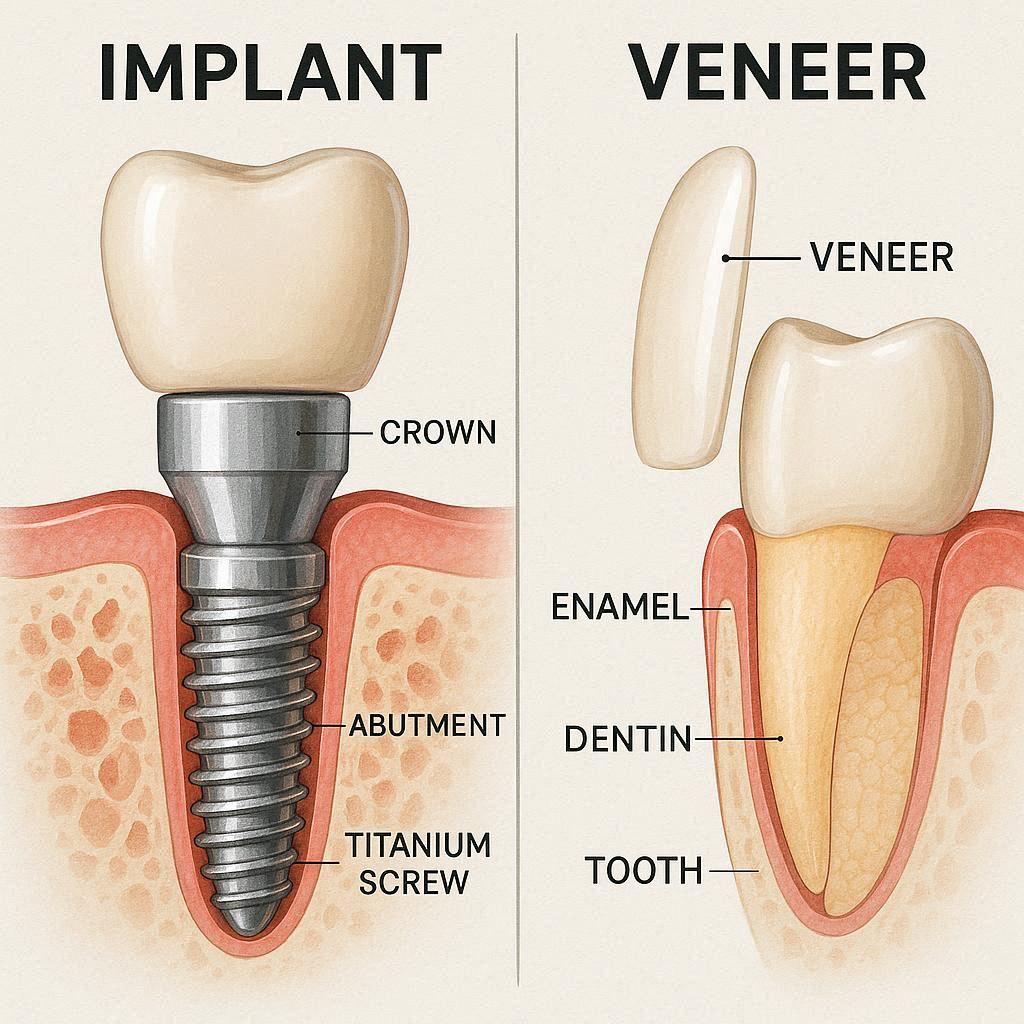
A dental implant is a solution for a missing tooth. It is a three-part system: a titanium post (the implant itself) that fuses with your jawbone, an abutment (connector), and a crown (the visible fake tooth).
The key distinction here is that the implant replaces the root of the tooth. When you lose a tooth, the jawbone underneath begins to shrink because it no longer receives stimulation from chewing. An implant is the only dental restoration that stops this bone loss. It is surgery. It is a permanent fixture anchored in your skeleton. You treat it as a medical procedure that has a cosmetic side effect (a nice-looking tooth).
The Veneer: Hiding the Front Surface
A veneer is a wafer-thin shell, usually made of porcelain, that bonds to the front of an existing, healthy tooth. The tooth must still be there. You cannot put a veneer on empty space.
Veneers are cosmetic. They are about color, shape, alignment, and minor spacing issues. They are the “red carpet” treatment for teeth that are structurally sound but visually flawed. They do nothing to strengthen a weak tooth or fill a gap left by an extraction.
Key Distinction: An implant fills a hole in your jaw. A veneer covers a stain or chip on a tooth that is already there.
Why This Distinction Matters for Your Research
Many patients walk into a dental office saying, “I want a perfect smile.” They might have a missing back molar (needs an implant) and crooked front teeth (needs veneers). Understanding the vocabulary—understanding that implants are replacement and veneers are concealment—saves you from pursuing the wrong treatment plan.
If you go to a consultation asking for veneers to close a space where a tooth was pulled five years ago, the dentist will have to gently explain that veneers require tooth structure to adhere to. Without the tooth root, veneers are not an option.
Part 1: Dental Implants In-Depth – The Structural Solution
To appreciate the Difference Between Dental Implants and Veneers, we must first understand the implant journey in detail. This is the more complex and invasive of the two procedures. It is also, arguably, the most significant advancement in modern dentistry.
The Anatomy of a Dental Implant
It is helpful to visualize an implant as a fake tree. It has roots underground (the implant post) and the visible tree trunk (the crown). Nothing floats on the surface.
- The Fixture (Implant Body): This is a screw-shaped piece of titanium. It is surgically placed into the jawbone. Titanium is used because it is biocompatible. This means your bone cells will not reject it; instead, they will grow into the microscopic roughness of the titanium surface and lock it in place. This process is called osseointegration.
- The Abutment: This is a small connector piece. Once the implant has fused with the bone (which takes months), the dentist exposes the top of the implant and screws the abutment into it. This part sticks out of the gum line like a mini tooth stump.
- The Prosthesis (Crown): This is the part you see. It is a custom-made tooth, usually ceramic or porcelain fused to metal, that is either cemented or screwed onto the abutment.
The Full Surgical Process: A Timeline of Healing
Understanding the timeline is crucial because this is where the Difference Between Dental Implants and Veneers becomes most stark in terms of convenience and recovery. Veneers take two visits over three weeks. Implants can take four months to over a year.
Phase 1: Consultation and 3D Imaging
The first step is not surgery; it is mapping. Your dentist will take a Cone Beam Computed Tomography (CBCT) scan. This is a 3D X-ray that shows the height, width, and density of your jawbone. It also reveals the exact location of nerves and sinuses. A dentist cannot place an implant blindly. If the scan shows insufficient bone, you cannot proceed to Phase 2 immediately. You may need a bone graft.
Phase 2: Bone Grafting (If Necessary)
This is a common detour for people who lost a tooth years ago. Without a root, the jawbone resorbs (melts away). If the ridge of bone is too thin or too short to hold the implant screw, the dentist must add bone material. This material can be synthetic, from a human tissue bank, or from an animal source (bovine).
- Healing Time for Graft: 3 to 6 months.
This is a hard truth about implants: the prep work often takes longer than the actual implant placement.
Phase 3: Implant Placement Surgery
This is the day of the actual procedure. It is surgery, but it is often less dramatic than patients fear. You will receive local anesthetic (numbing) and possibly sedation.
- The dentist makes a small incision in the gum to expose the bone.
- Using a series of precision drills, they create a channel in the bone that exactly matches the size of the titanium implant.
- The implant is screwed into place.
- The gum is stitched closed over the implant (or a small healing cap is placed on top, depending on the technique).
- You go home.
Important Note: At this stage, there is no tooth visible. You will have a gap, a temporary denture (flipper), or just a smooth gum surface. This is the “dark period” of the implant journey.
Phase 4: Osseointegration (The Waiting Game)
This is the critical, non-negotiable period of healing. Over the next 3 to 6 months (or longer for upper jaw implants), your jawbone grows directly onto the titanium surface. You cannot rush this. If you put pressure on the implant before this bond is complete, the implant will fail and fall out. You must eat soft foods and avoid chewing in that area.
Phase 5: Abutment and Crown Placement
Once the dentist confirms the implant is rock-solid (they test it with a torque wrench), you return for the final step.
- A small incision re-exposes the top of the implant.
- The abutment is screwed on.
- Impressions are taken of your mouth.
- A dental lab fabricates the custom crown to match your surrounding teeth in color and shape.
- Two weeks later, you return to have the crown cemented or screwed in place.
Ideal Candidates for Dental Implants
You are an excellent candidate for an implant if you meet these criteria:
- Missing One or More Teeth: This is the primary, non-negotiable requirement.
- Sufficient Bone Density: You have enough jawbone to anchor the screw.
- Good Oral Hygiene: You must be willing to floss around the implant daily.
- Non-Smoker (or Willing to Quit): Smoking constricts blood vessels and drastically increases the failure rate of implants.
- Free of Uncontrolled Chronic Disease: Conditions like uncontrolled diabetes impair healing and osseointegration.
The Advantages That Justify the Cost
Why would anyone go through months of healing and surgery for a fake tooth? The benefits are structural, not just cosmetic.
- Prevention of Bone Loss: This is the single greatest advantage of an implant over a bridge or denture. The implant stimulates the jawbone exactly like a natural root, preventing the “sunken face” look associated with long-term tooth loss.
- Preservation of Adjacent Teeth: A traditional bridge requires grinding down the two perfectly healthy teeth next to the gap. An implant stands alone. It does not damage neighboring teeth.
- Longevity: A well-maintained implant and crown can last 30 years or a lifetime. The crown may need replacement every 15-20 years due to wear, but the titanium post remains in the bone indefinitely.
- Stability: It does not move. It does not click when you talk. It functions at 100% chewing force compared to a natural tooth. Dentures offer about 20% chewing force.
Potential Risks and Realistic Drawbacks
We must be honest about the downsides. Implants are not a magic bullet without complications.
- Peri-Implantitis: This is the implant version of gum disease. If plaque accumulates around the implant neck, the gum can become inflamed and the bone around the implant can erode. There is no ligament attachment on an implant like on a natural tooth. Therefore, once bone loss starts, it progresses faster and is harder to stop.
- Surgical Risks: Nerve damage (numbness of lip/chin in lower jaw), sinus perforation (in upper jaw), or infection.
- Failure to Integrate: Even in healthy patients, a small percentage of implants (2-5%) simply fail to bond with the bone and must be removed.
- Cost and Time: The commitment required is substantial.
Cost Analysis of Dental Implants
Pricing varies wildly by geography and complexity. However, we can provide a realistic, transparent range for a single tooth implant in the United States (as of 2026).
| Component of Treatment | Estimated Cost Range | Notes |
|---|---|---|
| Consultation & 3D Scan | $250 – $600 | Essential for planning. |
| Tooth Extraction (if needed) | $150 – $500 | Simple vs. Surgical extraction. |
| Bone Graft (if needed) | $400 – $1,200 | Per site. Major sinus lifts cost more. |
| Implant Fixture Placement | $1,200 – $2,500 | Surgery fee + cost of titanium post. |
| Abutment & Crown | $1,200 – $2,500 | The visible tooth. Lab fees included. |
| Total Single Tooth Implant | $3,500 – $7,000 | Total from start to finish. |
Financial Reality Check: Dental insurance often covers the crown portion (at 50%) but may limit coverage on the implant surgery. Always get a pre-treatment estimate sent to your insurance company.
Part 2: Dental Veneers In-Depth – The Cosmetic Facade
Now let’s pivot to the other side of the Difference Between Dental Implants and Veneers. If implants are about engineering the foundation, veneers are about interior design. They are the ultimate tool for cosmetic smile makeovers.
What Exactly Is a Veneer?
A veneer is a custom-made, extremely thin shell that is permanently bonded to the front surface of a tooth. The best analogy is a press-on fingernail—but one that is applied with industrial-strength dental cement and lasts for 15 years. You cannot take it off.
The material matters immensely. There are two main types, and confusing them can lead to disappointment.
Porcelain Veneers (The Gold Standard)
These are fabricated in a dental laboratory by a master ceramist. They are made of pressed ceramic.
- Translucency: Porcelain mimics natural tooth enamel perfectly. Light passes through it just like a real tooth.
- Stain Resistance: Porcelain is glass-like. It repels stains from coffee, red wine, and nicotine far better than natural enamel.
- Durability: Once bonded, they are extremely strong.
- Process: Requires two appointments. First for preparation and temporaries, second for final bonding.
Composite Veneers (Chairside Veneers)
These are sculpted directly onto your teeth by the dentist using the same resin material used for white fillings.
- Aesthetics: They can look good, but they lack the depth and light-play of porcelain. They are more prone to chipping and staining over time.
- Cost: Significantly cheaper (often 50-70% less than porcelain).
- Longevity: 4 to 8 years vs. 15+ years for porcelain.
- Process: Usually one appointment.
For the purpose of this deep-dive comparison, when we say “veneers,” we are primarily referring to Porcelain Veneers, as they represent the definitive cosmetic treatment comparable to the permanence of implants.
The Preparation Process: The “Prep” is Irreversible
This is the single most important piece of information regarding veneers: The procedure is permanent and irreversible.
To make a veneer look natural and not bulky like a Chicklet gum, the dentist must remove a tiny amount of enamel from the front and biting edge of the tooth. This is called “prepping” the tooth. The amount removed is roughly 0.5 millimeters—about the thickness of a fingernail.
Because enamel does not grow back, that tooth will always need a veneer or a crown to protect it. You cannot “go back” to having naked teeth after you get veneers. If a veneer falls off in 15 years, you must replace it. You cannot just leave the tooth bare; the prepared surface is rough and vulnerable to decay and extreme sensitivity.
Ideal Candidates for Veneers
Veneers are the solution when the tooth is present but imperfect. You might be a candidate if you have:
- Intrinsic Stains: Deep discoloration from tetracycline antibiotics or fluorosis that whitening cannot fix.
- Chipped or Worn Edges: Minor trauma or grinding (bruxism) has flattened the teeth.
- Diastema (Gaps): Small to moderate gaps between front teeth. (Large gaps may require orthodontics first).
- Minor Misalignment: Teeth that are slightly rotated or tilted.
- Peg Laterals: Small, pointy teeth next to the front two teeth.
Who Should NOT Get Veneers?
There is a dangerous trend of “same-day smile” mills pushing veneers on everyone. You are NOT a candidate for veneers if:
- You Have Active Gum Disease: Bonding a veneer to a tooth with bleeding gums is like painting a house while it’s on fire. The foundation will fail.
- You Grind Your Teeth Severely (Bruxism): Porcelain is strong, but it is brittle against the forces of night-time clenching. You will shatter veneers. (A night guard is mandatory if you have veneers and grind).
- Your Teeth are Too Crowded: If your teeth are severely overlapping, “prepping” for a veneer might hit the nerve of the tooth. Orthodontics (braces or Invisalign) should come first.
- You Have Large Fillings: Veneers bond best to natural enamel. If the tooth is mostly filling material, a crown is the better, stronger restoration.
The Artistic Side of Veneer Design
This is where the skill of the dentist makes or breaks the outcome. Unlike an implant, which is hidden under the gum, a veneer is visible every time you speak. The design elements include:
- Smile Arc: The curve of the top teeth should follow the curve of the lower lip.
- Proportions: The width-to-length ratio of the central incisors should be around 75-80%. Teeth that are too square look “denture-like.”
- Texture: Real teeth have vertical ridges (perikymata) and varying surface textures. Cheap veneers look flat and opaque.
Quotation from a Master Ceramist: “I can make a veneer look like a refrigerator white Chiclet, or I can make it look like it was given to you by God. The difference is in the opacity and the incisal edge characterization.”
Cost Analysis of Porcelain Veneers
Veneers are priced per tooth. Unlike implants which replace a single unit, veneers are usually done in sets of 2, 4, 6, 8, or 10 to create a symmetrical smile.
| Item | Cost per Tooth (Porcelain) | Cost per Tooth (Composite) |
|---|---|---|
| Fee Range (US Average) | $1,200 – $2,800 | $350 – $900 |
| Lab Fee (Included) | $200 – $400 | N/A |
| Replacement Cycle | Every 15-20 Years | Every 5-7 Years |
Note on “Smile Makeover” Packages: Some offices offer a discount if you do 8 or 10 veneers at once. Be wary of prices below $800 per tooth for porcelain. This usually indicates a low-quality lab or a dentist rushing the preparation.
Part 3: The Core Differences – A Detailed Side-by-Side Analysis
We have dissected the individual procedures. Now, let’s bring the Difference Between Dental Implants and Veneers into sharp focus using direct comparison. This section is designed to be the quick-reference guide you return to as you weigh your options.
Comparative Table: Implants vs. Veneers
| Feature | Dental Implant | Porcelain Veneer |
|---|---|---|
| Primary Purpose | Replace a missing tooth. | Cover existing tooth flaws. |
| Procedure Type | Surgical. | Cosmetic/Bonding. |
| Enamel Removal | None (tooth is already gone). | Permanent reduction of enamel. |
| Anesthesia | Local + Sedation (often recommended). | Local (often no needle needed if gum is healthy). |
| Number of Visits | 4 to 8 over 4-12 months. | 2 to 3 over 3-4 weeks. |
| Healing Time | 3-6 months (osseointegration). | 0 days (mild sensitivity for 48 hours). |
| Longevity | Implant post: Lifetime. Crown: 15-20 yrs. | Shell: 15-20 years. Tooth: Altered forever. |
| Reversibility | Yes (can remove implant and graft bone, but difficult). | NO. Tooth is permanently altered. |
| Impact on Bone | Preserves jawbone density. | No effect on bone. |
| Maintenance | Floss like a natural tooth. Waterpik helpful. | Normal brushing. Avoid biting hard objects. |
| Pain Level (Post-Op) | Moderate discomfort for 3-5 days. | Minimal to none. |
Detailed Breakdown of the Comparison Factors
1. Structural Integrity vs. Cosmetic Camouflage
This is the most profound Difference Between Dental Implants and Veneers.
- Implant Scenario: You are missing tooth #30 (lower right first molar). You cannot chew steak on that side. The tooth above it (#3) is starting to drift down into the empty space (super-eruption). The implant stops this architectural collapse of your bite.
- Veneer Scenario: You have tooth #8 (upper right front tooth). It is there. It is strong. But it is rotated 15 degrees and is a dull shade of yellow. The veneer does not add strength to the bite; it adds beauty to the smile line.
2. The Irreversibility Factor
This is the one fact that shocks many veneer patients after the fact.
- With an implant, if you regret it (which is rare), you can have the crown removed and the abutment covered. The jawbone is altered but the adjacent teeth are untouched.
- With a veneer, there is no going back. The enamel is in a dental biohazard bin. You are committed to veneers or crowns for the rest of your life on those teeth. This is not a “try it out” procedure. You must be 100% certain.
3. Timeline to Completion
- Veneers: You can have a new smile in two weeks. That is the appeal. It is instant gratification.
- Implants: You need patience. If you have a front tooth missing and need an implant, you will wear a temporary flipper (a removable plastic tooth) for up to six months while the implant heals. This is a major psychological hurdle for many patients.
4. The Financial Equation Over Time
While the upfront cost of a single implant ($5,000) is higher than a single veneer ($1,800), the lifetime cost can be deceptive.
- Implant: You pay $5,000 today. In 20 years, you might pay $1,500 for a new crown (the implant post remains free and clear).
- Veneers (8 teeth): You pay $14,000 today. In 15-20 years, you will need to replace all 8 veneers at a cost of likely $18,000+ (due to inflation and increased lab costs). That is a recurring cosmetic subscription for the rest of your life.
Part 4: The Hybrid Approach – Can You Get Both?
One of the most common questions patients ask is: “Can I get an implant on this back tooth and veneers on these front teeth?” The answer is a resounding YES. In fact, this is how Full Mouth Rehabilitation works.
You are not limited to choosing one treatment for your entire mouth. The Difference Between Dental Implants and Veneers actually allows them to work in perfect harmony.
- Posterior (Back): Use Implants to restore chewing function and prevent bone loss.
- Anterior (Front): Use Veneers to create the perfect smile aesthetic.
The Challenge of Matching Colors
There is a clinical challenge here that many patients do not anticipate. A porcelain crown on an implant and a porcelain veneer on a natural tooth are made of similar materials, but they reflect light differently.
- Implant Crown: Often has a metal or opaque zirconia core underneath. It blocks light.
- Veneer: Thin layer of porcelain over a yellow-ish natural tooth stump. Light passes through and bounces back.
A skilled dentist will manage this by choosing Zirconia implant abutments (white, not metal) and coordinating with a single lab to fabricate all restorations. This ensures the color and character match across the transition from implant crown to natural tooth veneer.
Case Study Example
Scenario: A 45-year-old patient presents with missing tooth #7 (lateral incisor) due to a childhood accident. The adjacent teeth #8 and #9 (front teeth) are present but have worn edges and old bonding that is stained.
Treatment Plan:
- Site #7: Surgical placement of a Dental Implant with bone graft. Healing time: 4 months.
- Sites #8, #9, #10: Preparation for Porcelain Veneers.
- Timing: While the implant heals, the patient wears a temporary bridge (Maryland bridge) covering the gap and covering the prepped front teeth.
- Final Delivery: At month 5, the implant is restored with a custom crown, and the veneers are bonded. The result is a seamless blend of restorative and cosmetic dentistry.
Part 5: Real-World Scenarios – Which Path Is Right for You?
Theory is helpful, but application is better. Let’s look at specific dental problems and apply the logic of the Difference Between Dental Implants and Veneers to find the right solution.
Scenario 1: “I have a gap between my two front teeth.”
- Treatment Options: Orthodontics (Invisalign/Braces) to close the gap or Veneers.
- The Verdict: If the gap is small (less than 2mm) and the teeth are otherwise straight, Veneers are a fast, cosmetic solution. You can close the diastema in two weeks.
- Warning: If you close a large gap with veneers, the front teeth will look very wide and unnatural (the “tooth-paste smile”). In that case, orthodontics is the more beautiful and conservative choice.
Scenario 2: “I knocked out my front tooth in an accident. I have the tooth, but the dentist couldn’t put it back.”
- Treatment Options: Dental Implant or Dental Bridge.
- The Verdict: Dental Implant. This is the textbook indication for an implant. A bridge would require grinding down the two adjacent healthy teeth. An implant saves those teeth and preserves the bone.
- Veneer Applicability: Zero. You cannot veneer a space.
Scenario 3: “My teeth are healthy but yellow and won’t whiten with strips.”
- Treatment Options: Professional Whitening or Veneers.
- The Verdict: Veneers only if you have exhausted all whitening options and have other shape issues. If the only issue is color, Whitening is cheaper and preserves enamel. If the teeth are also chipped or misshapen, veneers address both color and form.
Scenario 4: “I have an old, dark, failing root canal on a front tooth.”
- Treatment Options: Internal Bleaching or Crown or Implant (if extraction needed) or Veneer (if tooth is strong).
- The Verdict: This is a gray area. Internal bleaching (walking bleach) can lighten the tooth from the inside out. If that fails, a Porcelain Veneer can mask the darkness. However, if the tooth structure is weak and prone to fracture, a full Crown is safer than a veneer.
Scenario 5: “I’m missing all my back teeth on the bottom and I can’t wear a partial denture.”
- Treatment Options: Implant-Supported Denture (Snap-On) or All-on-4 Implants.
- The Verdict: This is the realm of Implants. Veneers are not a consideration here. This scenario highlights how implants are a medical necessity for function, not a cosmetic luxury.
Part 6: The Maintenance Guide – Long-Term Care Differences
How you care for these restorations differs significantly. Ignoring this part of the Difference Between Dental Implants and Veneers leads to early failure and wasted money.
Caring for Dental Implants
The enemy of an implant is Plaque and Bacteria. While the implant crown cannot decay, the gum and bone around it can get infected (Peri-Implantitis).
- Flossing Technique: You must use implant-specific floss (like Superfloss with a stiff end) or a Waterpik with a special tip. You need to clean under the gumline around the abutment post where it meets the crown.
- Interdental Brushes: These small “bottle brushes” are excellent for navigating the curves around an implant crown.
- Recall Frequency: Dentists often recommend 3-month cleanings for implant patients instead of 6-month cleanings. The hygienist will use plastic or titanium scalers to clean the implant. Metal scalers will scratch the titanium abutment, creating a rough surface that attracts more plaque.
Important Note: Do not smoke. Studies show smokers have a 2.5 times higher risk of implant failure due to decreased blood flow and healing capacity.
Caring for Porcelain Veneers
The enemy of a veneer is Torque and Force. Porcelain is hard but brittle.
- Biting Habits: You cannot bite your nails. You cannot open plastic packaging with your teeth. You cannot chew on ice or pens. These habits create “shear forces” that pop the porcelain off the tooth.
- Night Guard: If a dentist tells you that you grind your teeth, a custom-fitted night guard is non-negotiable insurance for your veneers. Think of it as a mouthguard for sleeping. Without it, you will chip the edges of your veneers within 3-5 years.
- Cleaning: Brush and floss normally. The seam between the veneer and the tooth is the margin. This is where decay can start if you don’t keep it clean. Even though the front is porcelain, the back of the tooth is still natural tooth structure that can get cavities.
- Toothpaste: Avoid overly abrasive “whitening” or “charcoal” toothpaste. These can dull the glaze (shine) on porcelain over time, making them look flat.
Table: Maintenance Comparison
| Maintenance Task | Dental Implant Care | Porcelain Veneer Care |
|---|---|---|
| Brushing | Soft bristle only. Electric toothbrush is safe. | Non-abrasive gel toothpaste. Soft bristle. |
| Flossing | Crucial. Must clean implant neck. | Standard floss to prevent margin decay. |
| Night Guard | Not required unless opposing natural teeth are worn. | Highly Recommended if you clench/grind. |
| Dietary Restrictions | None once healed. (Avoid hard nuts on temporary crowns). | Avoid biting hard objects (bones, hard candy). |
| Whitening Products | Ineffective. Implant crown material does not bleach. | Ineffective. Veneer porcelain does not bleach. |
Part 7: The Cosmetic Conundrum – Matching Implants to Veneers
This is a niche but crucial topic for anyone planning a smile makeover that includes both treatments. The Difference Between Dental Implants and Veneers in terms of optical properties can create a visual mismatch if not managed carefully.
The “Dead” Tooth Look
A single front implant crown can sometimes look “dead” or “opaque” next to a vibrant natural tooth or a translucent veneer.
- Why? An implant lacks the periodontal ligament (the tiny hammock fibers that hold a natural tooth). This ligament allows natural teeth to have a tiny amount of movement and “bounce.” An implant is rigidly fixed to the bone. This affects how light enters the gumline. More importantly, the underlying abutment (even if white zirconia) blocks light transmission differently than a live tooth root and dentin.
The Solution: Custom Shading and Tissue Management
To bridge this gap between a dental implant and a veneer, the dentist and lab technician must employ advanced techniques.
- Pink Porcelain: Sometimes, the lab will add a tiny rim of pink porcelain near the gumline of the implant crown to mimic the look of gum tissue or the root.
- Custom Zirconia Abutments: This ensures that the stump under the crown is white, not gray metal.
- Tissue Sculpting: A skilled surgeon can create a “papilla” (the little triangle of gum between teeth) around an implant that mimics nature. This is difficult but essential for a seamless blend with adjacent veneers.
Part 8: The Economics of a Smile – Investment vs. Expense
Understanding the Difference Between Dental Implants and Veneers also requires a financial literacy check. These are not purchases; they are investments in your health and confidence.
The Long-Term Cost Comparison: 30-Year Outlook
Let’s project the cost of maintaining a smile over three decades. Assume you are 40 years old and plan to keep your teeth until you are 70.
Scenario A: Single Tooth Replacement
- Option 1: Dental Implant.
- Year 1 Cost: $5,000 (Implant + Crown).
- Year 20 Cost: $1,800 (Crown Replacement due to wear).
- Total 30-Year Cost: ~$6,800.
- Option 2: 3-Unit Bridge.
- Year 1 Cost: $4,500.
- Year 15 Cost: $5,500 (Bridge Replacement + possible decay under old bridge).
- Year 30 Cost: $6,500.
- Total 30-Year Cost: ~$16,500 + potential loss of abutment teeth.
Scenario B: Cosmetic Smile Enhancement (6 Front Teeth)
- Option 1: Porcelain Veneers.
- Year 1 Cost: 6 x $1,800 = $10,800.
- Year 20 Cost: 6 x $2,200 = $13,200 (Replacement).
- Total 30-Year Cost: ~$24,000.
- Option 2: Orthodontics + Whitening.
- Year 1 Cost: $6,500.
- Year 5 Cost: $300 (Touch-up whitening).
- Total 30-Year Cost: ~$8,000.
The “Dental Tourism” Warning
You will see prices online for implants for $800 or veneers for $200 in countries like Mexico, Costa Rica, or Turkey. While some of these clinics are excellent, the Difference Between Dental Implants and Veneers in terms of complication management is vast.
- Implants: If a bargain implant fails due to poor placement (e.g., in the sinus or on a nerve), fixing it costs 5x more than starting over in the US. US dentists often refuse to touch foreign implant work due to unknown parts and liability.
- Veneers: Cheap veneers are often bulky, overly white, and leak cement at the edges, causing decay within 2 years.
Rule of Thumb: The true cost of dentistry is not the first time you do it. It is the cost to redo it.
Part 9: Psychological Impact and Quality of Life
Beyond the technical Difference Between Dental Implants and Veneers, there is a human element that deserves attention.
The Implant Patient: Relief and Return to Normality
Patients who receive a dental implant after years of wearing a flipper or partial denture often describe a feeling of “forgetting it’s there.” That is the ultimate success metric for a prosthetic.
- Chewing Confidence: You can eat an apple. You can eat corn on the cob. You can chew a steak. These simple joys are restored.
- Speech: Missing front teeth cause a lisp. Implants restore crisp pronunciation of “S” and “F” sounds.
The Veneer Patient: The New Smile Syndrome
There is a phenomenon known as “Veneer Shock.” For the first 48 hours, the new teeth feel huge and foreign. The patient might panic, thinking they look like a horse.
- Adaptation: It takes about two weeks for the brain to re-map the lips and tongue to the new contours of the teeth.
- Confidence Boost: Studies show a significant increase in self-esteem and willingness to smile in photographs post-veneer placement. You go from a tight-lipped smile to a full, genuine grin.
Part 10: The Role of the Dental Lab and Technician
Patients rarely meet the person who actually makes the implant crown or the veneer. Yet, this person is 50% of the Difference Between Dental Implants and Veneers outcome.
The Implant Lab Work
The technician must design a crown that fits the abutment with micrometer precision. A gap larger than 30-50 microns allows bacteria in, causing odor and inflammation.
- Emergence Profile: This is the shape of the crown as it comes out of the gum. A good lab makes it look like it grew there. A bad lab makes it look like a fence post stuck in the mud.
The Veneer Lab Work
Creating a set of six or eight veneers is an art form.
- Layering: Porcelain is built up in layers (dentin layer, enamel layer, translucent incisal edge) and fired in an oven multiple times.
- Custom Staining: The technician paints in tiny brown or white flecks to match the character of your natural teeth.
Question to ask your dentist: “Do you use a local lab or a national lab? Can I see photos of their work?” A dentist who is proud of their lab relationship will happily show you.
Part 11: Emerging Technologies and Future Trends
The Difference Between Dental Implants and Veneers is becoming less stark as technology evolves.
For Implants: Immediate Load (“Teeth in a Day”)
In specific, ideal bone conditions, a dentist can place an implant and put a temporary crown on it the same day. This eliminates the 4-month gap period.
- Caveat: You cannot chew on this tooth for 4 months. It is for cosmetic appearance only while healing occurs. Chewing on it will cause it to fail. This is a crucial distinction patients misunderstand.
For Veneers: No-Prep or Minimal-Prep Veneers
Brands like Lumineers or DURAthin are ultra-thin veneers (0.2mm – 0.3mm) that sometimes require no drilling of the natural tooth.
- The Truth: They only look good if your teeth are already in a perfect position (no crowding) and are just small or spaced. If you have protrusive teeth, adding a “no-prep” veneer will make your teeth stick out farther, creating a “buck tooth” appearance. They are not a universal solution.
Part 12: Frequently Asked Questions (FAQ)
Here are the most common questions that arise when patients explore the Difference Between Dental Implants and Veneers.
Q1: Can I get a veneer on a dental implant?
A: Technically, no. A veneer bonds to tooth enamel. An implant has a crown which is a 360-degree cap that covers the entire abutment. You can make that implant crown look like the adjacent veneers, but it is structurally a crown, not a veneer.
Q2: Which hurts more: implant surgery or veneer prep?
A: Implant surgery involves more post-operative discomfort. You are cutting into bone and gum. Expect to take ibuprofen for 3-4 days. Veneer preparation is often painless, similar to having a filling done. There is no “recovery” from veneers.
Q3: Do implants or veneers stain over time?
A: High-quality Porcelain on both implants and veneers is highly stain-resistant. The cement line or margin where the restoration meets the tooth/gum can stain brown or yellow over time if hygiene is poor. Composite veneers stain much more easily than porcelain.
Q4: Can I whiten my veneers or implant crown?
A: No. Whitening gel only works on natural tooth enamel. It does nothing to porcelain or ceramic. This is why if you plan to whiten your natural teeth, you must do it BEFORE the dentist matches the shade for your veneer or implant crown.
Q5: What happens if my dental implant fails?
A: The implant is removed (usually a quick, non-painful procedure as it’s loose). The site is allowed to heal for a few months, and a new implant (usually wider) can be placed. Success rates for a second implant are still high.
Q6: Can I get an MRI if I have a dental implant?
A: Yes. Titanium is non-magnetic (non-ferrous). It will not heat up or pull out of your head in an MRI machine. However, the metal can cause a “scatter artifact” or distortion on the MRI image of the head and neck. You should always inform the radiologist you have an implant, but it is not a contraindication for the scan.
Q7: My veneer fell off. Can I glue it back on with Super Glue?
A: ABSOLUTELY NOT. Do not do this. Super Glue (cyanoacrylate) is toxic to the pulp (nerve) of the tooth and will kill the tooth, leading to a root canal. If a veneer pops off, keep it clean and dry, and see a dentist within a day or two to have it bonded back with dental cement.
Conclusion
The journey to understanding the Difference Between Dental Implants and Veneers ultimately leads to one question: Are you missing structure, or are you hiding a flaw? Dental implants rebuild the foundation of your mouth, acting as artificial roots to preserve bone and restore function for a lifetime. Veneers, on the other hand, are permanent cosmetic enhancements applied to existing teeth to transform shape and color. Your unique dental health and aesthetic goals will determine which path—or combination of both—is the right investment for a smile that is as healthy as it is beautiful.
Additional Resource
For a deeper understanding of the bone integration process that makes implants successful, you can review the research and patient resources available through the Academy of Osseointegration.
Link: Academy of Osseointegration Patient Resources
Frequently Asked Questions (FAQ) Summary Section
What is the main difference between a dental implant and a veneer?
An implant replaces a missing tooth root and crown, while a veneer is a thin shell that covers the front of an existing tooth for cosmetic purposes.
How long do dental implants last compared to veneers?
The titanium implant post can last a lifetime with proper care, though the crown may need replacement in 15-20 years. Porcelain veneers typically last 15-20 years before requiring replacement.
Are dental implants more expensive than veneers?
A single dental implant typically costs more upfront ($3,500 – $7,000) than a single veneer ($1,200 – $2,800). However, implants are a one-time structural investment, while veneers are a recurring cosmetic expense every 15-20 years.
Is the procedure for veneers painful?
Veneer preparation is minimally invasive and usually requires little to no anesthesia. Implant placement is a surgical procedure requiring local anesthesia and involves a recovery period of several days.
Can I have both dental implants and veneers at the same time?
Yes. A common treatment plan includes implants for missing back teeth (restoring function) and veneers for healthy front teeth (enhancing aesthetics). This is known as a full mouth rehabilitation.